When I Lost God, I Found the Universe

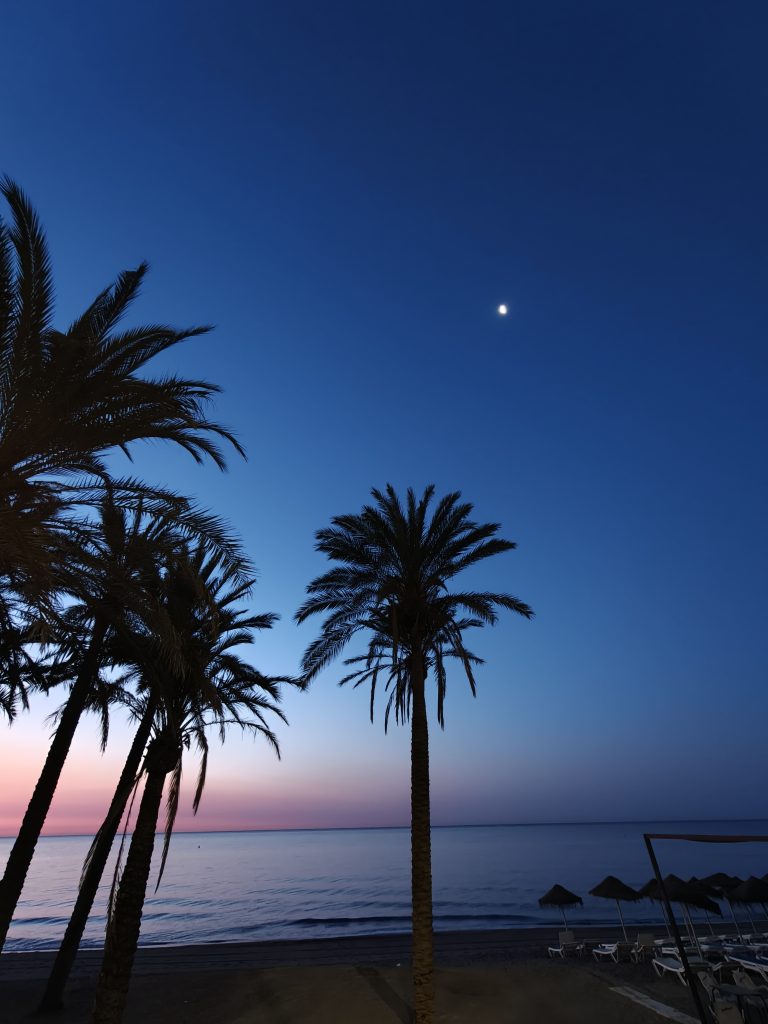
God declares his glory at the rising of the sun.
Photo taken with Oppo X9 on 7th July 2026 at 06:37 am, f2, 15 mm.

“The heavens declare the glory of God.”

For almost ten years, belief in God shaped the way I looked at the night sky.

This morning, at six o’clock, I realised how completely that has changed.

I began my usual jog while Torremolinos was still asleep. The promenade along La Carihuela was almost empty. The only sounds were the rhythmic slap of my trainers against the pavement and the gentle breathing of the Mediterranean.

I reached the harbour wall at Benalmádena just before sunrise.

The sea looked like polished, rippled glass.

Above me, Venus still shone brightly in the deep blue sky while the first orange light slowly crept over the mountains of the Sierra Nevada. They didn’t merely look beautiful. Those mountains are themselves the product of millions of years of continental collision, uplift and erosion. Even the backdrop to an ordinary sunrise carries an almost unimaginable history.

I sat. I started my meditation. I breathed. Then I opened my eyes and watched.

As the Sun finally appeared above the horizon, I found myself overwhelmed — not with worship, but with wonder.

Not because I imagined someone had painted the sunrise for me.

But because I knew what I was actually looking at.


Seven facts that never fail to humble me

Brian Cox has a wonderful gift.

He reminds us that reality is almost always far more astonishing than fiction.

Here are six examples.

1. You are travelling faster than a bullet…

…while sitting perfectly still.

The Earth rotates at about 1,670 km/h at the equator.

It orbits the Sun at roughly 107,000 km/h.

Our Solar System orbits the centre of the Milky Way at about 828,000 km/h.

Meanwhile, the Milky Way itself is hurtling through space at over two million kilometres per hour relative to the cosmic microwave background.

Right now, we are moving through the universe at extraordinary speed. We  simply don’t notice because everything around us is travelling with us.


2. There are ten billion times more planets than hours since the Big Bang

Astronomers now estimate that our Milky Way alone contains around 100–400 billion stars, with most stars likely possessing planets.

Across the observable universe there may be around 10²⁴ planets.

That is one septillion planets.

If every second since the beginning of the universe represented one planet, you would still not have counted even a microscopic fraction of them.


3. Every atom inside your body is older than the Earth

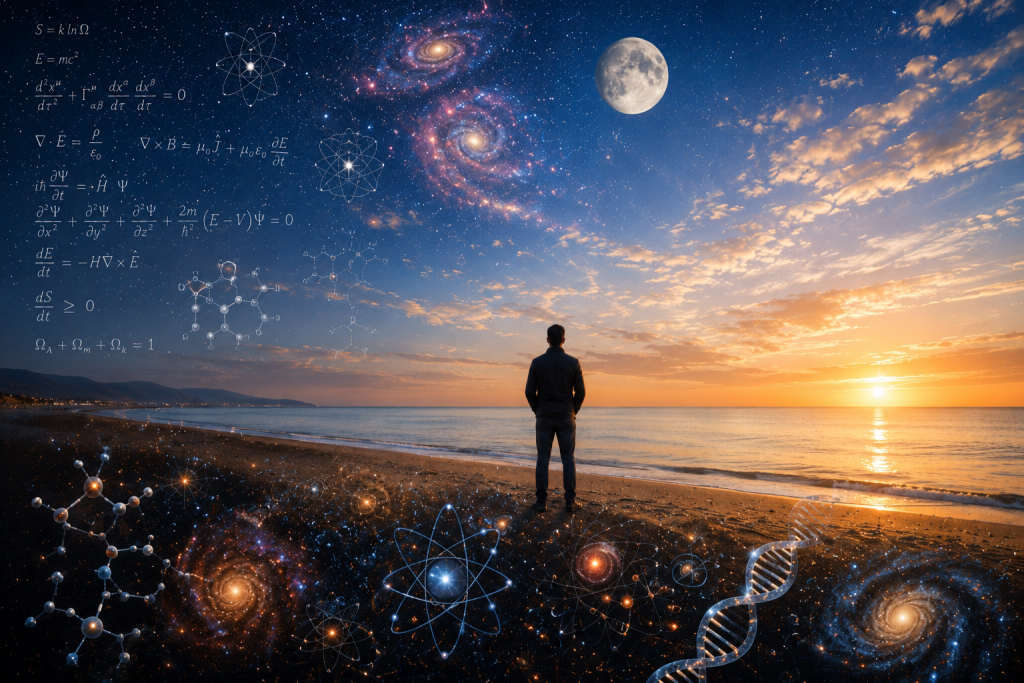
The iron in our blood, the calcium in our bones, the oxygen we are breathing were all forged inside ancient stars that exploded billions of years before the Sun even existed. We are literally made of stardust.

Carl Sagan famously summarised it beautifully:

“We are a way for the cosmos to know itself.”

Literally.


4. The Mycoplasma cell

One of the smallest living things on Earth is a bacterium called Mycoplasma.

Around 5,000 of them placed end to end would stretch only one millimetre.

Yet inside that microscopic cell is a membrane, half a million DNA letters, hundreds of genes, molecular factories called ribosomes, and thousands of proteins performing countless chemical reactions every second.

It isn’t a blob. It is a self-maintaining chemical factory. And it’s alive.

That is magnificent.


5. There are more microbes living inside you than people who have ever lived

The average human body contains roughly 38 trillion bacteria, most living in the gut.

Without them, we couldn’t digest food, produce certain vitamins or even maintain a healthy immune system.

We are not one organism.

We are an ecosystem.


6. Everything alive is literally related.

A blue whale…

an oak tree…

a hummingbird…

a mushroom…

an octopus…

the bacteria living inside your intestine…

and you…

all use essentially the same genetic code.

Every living thing on Earth is related.

Not poetically, metaphorically or mythically.

Literally.


7. Tonight, when we look at the stars…

…we are looking into history.

The light from the Moon is about 1.3 seconds old.

From the Sun? Eight minutes.

From the nearest large galaxy, Andromeda? About 2.5 million years.

The light entering our eyes tonight began its journey when our ancestors were making stone tools.

The James Webb Space Telescope now observes galaxies whose light has travelled for more than 13 billion years.

We do not merely look across space.

We look backwards through time.

I honestly struggle to imagine anything more astonishing than that.


Then I remembered another way of seeing all this

There was a period of my life when I believed something very different.

For nearly ten years I was an evangelical Christian. I believed that God had created the heavens and the earth by speaking.

Genesis begins:

“And God said, ‘Let there be light,’ and there was light.”
— Genesis 1:3 (NIV)

I was taught that the universe ultimately existed to reveal God’s glory.

That human beings had been created to worship Him.

That no sunset, no mountain and no star could ever truly satisfy unless it led us to thank its Creator.

One argument particularly stayed with me.

What is the point of experiencing something beautiful, if you have nobody to thank for it?

At the time, that sounded deeply persuasive. Today, it doesn’t.


Wonder no longer needs an author

Ironically, losing my belief in God did not make the universe smaller.

It made it unimaginably larger.

Instead of being told the answers, I discovered questions.

Instead of certainty, I found endless curiosity.

Instead of myth, I found history.

Every mountain. Every whale. Every oak tree. Every coral reef. Every human brain. Every galaxy. Every living cell.

Each became vastly more interesting once I understood that none of them appeared fully formed.

Each carries within it an astonishing history stretching back billions of years.

Reality became deeper than any miracle story I had ever been taught. As I write the last chapter of my first novel:

Yet one certainty remains: we are constellations of atoms, stardust reassembled by chance and time, hurtling around our sun on a rock at 67,000 mph. DNA coils like ancient runes in every cell, issuing silent instructions: become, live, persist. From this choreography comes breath, thought, memory: a mother’s laughter, longing for distant places, a lover’s hand in the dark. We invent gods and heroes, build cathedrals and poems, grieve, and love. All this from fragile molecules wrapped in skin. Just chemistry. An echo of evolution.

And yet: is it not a miracle that matter dreams at all?

Today, I no longer see humanity as separate from nature. I know that the cells in my own body, the bacteria in my intestine, the dolphins swimming off this coastline, the pine trees on the Sierra Nevada and the swallows flying overhead are all distant cousins on one immense family tree stretching back nearly four billion years. Human unity is not simply a moral aspiration. It is a biological fact. So too is our kinship with every other living thing on Earth.


Does meaning require a creator?

I no longer think so.

Watching today’s sunrise did not feel empty because I wasn’t thanking somebody.

Quite the opposite.

It filled me with gratitude.

Not gratitude directed upwards.

But gratitude simply for existing at all.

For having evolved into a creature capable of understanding even a tiny fragment of what the universe is.

That is more than enough for me.


One unintended consequence

There is one further implication that I hadn’t appreciated when I was a Christian.

Some believers sincerely conclude that because God will one day replace this present world with “a new heaven and a new earth” (Revelation 21:1), environmental destruction is ultimately temporary.

Many Christians reject that conclusion and instead argue that humanity has a God-given responsibility to care for creation. I respect that view.

But I have encountered the first attitude often enough to think it matters.

Once this world becomes merely a waiting room for the next, its long-term future can begin to feel less urgent.

My own perspective has moved in the opposite direction.

If this is the only Earth our civilisation will ever inhabit, then every forest matters. Every coral reef matters. Every species matters.

Because this extraordinary planet is not a rehearsal.

It is home. Not just for human beings, but for every sentient fish, every majestic bird, every minuscule Mycoplasma.


Which story leaves you more awestruck?

One story says:

“And God said, ‘Let there be light.'”

The other says:

Hydrogen formed shortly after the Big Bang.

Gravity slowly gathered it into stars.

Those stars forged heavier elements.

Some exploded as supernovae.

Those atoms became planets.

One of those planets developed self-replicating chemistry.

After nearly four billion years of evolution, one species evolved capable of asking where it came from.

I know which story leaves me speechless.

Not because it is comforting.

But because it is true.


“The most beautiful experience we can have is the mysterious. It is the fundamental emotion that stands at the cradle of true art and true science.”
Albert Einstein

Can Cosmology Provide a Foundation for Human Ethics?

Contemplation of cosmology under the cosmic dawn
How the moon led me to rethink the origins of the universe and humanity’s place and responsibility within it.

As I settle into my new life in Spain, I wake up before dawn in order to jog along the promenade before it gets too hot, watch the sunrise, contemplate cosmology and meditate.

Last week, to the west above the Carihuela, there was a huge, bright, full moon poised low in the sky before the sunrise.

It wasn’t merely bright. It seemed suspended. As if detached from its control of the tides below. Silver against an increasingly blue sky, refusing — for a few precious minutes — to surrender to the approaching sun.

The sea below was calm. The seagulls were swooping down majestically to collect their breakfast. Somewhere behind me, the town was waking. Yet for a brief moment everything felt strangely timeless.

I stood there on the harbour wall longer than I intended. Not because I understood what I was looking at. Indeed, as I meditated, I was startled by how little I did.

That quiet moment began another of my recent intellectual odysseys. I jogged home and began researching in detail the origins of the universe.

The answers I discovered have profoundly changed the way I see both the universe and humanity.

We began with almost nothing

According to our best scientific understanding, the Universe began around 13.8 billion years ago.

In the first few minutes after the Big Bang, almost all that existed were the simplest elements imaginable: hydrogen, helium and tiny traces of lithium.

There was no carbon.

No oxygen.

No calcium.

No iron.

No chlorine.

No lead.

Nothing from which planets, oceans or living organisms could eventually be built.

Everything else had yet to be created.

Stars are not simply lights

The next discovery astonished me even more.

I had always thought of stars as glowing balls of gas.

In reality, they are unimaginably powerful nuclear furnaces.

The identity of every chemical element is determined simply by the number of protons in the nucleus of each atom.

Hydrogen has one proton.

Helium has two.

Carbon has six.

Oxygen has eight.

Iron has twenty-six.

Lead has eighty-two.

Inside stars, gravity compresses matter with such extraordinary force that atomic nuclei are pushed together in a process known as nuclear fusion.

When four hydrogen nuclei fuse together, they produce helium and release enormous amounts of energy.

Later, when stars become even hotter, three helium nuclei combine to create carbon. Carbon can then fuse with helium to produce oxygen. Larger stars continue building heavier and heavier elements through countless further fusion reactions.

Quite literally, the periodic table is assembled one proton at a time.

Eventually, the largest stars manufacture elements all the way to iron. When those stars finally exhaust their fuel, they explode as supernovae, scattering their newly created elements across the galaxy.

During those unimaginably violent explosions, still heavier elements such as gold, lead and uranium are created before being hurled into interstellar space.

Without generations of stars living and dying long before our Solar System existed, neither the Earth nor we ourselves could ever have existed.

We really are made of stardust

Carl Sagan famously said:

“We are a way for the cosmos to know itself.”

He also said that we are made of star stuff.

For years I assumed that was simply a poetic metaphor.

It isn’t.

The hydrogen in the water within my body was formed shortly after the Big Bang itself.

But almost every other element within me has a different origin.

The carbon in my muscles.

The oxygen I breathe.

The calcium in my bones.

The iron carried around my body by my blood.

All of them were forged inside stars that died billions of years before the Earth even formed.

Some of those atoms may once have been part of ancient forests.

Some may have passed through dinosaurs.

Some may have circulated through countless generations of my own ancestors.

Matter itself is endlessly recycled.

The atoms change partners.

The universe never stops reusing its building blocks.

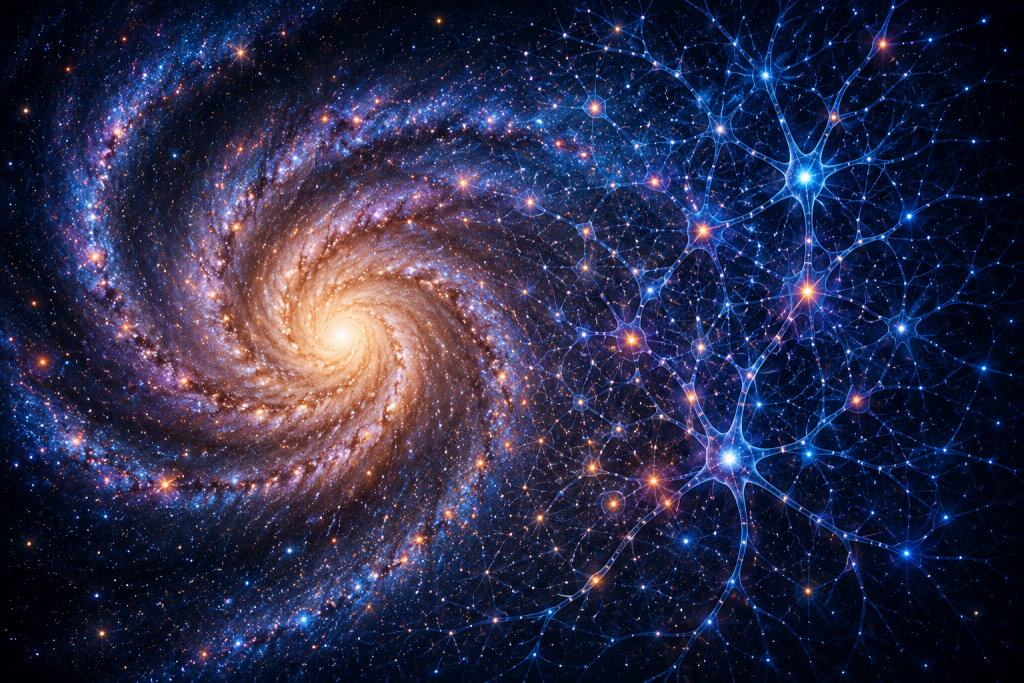
In this way, it is no coincidence that the branching networks of our neurons and the elegant spirals in hurricanes and elements of our DNA echo patterns that also appear throughout the cosmos. Different processes, different scales, yet strikingly familiar forms emerging from the same universe.

Then came another surprise

Just when I thought the story could not become any more remarkable, genetics added another layer.

Every person alive today shares common ancestry.

Research suggests that all living humans inherited their mitochondrial DNA from one woman who lived in Africa roughly 150,000 to 200,000 years ago.

Likewise, all living men inherited their Y chromosome from one man who lived much later.

They were not the only people alive at the time.

They are simply the individuals whose particular genetic lines survived uninterrupted to the present day.

Meanwhile, every generation doubles the number of our ancestors.

Travel back only a few thousand years and our family trees overlap so extensively that the distinctions between “my ancestors” and “your ancestors” begin to disappear.

In a very real biological sense, humanity is one enormous extended family.

A different foundation for responsibility

As the moon faded into the brightening Andalusian sky, I found myself asking a question that science itself cannot answer.

If Carl Sagan was right that “we are a way for the cosmos to know itself,” what follows logically from that?

As far as we currently know, nowhere else has the universe organised itself into beings capable of wondering where the universe came from.

Nowhere else has hydrogen learned to write symphonies.

Or paint masterpieces.

Or decode DNA.

Or ask why anything exists at all.

Perhaps intelligent life is common throughout the cosmos.

I hope it is.

But until we know otherwise, we must take seriously the possibility that conscious beings like ourselves are extraordinarily rare. Maybe even unique.

If that is true, then our responsibility extends far beyond ourselves.

Protecting our planet.

Seeking truth.

Advancing knowledge.

Caring for one another.

Safeguarding future generations.

These are not merely useful social conventions.

They become responsibilities entrusted to the very few beings — perhaps the only beings — capable of understanding what is at stake.

The moon itself had not changed that morning.

Nor had the sea.

Nor the rising sun.

What changed was my understanding.

For the first time, I began to see humanity not as something standing apart from the universe, but as one of the most extraordinary things the universe has so far produced.

Perhaps, after all, the starry heavens above us do not merely invite our curiosity. They really can provide us with the most rational basis for human ethics that we will ever discover.

“Two things fill the mind with ever new and increasing admiration and awe… the starry heavens above me and the moral law within me.”
— Immanuel Kant

Why Did Nobody Teach Me This at School?

What history should really teach
How a Spanish football shirt unexpectedly changed the way I think about history, education and the origins of our globalised world.

I recently bought a Spanish football shirt to wear at a bar while watching Spain’s 3:0 win against Austria on Thursday.

That simple purchase unexpectedly led me down one of the most fascinating rabbit holes I have explored in a while.

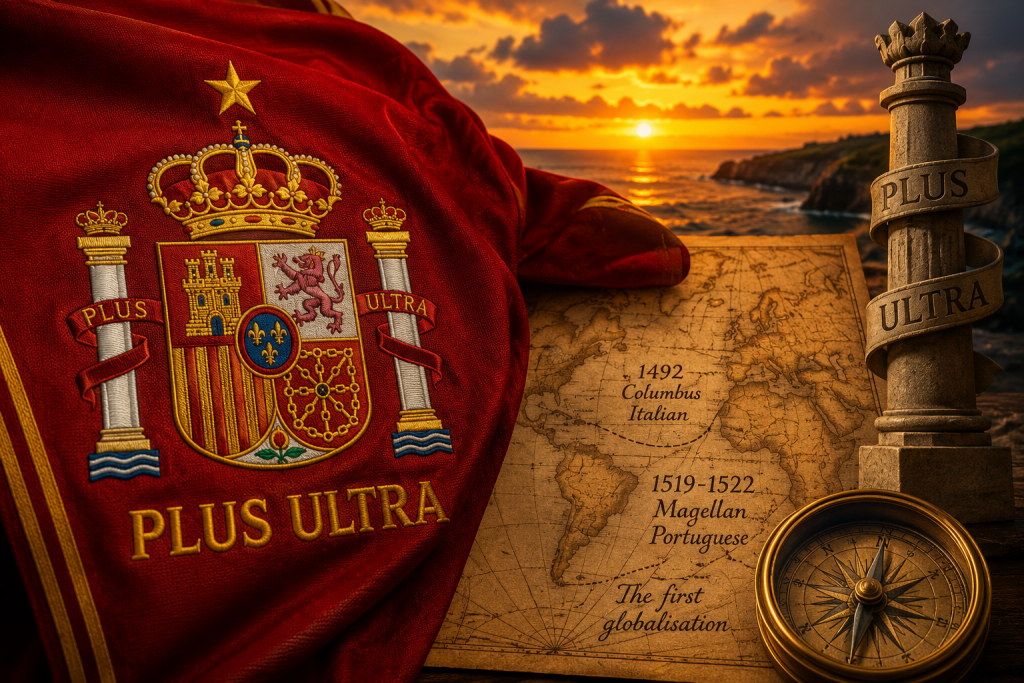
It began with two Latin words embroidered on Spain’s coat of arms: Plus Ultra.

I knew from my school-Latin what the words meant, further beyond, but I still needed some context to understand the meaning.

A little research revealed that they are a reference to the Pillars of Hercules at the Strait of Gibraltar. For the ancient world, these marked the edge of the known earth. The old warning was “Non Plus Ultra” nothing lies beyond.

Then came the voyages of exploration.

The warning became an invitation.

There was indeed more beyond.

That discovery prompted another question.

Christopher Columbus sailed for Spain. Yet I vaguely remembered reading somewhere that he was Italian. Was that right?

It was. I kept digging.

Born in Genoa, Columbus spent years trying to persuade different European rulers to finance his ambitious plan to reach Asia by sailing west. It was only when the Spanish Crown agreed to back him that history changed forever.

Then I discovered something even more surprising.

Ferdinand Magellan, whose expedition first circumnavigated the globe, wasn’t Spanish either. He was Portuguese. And he himself was killed in the Philippines before the expedition was completed.

Like Columbus, he simply happened to be sailing under the Spanish flag.

As I kept digging, I also learnt for the first time why America is called America and why the Pacific is called the Pacific. I learnt why Brazil speaks Portuguese while much of South America speaks Spanish, why Spain became one of history’s great global powers, how its sudden enormous wealth became a resource curse, and, most strikingly of all, how all these historical facts are mirrored in the events happening in the world today.

By now, all this led to another kind of question:

Why was I only learning this as I approach retirement?

None of these are obscure historical curiosities.

They explain the world we live in.


The more I thought about it, the more I realised that perhaps history has often been taught backwards.

Schools understandably devote considerable attention to national history. In Britain, we studied the Tudors, the Industrial Revolution and the Second World War. In Germany, where I spent many years teaching, National Socialism understandably occupies a central place throughout secondary education.

These are all profoundly important topics.

But too often history becomes an exercise in remembering names, dates, battles and treaties.

The examination rewards recall.

Real understanding often comes later.

History is not simply the story of what happened.

History can be the highly relevant explanation of why today’s world looks the way it does.

Why does almost an entire continent speak Spanish?

Why is Brazil different?

Why was Córdoba (Spain) once much bigger and more important than London?

Why are Europe and Latin America still so culturally intertwined?

Why and how did globalisation begin centuries before the Internet?

Those are historical questions too.

They just happen to illuminate the present rather than merely describe the past.


While I was training teachers at the University of Sussex, one of the finest history lessons I have ever witnessed contained almost no conventional history.

The young trainee teacher warned parents in advance that the lesson would be unusual.

She darkened the classroom. She played the sound of air-raid sirens followed by distant explosions. Beforehand, she asked the children to climb underneath their desks and lie silently on the floor with their eyes closed.

For several minutes they simply listened.

Afterwards she asked them to write, not about dates, military strategy or political leaders, but about how they had felt.

For a brief moment, those children had experienced uncertainty, vulnerability and fear. Not the reality of war, of course, but enough to begin imagining what it might feel like to be a child living through one.

I have forgotten countless historical dates since leaving school. I have never forgotten that lesson.

Nor, I suspect, have the children who experienced it.

That teacher wasn’t merely teaching history.

She was teaching empathy and vividly demonstrating how history is so relevant to life in the 21st Century.


As I have grown older, I find myself increasingly drawn to education that asks questions rather than rewards memorisation.

The same thought has appeared repeatedly in my recent writing about economics.

Financial literacy is not really about memorising definitions.

It is about understanding why economies behave as they do.

Likewise, history should not simply teach us to remember what happened.

It should help us understand why our world became what it is.

Perhaps that is why I have found these discoveries in Spain so unexpectedly exciting.

I wasn’t simply learning historical facts.

I was discovering connections.

The voyages of Columbus and Magellan were not isolated adventures.

They marked the beginning of the first great wave of globalisation.

Trade routes expanded.

Ideas travelled.

Plants, animals, diseases and cultures crossed oceans.

The Mediterranean outside my window here was once dry land – another fact I was unaware of. It is only thanks to the Zanclean Flood that water entered from the Atlantic through the Strait of Gibraltar and opened up the possibility of a future global trade highway.

The world became permanently interconnected.

Five centuries later we are still living with the consequences.

History also reminds us that no civilisation remains permanently at the top.


Sometimes I wonder whether schools unintentionally leave us with the impression that education ends when we pass our examinations.

In reality, the opposite is true.

The most rewarding learning often begins afterwards.

It begins when curiosity replaces obligation.

When we are no longer asking, “Will this be in the exam?”

Instead we ask, “Why did nobody ever explain this?”
Perhaps that is the real purpose of education.

Not to fill our minds with information.

But to awaken a curiosity that lasts for the rest of our lives.

“The real voyage of discovery consists not in seeking new landscapes, but in having new eyes.”
— Marcel Proust

The Seven Economic Myths We Tell Ourselves

Seven economic myths we tell ourselves

Last week I questioned whether our current school curriculum provides us with the knowledge we require for handling money during our adult life. This week I’d like to look at seven common economic myths I consequently grew up with that, I believe, should be examined by students in today’s education system.

Economics is often presented as a science of numbers. We hear about growth rates, inflation figures, government debt and stock market performance. Experts produce graphs. Politicians quote statistics. Journalists report percentages.

Yet much of our thinking about economics is not based on facts. We inherit economic beliefs in much the same way that we inherit religious beliefs, political loyalties, or assumptions about human nature. They become part of our mental furniture. We rarely examine them. We simply assume they are true.

Here are seven economic stories many of us have been taught to believe.

Myth No. 1. If GDP Is Growing, Everything Must Be Fine

One of the most common assumptions is that economic growth automatically means social progress. If the Gross Domestic Product is increasing, politicians congratulate themselves, commentators celebrate and newspapers announce that the economy is doing well.

But there is an obvious question that often goes unasked: doing well for whom?

GDP measures economic activity. It measures production. It tells us how much a country produces and sells. What it does not tell us is how that wealth is distributed or whether ordinary people are benefiting from it.

A nation can have impressive growth while housing becomes unaffordable, public services deteriorate and large sections of the population struggle to make ends meet.

As a former teacher, I sometimes compare GDP with examination results. A school may improve its statistics while becoming a worse place to learn. The numbers can look impressive while something essential is being lost.

The same is true of nations. Economic growth matters, but it is not the same thing as human flourishing.

Myth No. 2. Debt Is Always Bad

Most of us are taught to fear debt. For individuals, that is often sensible. Excessive borrowing can destroy lives. It can create stress, dependency and hardship. Yet not all debt is the same.

A mortgage, a student loan or a business investment is different from borrowing money to fund reckless consumption. One creates future value; the other merely brings tomorrow’s spending into today.

The same principle applies to governments. When a state borrows to invest in education, infrastructure, scientific research or healthcare, it may be creating assets that benefit future generations. The question is not whether debt exists, but whether the borrowing is productive and sustainable.

The most successful economies in the world often carry substantial public debt. What matters is not the existence of debt itself, but the wisdom with which it is used.

Myth No. 3. The Rich Create Jobs

This idea appears so frequently in political debate that many people accept it without question. There is, of course, some truth in it. Entrepreneurs create businesses. Businesses employ people. Investment can stimulate growth. But the story is incomplete.

Businesses do not hire employees simply because their owners are wealthy. They hire employees because there is demand for their products and services. A restaurant expands because customers fill its tables. A manufacturer recruits workers because orders are increasing. A shop hires staff because people are buying what it sells.

In other words, jobs are not created by wealth alone. They are created by economic activity. Moreover, much employment comes not from billionaires or multinational corporations, but from small and medium-sized businesses. Across Europe, countless family businesses, local shops, tradespeople and self-employed entrepreneurs collectively employ millions of people.

The real engine of employment is not wealth itself but a healthy and active economy.

Myth No. 4. Markets Always Know Best

For some people, the market has become almost a secular religion. The argument is familiar. Left alone, markets allocate resources efficiently. Government intervention merely creates distortions and stunts economic growth.

There is certainly some truth in this. Competitive markets can be remarkably effective. They often encourage innovation, efficiency and consumer choice. But markets are not infallible.

Consider healthcare. If access to medical treatment depends entirely upon ability to pay, many vulnerable people will be excluded.

Consider environmental protection. Businesses may profit by passing environmental costs onto society as a whole. Pollution becomes someone else’s problem.

Economists even have a term for these situations: market failures.

The reality is that markets and governments each have strengths and weaknesses. Mature societies require both. The challenge is not choosing one over the other, but finding the right balance between them.

Whenever someone insists that the answer is always more market or always more state, I become suspicious. Human societies are rarely that simple.

Myth No. 5. If You Tax the Rich, They Will Leave

This argument appears whenever tax reform is proposed. Raise taxes on wealthy individuals, we are told, and they will immediately pack their bags and move elsewhere.

At first glance, the claim seems plausible. Yet people are not spreadsheets.

Human beings make decisions based on family, friendships, culture, language, quality of life, security and belonging. Financial considerations matter, but they are rarely the only consideration.

Countries such as Norway, Sweden and Denmark have maintained relatively high levels of taxation while remaining prosperous, innovative and attractive places to live.

This does not mean taxes can be increased without limit. Excessive taxation can certainly discourage investment and entrepreneurship.

The point is simply that reality is more nuanced than political slogans suggest.

People stay for many reasons. They leave for many reasons. Tax is only one factor among many.

Myth No. 6. Inflation Is Always Bad

The word inflation usually arrives wrapped in anxiety. We hear that prices are rising and immediately assume disaster.

Certainly, high inflation can be deeply damaging. It erodes savings, creates uncertainty and hits those on lower incomes particularly hard. Yet economists generally do not aim for zero inflation.

A modest level of inflation is usually considered healthy because it reflects a growing economy. It encourages spending, investment and economic activity.

What is often forgotten is that the opposite problem can be equally dangerous.

If prices continually fall, people postpone purchases. Why buy today if everything will be cheaper tomorrow? Businesses then sell less, investment slows and unemployment may rise.

Like many things in life, the issue is not inflation versus no inflation. It is balance. Too much inflation can be destructive. Too little can be equally problematic.

Myth No. 7. Money Is Real

This final myth is my favourite because it takes us beyond economics and into philosophy.

Most of us think of money as something solid and tangible. We earn it, spend it, save it and worry about it. Yet money possesses no intrinsic value.

A fifty-euro note is merely paper. The number displayed in your bank account is simply a digital record stored on a computer somewhere.

Money works because we collectively believe it works. Its value depends upon trust.

This is not as strange as it sounds. Much of human civilisation rests upon shared beliefs. Nations exist because enough people believe they exist. Laws function because people collectively accept their legitimacy. Companies, universities and governments all depend upon systems of shared trust.

Money is one of humanity’s most successful collective stories. That does not make it imaginary. It makes it a social construct, like any other.

And perhaps that is one of the most important lessons economics can teach us.

If only I’d known in my twenties what I know now

If there is a lesson I wish somebody had taught me when I was starting out, it is that wealth is rarely built through cleverness alone. Looking back, the people who seem to achieve financial security are often not the most intelligent, the most educated or even the highest earners.

They are the people who consistently do a few simple things well.

    • They spend less than they earn
    • They avoid unnecessary debt
    • They acquire productive assets
    • They diversify their investment portfolio
    • They think long term
    • And above all, they allow time and compounding to work their quiet magic.

Perhaps that is the greatest economic lesson of all. Not that there are easy answers. But that small, sensible decisions repeated over decades are often more powerful than brilliant ideas pursued for a few months.

Beyond Economics

The purpose of examining these myths is not to replace one certainty with another.

It is to become more cautious whenever someone offers a simple explanation for a complicated problem.

Economic debates are often presented as battles between truth and error, between common sense and foolishness, between left and right. Reality is usually less satisfying.

The older I become, the less interested I am in certainty and the more interested I am in questions.

    • Who benefits from economic growth?
    • What kind of debt creates value?
    • When do markets work well, and when do they fail?
    • How much inequality can a society tolerate before trust begins to erode?

And perhaps most intriguingly of all: what other things do we collectively believe in that are no less dependent on faith than money itself?

Economics turns out to be about far more than money.

It is about human beings and the stories we tell ourselves about how society works.

The test of a first-rate intelligence is the ability to hold two opposed ideas in mind at the same time and still retain the ability to function.

— F. Scott Fitzgerald