School doesn’t prepare children for the world. It sorts them for It.
“Care should be taken to choose a guide with a well-made rather than a well-filled head.”
— Michel de Montaigne, Of the Education of Children
Imagine that we were designing an education system from scratch.
We know that today’s children will enter a world shaped by artificial intelligence, climate change, migration, geopolitical instability and rapidly changing employment. They will have instant access to more information than any previous generation, as well of course to more misinformation.
Would we prepare them by dividing knowledge into isolated subjects, ringing a bell every 50 minutes and testing how much information they can reproduce under examination conditions? Almost certainly not.
Yet this is essentially the system we continue to operate: a modernist curriculum built upon separation, standardisation and specialisation, preparing young people for a postmodern world in which everything is connected.
New lanes on the old motorway
Prime Minister Andy Burnham is right to give technical education, apprenticeships and vocational routes greater status. For too long, British education has treated university as the only socially respectable route to well-paid employment and practical ability as a consolation prize for those deemed insufficiently academic.
But adding vocational courses alongside academic ones does not address the deeper problem. It merely adds another lane to the old motorway. Or should I say lanes? A levels, T levels, V levels …
This may even recreate one of the most damaging features of the former grammar-school and secondary-modern system: affluent children receiving a broad academic education while working-class children are directed towards the immediate needs of local employers.
The language will be more modern and the buildings more attractive, but the old division is sure to return. One group will be educated to direct society; the other trained to service it.
There is no such thing as a neutral education process. Education either functions as an instrument which is used to facilitate the integration of generations into the logic of the present system and bring about conformity to it, or it becomes the “practice of freedom”, the means by which men and women deal critically with reality and discover how to participate in the transformation of their world. — Richard Shaull
When failure really means refusing to play
Girls continue to outperform boys across England’s principal GCSE attainment measures. Social class produces an even greater divide. In the latest government figures, only 24 per cent of disadvantaged boys achieved grade 5 or above in English and mathematics, compared with 51 per cent of boys from more advantaged backgrounds. Disadvantaged girls also performed poorly, although slightly better at 28 per cent. The figures describe a system stratified by both sex and social disadvantage.
This does not demonstrate that girls are more intelligent than boys, or that middle-class children possess innately superior minds. It simply shows which pupils are succeeding at the particular game our schools require them to play.
That game rewards memory, written, middle-class fluency, organisation, compliance and examination technique. Children from professional families are more likely to have quiet study space, books, tutoring and parents who understand subject choices, university admissions and the unwritten codes of education.
Other young people, and working-class boys especially, often conclude that the game has little connection with their lives. Some withdraw, truant or become disruptive. Their boredom is then interpreted as lack of ability, and the resulting poor grades appear to confirm the original judgement.
Of course, disengagement has many causes: poverty, family circumstances, special educational needs, peer culture and the quality of individual schools all matter. But we must at least consider the possibility that some pupils are not failing to learn but are refusing to play a game whose relevance nobody has successfully explained to them.
Reality arrives whole
At school, history happens in the history classroom. Geography happens next door. Mathematics, economics, religion, languages and science occupy their allotted spaces on the timetable. Yet the real world is not organised like that.
Climate change is simultaneously scientific, economic, geographical, historical, political and moral. Migration involves war, work, empire, religion, language and human aspiration. Artificial intelligence combines mathematics and engineering with employment, journalism, psychology, ethics and power. Reality arrives as a whole. Schools cut it into pieces.
I am not proposing that we abolish discrete subjects. Children need disciplinary knowledge. Critical thinking is impossible when we know nothing to think about.
But disciplines should become lenses rather than boxes.
A historian, scientist and economist look at the same problem differently. Education should teach children how to use those lenses and then how to combine what they reveal.
A Tuesday in the school of the future
What might this mean in practice?
A pupil’s week could combine two kinds of learning.
During foundation sessions, specialist teachers would explicitly teach language, mathematics, science, history, civic understanding and digital literacy. Pupils would still learn equations, grammar, scientific principles, historical chronology and the methods particular disciplines use to establish truth.
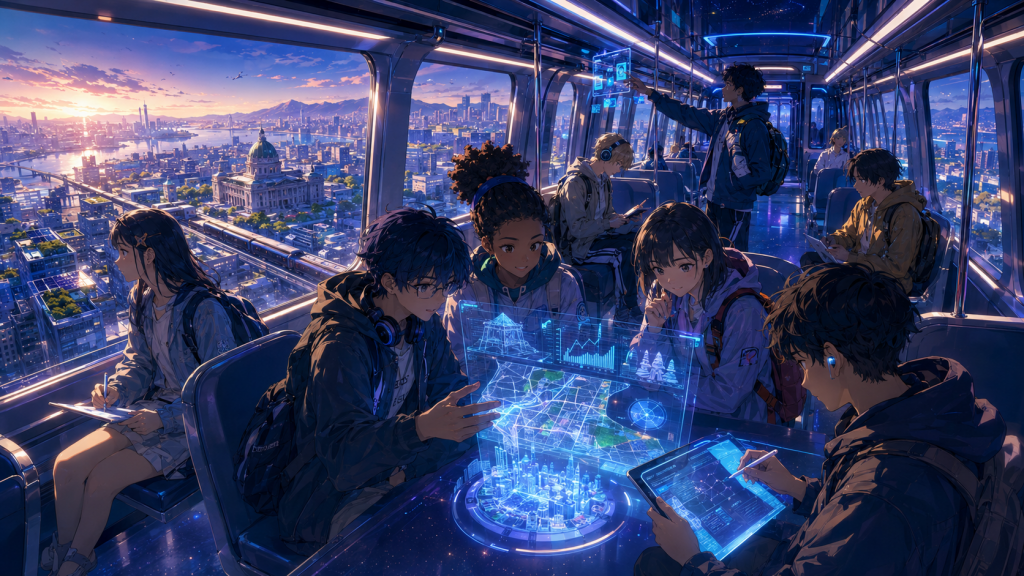
But during the other half the week would take place in longer, interdisciplinary learning studios organised around real questions.
Imagine a six-week studio entitled:
How can our town remain liveable at 40°C?
Pupils begin by measuring temperatures around their community. They use mathematics to analyse the results and identify heat islands. In science, they investigate insulation, shade, evaporation and the properties of different building materials.
Geography helps them map which neighbourhoods are most exposed. History reveals how earlier societies in southern Europe, North Africa and Asia designed buildings before air conditioning. Economics introduces the costs of different solutions and asks who should pay. Politics raises questions about public priorities, inequality and local decision-making.
The pupils interview residents, architects, health workers and shopkeepers. They visit older buildings, compare traditional and modern designs, and test materials by constructing models.
Finally, teams present proposals to a panel including teachers, local residents and an external specialist. Each pupil must also explain individually what the evidence showed, where the team disagreed and why they reached their final recommendation.
The studio might produce a scale model, statistical report, short documentary and public presentation. But it would also require calculations, scientific knowledge, historical research, persuasive writing and ethical judgement. The discrete subjects have not disappeared. They have acquired a purpose.
A different studio might ask:
-
- What causes people to migrate?
- Who benefits from the clothes we buy?
- Why do wars begin?
- How should artificial intelligence be controlled?
- Could our school produce some of its own food?
- Why are some neighbourhoods healthier than others?
This is not an occasional “project week” added after the real learning has finished. It is where much of the real learning happens.
From examination results to learning passports
If the curriculum changes but assessment does not, the old system will quickly reassert itself.
Written examinations should not disappear. They can test essential knowledge, independent thinking and a pupil’s ability to perform without outside assistance. But they should become one source of evidence rather than the final definition of success.
Each pupil could build a digital learning passport containing:
-
- shorter examinations in essential knowledge
- interdisciplinary projects
- practical demonstrations
- individual research
- collaborative work
- public presentations
- portfolios showing improvement
- an annual oral defence.
AI would be permitted during some tasks and prohibited during others. When it was used, pupils would have to document how.
Assessment would ask: Did the pupil frame the problem intelligently? Could they locate and verify evidence? Did they recognise an invented source? Could they challenge or improve the AI’s answer? What independent judgement did they finally make?
The passport would show not simply what grade a pupil received, but what that pupil could actually do.
At 16 or 18, every student would complete a substantial public graduation project. It might be a research paper, documentary, engineered object, computer program, business proposal, environmental plan or community initiative.
Whatever its form, it would require evidence, numerical understanding, historical context, ethical reflection and clear communication. The pupil would then defend it before a small panel.
Graduation would become something a young person had accomplished, not merely the point at which the examinations stopped.
Teachers cannot do this during their lunch breaks
This transformation cannot be achieved by issuing a new curriculum and expecting teachers to deliver it on Monday morning.
Most teachers were themselves educated through specialised subjects. They trained as historians, linguists, mathematicians and scientists. Asking them suddenly to design and assess interdisciplinary work would be unreasonable and, in many schools, impossible.
They would need:
-
- paid professional-development terms
- substantially more collaborative planning time
- training in interdisciplinary project design
- experience of team teaching
- placements with workplaces and community organisations
- regional curriculum laboratories in which new approaches could be tested.
A history teacher would not be expected to teach advanced physics, nor a scientist to become an economist overnight. They would contribute their expertise to a shared investigation and help pupils understand what their discipline reveals.
Teacher training would change accordingly. New teachers would retain a subject specialism while also learning to plan with colleagues, supervise projects and assess several different forms of achievement.
Existing teachers must become the architects of the transformation, not its exhausted victims.
Universities must surrender their veto
Schools cannot reform while universities continue demanding the same subject combinations and conventional examination grades.
University admissions would need to recognise the learning passport, graduation project and oral defence alongside any essential specialist knowledge. Medicine, engineering or languages would still require appropriate foundations, but a single row of grades would no longer be treated as a complete portrait of ability.
Universities receiving public funding should be required to accept the new qualifications from the first participating cohort.
Otherwise, prosperous families will retreat into private schools offering the old examinations, and a reform intended to reduce inequality will reinforce it.
Ground Zero Day
The transformation would be difficult. That is not an argument against attempting it.
In 1967, Sweden changed the side of the road on which an entire country drove. It required years of preparation, new infrastructure, extensive public education and a clearly announced date.
Educational reform needs the same decisiveness. A government could establish a national curriculum convention involving teachers, pupils, parents, universities, employers, trade unions and educationists. Regional partnerships would then receive two years to design and test learning studios, passports and graduation projects.
Teachers would begin their retraining before the first pupil entered the system.
Then a single age cohort, for example children entering secondary school, would start the new curriculum on a predetermined Ground Zero Day. Their assessment arrangements and future university-entry rights would be guaranteed from the outset.
The old and new systems would operate alongside one another only while the older cohorts completed their education. Within seven years, the transition through secondary schooling would be complete.
The reform would require protected funding and legislation lasting beyond one government. Independent researchers would publish evidence about what worked, what failed and what needed to change.
It would not be simple. Nor was creating universal education, establishing the National Health Service or changing the side of the road.
Complexity is not impossibility. It is a demand for preparation.
From well-filled heads to well-made minds
More than four centuries ago, Montaigne distinguished between the well-filled head and the well-made one.
Our schools remain extraordinarily efficient at filling: filling exercise books, filling timetables, filling examination papers and filling young minds with information that can be reproduced and forgotten.
Children entering an AI-infused world will certainly need knowledge. But they will also need to connect it, question it, test it and use it to solve problems that do not arrive conveniently labelled History, Mathematics or Science.
It is high time that an education system designed to replicate the social order, based largely on a divided curriculum and memory recall, were abolished. We urgently and seriously need an educational revolution that begins with the question:
How do we equip our children for understanding and developing the world in which we live?
“Education either functions as an instrument … to bring about conformity, or it becomes ‘the practice of freedom’.”
— Paulo Freire, Pedagogy of the Oppressed