Why Did Nobody Teach Me This at School?

What history should really teach
How a Spanish football shirt unexpectedly changed the way I think about history, education and the origins of our globalised world.

I recently bought a Spanish football shirt to wear at a bar while watching Spain’s 3:0 win against Austria on Thursday.

That simple purchase unexpectedly led me down one of the most fascinating rabbit holes I have explored in a while.

It began with two Latin words embroidered on Spain’s coat of arms: Plus Ultra.

I knew from my school-Latin what the words meant, further beyond, but I still needed some context to understand the meaning.

A little research revealed that they are a reference to the Pillars of Hercules at the Strait of Gibraltar. For the ancient world, these marked the edge of the known earth. The old warning was “Non Plus Ultra” nothing lies beyond.

Then came the voyages of exploration.

The warning became an invitation.

There was indeed more beyond.

That discovery prompted another question.

Christopher Columbus sailed for Spain. Yet I vaguely remembered reading somewhere that he was Italian. Was that right?

It was. I kept digging.

Born in Genoa, Columbus spent years trying to persuade different European rulers to finance his ambitious plan to reach Asia by sailing west. It was only when the Spanish Crown agreed to back him that history changed forever.

Then I discovered something even more surprising.

Ferdinand Magellan, whose expedition first circumnavigated the globe, wasn’t Spanish either. He was Portuguese. And he himself was killed in the Philippines before the expedition was completed.

Like Columbus, he simply happened to be sailing under the Spanish flag.

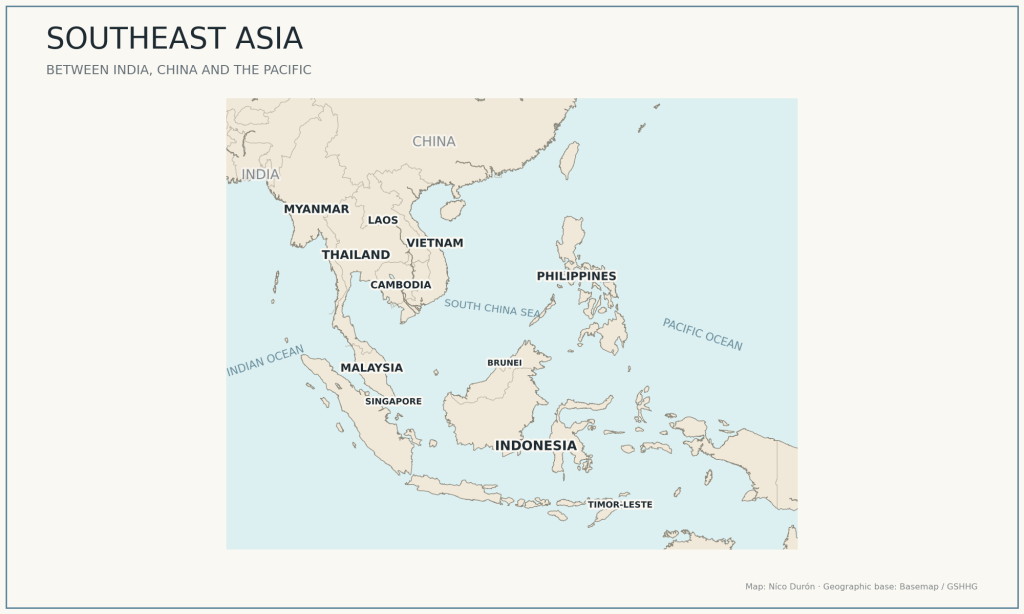
As I kept digging, I also learnt for the first time why America is called America and why the Pacific is called the Pacific. I learnt why Brazil speaks Portuguese while much of South America speaks Spanish, why Spain became one of history’s great global powers, how its sudden enormous wealth became a resource curse, and, most strikingly of all, how all these historical facts are mirrored in the events happening in the world today.

By now, all this led to another kind of question:

Why was I only learning this as I approach retirement?

None of these are obscure historical curiosities.

They explain the world we live in.


The more I thought about it, the more I realised that perhaps history has often been taught backwards.

Schools understandably devote considerable attention to national history. In Britain, we studied the Tudors, the Industrial Revolution and the Second World War. In Germany, where I spent many years teaching, National Socialism understandably occupies a central place throughout secondary education.

These are all profoundly important topics.

But too often history becomes an exercise in remembering names, dates, battles and treaties.

The examination rewards recall.

Real understanding often comes later.

History is not simply the story of what happened.

History can be the highly relevant explanation of why today’s world looks the way it does.

Why does almost an entire continent speak Spanish?

Why is Brazil different?

Why was Córdoba (Spain) once much bigger and more important than London?

Why are Europe and Latin America still so culturally intertwined?

Why and how did globalisation begin centuries before the Internet?

Those are historical questions too.

They just happen to illuminate the present rather than merely describe the past.


While I was training teachers at the University of Sussex, one of the finest history lessons I have ever witnessed contained almost no conventional history.

The young trainee teacher warned parents in advance that the lesson would be unusual.

She darkened the classroom. She played the sound of air-raid sirens followed by distant explosions. Beforehand, she asked the children to climb underneath their desks and lie silently on the floor with their eyes closed.

For several minutes they simply listened.

Afterwards she asked them to write, not about dates, military strategy or political leaders, but about how they had felt.

For a brief moment, those children had experienced uncertainty, vulnerability and fear. Not the reality of war, of course, but enough to begin imagining what it might feel like to be a child living through one.

I have forgotten countless historical dates since leaving school. I have never forgotten that lesson.

Nor, I suspect, have the children who experienced it.

That teacher wasn’t merely teaching history.

She was teaching empathy and vividly demonstrating how history is so relevant to life in the 21st Century.


As I have grown older, I find myself increasingly drawn to education that asks questions rather than rewards memorisation.

The same thought has appeared repeatedly in my recent writing about economics.

Financial literacy is not really about memorising definitions.

It is about understanding why economies behave as they do.

Likewise, history should not simply teach us to remember what happened.

It should help us understand why our world became what it is.

Perhaps that is why I have found these discoveries in Spain so unexpectedly exciting.

I wasn’t simply learning historical facts.

I was discovering connections.

The voyages of Columbus and Magellan were not isolated adventures.

They marked the beginning of the first great wave of globalisation.

Trade routes expanded.

Ideas travelled.

Plants, animals, diseases and cultures crossed oceans.

The Mediterranean outside my window here was once dry land – another fact I was unaware of. It is only thanks to the Zanclean Flood that water entered from the Atlantic through the Strait of Gibraltar and opened up the possibility of a future global trade highway.

The world became permanently interconnected.

Five centuries later we are still living with the consequences.

History also reminds us that no civilisation remains permanently at the top.


Sometimes I wonder whether schools unintentionally leave us with the impression that education ends when we pass our examinations.

In reality, the opposite is true.

The most rewarding learning often begins afterwards.

It begins when curiosity replaces obligation.

When we are no longer asking, “Will this be in the exam?”

Instead we ask, “Why did nobody ever explain this?”

Perhaps that is the real purpose of education.

Not to fill our minds with information.

But to awaken a curiosity that lasts for the rest of our lives.

“The real voyage of discovery consists not in seeking new landscapes, but in having new eyes.”
— Marcel Proust

When a Country Gets Richer, Who Owns the Wealth?

Wealth. A man reading a financial newspaper about who owns Spain's wealth in the background.A newspaper headline over breakfast in Spain made me question something I’d never really considered before. When a country’s economy is booming, who actually owns the wealth that’s being created?

One of the unexpected pleasures of moving to Spain has been rediscovering the lost art of breakfast.

Most mornings I walk to my favourite café, order a café con leche and toasted bread rubbed with fresh tomato and olive oil, then spend half an hour simply watching the town wake up. The same waiter greets familiar faces with effortless warmth. Elderly couples linger over coffee. Shopkeepers raise their shutters. Sunburnt tourists wobble by. There is something reassuring about the rhythm of ordinary life here.

A few mornings ago, however, it wasn’t the people who caught my attention. It was a newspaper.

The gentleman at the next table was reading Expansión, Spain’s financial newspaper. Across the front page was a headline that immediately made me stop.

The real owners of the IBEX 35.

The real owners?

Surely Spain’s largest companies belong to Spain.

I finished my breakfast, but the question followed me home.


The Assumption

Like most people, I have spent much of my life assuming that when a country’s economy grows, its people become wealthier. I’ve lived in Germany for 16 years, which always provided me with the perfect example.

And that is how the news is usually presented.

The economy is booming.

Corporate profits are rising.

The stock market reaches another record.

We instinctively hear those as different ways of saying the same thing.

But they are not.

Companies create wealth where they operate.

Ownership determines where much of that wealth ultimately accumulates.

The distinction sounds almost trivial.

It isn’t.

It changes the way we think about almost everything.


Creating and Owning Wealth

Imagine two people.

One spends forty years working.

The other spends forty years owning.

The first helps create prosperity.

The second receives part of the return from that prosperity.

Sometimes, of course, they are the same person.

Often they are not.

That morning, as I watched the waiter carrying coffees from table to table, it occurred to me that he was helping to create Spain’s prosperity every bit as much as a hotel owner, a banker or a company director. Every tourist welcomed, every breakfast served and every day’s work honestly completed contributes, however modestly, to a nation’s success.

Yet if one of Spain’s largest companies doubles its profits this year, a significant share of those profits may eventually belong to people who have never set foot in Spain.

The wealth is created here.

The ownership may be somewhere else.

For some reason, that simple distinction had never really occurred to me before.


A Global Story

The more I reflected on it, the more I realised that Spain was merely the setting.

This is the story of the modern world.

Capital crosses borders far more easily than people do.

That freedom has transformed our lives. It has financed innovation, built industries, connected economies and lifted hundreds of millions of people out of poverty. Few of us would seriously wish to reverse it.

Yet every system has consequences.

Perhaps the least discussed consequence of global capitalism is that it increasingly separates the place where wealth is created from the place where much of it is ultimately owned.

The two are no longer the same thing.


Britain Taught Me the Lesson Before Spain Did

Ironically, Britain had been teaching me this lesson for decades without my noticing.

Successive governments sold companies, utilities, railways, airports, property and infrastructure into private and often international ownership. We were told that this was modernisation, efficiency and the price of attracting investment. In many respects, it was.

Investment creates jobs.

Investment raises productivity.

Investment helps economies grow.

But every sale also carried another consequence.

A little more of tomorrow’s income would belong to someone else. And if the quality of a service such as buses and railways deteriorates in Manchester when the company owners sit in an office along the Champs Elysées, we should not be too surprised.

At the same time, Britain itself became a major owner of overseas assets. Pension funds, investment companies and multinational businesses accumulated wealth around the world. Perhaps that is one reason Britain has continued to generate considerable income despite producing far fewer of the manufactured goods that once defined its economy.

I had simply never connected those two facts before.

The newspaper in Spain finally joined the dots for me.


The Conversation We Rarely Have About Wealth

Political arguments usually revolve around wages, taxation or redistribution.

The left asks how wealth should be shared.

The right asks how more wealth can be created.

Both debates matter.

But perhaps they both overlook an earlier question.

Who owns the wealth before anyone starts arguing about how to redistribute it?

That seems to me to be one of the defining questions of our age.

Not because ownership should be concentrated within national borders.

Nor because global investment is somehow undesirable.

But because ownership itself has become strangely invisible.

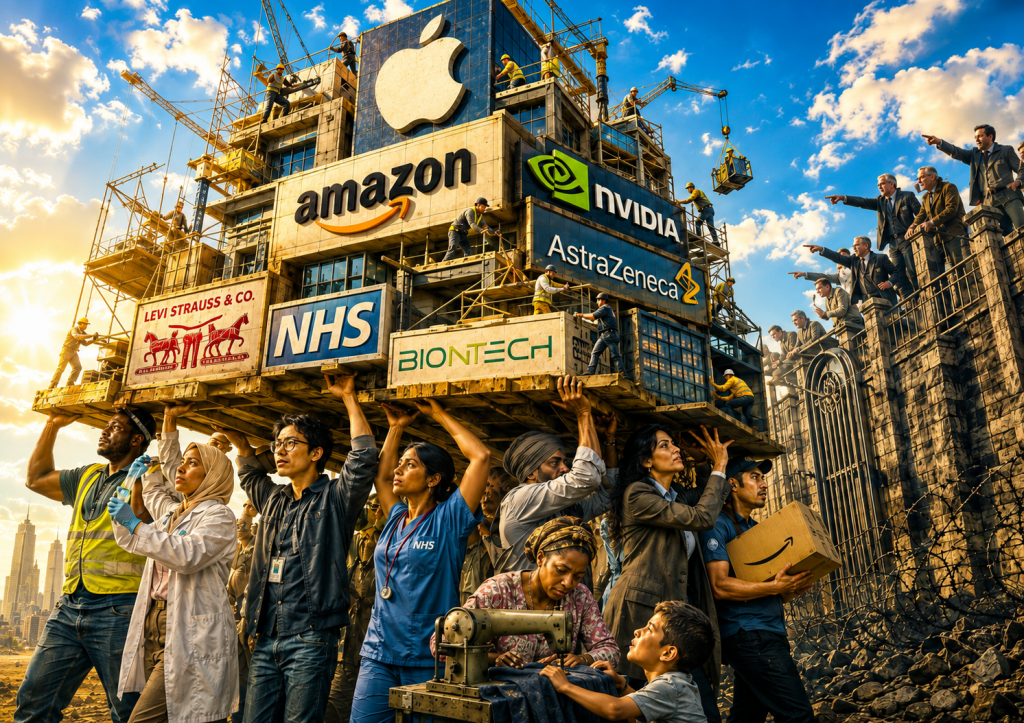
Millions of people spend entire careers helping to create wealth while accumulating very little ownership of the economy they are helping to build.

They earn incomes.

But wages and ownership are not the same thing.

One pays today’s bills.

The other builds tomorrow’s security.


A Fairer Form of Globalisation

I have no desire to retreat into economic nationalism.

The extraordinary prosperity of the modern world owes much to capital flowing freely across borders. The challenge, surely, is not to make investment less global but ownership less exclusive.

Economic growth should not become a spectator sport in which millions of people spend their lives creating wealth they will never meaningfully own.

A healthy economy should produce not only better wages but broader ownership, because ownership is what allows one generation’s work to become the next generation’s security.

That does not require abandoning global markets.

It requires asking whether ordinary citizens have enough opportunities to become long-term owners of the prosperity they spend their lives creating.

What if governments devoted as much energy to widening ownership as they currently devote to encouraging growth?

What if employee share ownership became the norm rather than the exception?

What if ordinary citizens found it easier to build long-term stakes in productive businesses through pension funds, savings schemes and investment accounts?

What if the people whose daily work creates prosperity gradually came to own a larger share of that prosperity?

That strikes me as a far more constructive ambition than trying to turn back the clock on globalisation.


I still remember folding that newspaper and taking one last sip of coffee before walking home.

The headline had answered one question.

But it had raised another.

When we say that a country’s economy is booming, we usually ask how much wealth has been created.

Perhaps the more important question is one we almost never ask.

Who really owns the wealth that a nation’s workforce is creating?

“The political problem of mankind is to combine three things: economic efficiency, social justice and individual liberty.”
— John Maynard Keynes


The Seven Economic Myths We Tell Ourselves

Seven economic myths we tell ourselves

Last week I questioned whether our current school curriculum provides us with the knowledge we require for handling money during our adult life. This week I’d like to look at seven common economic myths I consequently grew up with that, I believe, should be examined by students in today’s education system.

Economics is often presented as a science of numbers. We hear about growth rates, inflation figures, government debt and stock market performance. Experts produce graphs. Politicians quote statistics. Journalists report percentages.

Yet much of our thinking about economics is not based on facts. We inherit economic beliefs in much the same way that we inherit religious beliefs, political loyalties, or assumptions about human nature. They become part of our mental furniture. We rarely examine them. We simply assume they are true.

Here are seven economic stories many of us have been taught to believe.

Myth No. 1. If GDP Is Growing, Everything Must Be Fine

One of the most common assumptions is that economic growth automatically means social progress. If the Gross Domestic Product is increasing, politicians congratulate themselves, commentators celebrate and newspapers announce that the economy is doing well.

But there is an obvious question that often goes unasked: doing well for whom?

GDP measures economic activity. It measures production. It tells us how much a country produces and sells. What it does not tell us is how that wealth is distributed or whether ordinary people are benefiting from it.

A nation can have impressive growth while housing becomes unaffordable, public services deteriorate and large sections of the population struggle to make ends meet.

As a former teacher, I sometimes compare GDP with examination results. A school may improve its statistics while becoming a worse place to learn. The numbers can look impressive while something essential is being lost.

The same is true of nations. Economic growth matters, but it is not the same thing as human flourishing.

Myth No. 2. Debt Is Always Bad

Most of us are taught to fear debt. For individuals, that is often sensible. Excessive borrowing can destroy lives. It can create stress, dependency and hardship. Yet not all debt is the same.

A mortgage, a student loan or a business investment is different from borrowing money to fund reckless consumption. One creates future value; the other merely brings tomorrow’s spending into today.

The same principle applies to governments. When a state borrows to invest in education, infrastructure, scientific research or healthcare, it may be creating assets that benefit future generations. The question is not whether debt exists, but whether the borrowing is productive and sustainable.

The most successful economies in the world often carry substantial public debt. What matters is not the existence of debt itself, but the wisdom with which it is used.

Myth No. 3. The Rich Create Jobs

This idea appears so frequently in political debate that many people accept it without question. There is, of course, some truth in it. Entrepreneurs create businesses. Businesses employ people. Investment can stimulate growth. But the story is incomplete.

Businesses do not hire employees simply because their owners are wealthy. They hire employees because there is demand for their products and services. A restaurant expands because customers fill its tables. A manufacturer recruits workers because orders are increasing. A shop hires staff because people are buying what it sells.

In other words, jobs are not created by wealth alone. They are created by economic activity. Moreover, much employment comes not from billionaires or multinational corporations, but from small and medium-sized businesses. Across Europe, countless family businesses, local shops, tradespeople and self-employed entrepreneurs collectively employ millions of people.

The real engine of employment is not wealth itself but a healthy and active economy.

Myth No. 4. Markets Always Know Best

For some people, the market has become almost a secular religion. The argument is familiar. Left alone, markets allocate resources efficiently. Government intervention merely creates distortions and stunts economic growth.

There is certainly some truth in this. Competitive markets can be remarkably effective. They often encourage innovation, efficiency and consumer choice. But markets are not infallible.

Consider healthcare. If access to medical treatment depends entirely upon ability to pay, many vulnerable people will be excluded.

Consider environmental protection. Businesses may profit by passing environmental costs onto society as a whole. Pollution becomes someone else’s problem.

Economists even have a term for these situations: market failures.

The reality is that markets and governments each have strengths and weaknesses. Mature societies require both. The challenge is not choosing one over the other, but finding the right balance between them.

Whenever someone insists that the answer is always more market or always more state, I become suspicious. Human societies are rarely that simple.

Myth No. 5. If You Tax the Rich, They Will Leave

This argument appears whenever tax reform is proposed. Raise taxes on wealthy individuals, we are told, and they will immediately pack their bags and move elsewhere.

At first glance, the claim seems plausible. Yet people are not spreadsheets.

Human beings make decisions based on family, friendships, culture, language, quality of life, security and belonging. Financial considerations matter, but they are rarely the only consideration.

Countries such as Norway, Sweden and Denmark have maintained relatively high levels of taxation while remaining prosperous, innovative and attractive places to live.

This does not mean taxes can be increased without limit. Excessive taxation can certainly discourage investment and entrepreneurship.

The point is simply that reality is more nuanced than political slogans suggest.

People stay for many reasons. They leave for many reasons. Tax is only one factor among many.

Myth No. 6. Inflation Is Always Bad

The word inflation usually arrives wrapped in anxiety. We hear that prices are rising and immediately assume disaster.

Certainly, high inflation can be deeply damaging. It erodes savings, creates uncertainty and hits those on lower incomes particularly hard. Yet economists generally do not aim for zero inflation.

A modest level of inflation is usually considered healthy because it reflects a growing economy. It encourages spending, investment and economic activity.

What is often forgotten is that the opposite problem can be equally dangerous.

If prices continually fall, people postpone purchases. Why buy today if everything will be cheaper tomorrow? Businesses then sell less, investment slows and unemployment may rise.

Like many things in life, the issue is not inflation versus no inflation. It is balance. Too much inflation can be destructive. Too little can be equally problematic.

Myth No. 7. Money Is Real

This final myth is my favourite because it takes us beyond economics and into philosophy.

Most of us think of money as something solid and tangible. We earn it, spend it, save it and worry about it. Yet money possesses no intrinsic value.

A fifty-euro note is merely paper. The number displayed in your bank account is simply a digital record stored on a computer somewhere.

Money works because we collectively believe it works. Its value depends upon trust.

This is not as strange as it sounds. Much of human civilisation rests upon shared beliefs. Nations exist because enough people believe they exist. Laws function because people collectively accept their legitimacy. Companies, universities and governments all depend upon systems of shared trust.

Money is one of humanity’s most successful collective stories. That does not make it imaginary. It makes it a social construct, like any other.

And perhaps that is one of the most important lessons economics can teach us.

If only I’d known in my twenties what I know now

If there is a lesson I wish somebody had taught me when I was starting out, it is that wealth is rarely built through cleverness alone. Looking back, the people who seem to achieve financial security are often not the most intelligent, the most educated or even the highest earners.

They are the people who consistently do a few simple things well.

    • They spend less than they earn
    • They avoid unnecessary debt
    • They acquire productive assets
    • They diversify their investment portfolio
    • They think long term
    • And above all, they allow time and compounding to work their quiet magic.

Perhaps that is the greatest economic lesson of all. Not that there are easy answers. But that small, sensible decisions repeated over decades are often more powerful than brilliant ideas pursued for a few months.

Beyond Economics

The purpose of examining these myths is not to replace one certainty with another.

It is to become more cautious whenever someone offers a simple explanation for a complicated problem.

Economic debates are often presented as battles between truth and error, between common sense and foolishness, between left and right. Reality is usually less satisfying.

The older I become, the less interested I am in certainty and the more interested I am in questions.

    • Who benefits from economic growth?
    • What kind of debt creates value?
    • When do markets work well, and when do they fail?
    • How much inequality can a society tolerate before trust begins to erode?

And perhaps most intriguingly of all: what other things do we collectively believe in that are no less dependent on faith than money itself?

Economics turns out to be about far more than money.

It is about human beings and the stories we tell ourselves about how society works.

The test of a first-rate intelligence is the ability to hold two opposed ideas in mind at the same time and still retain the ability to function.

— F. Scott Fitzgerald


I studied for four years at Oxford and Nobody Taught Me How Money Works

The British government has this week announced plans to ban social media access for under-16s. Ministers describe it as a historic intervention to protect children. Newspapers are full of discussion about algorithms, screen addiction and online harms. Yet as I watched the announcement unfold, I found myself asking a different question entirely. Why are we once again arguing about what children should be prevented from doing rather than what they should be taught?

The discussion is presented as a matter of national importance. Ministers speak gravely about online harms. Newspapers speculate about restrictions and enforcement. Experts are summoned to television studios. Committees are established. Reports are commissioned.

But all of my experience as a student and teacher tells me that we are arguing passionately about the wrong problem. At sixty-five years of age, having attended good schools, won a scholarship to Oxford, taught for decades and worked in several countries, I have reached an uncomfortable conclusion: almost nobody ever taught me how money works.

Nobody explained investing. Nobody explained compound interest. Nobody explained pensions. Nobody explained the long-term consequences of inflation. Nobody explained the relationship between taxation and public services. Nobody explained mortgages beyond the most superficial level. Nobody explained the astonishing difference between acquiring assets and merely consuming income.

Yet these are not specialist concerns. They are among the most important forces shaping the lives of ordinary citizens.

They influence where people live, when they retire, whether they accumulate wealth, how vulnerable they are to economic shocks and, ultimately, the degree of freedom they enjoy throughout their lives.

The strange thing is that this educational failure is almost invisible. Some parents complain if their children leave school unable to read Shakespeare. Politicians worry if socially constructed examination results fall.

Universities debate decolonisation, inclusion, safe spaces and artificial intelligence.

Meanwhile, millions of young adults enter the world with little understanding of debt, investment, taxation, pensions or wealth creation.

Nobody seems particularly alarmed. But as a teacher, I find this extraordinary. And as a citizen, I find it deeply disturbing.

As someone who grew up in a working-class family, I find it difficult to avoid an even more uncomfortable observation.

Those who grow up in affluent families often learn these things anyway.

They hear conversations around the dinner table. They observe parents discussing property, investments, inheritance and taxation. They absorb financial knowledge almost by osmosis.

Those from less privileged backgrounds are often far less fortunate.

The result is that schools, which are supposed to reduce inequality of opportunity, usually end up reinforcing it.

I studied languages, theology, literature and philosophy. I do not regret a moment of it. Education transformed my life and broadened my horizons in ways I shall always be grateful for.

Yet if I am completely honest, my grandfather, a builder with far less formal education, may well have understood practical wealth creation better than I did. He understood property. He understood value. He understood patience. Most importantly, he understood that money is not primarily about income. It is about what income becomes over time. That lesson alone may be worth more than half the curriculum I studied. Unfortunately, he passed away when I was five years old, so he could never pass on his wisdom.

The question therefore is not whether children should be protected from harmful content online. Of course they should.

The question is why governments find it easier to regulate TikTok than to ask whether the curriculum itself is preparing young people for adult life.

Why is there endless discussion about screen time but comparatively little discussion about economic literacy?

Why do we devote thousands of classroom hours to subjects that many pupils will never use again while allocating almost no serious time to understanding mortgages, pensions, inflation, taxation, investing and economic reasoning?

And why, after decades of educational reform, do so many intelligent, capable and highly educated adults still feel financially illiterate?

These are not merely personal questions. They are political questions. They are social questions.

And they are ultimately questions about power.

A population that cannot critically evaluate economic arguments is easier to persuade, easier to frighten and easier to divide. It becomes dependent upon experts, commentators and politicians to interpret reality on its behalf.

A population that understands economics is harder to manipulate.

Perhaps that is why the seven economic myths I recently encountered fascinated me so much. I will share them here next week.

These seven myths didn’t just reveal something about economics, but they revealed something about education.

And perhaps, more importantly, about what education still fails to teach.

“Education is not the filling of a pail, but the lighting of a fire.”

— W. B. Yeats

If Yeats was right, then perhaps we need to ask whether we are lighting the wrong fires.


Gregor Gysi: The Best Chancellor Germany Never Had

Why Friedrich Merz Is Sealing Germany’s Coffin

Recently, Gregor Gysi made an observation that deserves far more attention than it has received. According to Gysi, Friedrich Merz’s political strategy is increasingly based on finding new groups of people to blame for Germany’s socio-economic problems rather than confronting the deeper causes of the country’s decline.

First it was immigrants and refugees.

Then it was the healthcare system.

Now it is Germany’s workforce.

Whether one agrees with Gregor Gysi on everything or not, his criticism exposes a troubling pattern. Whenever Germany faces a serious challenge, Merz appears more interested in identifying a convenient target than offering either a compelling vision for the future or consistent decisions aligned with clear political and ethical values.

The Refugees Who Helped Germany

Germany welcomed around one million refugees during the migration crisis of 2015 and 2016. The decision was controversial then and remains controversial today, stoked up by the nationalism of the AfD.

Yet ten years later, many of these refugees have integrated successfully. They have learned German, entered the labour market, started businesses, paid taxes, contributed to the pension system and become part of German society.

Some arrived as highly qualified professionals: doctors, engineers, academics and lawyers. Others filled essential jobs that Germany struggles to recruit for itself.

Germany’s demographic crisis is not a future problem. It is happening now. Employers across the country face labour shortages. The pension system depends on a shrinking workforce supporting a growing retired population.

Against this background, treating refugees primarily as a burden rather than as contributors makes little economic sense.

I recently thought of a young Syrian woman I know. She now speaks fluent German, as well as English and Arabic. She is completing a doctorate in law and has every prospect of becoming a highly productive member of German society.

Yet she is planning her future elsewhere, most likely in the United States.

Germany invested in her integration. Germany benefited from her talent. Germany may now lose her altogether.

That is not a success story. It is a failure of political imagination.

Scapegoating Healthcare

The same pattern appears in healthcare.

Germany undoubtedly faces major financial pressures in its health and social insurance systems. An ageing population, rising costs and economic stagnation create genuine challenges.

But the answer cannot simply be to reduce protections that millions of people rely upon.

The principle that families should have access to healthcare regardless of income has long been one of the strengths of the German social model. Weakening that principle may save money in the short term, but it risks creating greater social and economic costs in the future.

What is particularly striking is the contrast between the urgency applied to military spending and the hesitation shown towards investments in social infrastructure.

Politicians readily describe defence spending as an investment in the future. Yet healthcare, education and social stability are investments too.

A nation is not defended only by weapons. It is defended by healthy, educated and confident citizens.

The Myth of Working Longer

The latest target appears to be Germany’s workforce.

Merz has argued that Germans need to work more hours and remain economically active for longer. On the surface, this sounds practical and responsible.

In reality, it reflects a remarkably outdated understanding of productivity.

Human beings are not machines.

Productivity depends upon motivation, trust, leadership, skills, technology and working conditions. A well-managed and valued employee working thirty-five hours per week can often contribute more than an exhausted and disengaged employee working fifty-five.

The most successful economies do not necessarily have the longest working weeks. They have the most productive working hours.

Germany’s challenge is not primarily that its people are lazy. It is that investment in digitalisation, reducing bureaucracy, promoting infrastructure and innovation has lagged behind many competitors for years.

Blaming workers is easier than fixing structural problems. But it is also less effective.

Germany Needs Leadership, Not Scapegoats

Friedrich Merz undoubtedly possesses ambition. He looks like a statesman. He speaks confidently. He projects authority.

Yet genuine leadership requires more than authority.

It requires empathy.

It requires vision.

It requires values.

The CDU once prided itself on balancing economic responsibility with social responsibility. Today, that balance often seems absent. The willingness to embrace large-scale borrowing while simultaneously questioning social protections creates the impression not of strategic thinking but of political inconsistency.

Germany faces enormous challenges: demographic decline, economic stagnation, digital backwardness, labour shortages and growing political polarisation.

None of these problems will be solved by blaming refugees, healthcare recipients or workers.

They require something much rarer.

They require a government willing to unite rather than divide.

For all his political flaws, Gregor Gysi has long understood one simple truth: a society becomes stronger when it expands the circle of belonging rather than narrowing it. He truly is the best chancellor Germany never had.

Germany’s future will depend on whether more of its leaders understand that truth as well.

“When five people own more wealth than the poorer half of an entire nation, the problem is not refugees, nurses or workers. The problem is where the wealth has gone.”
— Gregor Gysi (paraphrased from his speeches on wealth inequality)

Sovereignty Begins at the Desktop

Linux desktop workspace representing digital sovereignty, privacy and independence from big tech ecosystems

For years, choosing an operating system was treated as a consumer preference: Mac or Windows. Apple or Microsoft. Design or compatibility.

Those days are ending. Indeed, for me, they have already ended.

My move to Linux was not born of practicality. It began as an explicitly political decision: a small personal protest against what I see as the increasingly troubling direction of the United States and my growing discomfort about privacy and with Europe’s dependence on American technology.

What began as principle, however, quickly became something more exciting. An education, even.

In moving away from mainstream platforms, I discovered not merely a political statement but a better way of computing: faster, calmer, less intrusive, more user-controlled—and one that forced me to confront how casually many of us have entrusted vast quantities of personal data to a handful of foreign corporations.

Increasingly, our technology choices are no longer merely about convenience or aesthetics. They are about jurisdiction, sovereignty, dependence and trust.

The Illusion of Neutral Technology

We have spent two decades pretending that software is apolitical. It is not.

Private data is the so-called new oil.
Cloud platforms are geopolitical assets.
Operating systems are instruments of jurisdiction.
App ecosystems are channels of dependency.

To build one’s digital life entirely on American platforms is not simply to use foreign products. It is to place one’s communications, workflows, data and habits inside systems governed elsewhere.

For years, this dependency seemed harmless because America appeared stable, predictable and aligned with European interests. That assumption now looks far less secure.

Why Linux Appeals Beyond the Technically Curious

My own switch to Linux was motivated initially by principle, but sustained by practical reality.

Linux is, quite simply, excellent.

It offers:

    • greater speed and efficiency
    • far less software bloat
    • more user control
    • minimal intrusive advertising or telemetry
    • freedom from forced ecosystem lock-in
    • a calmer, more focused computing experience

It also avoids a growing trend I find exhausting in mainstream software: the transformation of operating systems into hyperactive consumer platforms.

Notifications.
Recommendations.
Prompts.
Pop-ups.
Embedded AI assistants.
Animated interfaces designed less for work than for perpetual engagement.

Linux, by contrast, still feels like a tool. Not a theme park.

My Preferred Distributions: Mint and Arch

For those exploring Linux, I find two distributions particularly compelling.

Linux Mint: Mature Practicality

Mint is Linux at its most civilised.

Stable, polished, intuitive and highly accessible, it offers a reassuringly traditional desktop experience without sacrificing elegance.

It is the Linux distribution I would recommend to most ordinary users and beginners.

Arch Linux: Radical User Ownership

Arch is a different philosophy entirely.

Minimal, modular and deeply configurable, it demands more of the user—but rewards that effort with extraordinary control.

Arch is not merely software.

It is a statement of intent:

I will shape my tools. My tools will not shape me.

Europe Is Beginning to Think This Way Too

What may once have looked like niche hobbyism is increasingly becoming state policy.

The French government has announced plans to migrate large parts of its public administration away from Windows and toward Linux as part of a broader digital sovereignty strategy.

Other European administrations are exploring or implementing similar moves, including regional and national migrations toward open-source alternatives in Germany and Denmark.

Why?

Because governments are recognising what individuals increasingly recognise:

Dependency creates vulnerability.

Reliance on foreign proprietary platforms means reliance on:

    • foreign licensing decisions
    • foreign corporate roadmaps
    • foreign legal jurisdictions
    • foreign political stability

The Great Irony: Linux Already Runs the World

Here is the part casual users often miss: Linux may still be niche on consumer desktops, but it already powers much of the digital world.

Linux runs:

    • most of the web’s server infrastructure
    • the overwhelming majority of supercomputers globally
    • vast portions of cloud computing infrastructure
    • countless embedded and industrial systems
    • even Android is based on a modified version of the Linux kernel

In other words:

Linux is not an outsider technology.

It is the backbone of modern computing.

The desktop is merely catching up.

A Warning to America — And An Opportunity for Europe

The United States should not assume technological dominance is permanent.

Consumers, institutions and governments are increasingly asking difficult questions:

    • Who controls our infrastructure?
    • Who governs our data?
    • What happens if political alignment breaks?
    • Why are we so dependent on foreign platforms for essential digital life?

If American tech firms continue to treat lock-in as strategy and complacency as entitlement, they may discover that dominance breeds resistance.

Meanwhile Europe has an opportunity.

Not necessarily to replace Silicon Valley overnight.

But to build credible alternatives.

To invest in open standards.
To support interoperable software.
To back European cloud and software infrastructure.
To treat digital autonomy as seriously as energy autonomy.

The next decade may not produce a mass exodus from American technology.

But the direction of travel is becoming harder to ignore.

Slowly, unevenly, but unmistakably.

Final Thought

My move to Linux will not alter geopolitics.

But it is, in its own small way, an expression of a wider conviction:

That technology should serve its user.
That infrastructure should remain contestable.
That dependency should never become invisible.

Linux is not merely for hobbyists anymore.

It is increasingly for those asking a larger question:

Who should control the tools on which modern life depends?

“In times of change, the learners inherit the earth, while the learned find themselves beautifully equipped for a world that no longer exists.”
Eric Hoffer

When breaking the law is the right thing to do

When Absolutes Meet Life: The Ten Commandments in a World of Grey Zones

Introduction: Granite Pillars, Shifting Ground

The Ten Commandments stand like granite pillars in the moral imagination of the West. Their clarity and simplicity — do not lie, do not steal, do not kill — promise a moral compass that transcends culture, time and circumstance.

Yet the moment we bring them into the tangle of real life, absolutes begin to rub against exceptions.

Take truth-telling: you shall not bear false witness. But if lying spares the hunted from a tyrant’s soldiers, can we still call it sin?

Or killing: you shall not murder. What of the soldier who fires not from hatred but to liberate, or the doctor who relieves excruciating suffering when life is otherwise ebbing away?

The commandments do not disappear. But they begin to bend under the weight of reality.

Where the Commandments Begin to Fracture

Each commandment, when examined closely, reveals a fault line:

    • Do not lie → What if a lie saves a life?
    • Do not kill → What about self-defence, war, euthanasia?
    • Do not steal → What if a starving person takes bread?
    • Honour your parents → What if they are abusive?
    • Keep the Sabbath → What if healing or survival requires breaking it?

Even the Hebrew scriptures acknowledge this tension:
David eats sacred bread when starving. Rahab lies and is praised.

The pattern is consistent: when strict obedience collides with human dignity, compassion begins to override rule.

Modern Grey Zones: Where Ethics Gets Uncomfortable

The ancient dilemmas have not disappeared. They have intensified.

1. Civil Disobedience and Tax Resistance

If citizens believe a war is unjust, are they morally obliged to fund it?

If millions refused to pay taxes in protest, would that be:

    • theft from the state?
    • or moral courage against injustice?

History complicates the answer. Figures like Gandhi and Martin Luther King Jr. framed civil disobedience not as lawlessness, but as obedience to a higher law.

Yet the danger is obvious: if everyone decides individually which laws to obey, social order collapses. So where is the line — between conscience and chaos?

2. State Policies and Human Life

Consider population control policies that have led, directly or indirectly, to the killing of female infants. Is this:

    • a utilitarian attempt to manage resources?
    • or a violation of the most basic moral law — the sanctity of life?

Here the commandment “do not kill” confronts the brutal logic of state planning.

3. Wealth, Environment, and Collective Harm

We do not steal — and yet entire economies extract from the planet in ways that may destroy future generations.

    • Is environmental destruction a form of theft from the unborn?
    • Does profit justify long-term harm?

The commandments were written for individuals.
But today, systems commit what individuals once did.

4. Truth in the Age of Power

“Do not bear false witness” once meant lying in court. Now it includes:

    • political disinformation
    • media manipulation
    • algorithmic distortion

When truth itself becomes a battlefield, the commandment remains, but its application becomes infinitely more complex.

A Personal Dilemma: When Every Commandment Collides

There was a moment when all of this ceased to be theoretical for me.

My mother came to visit me in Germany. At the airport, she was pushed over by an impatient passenger in one of those electric buggies. The fall seemed minor at the time, but it accelerated everything. Her health declined rapidly. Incontinence. Dementia. Depression.

Her GP made a suggestion. We could simulate a bladder infection. That would justify a hospital admission. From there, she would be transferred to a care home for short-term recovery — and, most likely, remain there long-term.

It would mean lying. It would mean manipulating the system. It would mean, in some sense, taking resources that were not strictly ours.

And yet the alternative was to watch her deteriorate without adequate care.

In that moment, the commandments did not line up neatly. They collided.

    • Do not lie — and yet the lie would open the door to care.
    • Do not steal — and yet the system existed precisely to care for the vulnerable.
    • Do not covet — and yet I envied those whose lives were not constrained by such responsibility.
    • Do not kill — and yet I felt flashes of rage toward the woman who had pushed her, a dark instinct that shocked me.

In the end, I followed the doctor’s advice.

My mother received excellent care. She lived for another seven years, safe, supported, and dignified in ways that would not otherwise have been possible.

Looking back, I still ask the question: was it right?

In the language of absolute rules, perhaps not.
In the language of lived reality, I believe it was.

And yet I cannot prove it was right.
I can only say that it was human.

The Real Question: Rules or Responsibility?

The deeper issue is not whether the commandments are right.

It is whether they can ever be applied without interpretation.

    • Absolute rules offer clarity.
    • Real life demands judgment.

Too much rigidity → cruelty in the name of morality.
Too much flexibility → chaos disguised as freedom.

We are left in tension.

A Different Way to Read the Commandments

Perhaps the commandments were never meant to function as rigid laws in every conceivable situation.

Perhaps they are moral directions rather than mechanical rules:

    • not “never lie,” but protect truth and trust
    • not “never kill,” but honour the sacredness of life
    • not “never steal,” but respect what belongs to others

In this reading, the spirit matters more than the letter.

But that raises a dangerous possibility: who decides what the “spirit” requires?

Between Fanaticism and Relativism

This is where modern ethics fractures into two extremes:

    • Fanaticism → rigid obedience, even when it harms
    • Relativism → anything can be justified

Neither is sufficient.

The real challenge is harder: to hold onto moral clarity without losing moral intelligence.

Conclusion: The Burden of Being Human

The commandments remain.

But they no longer stand untouched on distant stone tablets.
They stand within us — contested, interpreted, lived.

To be human is not simply to obey rules.
It is to carry the burden of deciding when, and how, they apply.

And that burden cannot be escaped.

Closing quotation

“He who fights with monsters should see to it that he himself does not become a monster… for when you gaze long into the abyss, the abyss gazes also into you.”
Friedrich Nietzsche

Social Media Bans for Under 16s

Why banning social media for under-16s may feel right — but fails to address the real issue

There is a growing political appetite to ban social media for under-16s. Governments in countries such as Australia and Indonesia have already moved in this direction, driven by rising concern about anxiety, depression, and the psychological effects of digital life.

The instinct is understandable. But it may also be wrong.

The comfort of the ban

A ban is politically attractive because it is clear, decisive and easy to communicate. It signals protection. It tells a worried public that something is being done.

But it also avoids a harder question.

Why has social media become so central to childhood in the first place?

Policy without evidence

The Cambridge psychologist Sander van der Linden has been unusually blunt. There is, he argues, “zero empirical evidence” that banning social media for teenagers improves outcomes.

His warning is not ideological but methodological:

“Blindly instituting wholesale bans for teens takes the ‘evidence’ out of evidence-based policy.”

This matters. Because once policy is driven primarily by anxiety, it becomes vulnerable to simplification.

And simplification is exactly what this issue does not need.

The variability problem

Social media does not affect all children in the same way.

For some, it amplifies vulnerability: comparison, exclusion, anxiety.
For others, it provides connection, identity and support. As well as of course access to information for school work.

The outcome depends on:

    • personality
    • patterns of use
    • existing mental health
    • social environment

A blanket ban assumes uniform harm where there is, in reality, radical variation.

The misdiagnosis

More fundamentally, a ban risks targeting the wrong thing.

The problem is not simply that children use social media. It is that social media have been designed to capture attention:

    • infinite scroll
    • algorithmic reinforcement
    • intermittent rewards

These are not neutral features. They are behavioural systems.

Yet instead of regulating the environment, we regulate the child.

We restrict the user because we do not confront the system.

The illusion of control

Even on practical grounds, bans are fragile.

    • Teenagers will bypass them
    • Peer groups will remain online
    • The demand for connection will persist
    • Evidence shows that the dangers are greater once hidden underground

The behaviour does not disappear. It relocates. More importantly, a ban does not teach navigation. It postpones exposure.

From protection to preparation

Van der Linden’s alternative is not permissiveness, but preparation:

    • early digital literacy
    • gradual exposure
    • critical thinking
    • resilience

In short:

Not protection through restriction, but protection through competence.

The question beneath the question

But even this may not be the deepest layer because the focus on social media obscures a more uncomfortable possibility.

Over recent decades, childhood has changed:

    • less independent movement
    • less unsupervised play
    • more adult control
    • more structured time

Children are safer, and yet less free.

We did not simply give children smartphones.
We removed much of the world they would otherwise have enjoyed.

Social media did not replace childhood.
In some respects, it stepped into a space that had already been narrowed.

Conclusion

The case for concern about social media is strong.
The case for banning it is not.

As Sander van der Linden argues, policy should be guided by evidence, not urgency or political posturing. At present, the evidence for bans is thin, while the complexity of the problem is substantial.

If we want children to spend less time online, we will have to do something more difficult than passing laws.

We will have to ask what kind of childhood we are willing to allow.

“Of all tyrannies, a tyranny sincerely exercised for the good of its victims may be the most oppressive.”              – C.S. Lewis

The Myth of Powerlessness

What one person cannot do alone — and what millions can still do together.

In a time of escalating global conflict and war, many people are asking the same question: what can one individual actually do?

Almost everyone I speak to says the same thing. On trains. In cafés. On the street. Among friends.

“Nothing.”

What can I do? I am one person. One voter. One consumer. One voice. The machine is too big. The war is too far away. The system is too entrenched.

It sounds like realism. But it is something closer to resignation.

At the time of writing, this is not an abstract question. The United States and Israel are engaged in a widening military campaign across Iran and the region, with consequences already extending into Lebanon and beyond. Civilian infrastructure has been hit. Escalation remains a real possibility. The language of expansion and power is no longer confined to the margins.

And yet, in the face of all this, the most common response remains the same: there is nothing I can do.

No one person can stop a war alone. That is true. But it does not follow that one person has nothing to do. It only means that conscience must become collective before it becomes consequential.

Every system of violence depends not only on leaders, generals, and ideologues, but on millions of smaller permissions: purchases, habits, silences, career calculations, and the daily decision to do nothing because doing something feels futile. That is where power really sits.

We do not have to look far, in my adotped country, to see both what passive compliance can enable and what collective refusal can undo.

Where pressure comes from

We tend to imagine power as something distant: governments, armies, corporations. And of course, it is. But it is also embedded in the ordinary flows that sustain those systems: money, attention, legitimacy, cooperation.

Remove enough of those, and even large structures begin to strain.

As Charles Eisenstein has argued, modern systems are often more fragile than they appear. Confidence depends on participation. Withdraw participation at scale, and the system feels it.

The point is not that one person can bring about collapse. The point is that systems depend on millions of people continuing to cooperate. Which means that non-cooperation matters too.

Not expression, but leverage

Much of what passes for protest today is expressive. It allows us to signal disapproval, to feel aligned, to release moral tension. But expression is not the same as pressure.

Pressure is slower, less visible, and more demanding. It involves changing behaviour, not just declaring opinion. It involves cost.

If anything is to change, the question is not what we feel, but what we are prepared to do differently.

What can actually be done

None of what follows is dramatic. That is precisely the point. These are actions available to ordinary people, within the law, that become powerful only when they are repeated, shared, and sustained.

Speak clearly

Not “this is terrible.” Say what you oppose, what you want changed, and who has the power to act. Silence is easy to ignore. Clarity is not.

Write, then write again

One message can be dismissed. Patterns cannot. Ask for a position, not a platitude. Follow up.

Use money deliberately

Reconsider where you bank. Review what your investments support. Cancel subscriptions tied to companies you wish to avoid. Move spending where you can. Systems built on constant inflow notice outflow.

Recently, after 20 years of brand loyalty, I shut down my Apple eco-system. I now use European-based Proton Mail, Calendar and Drive and I write using Linux Mint and open source software. I’ve discovered that I am not alone.

Boycott with focus

Vague refusal achieves little. Targeted, visible refusal accumulates. Choose specific companies or sectors. Be consistent. Make your reasons public.

Pressure the institutions around you

Your university, your workplace, your church, your professional body. Ask what they fund, who they partner with, what position they take.

Institutions prefer neutrality. Pressure forces articulation.

Organise—and keep going

Movements rarely begin large. They begin with a handful of people who decide to act together and to continue acting.

Continuity matters more than size.

Show up

Demonstrations are not sufficient, but they are not meaningless. Presence, visibility, repetition—these change the atmosphere in which decisions are made.

Support truth and relief

Support serious journalism, legal work and humanitarian organisations. Wars continue more easily when they are obscured.

Turn agreement into action

Agreement has no effect until it is organised. Exchange names. Set a date. Do one thing. Repeat.

What this requires

None of this is easy.

It requires persistence rather than intensity. Discipline rather than outrage. Coordination rather than isolation.

It also requires something else: the refusal to adopt the logic of the thing one opposes.

If protest becomes only anger, only dehumanisation, only the search for enemies, it begins to mirror the structure it resists. The aim is not to reverse roles within the same system, but to alter the system itself.

It is easier to argue about geopolitics than to examine the small ways in which we continue to cooperate with it.

That is slower work. But it is more durable.

Conclusion

No one person can stop a war.

But wars do not continue by themselves. They continue because millions of ordinary people, in thousands of small ways, continue to cooperate with the systems that sustain them.

Withdraw enough of that cooperation — financially, politically, socially, publicly — and pressure begins to build.

The question is not whether you can do everything.

It is whether you are willing to do something.

And whether enough of us are willing to do it together.

“The sad truth is that most evil is done by people who never make up their minds to be either good or evil.”
Hannah Arendt

War Again — Have We Learned Nothing?

A Ruin in Berlin

For three years I lived in West Berlin just a few streets from the Kaiser-Wilhelm-Gedächtniskirche.

The ruined spire of that church stands there deliberately. It was left broken after the bombing of Berlin in the Second World War as a powerfully emotive reminder, a warning in stone, of what war does to human civilisation.

Every day thousands of people walk past it.

Its message is simple:
Never again.

And yet, eighty years later, the world appears to have learned almost nothing.

Today we watch yet another war unfolding, this time in Iran, and once again political leaders behave as though history has taught us nothing at all.


International Law and the Collapse of Moral Consistency

The United States and Israel launched coordinated military strikes against Iran on 28 February 2026, triggering what is now a rapidly escalating regional conflict.

The legal justification for this war is deeply contested. In my opinion, it is illegal, as well as ethically abominable.

Under international law, the use of military force against another sovereign state is permitted only under very limited circumstances — primarily self-defence against an imminent armed attack or authorisation by the UN Security Council.

Neither condition is widely accepted as clearly satisfied in this case.

The uncomfortable truth is that international law increasingly appears to function selectively. Western governments rightly condemn Russia’s invasion of Ukraine as a violation of sovereignty and international law. Yet when powerful states carry out military action themselves, the language suddenly changes: “pre-emptive defence,” “security operations,” or “regime change.”

“The ideal subject of totalitarian rule is not the convinced Nazi or the convinced Communist, but people for whom the distinction between fact and fiction no longer exists.”
— Hannah Arendt

Such double standards undermine the very legal order the West claims to defend.

If international law is to mean anything at all, it must apply to everyone, including the most powerful nations on Earth.


A War Already Spreading Beyond Control

The consequences of the war are already rippling far beyond Iran’s borders.

Iran has retaliated with missile and drone strikes across the region, targeting U.S. bases and allied facilities in Gulf states.

Fighting has spread into neighbouring areas including Lebanon and Bahrain, and attacks on shipping in the Persian Gulf have threatened one of the world’s most important energy corridors.

The Strait of Hormuz, through which roughly 20 percent of global oil shipments pass, has become a focal point of the conflict. Next is (already, actually) the Bab-el-Mandeb Strait.

Oil prices have surged toward $100 per barrel, sending shock-waves through the global economy and pushing inflation higher worldwide.

And as always, when energy prices spike, it is the poorest people on Earth who suffer first and most.

Meanwhile geopolitical tensions are intensifying:

    • Russia benefits financially from rising energy prices.
    • The threat to Ukraine increases.
    • Israel extends its devastating destruction.
    • China watches carefully while global attention shifts elsewhere.
    • Regional states are dragged into a widening conflict they did not start.

This is precisely how regional wars drift toward global crises.


The Question of Motives

Officially, the war is framed as an effort to neutralise Iran’s nuclear programme and weaken an authoritarian regime.

Yet history makes many observers sceptical of such explanations.

Geography and energy politics cannot be ignored.

Iran sits at one of the most strategically important crossroads on Earth — between Europe, the Middle East, Central Asia and South Asia. It possesses some of the world’s largest oil and gas reserves and lies adjacent to the shipping lanes that power the global economy.

Control of influence in this region has long been a central concern of global powers.

“Political language is designed to make lies sound truthful and murder respectable.”
George Orwell

Other factors also shape the conflict:

• Iran’s nuclear ambitions
• Regional rivalry with Israel
• The network of Iranian-backed militias across the Middle East
• Energy security and shipping routes
• Domestic political calculations inside the United States and Israel

Wars are almost never driven by a single motive. They emerge from a tangled mix of fear, power politics, ideology and economic interests.

But honesty about those motives is essential if democratic societies are to judge the wars fought in their name.


The Human Cost

Behind every strategic analysis lies a far more brutal reality.

People are dying.

Human rights groups estimate that more than 3,000 people have already been killed in Iran, including over 1,300 civilians, since the war began.

Other casualties have occurred across the region, including deaths in Lebanon and Gulf states, as the conflict spreads beyond its original battlefield.

Millions of civilians have been displaced from their homes.

War statistics are discussed like numbers.
But every number is a human life.

Each number represents a human life:
a child, a parent, a teacher, a medic, a neighbour.

War statistics are often discussed like sports scores.

But they are not numbers.

They are people. One race: the same story written in different ink. Human beings who deserve dignity and respect. No different from you and me.


The Environmental Catastrophe Few Are Discussing

Modern warfare also carries an enormous environmental cost.

Bombed industrial sites release toxic chemicals. Burning fuel depots poison air and soil. Damaged oil infrastructure risks catastrophic spills into fragile marine ecosystems.

The Persian Gulf, already one of the most environmentally stressed seas on Earth, could suffer damage lasting decades.

War is not only a human disaster.

It is also an ecological one.


A Plea for Sanity

Standing in front of the ruined church in Berlin yesterday, it is impossible not to think about the generations who built the world we inherited.

They saw what total war could do.

They tried to create institutions — the United Nations, international law, human rights conventions — designed to prevent humanity from repeating the same catastrophe.

Those institutions are now under severe strain.

“Those who can make you believe absurdities can make you commit atrocities.”
Voltaire

If they collapse entirely, the world risks sliding back into an age where tyrannical power alone determines what is right.

That path leads only to endless war.


An Urgent Plea for Peace

Standing before the ruined church in Berlin, it is impossible not to feel the weight of history.

Those shattered stones are not simply architecture. They are a warning left by an earlier generation that had seen cities burn and continents collapse into violence.

They believed that humanity might finally learn.

Yet today the same arrogance, the same illusions of power, the same willingness to sacrifice human lives for geopolitical ambition are once again steering the world toward catastrophe.

Ordinary people do not want war.
They want safety, dignity and the chance to live their lives in peace.

Diplomacy, accountability and international law remain the only realistic path forward. And perhaps even above that, an education for the world’s children that teaches them to embrace the riches of human diversity.

It is time for citizens, intellectuals, journalists and leaders everywhere to say what should never have needed saying again:

War is not a solution.
It is humanity’s greatest failure.

“I know not with what weapons World War III will be fought, but World War IV will be fought with sticks and stones.”
Albert Einstein