Who is God, really?

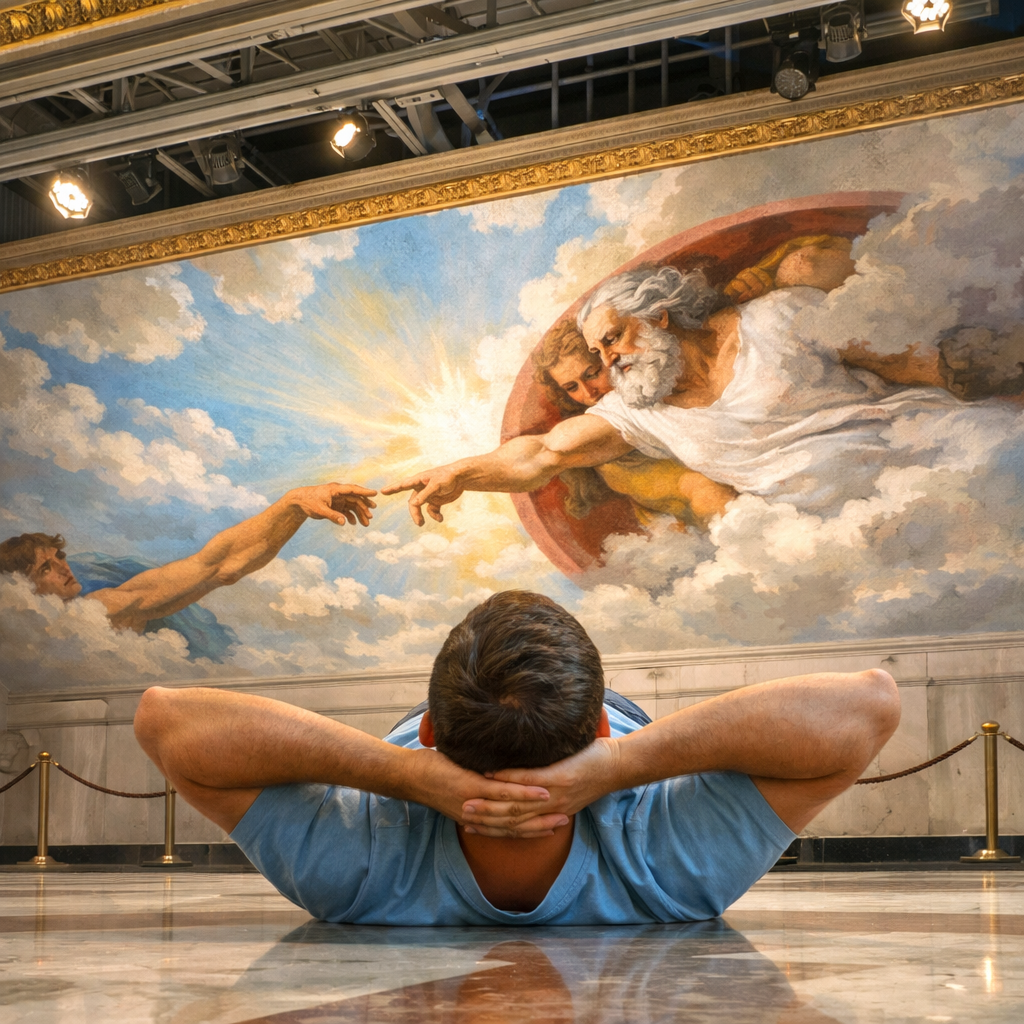
A man lies on the floor, staring up at heaven.
Light breaks through painted clouds. A hand reaches toward another — creation, divinity, meaning itself, captured in a single moment.

But from another angle, the sky is a ceiling. The divine is pigment. The gesture, for all its beauty, is human.

And the question for me, after two decades of fundamentalist Christianity, began there: have we been looking at our own creation all along?

If we look at everything that human beings have produced — art, language, moral codes, religion — God looks, in many ways, like our most sophisticated mirror. Literally every culture has invented (or discovered) some concept of a higher order: the ground of being, the ultimate judge, the cosmic parent. These images shift according to what any given society most needs or fears. In that sense, the God we talk about, the God with attributes, motives and commandments, is a human construction: a symbolic language for meaning, morality and mortality.

But that doesn’t automatically mean there is nothing beyond us. There’s a second, deeper question: whether our intuition that there is something conscious, ordering or transcendent that points to reality or whether it is simply an evolved illusion. Science can’t answer that question yet. What it can say is that mystical experience, moral intuition and awe all register in human brains as real and powerful phenomena. Whether they’re merely responses to something external or to our own depth is open.

If you push me personally, based on everything I’ve seen, read and experiences — I’d say this:

“What we call God may not be the source of our meaning, but the shape our need for meaning takes when we project it beyond ourselves.”

That’s not neutral. It’s a conviction that the word God is man-made, but the intuition behind it may be a genuine encounter with the structure of reality itself.

If there is something real behind the intuition of God, but it’s not a personal deity with emotions, commandments and preferences, then we have to rethink what faith, morality and meaning mean.

1. Ethically

Without a personal God, morality stops being obedience to an external authority and becomes alignment with reality itself.
If the “ground of being” is the structure out of which everything arises — consciousness, life, relationship — then to live morally is to live in harmony with that structure: honesty instead of delusion, compassion instead of domination, truth instead of manipulation.
Sin, in that framework, isn’t breaking divine rules; it’s acting against the grain of reality, damaging what is most real in ourselves and others.

2. Existentially

It removes the childish comfort of a sky-parent, but also the terror of divine punishment.
You can’t bargain with such a God; you can only participate in it.
Prayer becomes attention.
Worship becomes awe and gratitude.
Salvation becomes awakening: the recognition that you were never separate from the source to begin with.

3. Psychologically

Humans projected “God” outward because it’s hard to face the abyss of meaning and fear of death alone. But if the transcendent is immanent, built into consciousness itself, then our experience moves from obedience to discovery.
The “voice of God” becomes conscience, insight, intuition, the part of you that knows when you are betraying truth. That’s not delusion; it’s evolution giving us a compass.

4. Culturally

It explains why religions keep being both beautiful and dangerous. They are metaphors that became institutions — attempts to express the ineffable that hardened into dogma.
The task of a spiritually mature species might be to keep the poetry and let go of the literalism: to treat scripture as myth that reveals truth, not as truth that forbids doubt and causes division.

So:

If there is a real ground of being but no personal deity, then “God” is not Someone to worship but Something to wake up to.
The ethical life becomes an act of participation, not submission.
Heaven is clarity, not geography.

If we strip away the idea of a personal God but keep the intuition that there is a real ground of being, something that is truth, consciousness and life itself, then guilt, forgiveness and redemption become psychological-spiritual processes, not legal or supernatural ones.

1. Guilt

In this view, guilt isn’t a divine sentence; it’s the psyche’s alarm system.
It signals that you’ve moved out of alignment with what is real and life-affirming. When you deceive, harm, or instrumentalise others, you challenge your own coherence. The pain of guilt is not punishment but feedback: reality pushing you to restore integrity.

The problem is that most people either drown in guilt or silence it.
Religion often worsened that by turning guilt into debt, something owed to an external judge.
But in this framework, guilt is diagnostic, not damnatory.
You listen to it, trace it to its cause, and let it guide you back to truth.

2. Forgiveness

If there’s no divine being to forgive, then forgiveness must emerge within consciousness itself.
You can’t erase the past, but you can integrate it, see it truthfully, feel the pain, and let understanding dissolve the need for vengeance.
Forgiveness becomes a recognition of shared brokenness: that whoever harmed you (or whoever you harmed) was acting from ignorance, fear, or distortion.

Forgiving doesn’t mean excusing; it means releasing your identity as either the guilty or the victim.
You step out of the narrative of debt and punishment and into the reality that everyone is stumbling toward wholeness.

3. Redemption

Without a divine judge, redemption is not being declared clean — it’s becoming real again.
It’s the return to inner coherence after self-betrayal.
You redeem yourself by telling the truth, repairing what you can, and allowing compassion, not self-pity, to re-root you in reality.
It’s the same pattern you see in psychotherapy, art, confession, and love: the movement from concealment → exposure → integration.

4. The Shape of Grace

Even without a theistic God, something like “grace” still exists.
When you tell the truth, life has a way of meeting you with unexpected gentleness, not because someone decides to forgive you, but because truth itself is healing.
Reality is merciless with lies but merciful with honesty.

If you accept that, then the task of the guilty person is no longer to appease a deity but to become whole, to stop fragmenting themselves with denial.
And the task of the forgiver is not to absolve but to see: to understand enough that hatred dissolves into clarity.

Redemption isn’t about being declared innocent. It’s about becoming real again. The moment I stopped trying to defend the person I had been, something in me unclenched. The shards started fitting together, not into the old shape, but into something rougher, truer, almost beautiful in its fractures.

Grace, I realised, isn’t God sparing you. It’s reality allowing you to continue, to try again, to live in truth instead of illusion.

The glass doesn’t become clean; it becomes transparent. And through it, you see both your own reflection and the world beyond, no longer separate, no longer opposed.

We may never know whether there is something beyond us. But we can know this: the God we speak of bears an unmistakable human shape.

We painted the ceiling. We lay beneath it. And over time, we forgot that we had done so.

What remains is not emptiness, but a more difficult honesty: the possibility that meaning does not descend from above, but emerges from within, asking not for worship, but for a truth that is higher than faith.

“Theology is anthropology… the object of any subject is nothing else than the subject’s own nature taken objectively.”  – Ludwig Feuerbach
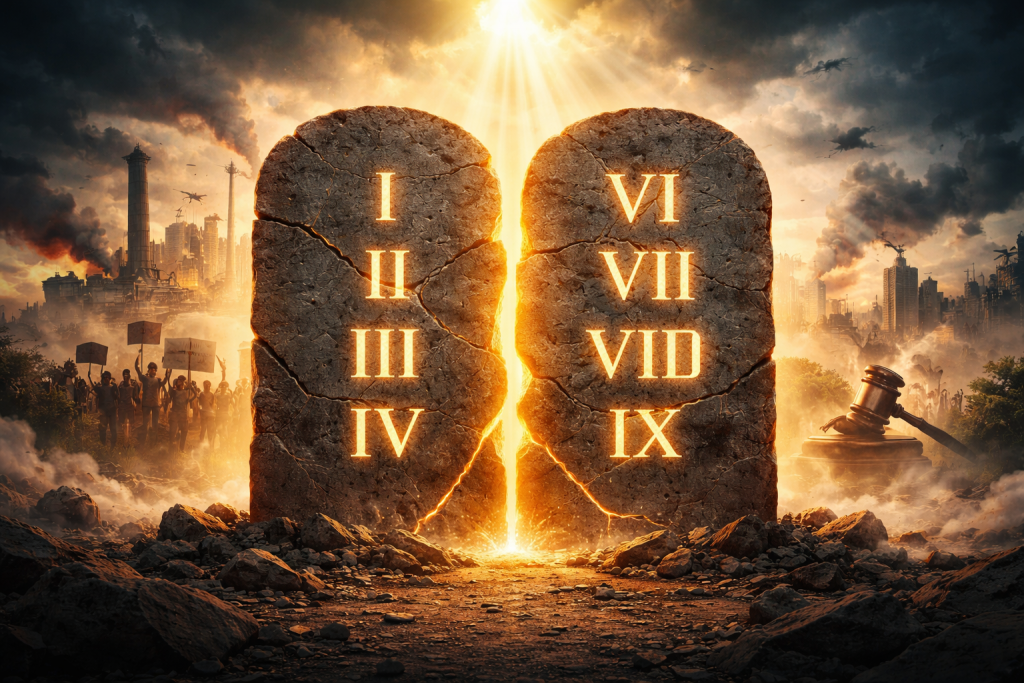
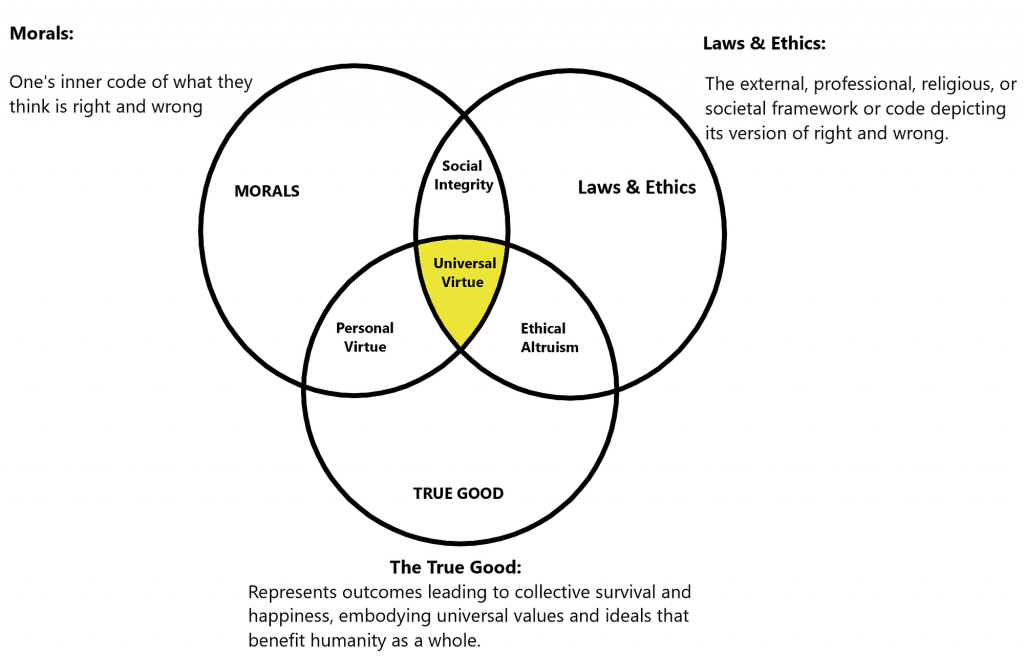
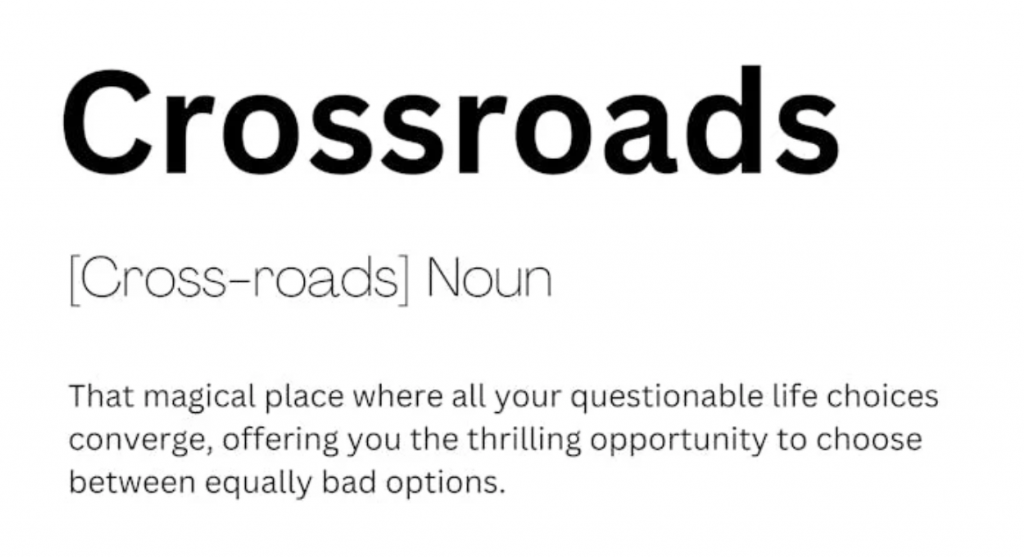
When breaking the law is the right thing to do

When Absolutes Meet Life: The Ten Commandments in a World of Grey Zones

Introduction: Granite Pillars, Shifting Ground

The Ten Commandments stand like granite pillars in the moral imagination of the West. Their clarity and simplicity — do not lie, do not steal, do not kill — promise a moral compass that transcends culture, time and circumstance.

Yet the moment we bring them into the tangle of real life, absolutes begin to rub against exceptions.

Take truth-telling: you shall not bear false witness. But if lying spares the hunted from a tyrant’s soldiers, can we still call it sin?

Or killing: you shall not murder. What of the soldier who fires not from hatred but to liberate, or the doctor who relieves excruciating suffering when life is otherwise ebbing away?

The commandments do not disappear. But they begin to bend under the weight of reality.

Where the Commandments Begin to Fracture

Each commandment, when examined closely, reveals a fault line:

    • Do not lie → What if a lie saves a life?
    • Do not kill → What about self-defence, war, euthanasia?
    • Do not steal → What if a starving person takes bread?
    • Honour your parents → What if they are abusive?
    • Keep the Sabbath → What if healing or survival requires breaking it?

Even the Hebrew scriptures acknowledge this tension:
David eats sacred bread when starving. Rahab lies and is praised.

The pattern is consistent: when strict obedience collides with human dignity, compassion begins to override rule.

Modern Grey Zones: Where Ethics Gets Uncomfortable

The ancient dilemmas have not disappeared. They have intensified.

1. Civil Disobedience and Tax Resistance

If citizens believe a war is unjust, are they morally obliged to fund it?

If millions refused to pay taxes in protest, would that be:

    • theft from the state?
    • or moral courage against injustice?

History complicates the answer. Figures like Gandhi and Martin Luther King Jr. framed civil disobedience not as lawlessness, but as obedience to a higher law.

Yet the danger is obvious: if everyone decides individually which laws to obey, social order collapses. So where is the line — between conscience and chaos?

2. State Policies and Human Life

Consider population control policies that have led, directly or indirectly, to the killing of female infants. Is this:

    • a utilitarian attempt to manage resources?
    • or a violation of the most basic moral law — the sanctity of life?

Here the commandment “do not kill” confronts the brutal logic of state planning.

3. Wealth, Environment, and Collective Harm

We do not steal — and yet entire economies extract from the planet in ways that may destroy future generations.

    • Is environmental destruction a form of theft from the unborn?
    • Does profit justify long-term harm?

The commandments were written for individuals.
But today, systems commit what individuals once did.

4. Truth in the Age of Power

“Do not bear false witness” once meant lying in court. Now it includes:

    • political disinformation
    • media manipulation
    • algorithmic distortion

When truth itself becomes a battlefield, the commandment remains, but its application becomes infinitely more complex.

A Personal Dilemma: When Every Commandment Collides

There was a moment when all of this ceased to be theoretical for me.

My mother came to visit me in Germany. At the airport, she was pushed over by an impatient passenger in one of those electric buggies. The fall seemed minor at the time, but it accelerated everything. Her health declined rapidly. Incontinence. Dementia. Depression.

Her GP made a suggestion. We could simulate a bladder infection. That would justify a hospital admission. From there, she would be transferred to a care home for short-term recovery — and, most likely, remain there long-term.

It would mean lying. It would mean manipulating the system. It would mean, in some sense, taking resources that were not strictly ours.

And yet the alternative was to watch her deteriorate without adequate care.

In that moment, the commandments did not line up neatly. They collided.

    • Do not lie — and yet the lie would open the door to care.
    • Do not steal — and yet the system existed precisely to care for the vulnerable.
    • Do not covet — and yet I envied those whose lives were not constrained by such responsibility.
    • Do not kill — and yet I felt flashes of rage toward the woman who had pushed her, a dark instinct that shocked me.

In the end, I followed the doctor’s advice.

My mother received excellent care. She lived for another seven years, safe, supported, and dignified in ways that would not otherwise have been possible.

Looking back, I still ask the question: was it right?

In the language of absolute rules, perhaps not.
In the language of lived reality, I believe it was.

And yet I cannot prove it was right.
I can only say that it was human.

The Real Question: Rules or Responsibility?

The deeper issue is not whether the commandments are right.

It is whether they can ever be applied without interpretation.

    • Absolute rules offer clarity.
    • Real life demands judgment.

Too much rigidity → cruelty in the name of morality.
Too much flexibility → chaos disguised as freedom.

We are left in tension.

A Different Way to Read the Commandments

Perhaps the commandments were never meant to function as rigid laws in every conceivable situation.

Perhaps they are moral directions rather than mechanical rules:

    • not “never lie,” but protect truth and trust
    • not “never kill,” but honour the sacredness of life
    • not “never steal,” but respect what belongs to others

In this reading, the spirit matters more than the letter.

But that raises a dangerous possibility: who decides what the “spirit” requires?

Between Fanaticism and Relativism

This is where modern ethics fractures into two extremes:

    • Fanaticism → rigid obedience, even when it harms
    • Relativism → anything can be justified

Neither is sufficient.

The real challenge is harder: to hold onto moral clarity without losing moral intelligence.

Conclusion: The Burden of Being Human

The commandments remain.

But they no longer stand untouched on distant stone tablets.
They stand within us — contested, interpreted, lived.

To be human is not simply to obey rules.
It is to carry the burden of deciding when, and how, they apply.

And that burden cannot be escaped.

Closing quotation

“He who fights with monsters should see to it that he himself does not become a monster… for when you gaze long into the abyss, the abyss gazes also into you.”
Friedrich Nietzsche

Social Media Bans for Under 16s

Why banning social media for under-16s may feel right — but fails to address the real issue

There is a growing political appetite to ban social media for under-16s. Governments in countries such as Australia and Indonesia have already moved in this direction, driven by rising concern about anxiety, depression, and the psychological effects of digital life.

The instinct is understandable. But it may also be wrong.

The comfort of the ban

A ban is politically attractive because it is clear, decisive and easy to communicate. It signals protection. It tells a worried public that something is being done.

But it also avoids a harder question.

Why has social media become so central to childhood in the first place?

Policy without evidence

The Cambridge psychologist Sander van der Linden has been unusually blunt. There is, he argues, “zero empirical evidence” that banning social media for teenagers improves outcomes.

His warning is not ideological but methodological:

“Blindly instituting wholesale bans for teens takes the ‘evidence’ out of evidence-based policy.”

This matters. Because once policy is driven primarily by anxiety, it becomes vulnerable to simplification.

And simplification is exactly what this issue does not need.

The variability problem

Social media does not affect all children in the same way.

For some, it amplifies vulnerability: comparison, exclusion, anxiety.
For others, it provides connection, identity and support. As well as of course access to information for school work.

The outcome depends on:

    • personality
    • patterns of use
    • existing mental health
    • social environment

A blanket ban assumes uniform harm where there is, in reality, radical variation.

The misdiagnosis

More fundamentally, a ban risks targeting the wrong thing.

The problem is not simply that children use social media. It is that social media have been designed to capture attention:

    • infinite scroll
    • algorithmic reinforcement
    • intermittent rewards

These are not neutral features. They are behavioural systems.

Yet instead of regulating the environment, we regulate the child.

We restrict the user because we do not confront the system.

The illusion of control

Even on practical grounds, bans are fragile.

    • Teenagers will bypass them
    • Peer groups will remain online
    • The demand for connection will persist
    • Evidence shows that the dangers are greater once hidden underground

The behaviour does not disappear. It relocates. More importantly, a ban does not teach navigation. It postpones exposure.

From protection to preparation

Van der Linden’s alternative is not permissiveness, but preparation:

    • early digital literacy
    • gradual exposure
    • critical thinking
    • resilience

In short:

Not protection through restriction, but protection through competence.

The question beneath the question

But even this may not be the deepest layer because the focus on social media obscures a more uncomfortable possibility.

Over recent decades, childhood has changed:

    • less independent movement
    • less unsupervised play
    • more adult control
    • more structured time

Children are safer, and yet less free.

We did not simply give children smartphones.
We removed much of the world they would otherwise have enjoyed.

Social media did not replace childhood.
In some respects, it stepped into a space that had already been narrowed.

Conclusion

The case for concern about social media is strong.
The case for banning it is not.

As Sander van der Linden argues, policy should be guided by evidence, not urgency or political posturing. At present, the evidence for bans is thin, while the complexity of the problem is substantial.

If we want children to spend less time online, we will have to do something more difficult than passing laws.

We will have to ask what kind of childhood we are willing to allow.

“Of all tyrannies, a tyranny sincerely exercised for the good of its victims may be the most oppressive.”              – C.S. Lewis

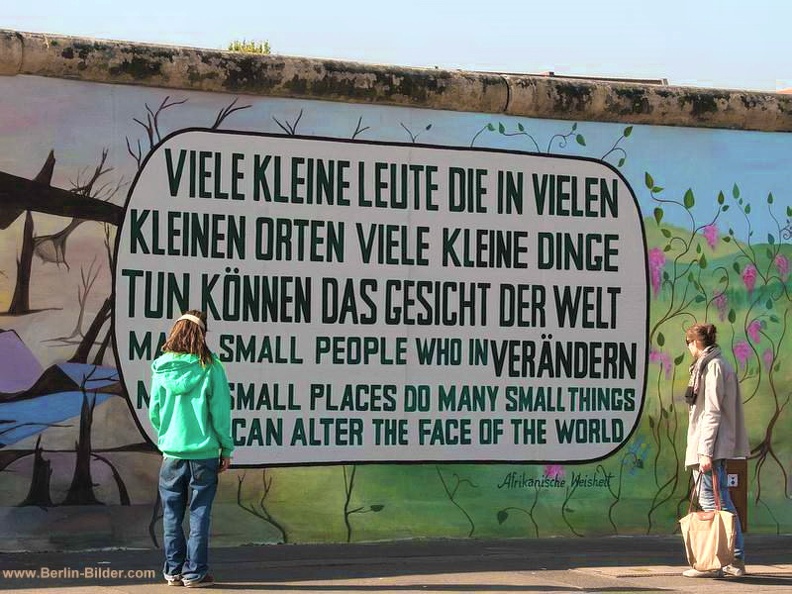
The Myth of Powerlessness

What one person cannot do alone — and what millions can still do together.

In a time of escalating global conflict and war, many people are asking the same question: what can one individual actually do?

Almost everyone I speak to says the same thing. On trains. In cafés. On the street. Among friends.

“Nothing.”

What can I do? I am one person. One voter. One consumer. One voice. The machine is too big. The war is too far away. The system is too entrenched.

It sounds like realism. But it is something closer to resignation.

At the time of writing, this is not an abstract question. The United States and Israel are engaged in a widening military campaign across Iran and the region, with consequences already extending into Lebanon and beyond. Civilian infrastructure has been hit. Escalation remains a real possibility. The language of expansion and power is no longer confined to the margins.

And yet, in the face of all this, the most common response remains the same: there is nothing I can do.

No one person can stop a war alone. That is true. But it does not follow that one person has nothing to do. It only means that conscience must become collective before it becomes consequential.

Every system of violence depends not only on leaders, generals, and ideologues, but on millions of smaller permissions: purchases, habits, silences, career calculations, and the daily decision to do nothing because doing something feels futile. That is where power really sits.

We do not have to look far, in my adotped country, to see both what passive compliance can enable and what collective refusal can undo.

Where pressure comes from

We tend to imagine power as something distant: governments, armies, corporations. And of course, it is. But it is also embedded in the ordinary flows that sustain those systems: money, attention, legitimacy, cooperation.

Remove enough of those, and even large structures begin to strain.

As Charles Eisenstein has argued, modern systems are often more fragile than they appear. Confidence depends on participation. Withdraw participation at scale, and the system feels it.

The point is not that one person can bring about collapse. The point is that systems depend on millions of people continuing to cooperate. Which means that non-cooperation matters too.

Not expression, but leverage

Much of what passes for protest today is expressive. It allows us to signal disapproval, to feel aligned, to release moral tension. But expression is not the same as pressure.

Pressure is slower, less visible, and more demanding. It involves changing behaviour, not just declaring opinion. It involves cost.

If anything is to change, the question is not what we feel, but what we are prepared to do differently.

What can actually be done

None of what follows is dramatic. That is precisely the point. These are actions available to ordinary people, within the law, that become powerful only when they are repeated, shared, and sustained.

Speak clearly

Not “this is terrible.” Say what you oppose, what you want changed, and who has the power to act. Silence is easy to ignore. Clarity is not.

Write, then write again

One message can be dismissed. Patterns cannot. Ask for a position, not a platitude. Follow up.

Use money deliberately

Reconsider where you bank. Review what your investments support. Cancel subscriptions tied to companies you wish to avoid. Move spending where you can. Systems built on constant inflow notice outflow.

Recently, after 20 years of brand loyalty, I shut down my Apple eco-system. I now use European-based Proton Mail, Calendar and Drive and I write using Linux Mint and open source software. I’ve discovered that I am not alone.

Boycott with focus

Vague refusal achieves little. Targeted, visible refusal accumulates. Choose specific companies or sectors. Be consistent. Make your reasons public.

Pressure the institutions around you

Your university, your workplace, your church, your professional body. Ask what they fund, who they partner with, what position they take.

Institutions prefer neutrality. Pressure forces articulation.

Organise—and keep going

Movements rarely begin large. They begin with a handful of people who decide to act together and to continue acting.

Continuity matters more than size.

Show up

Demonstrations are not sufficient, but they are not meaningless. Presence, visibility, repetition—these change the atmosphere in which decisions are made.

Support truth and relief

Support serious journalism, legal work and humanitarian organisations. Wars continue more easily when they are obscured.

Turn agreement into action

Agreement has no effect until it is organised. Exchange names. Set a date. Do one thing. Repeat.

What this requires

None of this is easy.

It requires persistence rather than intensity. Discipline rather than outrage. Coordination rather than isolation.

It also requires something else: the refusal to adopt the logic of the thing one opposes.

If protest becomes only anger, only dehumanisation, only the search for enemies, it begins to mirror the structure it resists. The aim is not to reverse roles within the same system, but to alter the system itself.

It is easier to argue about geopolitics than to examine the small ways in which we continue to cooperate with it.

That is slower work. But it is more durable.

Conclusion

No one person can stop a war.

But wars do not continue by themselves. They continue because millions of ordinary people, in thousands of small ways, continue to cooperate with the systems that sustain them.

Withdraw enough of that cooperation — financially, politically, socially, publicly — and pressure begins to build.

The question is not whether you can do everything.

It is whether you are willing to do something.

And whether enough of us are willing to do it together.

“The sad truth is that most evil is done by people who never make up their minds to be either good or evil.”
Hannah Arendt