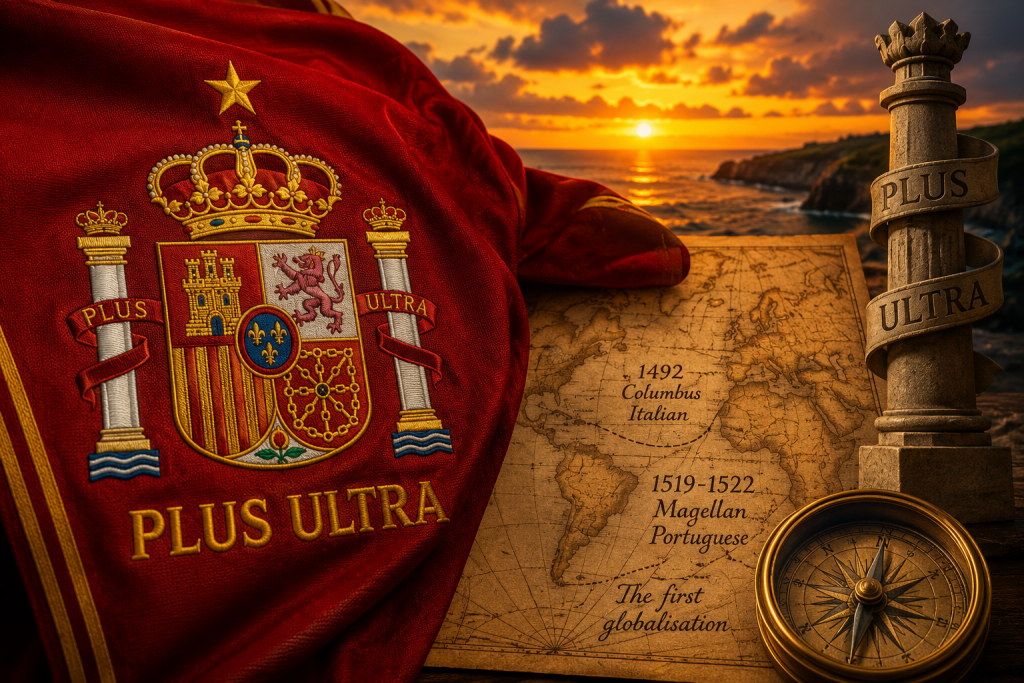
I recently bought a Spanish football shirt to wear at a bar while watching Spain’s 3:0 win against Austria on Thursday.
That simple purchase unexpectedly led me down one of the most fascinating rabbit holes I have explored in a while.
It began with two Latin words embroidered on Spain’s coat of arms: Plus Ultra.
I knew from my school-Latin what the words meant, further beyond, but I still needed some context to understand the meaning.
A little research revealed that they are a reference to the Pillars of Hercules at the Strait of Gibraltar. For the ancient world, these marked the edge of the known earth. The old warning was “Non Plus Ultra” — nothing lies beyond.
Then came the voyages of exploration.
The warning became an invitation.
There was indeed more beyond.
That discovery prompted another question.
Christopher Columbus sailed for Spain. Yet I vaguely remembered reading somewhere that he was Italian. Was that right?
It was. I kept digging.
Born in Genoa, Columbus spent years trying to persuade different European rulers to finance his ambitious plan to reach Asia by sailing west. It was only when the Spanish Crown agreed to back him that history changed forever.
Then I discovered something even more surprising.
Ferdinand Magellan, whose expedition first circumnavigated the globe, wasn’t Spanish either. He was Portuguese. And he himself was killed in the Philippines before the expedition was completed.
Like Columbus, he simply happened to be sailing under the Spanish flag.
As I kept digging, I also learnt for the first time why America is called America and why the Pacific is called the Pacific. I learnt why Brazil speaks Portuguese while much of South America speaks Spanish, why Spain became one of history’s great global powers, how its sudden enormous wealth became a resource curse, and, most strikingly of all, how all these historical facts are mirrored in the events happening in the world today.
By now, all this led to another kind of question:
Why was I only learning this as I approach retirement?
None of these are obscure historical curiosities.
They explain the world we live in.
The more I thought about it, the more I realised that perhaps history has often been taught backwards.
Schools understandably devote considerable attention to national history. In Britain, we studied the Tudors, the Industrial Revolution and the Second World War. In Germany, where I spent many years teaching, National Socialism understandably occupies a central place throughout secondary education.
These are all profoundly important topics.
But too often history becomes an exercise in remembering names, dates, battles and treaties.
The examination rewards recall.
Real understanding often comes later.
History is not simply the story of what happened.
History can be the highly relevant explanation of why today’s world looks the way it does.
Why does almost an entire continent speak Spanish?
Why is Brazil different?
Why was Córdoba (Spain) once much bigger and more important than London?
Why are Europe and Latin America still so culturally intertwined?
Why and how did globalisation begin centuries before the Internet?
Those are historical questions too.
They just happen to illuminate the present rather than merely describe the past.
While I was training teachers at the University of Sussex, one of the finest history lessons I have ever witnessed contained almost no conventional history.
The young trainee teacher warned parents in advance that the lesson would be unusual.
She darkened the classroom. She played the sound of air-raid sirens followed by distant explosions. Beforehand, she asked the children to climb underneath their desks and lie silently on the floor with their eyes closed.
For several minutes they simply listened.
Afterwards she asked them to write, not about dates, military strategy or political leaders, but about how they had felt.
For a brief moment, those children had experienced uncertainty, vulnerability and fear. Not the reality of war, of course, but enough to begin imagining what it might feel like to be a child living through one.
I have forgotten countless historical dates since leaving school. I have never forgotten that lesson.
Nor, I suspect, have the children who experienced it.
That teacher wasn’t merely teaching history.
She was teaching empathy and vividly demonstrating how history is so relevant to life in the 21st Century.
As I have grown older, I find myself increasingly drawn to education that asks questions rather than rewards memorisation.
The same thought has appeared repeatedly in my recent writing about economics.
Financial literacy is not really about memorising definitions.
It is about understanding why economies behave as they do.
Likewise, history should not simply teach us to remember what happened.
It should help us understand why our world became what it is.
Perhaps that is why I have found these discoveries in Spain so unexpectedly exciting.
I wasn’t simply learning historical facts.
I was discovering connections.
The voyages of Columbus and Magellan were not isolated adventures.
They marked the beginning of the first great wave of globalisation.
Trade routes expanded.
Ideas travelled.
Plants, animals, diseases and cultures crossed oceans.
The Mediterranean outside my window here was once dry land – another fact I was unaware of. It is only thanks to the Zanclean Flood that water entered from the Atlantic through the Strait of Gibraltar and opened up the possibility of a future global trade highway.
The world became permanently interconnected.
Five centuries later we are still living with the consequences.
History also reminds us that no civilisation remains permanently at the top.
Sometimes I wonder whether schools unintentionally leave us with the impression that education ends when we pass our examinations.
In reality, the opposite is true.
The most rewarding learning often begins afterwards.
It begins when curiosity replaces obligation.
When we are no longer asking, “Will this be in the exam?”
Instead we ask, “Why did nobody ever explain this?”
Perhaps that is the real purpose of education.
Not to fill our minds with information.
But to awaken a curiosity that lasts for the rest of our lives.
“The real voyage of discovery consists not in seeking new landscapes, but in having new eyes.”
— Marcel Proust