Why Did Nobody Teach Me This at School?

What history should really teach
How a Spanish football shirt unexpectedly changed the way I think about history, education and the origins of our globalised world.

I recently bought a Spanish football shirt to wear at a bar while watching Spain’s 3:0 win against Austria on Thursday.

That simple purchase unexpectedly led me down one of the most fascinating rabbit holes I have explored in a while.

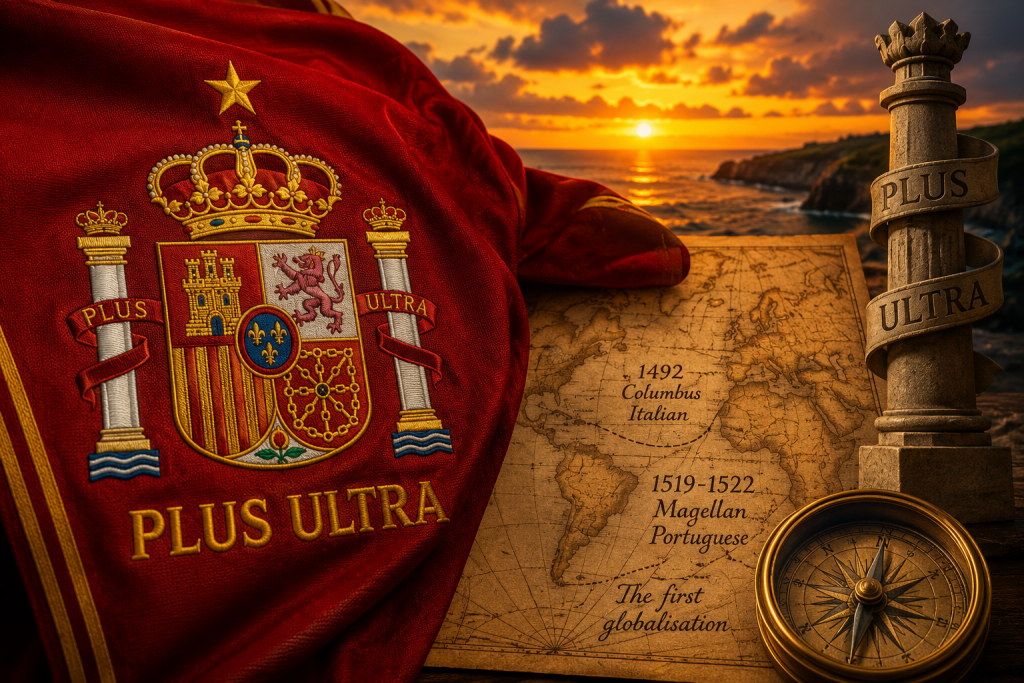
It began with two Latin words embroidered on Spain’s coat of arms: Plus Ultra.

I knew from my school-Latin what the words meant, further beyond, but I still needed some context to understand the meaning.

A little research revealed that they are a reference to the Pillars of Hercules at the Strait of Gibraltar. For the ancient world, these marked the edge of the known earth. The old warning was “Non Plus Ultra” nothing lies beyond.

Then came the voyages of exploration.

The warning became an invitation.

There was indeed more beyond.

That discovery prompted another question.

Christopher Columbus sailed for Spain. Yet I vaguely remembered reading somewhere that he was Italian. Was that right?

It was. I kept digging.

Born in Genoa, Columbus spent years trying to persuade different European rulers to finance his ambitious plan to reach Asia by sailing west. It was only when the Spanish Crown agreed to back him that history changed forever.

Then I discovered something even more surprising.

Ferdinand Magellan, whose expedition first circumnavigated the globe, wasn’t Spanish either. He was Portuguese. And he himself was killed in the Philippines before the expedition was completed.

Like Columbus, he simply happened to be sailing under the Spanish flag.

As I kept digging, I also learnt for the first time why America is called America and why the Pacific is called the Pacific. I learnt why Brazil speaks Portuguese while much of South America speaks Spanish, why Spain became one of history’s great global powers, how its sudden enormous wealth became a resource curse, and, most strikingly of all, how all these historical facts are mirrored in the events happening in the world today.

By now, all this led to another kind of question:

Why was I only learning this as I approach retirement?

None of these are obscure historical curiosities.

They explain the world we live in.


The more I thought about it, the more I realised that perhaps history has often been taught backwards.

Schools understandably devote considerable attention to national history. In Britain, we studied the Tudors, the Industrial Revolution and the Second World War. In Germany, where I spent many years teaching, National Socialism understandably occupies a central place throughout secondary education.

These are all profoundly important topics.

But too often history becomes an exercise in remembering names, dates, battles and treaties.

The examination rewards recall.

Real understanding often comes later.

History is not simply the story of what happened.

History can be the highly relevant explanation of why today’s world looks the way it does.

Why does almost an entire continent speak Spanish?

Why is Brazil different?

Why was Córdoba (Spain) once much bigger and more important than London?

Why are Europe and Latin America still so culturally intertwined?

Why and how did globalisation begin centuries before the Internet?

Those are historical questions too.

They just happen to illuminate the present rather than merely describe the past.


While I was training teachers at the University of Sussex, one of the finest history lessons I have ever witnessed contained almost no conventional history.

The young trainee teacher warned parents in advance that the lesson would be unusual.

She darkened the classroom. She played the sound of air-raid sirens followed by distant explosions. Beforehand, she asked the children to climb underneath their desks and lie silently on the floor with their eyes closed.

For several minutes they simply listened.

Afterwards she asked them to write, not about dates, military strategy or political leaders, but about how they had felt.

For a brief moment, those children had experienced uncertainty, vulnerability and fear. Not the reality of war, of course, but enough to begin imagining what it might feel like to be a child living through one.

I have forgotten countless historical dates since leaving school. I have never forgotten that lesson.

Nor, I suspect, have the children who experienced it.

That teacher wasn’t merely teaching history.

She was teaching empathy and vividly demonstrating how history is so relevant to life in the 21st Century.


As I have grown older, I find myself increasingly drawn to education that asks questions rather than rewards memorisation.

The same thought has appeared repeatedly in my recent writing about economics.

Financial literacy is not really about memorising definitions.

It is about understanding why economies behave as they do.

Likewise, history should not simply teach us to remember what happened.

It should help us understand why our world became what it is.

Perhaps that is why I have found these discoveries in Spain so unexpectedly exciting.

I wasn’t simply learning historical facts.

I was discovering connections.

The voyages of Columbus and Magellan were not isolated adventures.

They marked the beginning of the first great wave of globalisation.

Trade routes expanded.

Ideas travelled.

Plants, animals, diseases and cultures crossed oceans.

The Mediterranean outside my window here was once dry land – another fact I was unaware of. It is only thanks to the Zanclean Flood that water entered from the Atlantic through the Strait of Gibraltar and opened up the possibility of a future global trade highway.

The world became permanently interconnected.

Five centuries later we are still living with the consequences.

History also reminds us that no civilisation remains permanently at the top.


Sometimes I wonder whether schools unintentionally leave us with the impression that education ends when we pass our examinations.

In reality, the opposite is true.

The most rewarding learning often begins afterwards.

It begins when curiosity replaces obligation.

When we are no longer asking, “Will this be in the exam?”

Instead we ask, “Why did nobody ever explain this?”

Perhaps that is the real purpose of education.

Not to fill our minds with information.

But to awaken a curiosity that lasts for the rest of our lives.

“The real voyage of discovery consists not in seeking new landscapes, but in having new eyes.”
— Marcel Proust
The Seven Economic Myths We Tell Ourselves

Seven economic myths we tell ourselves

Last week I questioned whether our current school curriculum provides us with the knowledge we require for handling money during our adult life. This week I’d like to look at seven common economic myths I consequently grew up with that, I believe, should be examined by students in today’s education system.

Economics is often presented as a science of numbers. We hear about growth rates, inflation figures, government debt and stock market performance. Experts produce graphs. Politicians quote statistics. Journalists report percentages.

Yet much of our thinking about economics is not based on facts. We inherit economic beliefs in much the same way that we inherit religious beliefs, political loyalties, or assumptions about human nature. They become part of our mental furniture. We rarely examine them. We simply assume they are true.

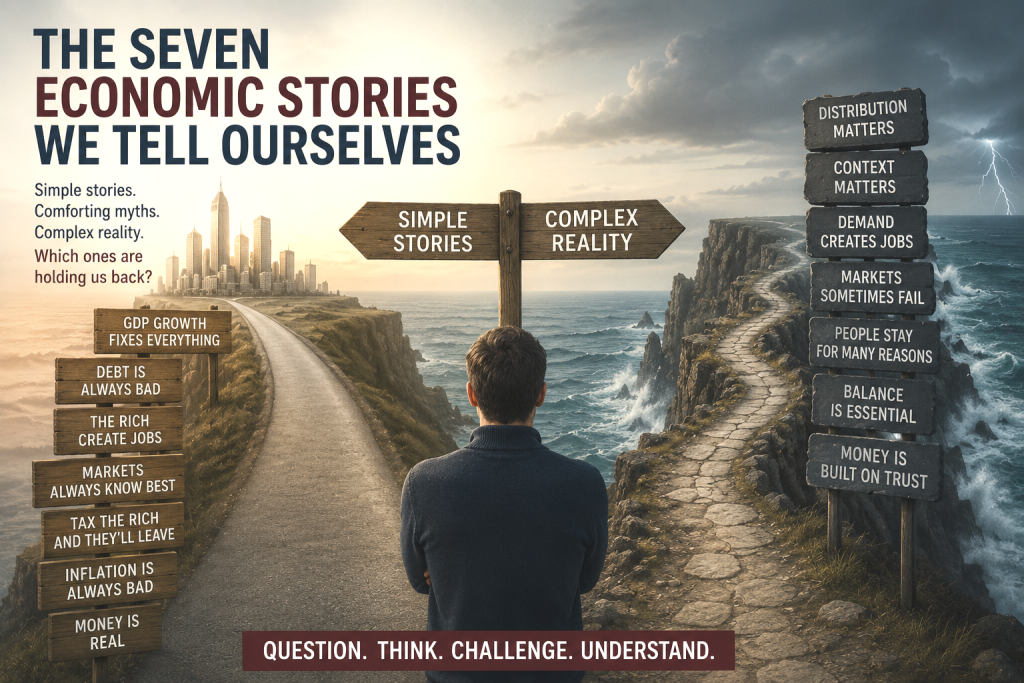
Here are seven economic stories many of us have been taught to believe.

Myth No. 1. If GDP Is Growing, Everything Must Be Fine

One of the most common assumptions is that economic growth automatically means social progress. If the Gross Domestic Product is increasing, politicians congratulate themselves, commentators celebrate and newspapers announce that the economy is doing well.

But there is an obvious question that often goes unasked: doing well for whom?

GDP measures economic activity. It measures production. It tells us how much a country produces and sells. What it does not tell us is how that wealth is distributed or whether ordinary people are benefiting from it.

A nation can have impressive growth while housing becomes unaffordable, public services deteriorate and large sections of the population struggle to make ends meet.

As a former teacher, I sometimes compare GDP with examination results. A school may improve its statistics while becoming a worse place to learn. The numbers can look impressive while something essential is being lost.

The same is true of nations. Economic growth matters, but it is not the same thing as human flourishing.

Myth No. 2. Debt Is Always Bad

Most of us are taught to fear debt. For individuals, that is often sensible. Excessive borrowing can destroy lives. It can create stress, dependency and hardship. Yet not all debt is the same.

A mortgage, a student loan or a business investment is different from borrowing money to fund reckless consumption. One creates future value; the other merely brings tomorrow’s spending into today.

The same principle applies to governments. When a state borrows to invest in education, infrastructure, scientific research or healthcare, it may be creating assets that benefit future generations. The question is not whether debt exists, but whether the borrowing is productive and sustainable.

The most successful economies in the world often carry substantial public debt. What matters is not the existence of debt itself, but the wisdom with which it is used.

Myth No. 3. The Rich Create Jobs

This idea appears so frequently in political debate that many people accept it without question. There is, of course, some truth in it. Entrepreneurs create businesses. Businesses employ people. Investment can stimulate growth. But the story is incomplete.

Businesses do not hire employees simply because their owners are wealthy. They hire employees because there is demand for their products and services. A restaurant expands because customers fill its tables. A manufacturer recruits workers because orders are increasing. A shop hires staff because people are buying what it sells.

In other words, jobs are not created by wealth alone. They are created by economic activity. Moreover, much employment comes not from billionaires or multinational corporations, but from small and medium-sized businesses. Across Europe, countless family businesses, local shops, tradespeople and self-employed entrepreneurs collectively employ millions of people.

The real engine of employment is not wealth itself but a healthy and active economy.

Myth No. 4. Markets Always Know Best

For some people, the market has become almost a secular religion. The argument is familiar. Left alone, markets allocate resources efficiently. Government intervention merely creates distortions and stunts economic growth.

There is certainly some truth in this. Competitive markets can be remarkably effective. They often encourage innovation, efficiency and consumer choice. But markets are not infallible.

Consider healthcare. If access to medical treatment depends entirely upon ability to pay, many vulnerable people will be excluded.

Consider environmental protection. Businesses may profit by passing environmental costs onto society as a whole. Pollution becomes someone else’s problem.

Economists even have a term for these situations: market failures.

The reality is that markets and governments each have strengths and weaknesses. Mature societies require both. The challenge is not choosing one over the other, but finding the right balance between them.

Whenever someone insists that the answer is always more market or always more state, I become suspicious. Human societies are rarely that simple.

Myth No. 5. If You Tax the Rich, They Will Leave

This argument appears whenever tax reform is proposed. Raise taxes on wealthy individuals, we are told, and they will immediately pack their bags and move elsewhere.

At first glance, the claim seems plausible. Yet people are not spreadsheets.

Human beings make decisions based on family, friendships, culture, language, quality of life, security and belonging. Financial considerations matter, but they are rarely the only consideration.

Countries such as Norway, Sweden and Denmark have maintained relatively high levels of taxation while remaining prosperous, innovative and attractive places to live.

This does not mean taxes can be increased without limit. Excessive taxation can certainly discourage investment and entrepreneurship.

The point is simply that reality is more nuanced than political slogans suggest.

People stay for many reasons. They leave for many reasons. Tax is only one factor among many.

Myth No. 6. Inflation Is Always Bad

The word inflation usually arrives wrapped in anxiety. We hear that prices are rising and immediately assume disaster.

Certainly, high inflation can be deeply damaging. It erodes savings, creates uncertainty and hits those on lower incomes particularly hard. Yet economists generally do not aim for zero inflation.

A modest level of inflation is usually considered healthy because it reflects a growing economy. It encourages spending, investment and economic activity.

What is often forgotten is that the opposite problem can be equally dangerous.

If prices continually fall, people postpone purchases. Why buy today if everything will be cheaper tomorrow? Businesses then sell less, investment slows and unemployment may rise.

Like many things in life, the issue is not inflation versus no inflation. It is balance. Too much inflation can be destructive. Too little can be equally problematic.

Myth No. 7. Money Is Real

This final myth is my favourite because it takes us beyond economics and into philosophy.

Most of us think of money as something solid and tangible. We earn it, spend it, save it and worry about it. Yet money possesses no intrinsic value.

A fifty-euro note is merely paper. The number displayed in your bank account is simply a digital record stored on a computer somewhere.

Money works because we collectively believe it works. Its value depends upon trust.

This is not as strange as it sounds. Much of human civilisation rests upon shared beliefs. Nations exist because enough people believe they exist. Laws function because people collectively accept their legitimacy. Companies, universities and governments all depend upon systems of shared trust.

Money is one of humanity’s most successful collective stories. That does not make it imaginary. It makes it a social construct, like any other.

And perhaps that is one of the most important lessons economics can teach us.

If only I’d known in my twenties what I know now

If there is a lesson I wish somebody had taught me when I was starting out, it is that wealth is rarely built through cleverness alone. Looking back, the people who seem to achieve financial security are often not the most intelligent, the most educated or even the highest earners.

They are the people who consistently do a few simple things well.

    • They spend less than they earn
    • They avoid unnecessary debt
    • They acquire productive assets
    • They diversify their investment portfolio
    • They think long term
    • And above all, they allow time and compounding to work their quiet magic.

Perhaps that is the greatest economic lesson of all. Not that there are easy answers. But that small, sensible decisions repeated over decades are often more powerful than brilliant ideas pursued for a few months.

Beyond Economics

The purpose of examining these myths is not to replace one certainty with another.

It is to become more cautious whenever someone offers a simple explanation for a complicated problem.

Economic debates are often presented as battles between truth and error, between common sense and foolishness, between left and right. Reality is usually less satisfying.

The older I become, the less interested I am in certainty and the more interested I am in questions.

    • Who benefits from economic growth?
    • What kind of debt creates value?
    • When do markets work well, and when do they fail?
    • How much inequality can a society tolerate before trust begins to erode?

And perhaps most intriguingly of all: what other things do we collectively believe in that are no less dependent on faith than money itself?

Economics turns out to be about far more than money.

It is about human beings and the stories we tell ourselves about how society works.

The test of a first-rate intelligence is the ability to hold two opposed ideas in mind at the same time and still retain the ability to function.

— F. Scott Fitzgerald

 

Social Media Bans for Under 16s

Why banning social media for under-16s may feel right — but fails to address the real issue

There is a growing political appetite to ban social media for under-16s. Governments in countries such as Australia and Indonesia have already moved in this direction, driven by rising concern about anxiety, depression, and the psychological effects of digital life.

The instinct is understandable. But it may also be wrong.

The comfort of the ban

A ban is politically attractive because it is clear, decisive and easy to communicate. It signals protection. It tells a worried public that something is being done.

But it also avoids a harder question.

Why has social media become so central to childhood in the first place?

Policy without evidence

The Cambridge psychologist Sander van der Linden has been unusually blunt. There is, he argues, “zero empirical evidence” that banning social media for teenagers improves outcomes.

His warning is not ideological but methodological:

“Blindly instituting wholesale bans for teens takes the ‘evidence’ out of evidence-based policy.”

This matters. Because once policy is driven primarily by anxiety, it becomes vulnerable to simplification.

And simplification is exactly what this issue does not need.

The variability problem

Social media does not affect all children in the same way.

For some, it amplifies vulnerability: comparison, exclusion, anxiety.
For others, it provides connection, identity and support. As well as of course access to information for school work.

The outcome depends on:

    • personality
    • patterns of use
    • existing mental health
    • social environment

A blanket ban assumes uniform harm where there is, in reality, radical variation.

The misdiagnosis

More fundamentally, a ban risks targeting the wrong thing.

The problem is not simply that children use social media. It is that social media have been designed to capture attention:

    • infinite scroll
    • algorithmic reinforcement
    • intermittent rewards

These are not neutral features. They are behavioural systems.

Yet instead of regulating the environment, we regulate the child.

We restrict the user because we do not confront the system.

The illusion of control

Even on practical grounds, bans are fragile.

    • Teenagers will bypass them
    • Peer groups will remain online
    • The demand for connection will persist
    • Evidence shows that the dangers are greater once hidden underground

The behaviour does not disappear. It relocates. More importantly, a ban does not teach navigation. It postpones exposure.

From protection to preparation

Van der Linden’s alternative is not permissiveness, but preparation:

    • early digital literacy
    • gradual exposure
    • critical thinking
    • resilience

In short:

Not protection through restriction, but protection through competence.

The question beneath the question

But even this may not be the deepest layer because the focus on social media obscures a more uncomfortable possibility.

Over recent decades, childhood has changed:

    • less independent movement
    • less unsupervised play
    • more adult control
    • more structured time

Children are safer, and yet less free.

We did not simply give children smartphones.
We removed much of the world they would otherwise have enjoyed.

Social media did not replace childhood.
In some respects, it stepped into a space that had already been narrowed.

Conclusion

The case for concern about social media is strong.
The case for banning it is not.

As Sander van der Linden argues, policy should be guided by evidence, not urgency or political posturing. At present, the evidence for bans is thin, while the complexity of the problem is substantial.

If we want children to spend less time online, we will have to do something more difficult than passing laws.

We will have to ask what kind of childhood we are willing to allow.

“Of all tyrannies, a tyranny sincerely exercised for the good of its victims may be the most oppressive.”              – C.S. Lewis

Cathedrals of Quiet Light: An Homage to Libraries

I did not expect a pilgrimage. All I wanted, on a cold Berlin morning, was a simple desk in my local library. A familiar refuge where I could coax myself into writing. Instead, I arrived to find the doors barred and the building shrouded in scaffolding. Closed for refurbishment. And yet even that felt oddly hopeful: a library being tended to, repaired, protected. A chrysalis in plywood. Still, it left me homeless for the day, so I pointed myself into the centre of Berlin and followed a vague instinct in search of a different reading room.

By early afternoon I was standing inside the Humboldt University Library, in the central Jacob-und-Wilhelm-Grimm-Zentrum — a building completed in 2009 at a cost of roughly €150 million, a temple to light and linearity, a modern cathedral carved out of honey-coloured wood. I had never been inside before. I found my way up several flights of stairs, past quiet students and moving columns of books, until I arrived in the library’s great central atrium.

There are moments when atmosphere becomes an event, as if the air thickens with meaning, as though the space itself has a pulse. That is what happened. The first glance into the atrium felt like encountering a new idea before you have the words for it.

The room opened before me in tiers, receding downwards in vast wooden frames, each level lined with narrow study desks illuminated by soft rectangular lamps. Above, the ceiling dissolved into a grid of skylights, a geometry of glass and daylight. Below, hundreds of young people bent over books and laptops, headphones cocooning them, highlighters poised like tiny torches hunting for truth in margins. It was an amphitheatre of thought, tier upon tier of silent striving, human concentration arranged like an inverted ziggurat.

The sight moved me more than I had anticipated. I had often studied in the ancient libraries of Oxford, with their stone floors worn by centuries of scholars and portraits of stern-faced alumni glaring down with a mixture of judgement and encouragement. But this — this modern Berlin chamber with its clean lines and its open light — held its own kind of splendour. If Oxford’s libraries feel like the weight of the past pressing lovingly upon you, the Grimm-Zentrum feels like the future stretching out somewhere beyond the roof.

And suddenly I felt small and young again, in the most wonderful way.


A Place Where the World Learns How to Think

What struck me first was the sound — or rather, the absence of it. The quiet in a library is not mere silence. It is a collective agreement, a social pact, a voluntary reverence. The students around me were not quiet because they were told to be. They were quiet because they were invested. Because something mattered.

Then came the smell — that unmistakable perfume of libraries everywhere:
waxed linoleum; varnished wood; warm dust that rises from the turning of pages; and above all that distinctive scent of old books, a mixture of paper, glue, ink, and time itself. It carries, always, a faint edge of mystery – a reminder that knowledge ages like a living thing.

As I sat down on the highest tier, overlooking this incredible geometry of minds at work, it occurred to me that libraries are among the few places left in modern life where human concentration is visible. We watch it manifest physically: in posture, in scribbles, in slow-page turns, in the absorbed stillness of someone who is trying to understand.

The atmosphere was electric but hushed, charged but respectful. There were students mapping out theses with coloured pens, others scrolling through academic articles, some chewing their pens absentmindedly while staring into middle distance — that universal gesture of a mind wrestling with a concept. There were those who looked exhausted but determined, and others who looked exhilarated by a sentence they had just discovered. Every face was a small story of effort.

This collective striving was profoundly moving. It made visible something we often forget: knowledge is crafted, not downloaded. Even with all the technology around them, these students were still doing the slow, patient work that makes civilisation possible. Research is not glamorous. It is hours of searching, scanning, discarding, re-reading. Yet they persisted.

Watching them, I felt privileged — almost intrusive — as though I were witnessing a kind of secular liturgy.


This Is Not an Anti-AI Eulogy. Quite the Opposite.

Let me say this clearly, and early, because sentiments like mine are often misinterpreted: this is not a rear-guard lament against AI.
No pious calls to return to pre-digital methods. No false nostalgia. No technophobia.

I embrace AI wholeheartedly. I use it every day, and I consider it one of the most extraordinary tools ever created. It accelerates learning, supports human creativity, and holds vast potential for everything from agriculture to medicine to interplanetary exploration. It will help build the colonies on Mars long before we finish debating whether rocket fuel is environmentally friendly.

So this reflection is not a plea for a world without technology. It is instead an attempt to articulate something different: that libraries and AI are not adversaries.
They are partners.
One is where the human mind trains its depth; the other is where it extends its reach.

Libraries teach us how to think.
AI helps us learn faster once we know how.

The library is the gymnasium of cognition.
AI is the exoskeleton.

We need both.


A Secular Temple — or Something More

As I sat in the top tier of that atrium, I realised that all my senses were activated at once: sight, sound, smell, touch, and the quiet murmur of pages turning like a heartbeat for the whole building. It was almost too much. It bordered on the religious.

If you believe in God, you could easily imagine gratitude rising like incense: look what humanity — the species fashioned out of dust and breath — has managed to build. Look how our curiosity has unfolded into architecture, scholarship, craft, and a hunger for understanding that seems inexhaustible.

If you do not believe in God, the miracle remains.
After all, what could be more astonishing than this? That the random electrical impulses arising from an indifferent universe have generated organisms who sit together in vast wooden halls reading about Mesopotamia, quantum mechanics, marine ecosystems, political philosophy, medieval manuscripts, and machine learning algorithms. That atoms born in supernovae now write essays on ethics and the shape of a meaningful life.

Even the most hardened atheist cannot deny the improbability, the majesty of that.

To sit in a library is to witness a miracle in motion — a civilisation rehearsing its own continuation.


The Invisible People Who Make It Possible

It is easy, in moments of beauty, to forget the infrastructure that supports them. But libraries are not spontaneous miracles. They are daily, deliberate acts of civic generosity.

Someone designed this building with its lightwells, its tiers, its acoustics, its quiet. Someone else built it, brick by brick, panel by panel. Others maintain it, polish the floors, fix the lamps, organise the recycling, restock the bathrooms, oil the doors so they close softly.

Then there are the librarians, the custodians of order in our age of chaos. The ones who curate, classify, preserve, and patiently help bewildered visitors locate that one book whose title they have partially forgotten. They are the guardians of continuity, the keepers of fragments, the quiet historians of our intellectual life.

Yesterday, I watched a librarian register new readers at the desk. One of them was me. The young man helping me was in his early twenties, wearing a university hoodie, and fascinated by my British passport. He asked why the text was printed both in English and French. He was curious about British attitudes to Europe, about why I had come to Berlin, about what I was planning to write.

There was no transactional coldness in him. Only a genuine hunger to learn, to connect, to understand. It was a small moment, and yet it added a human warmth to the architecture around us. It reminded me that libraries are not only spatial achievements; they are social ones. They bring together people who believe — perhaps stubbornly, courageously — that knowledge should remain accessible to all.

And yes, I felt grateful. Deeply grateful. In an age dominated by cynicism about governments, it is worth remembering that states still choose to spend millions on libraries, archaeology departments, social sciences faculties, digitisation projects, and the preservation of knowledge. This is not trivial. It is evidence of a civilisation still investing in its own mind.


A Place Where My Own Creativity Woke Up

I did not plan to begin outlining a new novel yesterday. But the effect of sitting in that atrium was galvanising. The sight of hundreds of young minds in motion, the geometry of the architecture, the warm glow of the wood, the filtered daylight, the portraitless vastness that made every student their own protagonist — it all stirred something in me.

Creativity, I am convinced, is contagious. We borrow the electricity of others. When you place yourself in an environment charged with intellectual purpose, something inside you aligns. Ideas begin to organise themselves. Sentences appear without being summoned. Pages begin to form.

That is exactly what happened.

Within an hour of sitting down, my mind was in overdrive, casting threads between ideas I had been carrying for months, imagining scenes, characters, dilemmas. The space did not merely host my creativity; it provoked it. I left with the outline of my next book beating quietly inside my bag.


Why This Matters for the World Our Children Inherit

As I gazed into the atrium, I kept thinking about the thousands of young people around the world who will never experience something like this — who study in overcrowded classrooms, or at kitchen tables, or not at all. And then I thought of the students who do have this privilege and perhaps take it for granted, because we all take blessings for granted when they become part of the wallpaper of our days.

A library like this is not a neutral space.
It is a statement.
A declaration of values.
A place where a society says to its young:

Take this. Explore. Learn. Write. Think. Question. Become. We believe you are worth the investment.

My hope is that such spaces will not become relics. That they will not be drowned by the easy seductions of instant information, nor by political short-sightedness, nor by economic austerity. May libraries continue to stand as cathedrals of collective education, where young people can enter free of charge and leave richer in spirit, sharper in thought, and braver in imagination.


A Final Word of Gratitude

So this is my homage — not to nostalgia, but to possibility. To the people who keep these spaces alive. To the students who fill them. To the architects who imagine them. To the librarians who protect them. And yes, to the governments and taxpayers whose resources make them real.

Most of all, it is an expression of gratitude for the simple miracle that humans still gather in large wooden rooms to read books, annotate pages, debate arguments, and shape knowledge. In a world that often feels fragmented, libraries remind us that our species is still capable of collective enlightenment.

As long as there are libraries, there is hope.
As long as there are young people hunched over books, there is a future worth fighting for.
And as long as we preserve places like this — vast, warm, light-filled, reverent — our civilisation will continue to write itself into being.

Yesterday I entered a library looking for a desk.
I left having recovered my faith in human curiosity.

And perhaps that is the true gift of a library:
it does not simply store knowledge —
it awakens the desire to create more of it.

“Education is the point at which we decide whether we love the world enough to assume responsibility for it.”  – Hannah Arendt

If you love the world enough, go back to a library. Sit down. Read something difficult. Support these spaces. They are still where civilisation renews itself.


Why Populists Thrive in a Connected World

Why Has Globalisation Increased Division Instead of Unity?

Globalisation should have been our great humanising force. For the first time in history, large numbers of people can travel freely, study abroad, work internationally, and encounter cultures that would once have remained distant and unknown. We have access to films, music, literature, foods, and languages from every continent. On paper, this should have produced an age of empathy. A century in which the old barriers of race, nationality, and religion dissolved into shared humanity.

Yet the opposite has happened. As the world has opened up, political identity has hardened. Populist nationalism has surged: Donald Trump in the United States, Viktor Orbán in Hungary, Vladimir Putin in Russia, and similar strongman figures elsewhere. Racism, religious extremism, conspiracy thinking, and tribal rhetoric are resurgent. The more connected the world becomes, the more threatened people seem to feel.

This contradiction is not new. It is the old story of the Tower of Babel. Human beings build upward toward unity, creativity, and common purpose—yet something in us fractures, resists, and disperses. Even if we don’t read that story religiously, it is psychologically precise. The closer we come to real integration, the more fear arises: fear of loss of identity, loss of control, loss of status.

Globalisation has consistently been experienced not as shared enrichment but as competition. The immigrant is framed not as a neighbour, but as a rival. Cultural diversity is discussed not as dialogue, but as dilution. Political rhetoric encourages the idea that “our” way of life is being erased. The result is defensive nationalism and, increasingly, violence.

This is not inevitable. The problem is not globalisation itself, but the absence of global solidarity to accompany global interdependence. We have integrated our economies, but not our ethics. We have connected our markets, but not our imaginations.

So the question is: How do we reverse the tide? How do we turn globalisation into a force for peace, dignity, and cooperation rather than division and resentment?

Here are three foundations:

1. Global Education that Teaches Perspective, Not Propaganda
International exchange programs cannot simply be tourism or language practice; they must cultivate the ability to see oneself from the outside. To understand how one’s culture appears to others, how history shapes identity, and how dignity must be mutual. Education that only reinforces national narratives will always produce suspicion, not solidarity.

2. Freedom of the Press, Protected by Law, Not Politics
Real democracy depends on the ability to critique power. When the press becomes the instrument of governments, oligarchs, or corporations, societies fracture along invented fears. The crisis at the BBC this week is not a local scandal—it is a warning. If journalism cannot report freely, citizens cannot think freely. And if citizens cannot think freely, they cannot live together freely.

3. Cross-Border Economic Cooperation That Shares, Not Extracts
The problem is not diversity—it is inequality. When globalisation enriches a few and impoverishes many, resentment is inevitable. But when globalisation supports fair wages, sustainable industry, ecological responsibility, and shared growth, it strengthens stability rather than fear.

In short: global interconnectedness must be matched with global empathy.

We already live in one shared world. The question is whether we will learn to behave as if that is true.

Unity is not naïve. It is the only realistic future we have.

“We may have different religions, different languages, different colored skin, but we all belong to one human race.”

–Kofi Annan

Labour’s lost its Lesson Plan

So, the latest UK budget no longer talks about reviving grammar schools or rolling out new academies. Instead, the focus has shifted to funding school repairs and rebuilding. Labour has increased spending, but only by a very modest 1.6% real-terms rise per pupil—a tiny amount when compared with vast sums directed toward war and weapons. Large investments are being channelled into special educational needs (SEND), which is badly needed, but it means that mainstream schools are seeing relatively little benefit.

Personally—and speaking as a teacher—I remain in favour of a selective secondary education system, provided that it has safeguards. Late developers should be able to transfer schools, and children from disadvantaged areas must have genuine access to these opportunities. Without such mechanisms, selection only entrenches privilege.

There are, however, two issues that I find absurd about how Britain continues to “reform” its education system. First, there is still no sign of a politician with a passionate, forward-looking vision for schooling that genuinely prepares young people for the unstoppable forces of technology and globalisation. Such a vision might involve dismantling the outdated timetable of narrow subject blocks, and instead encouraging flexible, interdisciplinary learning. Secondly, the entire system has been treated for decades as a political football, demoralising teachers and disrupting the lives of millions of children.

As usual, the Conservative Party blames Labour for whatever blocks their proposals, while conveniently forgetting that it was the Conservatives themselves who abolished grammar schools and introduced comprehensive education in the first place.

Yet the politicisation of education is only the tip of the iceberg. The deeper problem is that nearly all politicians’ children attend private schools, misleadingly known as “public schools.” I hate to sound cynical, but perhaps this issue is ignored because:
a) the label “public school” disguises their exclusivity, and
b) so many of the country’s most successful journalists also attended them, and are thus either blind to the inequity or complicit in maintaining it.

Even now, the majority of Oxbridge students come from private schools, and they go on to fill senior positions in politics (David Cameron, Theresa May, Tony Blair), the civil service, journalism, law, medicine, diplomacy, and business. For as long as this pipeline exists, why would politicians truly care about the state system?

Nowhere else in Europe is the link between private schooling and elite opportunity so entrenched. Education in the UK remains less about nurturing knowledge, skills, or culture, and more about handing out socially constructed keys to financial security.

A quick comparison with other European countries—where politicians’ children generally attend state schools—confirms the point.

Marx was right: capitalism sustains itself by maintaining an alienated underclass. The British education system is one of the most efficient tools for ensuring exactly that.

Education for the future, or the preservation of privilege?

Intelligence vs. Success: Why Our Education System is Broken

What is Intelligence?

At its simplest, intelligence is not about certificates, grades, or titles. True intelligence is the ability to understand, process, and reapply information in new contexts. It is a flexible and adaptive capacity — the skill to see patterns, make connections, and act with insight in real life. Many of the most intelligent people I have ever met were not those who topped the class but those who could solve a problem in unexpected ways, or question assumptions everyone else accepted as “normal.”

Success in a Socially Constructed System

Our education system, however, rewards something quite different. It is socially constructed in such a way that success is often defined by compliance with rules and frameworks designed generations ago. More than that, it is geared towards the preservation of privilege. Children from wealthy families are more likely to thrive in a system that reflects their own cultural capital, gaining qualifications that open doors to secure and lucrative careers. By contrast, working-class children are too often measured against a yardstick that was never designed with them in mind. In effect, the system keeps the rich rich and the poor poor.

A Lesson from Sussex

When I was researching at the University of Sussex, I interviewed working-class students about their approaches to GCSE questions. In one memorable case, a group of students deliberately wrote down the “wrong” answer to a maths problem. Why? Because the “right” answer, when calculated, contradicted the real-life cost of a can of Coca-Cola in a vending machine. Their intelligence was not lacking — on the contrary, they were thinking critically, applying lived experience, and exposing the unreality of the exam question itself. Yet, in the rigid world of assessment, such insight was penalised as failure.

Knowledge as a Social Construct

We like to imagine that subjects such as biology, history, or geography represent objective slices of truth. But these disciplines are themselves social constructs — artificial divisions of what is, in reality, a seamless experience. Even mathematics, often called “pure,” is anything but: it is shaped by human assumptions, conventions, and applications. Our schools carve up knowledge into neat compartments, while real life is profoundly cross-curricular. Consider the simple act of buying groceries: it involves mathematics, nutrition, economics, language, and even ethics. Yet no exam paper will ever measure this.

Falling Behind in the Age of AI

The problem is not only philosophical but practical. Technology has already transformed our lives, and artificial intelligence is now reshaping them even more dramatically. Our education systems, however, remain outdated relics of the industrial age, leaving students poorly prepared for the world they are about to inherit. Those without academic certificates are too often made to feel unintelligent, when in fact they may possess precisely the skills and insight the future will demand.

Towards a Radical Rethink

Something must change — and fast. We urgently need to deconstruct the oligarchical system of education and redesign it from the ground up. A modern education must:

  • Equip students for the realities of a technologically advanced, interconnected world.

  • Foster creativity and critical thinking alongside adaptability and resilience.

  • Sustain a love of the arts while embracing science and innovation.

  • Provide equal opportunities for children from all racial, social, and economic backgrounds.

True education should not preserve privilege. It should unleash intelligence in all its diverse forms — and prepare every young person to flourish in a future that belongs to them.