Saved, Not Straight

For a time in my early thirties, I believed I had been changed. From the inside out. Born again. A new beginning and fresh start.

I had undergone what, in the language of the Christian evangelical world, could only be called a genuine conversion. It did not feel theatrical or socially induced. It felt seismic. My life changed in a moment. Shame receded. Purpose arrived. The scattered pieces of my identity seemed, at last, to lock into place. My life mattered and I had a destiny.

I re-organised my life accordingly. I took the Bible seriously and literally. I reordered my habits, my friendships, my ambitions. At one point I sold almost everything and moved countries to help start a church. None of this was half-hearted. I was, by temperament, never capable of half-belief.

And for a while — and this is the part I misunderstood — it worked.

The chaos that had previously marked my inner life settled into a kind of disciplined calm. The evangelical framework gave me structure, language, community and a powerful moral narrative in which to locate myself. I was no longer drifting. I knew who I was supposed to be. Most importantly, Jesus had healed me of my homosexuality.

Looking back now, with the cooler eye of age and a good deal more psychological literacy, I can see that what changed most dramatically was not my sexuality but my behaviour, my identity story, and the level of internal containment I was able to sustain.

Yet at that time, it did not feel like containment. It felt like healing.

This distinction between what feels like transformation and what actually is, sits at the heart of many sincere but ultimately fragile “healing” narratives.

Human behaviour is extraordinarily plastic under conditions of high meaning and strong community reinforcement. A sufficiently immersive belief system can re-organise daily life with impressive speed. It can quieten compulsions, redirect attention and produce periods of genuine stability. I experienced all of that. Many others have too.

What it did not do, what it could not do, was re-write the underlying structure of my sexual orientation.

That structure had been there long before my conversion, and it remained long after the emotional intensity of that period began, slowly and almost imperceptibly at first, to cool.

This is the point at which some readers, particularly those still inside strongly theological frameworks, may feel the ground shifting uncomfortably beneath their feet. Because it requires holding two truths at once. And fundamentlist Christianity cannot do that.

The first is that the conversion experience can be entirely sincere. Mine was. I was not pretending. I was not cynically managing appearances as I felt God supernaturally call me to the fro of the meeting to repent. I believed what I believed with the full force of my personality.

The second is that sincerity, however intense, does not grant the human nervous system unlimited plasticity. There are layers of the self that respond readily to new narratives, new communities, engaging worship music, charismatic preaching, new disciplines. And there are layers that are markedly more stubborn.

Sexual orientation appears, for the vast majority of people, to belong to the latter category.

Over time, not suddenly, not dramatically, but with the slow persistence of something that had never actually left, the old patterns of attraction reasserted themselves. Not because I had secretly wished them to. Not because I lacked discipline. Not because I had prayed incorrectly or insufficiently. But because the earlier sense of “healing” had been, in important respects, a narrative laid over something more deeply wired.

None of this, I should say, requires contempt for religion. Religious conversion can do many things remarkably well. It can stabilise chaotic lives. It can interrupt destructive habits. It can support sobriety. It can give people a moral and communal framework strong enough to hold them together during extremely fragile periods.

It did some of those things for me.

But in my case, it did not and could not perform the more ambitious miracle that was quietly hoped for beneath the surface language of discipleship and obedience.

It did not make me straight.

Looking back now, the word narrative has acquired a deeper significance for me than it had at the time.

During those years of faith, the Christian story did not feel like a narrative at all. It felt like reality itself. God was not a concept but a presence; Jesus was not a historical figure interpreted through centuries of theology, but the living centre of the universe. Seated on the throne of God and ruling over both my life and the world. That conviction organised my moral life, my ambitions, my sense of purpose, even the geography of my life.

Today I see that experience differently.

What I once experienced as divine intervention I now understand as the extraordinary human capacity to live inside powerful linguistic and cultural frameworks. Human beings are storytelling animals. Through language we build moral worlds, sacred histories, and identities that feel as solid as the physical world around us. Religion is perhaps the most sophisticated expression of that capacity.

From my present perspective, the God I once believed had healed me now appears less as a supernatural agent and more as a compelling narrative structure — one created, transmitted, and sustained through communities of belief over many centuries. That does not mean the experience of faith is trivial or insincere. My own certainly was not. But it does mean that the transformative power I felt then came not from a divine rewiring of my biology, but from the immense psychological force of a story that I had come to inhabit completely.

And stories, however powerful, cannot re-engineer the deeper architecture of human sexuality.

With the perspective I now hold, I no longer believe there was ever any supernatural mechanism in play capable of doing so. Human sexuality, in all its stubborn biological embeddedness across species and cultures, does not appear to be the kind of system that yields to prayer, however fervent, or to theological conviction, however sincere.

What religion offered me was not rewiring but narrative — powerful, coherent, temporarily life-organising narrative.

And narrative can carry a person a very long way.

For some, perhaps, it carries them a lifetime. For others, particularly those of us whose temperaments strain toward a rather unforgiving internal consistency, the gap between story and structure eventually becomes too wide to ignore.

When that happens, the earlier sense of miraculous change often has to be reinterpreted, not as fraud, and not as self-deception in any crude sense, but as something more human and more psychologically intelligible: a period of intense behavioural reorganisation under the influence of an immensely compelling meaning system.

That may sound less dramatic than the language of healing.

But it is, I think, more accurate.

And accuracy, however sobering, has at least this advantage: it allows us to understand how thoroughly decent, educated and sincere people can believe that something fundamental has been remade, only to discover later that what changed was real but partial: powerful enough to re-organise behaviour, but not powerful enough to re-write the deeper biological architecture of desire.

If my own story illustrates anything, it is not that religious experience is fake or emotionally insignificant. My conversion was neither. It re-organised my life, gave me discipline, purpose and community, and for a time it steadied an inner world that had previously been chaotic.

But what it did not do was alter the deeper grammar of my sexuality.

What I once interpreted as divine intervention I now understand as the extraordinary psychological force of a narrative fully inhabited, a story powerful enough to guide behaviour, but not powerful enough to redesign the organism that was living inside it.

And that, I have come to think, is the truth behind many testimonies of healing.

Conversion can change the story we tell about ourselves.

It cannot rewrite the nature we never chose in the first place.

“The most powerful stories are not those we tell others, but those we tell ourselves about who we are.”
Daniel Kahneman


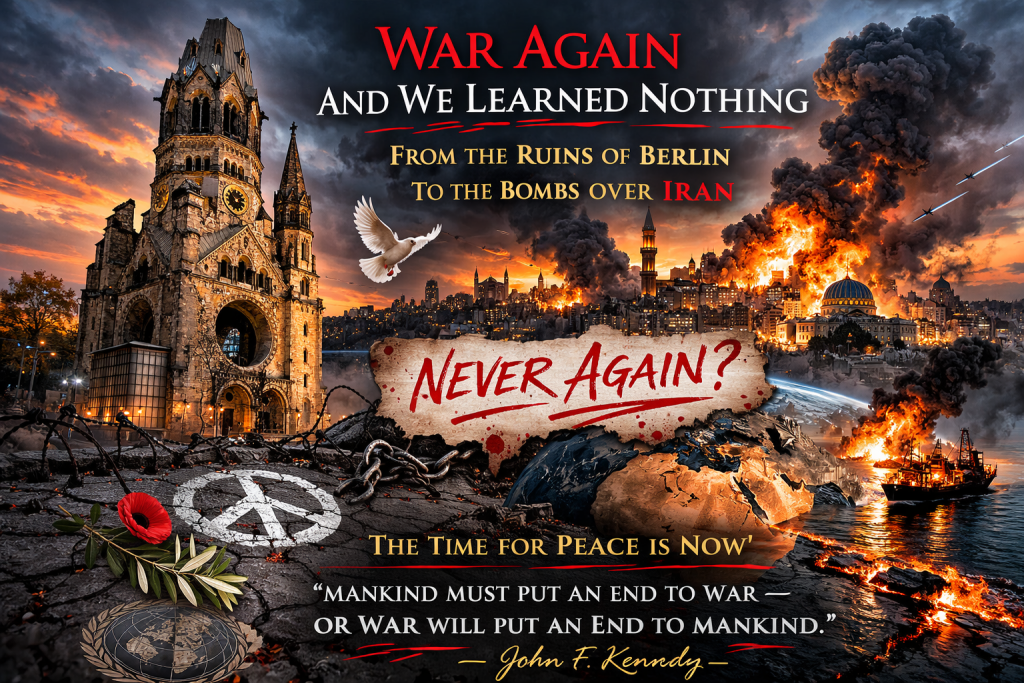
War Again — Have We Learned Nothing?

A Ruin in Berlin

For three years I lived in West Berlin just a few streets from the Kaiser-Wilhelm-Gedächtniskirche.

The ruined spire of that church stands there deliberately. It was left broken after the bombing of Berlin in the Second World War as a powerfully emotive reminder, a warning in stone, of what war does to human civilisation.

Every day thousands of people walk past it.

Its message is simple:
Never again.

And yet, eighty years later, the world appears to have learned almost nothing.

Today we watch yet another war unfolding, this time in Iran, and once again political leaders behave as though history has taught us nothing at all.


International Law and the Collapse of Moral Consistency

The United States and Israel launched coordinated military strikes against Iran on 28 February 2026, triggering what is now a rapidly escalating regional conflict.

The legal justification for this war is deeply contested. In my opinion, it is illegal, as well as ethically abominable.

Under international law, the use of military force against another sovereign state is permitted only under very limited circumstances — primarily self-defence against an imminent armed attack or authorisation by the UN Security Council.

Neither condition is widely accepted as clearly satisfied in this case.

The uncomfortable truth is that international law increasingly appears to function selectively. Western governments rightly condemn Russia’s invasion of Ukraine as a violation of sovereignty and international law. Yet when powerful states carry out military action themselves, the language suddenly changes: “pre-emptive defence,” “security operations,” or “regime change.”

“The ideal subject of totalitarian rule is not the convinced Nazi or the convinced Communist, but people for whom the distinction between fact and fiction no longer exists.”
— Hannah Arendt

Such double standards undermine the very legal order the West claims to defend.

If international law is to mean anything at all, it must apply to everyone, including the most powerful nations on Earth.


A War Already Spreading Beyond Control

The consequences of the war are already rippling far beyond Iran’s borders.

Iran has retaliated with missile and drone strikes across the region, targeting U.S. bases and allied facilities in Gulf states.

Fighting has spread into neighbouring areas including Lebanon and Bahrain, and attacks on shipping in the Persian Gulf have threatened one of the world’s most important energy corridors.

The Strait of Hormuz, through which roughly 20 percent of global oil shipments pass, has become a focal point of the conflict. Next is (already, actually) the Bab-el-Mandeb Strait.

Oil prices have surged toward $100 per barrel, sending shock-waves through the global economy and pushing inflation higher worldwide.

And as always, when energy prices spike, it is the poorest people on Earth who suffer first and most.

Meanwhile geopolitical tensions are intensifying:

    • Russia benefits financially from rising energy prices.
    • The threat to Ukraine increases.
    • Israel extends its devastating destruction.
    • China watches carefully while global attention shifts elsewhere.
    • Regional states are dragged into a widening conflict they did not start.

This is precisely how regional wars drift toward global crises.


The Question of Motives

Officially, the war is framed as an effort to neutralise Iran’s nuclear programme and weaken an authoritarian regime.

Yet history makes many observers sceptical of such explanations.

Geography and energy politics cannot be ignored.

Iran sits at one of the most strategically important crossroads on Earth — between Europe, the Middle East, Central Asia and South Asia. It possesses some of the world’s largest oil and gas reserves and lies adjacent to the shipping lanes that power the global economy.

Control of influence in this region has long been a central concern of global powers.

“Political language is designed to make lies sound truthful and murder respectable.”
George Orwell

Other factors also shape the conflict:

• Iran’s nuclear ambitions
• Regional rivalry with Israel
• The network of Iranian-backed militias across the Middle East
• Energy security and shipping routes
• Domestic political calculations inside the United States and Israel

Wars are almost never driven by a single motive. They emerge from a tangled mix of fear, power politics, ideology and economic interests.

But honesty about those motives is essential if democratic societies are to judge the wars fought in their name.


The Human Cost

Behind every strategic analysis lies a far more brutal reality.

People are dying.

Human rights groups estimate that more than 3,000 people have already been killed in Iran, including over 1,300 civilians, since the war began.

Other casualties have occurred across the region, including deaths in Lebanon and Gulf states, as the conflict spreads beyond its original battlefield.

Millions of civilians have been displaced from their homes.

War statistics are discussed like numbers.
But every number is a human life.

Each number represents a human life:
a child, a parent, a teacher, a medic, a neighbour.

War statistics are often discussed like sports scores.

But they are not numbers.

They are people. One race: the same story written in different ink. Human beings who deserve dignity and respect. No different from you and me.


The Environmental Catastrophe Few Are Discussing

Modern warfare also carries an enormous environmental cost.

Bombed industrial sites release toxic chemicals. Burning fuel depots poison air and soil. Damaged oil infrastructure risks catastrophic spills into fragile marine ecosystems.

The Persian Gulf, already one of the most environmentally stressed seas on Earth, could suffer damage lasting decades.

War is not only a human disaster.

It is also an ecological one.


A Plea for Sanity

Standing in front of the ruined church in Berlin yesterday, it is impossible not to think about the generations who built the world we inherited.

They saw what total war could do.

They tried to create institutions — the United Nations, international law, human rights conventions — designed to prevent humanity from repeating the same catastrophe.

Those institutions are now under severe strain.

“Those who can make you believe absurdities can make you commit atrocities.”
Voltaire

If they collapse entirely, the world risks sliding back into an age where tyrannical power alone determines what is right.

That path leads only to endless war.


An Urgent Plea for Peace

Standing before the ruined church in Berlin, it is impossible not to feel the weight of history.

Those shattered stones are not simply architecture. They are a warning left by an earlier generation that had seen cities burn and continents collapse into violence.

They believed that humanity might finally learn.

Yet today the same arrogance, the same illusions of power, the same willingness to sacrifice human lives for geopolitical ambition are once again steering the world toward catastrophe.

Ordinary people do not want war.
They want safety, dignity and the chance to live their lives in peace.

Diplomacy, accountability and international law remain the only realistic path forward. And perhaps even above that, an education for the world’s children that teaches them to embrace the riches of human diversity.

It is time for citizens, intellectuals, journalists and leaders everywhere to say what should never have needed saying again:

War is not a solution.
It is humanity’s greatest failure.

“I know not with what weapons World War III will be fought, but World War IV will be fought with sticks and stones.”
Albert Einstein

Bürgergeldempfänger als Deutschlands liebste Sündeböcke

Die kleinste Ausgabe des deutschen Sozialstaates erzeugt die lauteste politische Empörung.

Die deutsche Debatte über das Bürgergeld wird meist im Ton gereizter Empörung geführt. Zu viel Geld, zu wenig Druck, zu wenige Anreize, zu viel Nachsicht. Das Bild dahinter ist simpel: Der Staat verteilt Geld – und dann ist es weg.

Doch dieses Bild ist sowohl ökonomisch grob als auch eine politisch bequeme und polarisierende Ablenkung.

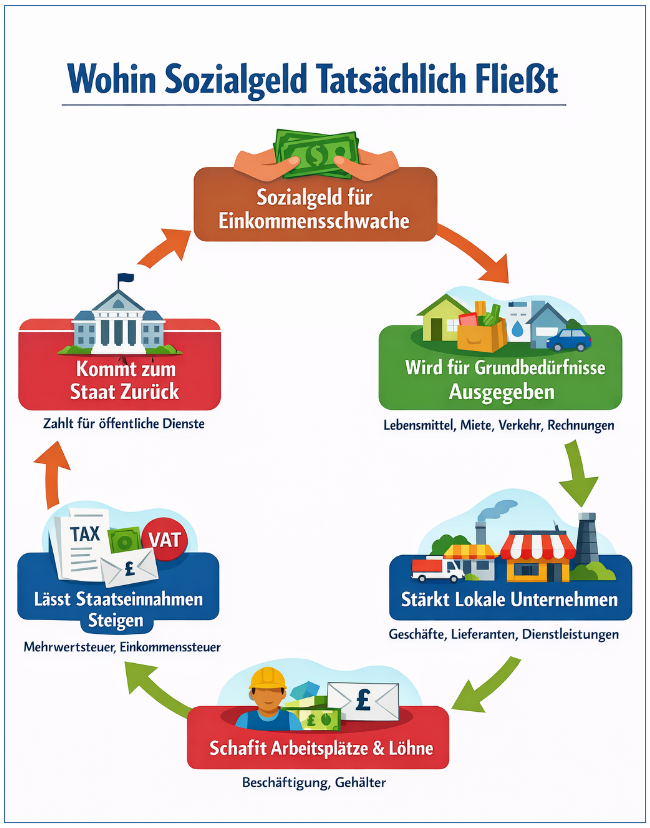
Geld, das an einkommensschwache Haushalte gezahlt wird, verschwindet nicht. Es zirkuliert. Ein Teil fließt sofort über die Mehrwertsteuer zurück zum Staat. Ein größerer Teil landet bei Supermärkten, Lieferanten, Vermietern, Dienstleistern – und damit wiederum in Löhnen, Gewinnen und Steuereinnahmen. Sobald man aufhört, Sozialleistungen so zu betrachten, als würden sie einfach in einem schwarzen Loch verschwinden, sieht die Rechnung plötzlich ganz anders aus.

Der unmittelbare Rückfluss über Steuern

Beginnen wir mit dem Offensichtlichen. In Deutschland zahlt der Endverbraucher die Mehrwertsteuer. Der reguläre Satz beträgt 19 Prozent; für viele Grundbedürfnisse gilt der ermäßigte Satz von 7 Prozent.

Wenn ein Haushalt mit niedrigem Einkommen sein Geld für Lebensmittel, Kleidung, Hygieneartikel, Verkehr oder andere Alltagsausgaben verwendet, fließt ein Teil dieses Geldes unmittelabar zurück in die öffentlichen Kassen. Bei einem Einkauf von einem Euro mit 7 Prozent Mehrwertsteuer stecken etwa 6,5 Cent Steuer im Endpreis. Bei 19 Prozent sind es rund 16 Cent.

Schon bevor man die weiteren wirtschaftlichen Effekte betrachtet, ist also klar: Die Vorstellung, Sozialtransfers seien reine Einbahnstraßenverluste, stimmt schlicht nicht.

Warum ärmere Haushalte mehr ausgeben

Der wichtigere Punkt kommt danach: Menschen mit geringem Einkommen geben Geld aus. Meistens müssen sie das auch.

Ökonomen beschreiben dieses Verhalten mit dem Begriff der marginalen Konsumneigung – also dem Anteil eines zusätzlichen Euro, der tatsächlich ausgegeben statt gespart wird. Der Befund aus zahlreichen Studien ist eindeutig: Haushalte unter finanziellem Druck geben einen größeren Teil zusätzlicher Einnahmen aus, während wohlhabendere Haushalte ihr überschüssiges Geld eher sparen oder steuerlich begünstigt investieren.

Eine Studie des Internationalen Währungsfonds zeigt beispielsweise, dass finanziell belastete Haushalte Transferzahlungen mit einer um mehr als 20 Prozent höheren Konsumneigung verwenden als Haushalte ohne solche Sorgen. Eine andere Analyse kommt zu dem Schluss, dass Transfers über mehrere Jahre hinweg gesamtwirtschaftliche Multiplikatoreffekte deutlich über eins erzeugen können.

In einfachen Worten: Ein ausgezahlter Euro kann mehr als einen Euro wirtschaftliche Aktivität erzeugen.

Die Zirkulation des Geldes

Genau deshalb ist die klassische konservative Kritik am Bürgergeld oft nur halb blind. Sie zählt die Bruttoausgaben – aber nicht die Zirkulation danach.

Der Empfänger kauft Lebensmittel. Der Supermarkt bezahlt Personal und Großhändler. Der Großhändler bezahlt Transport und Lager. Beschäftigte geben ihre Löhne aus. Unternehmen zahlen Mehrwertsteuer, Gewerbesteuer, Körperschaftsteuer und Sozialabgaben.

Kein seriöser Ökonom würde behaupten, dass jeder ausgezahlte Euro sich vollständig selbst finanziert. Aber ebenso wenig ist es ehrlich, so zu tun, als würde der Staat das Geld einfach verbrennen.

Marx und die „Reservearmee“

Es gibt noch einen tieferen gesellschaftlichen Punkt. Karl Marx’ alte Idee von der „industriellen Reservearmee“ hat bis heute eine gewisse Erklärungskraft. Kapitalismus stabilisiere sich, argumentierte Marx, unter anderem durch die Existenz einer Bevölkerung, die arbeitslos, unterbeschäftigt oder wirtschaftlich unsicher genug ist, um Druck auf diejenigen auszuüben, die Arbeit haben.

„Je größer der gesellschaftliche Reichtum … desto größer die industrielle Reservearmee.“
— Karl Marx, Das Kapital, Band I

Man muss kein Marxist sein, um die Relevanz dieses Gedankens zu erkennen. Arbeitsmärkte brauchen immer eine gewisse Zone der Verwundbarkeit: Menschen, die verfügbar sind; Menschen, die unsicher sind; Menschen, die daran erinnert werden, was passiert, wenn sie herausfallen.

Auch deshalb werden Debatten über soziale Mindeststandards so emotional geführt. Beim Bürgergeld geht es nie nur um Haushaltszahlen. Es geht auch darum, welches Maß an Unsicherheit eine Gesellschaft für akzeptabel – oder sogar nützlich – hält.

Die Zahlen des deutschen Sozialstaates

Und hier werden die deutschen Zahlen politisch aufschlussreich.

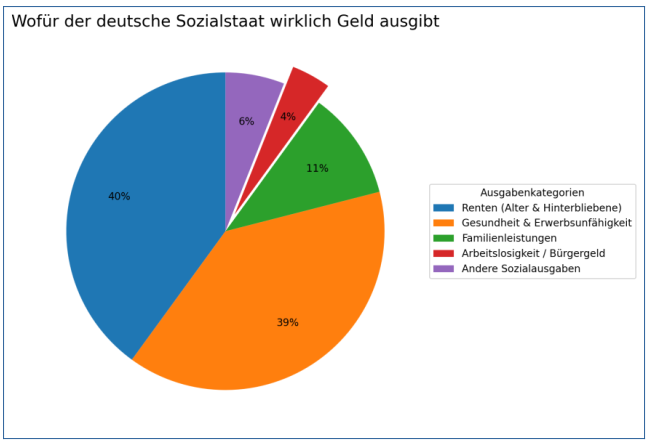
Laut Sozialbudget 2024 des Bundesministeriums für Arbeit und Soziales beliefen sich die gesamten Sozialausgaben Deutschlands auf rund 1,345 Billionen Euro. Davon entfielen etwa 58,2 Milliarden Euro auf das Bürgergeld – rund 4,3 Prozent der Gesamtausgaben.

Zum Vergleich: Allein für Alter und Hinterbliebene wurden 533 Milliarden Euro ausgegeben. Für Krankheit und Invalidität rund 523 Milliarden Euro.

„Die kleinste Scheibe des Sozialstaates erzeugt die lauteste politische Empörung.“

Wie auch immer man den Haushalt betrachtet – die Vorstellung, Bürgergeld sei das zentrale finanzielle Monster des deutschen Sozialstaates, ist schlicht absurd. Es ist sichtbar, ja. Politisch verwertbar, sicherlich. Aber es ist nicht die Hauptgeschichte.

Politische Obsession und reale Probleme

Und das ist nicht trivial. Politische Obsession kostet Zeit.

Zeit, die damit verbracht wird, über Bürgergeld zu moralisieren, fehlt bei der Auseinandersetzung mit den wirklich großen Herausforderungen der deutschen Wirtschaft: schwaches industrielles Wachstum, lähmende Bürokratie, schleppende Digitalisierung, überforderte Verwaltungen, unzureichende Qualifizierungssysteme, ein angespanntes Gesundheitssystem, steigende Rentenlasten und die fiskalischen Entscheidungen rund um Verteidigung und Staatsverschuldung.

Den Blick unverhältnismäßig stark auf die unterste Stufe der Einkommensleiter zu richten, ist keine nüchterne Realpolitik. Es ist eine politische Ersatzhandlung.

Die Lehre aus der Kurzarbeit

Deutschland selbst hat übrigens bereits gezeigt, wie die Logik solcher wirtschaftlichen Multiplikatoren funktionieren kann. Während der Pandemie setzte der Staat nicht allein auf moralische Appelle zur Eigenverantwortung, sondern nutzte Kurzarbeit, um Einkommen an Beschäftigung zu binden.

Auf dem Höhepunkt befanden sich fast sechs Millionen Menschen in Kurzarbeit. Studien des Instituts für Arbeitsmarkt- und Berufsforschung legen nahe, dass das Instrument dauerhaft Arbeitsplätze gesichert hat.

Die Lehre daraus ist einfach: Wenn der Staat Einkommen stabilisiert, stabilisiert er auch Nachfrage, Unternehmen und Beschäftigung.

Bürgergeld ist ein anderes Instrument. Aber das Prinzip ist ähnlich.

Einkommenssicherung ist oft billiger als gesellschaftlicher Absturz.

Ein ehrlicher Ausgangspunkt

Eine ehrlichere Debatte über Grundsicherung müsste deshalb mit einem einfachen Satz beginnen:

Dieses Geld verschwindet nicht.

Ein Teil fließt sofort über Steuern zurück. Ein größerer Teil hält Nachfrage in der realen Wirtschaft aufrecht. Und alles zusammen verhindert die weitaus höheren Kosten von Armut: schlechtere Gesundheit, geringere Beschäftigungsfähigkeit, soziale Demütigung, familiären Stress und langfristigen Vertrauensverlust in staatliche Institutionen.

Wenn Deutschland wirklich weniger Menschen im Bürgergeld haben möchte, lautet die Antwort nicht moralische Empörung.

Sie lautet: Wachstum, Kompetenz, Qualifizierung, funktionierende Verwaltung und ein Arbeitsmarkt, der Menschen tatsächlich wieder in stabile Beschäftigung aufnehmen kann.

Bis dahin sagt das höhnische Reden über diejenigen, die gezwungen sind, vom Minimum zu leben, vielleicht weniger über sie aus als über die Armut der Debatte selbst.

„Die Ideen von Ökonomen und politischen Philosophen, ob richtig oder falsch, sind mächtiger, als gemeinhin angenommen wird.“
— John Maynard Keynes


The Dishonest Distraction About The Dole

Welfare Money Does Not Disappear

Across Europe the debate about welfare spending tends to follow a predictable script. Governments warn about ballooning costs. Conservative politicians complain about incentives. Newspapers highlight the most extreme cases of abuse. The impression created is simple: the state hands money out, and the money is gone. This is even implied in the English word “dole.”

But economically, this picture is deeply misleading.

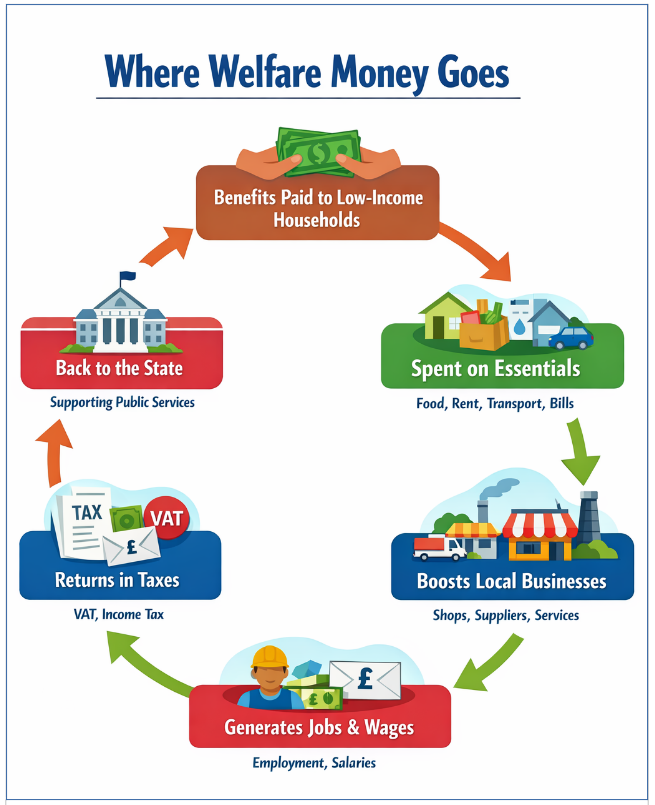
Money paid to low-income households does not disappear. It circulates through the economy, supports businesses, generates tax revenue and stabilises demand. A portion returns immediately to the state through consumption taxes. A larger portion sustains economic activity that would otherwise collapse.
Once this is understood, the political argument about welfare begins to look rather different.


The immediate return: consumption taxes

Across Europe, the final consumer pays VAT (or its equivalent). In Germany it is 19 percent; in the UK it is 20 percent; reduced rates apply to essentials such as food or children’s clothing.

When a low-income household spends welfare payments on groceries, toiletries, clothing, transport or household goods, a share of that spending flows straight back to the public purse.

This means welfare transfers are never purely one-way payments. Even before wider economic effects are considered, part of the money immediately returns to government.


The multiplier effect

The more important effect comes from how poorer households use money.

Economists describe this through the marginal propensity to consume — the proportion of additional income that is spent rather than saved.

Low-income households typically spend most or all of any extra income simply because they have to. Bills must be paid, food bought, and rent covered. Wealthier households, by contrast, are more likely to save additional income or invest it, taking advantage of tax incentives that reduce government income.

This matters because spending generates economic activity.

When a welfare recipient buys groceries:

    • the supermarket pays staff
    • suppliers receive orders
    • workers earn wages
    • those workers spend their own income

Taxes are paid at multiple stages — VAT, payroll taxes, corporate taxes.

Studies by organisations such as the International Monetary Fund and the OECD repeatedly find that transfers to poorer households produce relatively high fiscal multipliers. In simple terms, each euro or pound transferred can generate more than one euro or pound of economic activity.


The invisible stabiliser

This mechanism is why many European welfare systems act as automatic stabilisers during economic downturns.

When unemployment rises:

    • government spending increases
    • households retain some purchasing power
    • businesses retain customers

This prevents economic contractions from becoming deeper recessions.

Germany’s Kurzarbeit scheme during the COVID-19 crisis is an example of the same principle applied to wages. By subsidising reduced working hours instead of allowing mass layoffs, the government kept millions of workers connected to their employers and maintained consumer demand.

Income support, in other words, is often cheaper than economic collapse.


The Marxian shadow

None of this would have surprised Karl Marx. Marx argued that capitalist economies maintain what he called a “reserve army of labour” — a population that is unemployed or precariously employed, exerting downward pressure on wages and disciplining those who remain in work.

Whether one accepts Marx’s wider conclusions or not, the idea captures a persistent truth: labour markets always contain a margin of insecurity.

Welfare systems therefore operate at a delicate intersection. They prevent destitution while preserving enough economic pressure to keep labour markets functioning.

“The greater the social wealth, the functioning capital, the extent and energy of its growth… the greater is the industrial reserve army.”  — Karl Marx


The political misdirection

The numbers themselves reveal how distorted the debate often is.

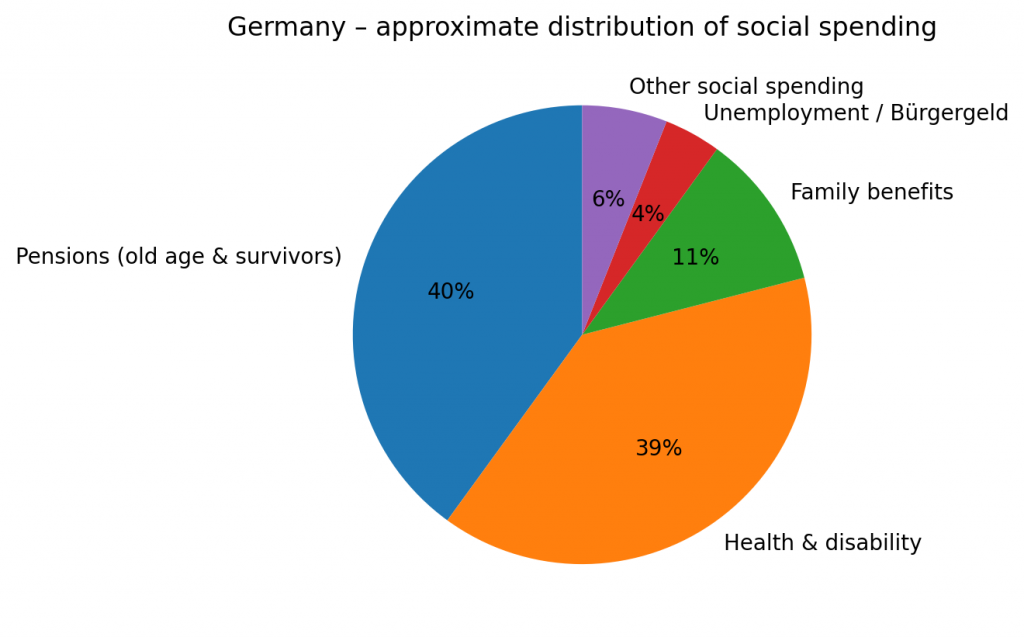
In Germany, for example, spending on pensions alone exceeds €500 billion per year, while the Bürgergeld programme for the long-term unemployed accounts for only a small fraction of total social spending.

Yet political debates frequently focus obsessively on the latter.

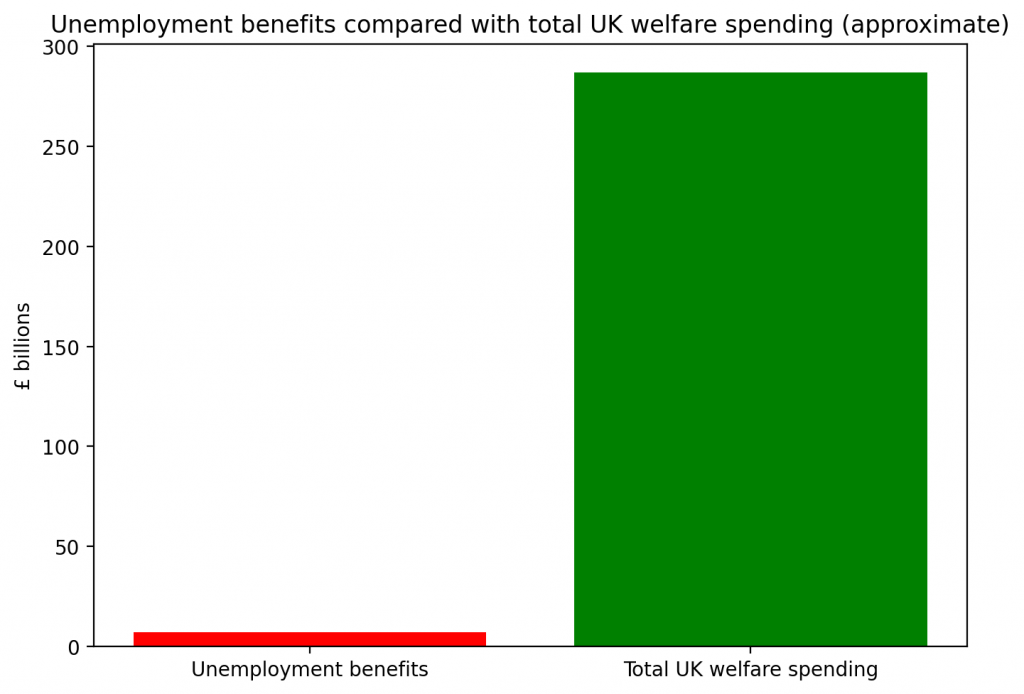
Across Europe the pattern is similar: politically visible welfare programmes for the unemployed attract far more attention than the vastly larger costs associated with pensions, healthcare, demographic ageing and long-term care.

The result is a curious form of fiscal theatre. Here is the statistical reality in the UK:


The real question

If governments genuinely want fewer people dependent on welfare, the answer is not moral outrage. It is:

    • economic growth
    • functioning labour markets
    • effective training systems
    • efficient public administration
    • investment in education and skills

Until those foundations improve, the debate about welfare spending risks becoming little more than a ritualised complaint about the weakest participants in the economy, akin to refugees arriving in boats.


A more honest conversation

The welfare debate would look very different if it began with a simple act of honesty. Welfare money does not disappear. It circulates through shops, businesses, wages and tax systems before returning, partly and often quickly, to the state itself.

The real fiscal pressures facing European governments lie elsewhere: ageing populations, pensions, healthcare and the long-term costs of economic stagnation. Yet political attention continues to circle obsessively around the smallest slice of the welfare state. Perhaps that is because it is easier to argue about the poor than to confront the deeper structural challenges of a modern economy.

The ideas of economists and political philosophers, both when they are right and when they are wrong, are more powerful than is commonly understood.                — John Maynard Keynes

The Authentic Illusion of Salvation

A moment of religious devotion can feel like a direct encounter with the divine — but the experience may have deeply human origins.

There are few experiences in human life more convincing than religious conversion.

In the moment it happens, it feels absolute.

The new believer does not merely adopt a belief; he experiences what appears to be a profound transformation of reality itself. The world suddenly becomes charged with meaning. Events seem purposeful. Personal history acquires a narrative arc. Even suffering can appear reinterpreted as part of a divine plan.

To the convert, the conclusion feels unavoidable: God has revealed Himself.

I know this experience from the inside. For several years I believed, with complete sincerity, that God had personally intervened in my life. The sense of transformation was overwhelming. At the time it felt impossible to doubt that something supernatural had occurred.

The experience is often accompanied by powerful emotions: relief, gratitude, awe, sometimes tears. The convert may describe feeling “known,” “forgiven,” or “reborn.” For many, this moment becomes the central turning point of their life story.

From the inside, the experience feels like the discovery of truth. God exists. Faith becomes certainty (Hebrews 11:1).

From the outside, however, something more complex is happening.

A psychological ignition

Modern psychology offers a more prosaic explanation for the intensity of conversion.

Many conversions occur at moments of emotional vulnerability: crisis, guilt, loneliness, addiction, grief, or identity confusion. In such moments the mind becomes unusually receptive to radical reinterpretations of reality.

These states create a powerful readiness for cognitive re-organisation. The mind searches urgently for a coherent narrative capable of resolving internal tension.

Religious frameworks are uniquely suited to provide such narratives. They offer a ready-made interpretation of suffering, a clear moral structure and the promise of forgiveness and life beyond the grave.

When the new believer accepts this framework, the psychological relief can be immense. The sense of personal chaos suddenly resolves into a meaningful story.

The experience feels supernatural.

In reality, it may simply be the human mind discovering an interpretation that temporarily stabilises itself.

The sociological amplifier

But psychology alone does not explain the power of conversion.

The social environment plays an equally decisive role.

Conversion rarely happens in isolation. It usually occurs within communities already organised around the expectation of transformation. Worship services, testimonies, music, prayer and communal affirmation together create a powerful emotional ecosystem.

When a convert stands before such a community and declares a new faith, the response is immediate: approval, celebration, belonging.

The individual does not simply gain a belief.
He gains a new identity and a new tribe.

Human beings are exquisitely sensitive to social reinforcement. Once a community confirms that a person has been “saved,” the psychological commitment deepens rapidly. Doubt becomes socially costly. Certainty becomes a badge of belonging.

Belief, in this sense, is stabilised not only internally but collectively.

The sincerity paradox

None of this means that conversion experiences are insincere.

Quite the opposite.

At the moment of conversion, the belief is usually completely genuine. The emotional intensity is real. The sense of transformation is real. The feeling of encountering God is real.

But sincerity does not guarantee accuracy.

Human beings are capable of deeply authentic experiences that nevertheless rest upon mistaken interpretations of reality.

Religious conversion may be one of the most powerful examples of this phenomenon.

Human beings are capable of deeply authentic experiences that nevertheless rest upon mistaken interpretations of reality.

The problem of competing revelations

One further observation complicates the picture.

If religious conversion truly revealed a universal divine reality, we might expect converts around the world to converge toward the same understanding of God.

Instead, the opposite happens.

Christians experience conversions that confirm Christianity.
Muslims experience conversions that confirm Islam.
Hindus encounter Krishna.
Pentecostals encounter the Holy Spirit.
Catholics encounter the Virgin Mary.

Each experience feels equally convincing to the person undergoing it.

The simplest explanation is not that all these mutually contradictory revelations are true.

It is that the human mind is capable of generating profoundly convincing experiences within whatever symbolic framework it inhabits.

The quiet aftermath

For some people, the story ends with lifelong faith.

For others, something else happens.

Years later, the convert begins to recognise the psychological and sociological forces that once felt invisible. The experience that once seemed supernatural begins to look more recognisably human.

This realisation can be unsettling.

Because it means confronting a difficult possibility:

The God who once felt unquestionably real may have been a projection created by the deepest needs of the human mind.

And yet the experience itself — the hope, the meaning, the transformation — was never fake.

It was simply human.

“The gods we worship write their names on our faces.”
— C. G. Jung

Gay Fathers: Why Gay Men Build Straight Families

The Closet Has A Wedding Ring: How Gay Men Became Fathers

A few weeks ago, in a bar in Berlin, I mentioned to a man I had just met that I am the father of four. He paused briefly, then smiled and said, “Me too.”

Neither of us was surprised.

Among gay men of my generation, this quiet moment of recognition is more common than most people realise. Many of us built heterosexual families before we ever spoke openly about our sexuality. The pattern is well known in private and rarely examined in public.

The easy explanations tend to fall into two unsatisfactory camps. Either the men are portrayed as victims of their era, pushed helplessly into lives they never chose, or they are depicted as fundamentally deceptive, as though their marriages were nothing more than elaborate shams.

Reality, as usual, is more complicated and more human than either of these caricatures allows.


Orientation and Behaviour: A Necessary Distinction

One of the most important starting points is a simple but often overlooked distinction: sexual orientation and lived behaviour do not always align neatly. Sexual behaviour is fluid; sexual orientation is not.

For many heterosexual people, desire and life path coincide without much friction. For a significant number of gay men, particularly in earlier decades, the relationship between the two was more complex.

This does not mean orientation is infinitely fluid. It means only that human beings are capable of living in ways that do not perfectly mirror their inner erotic life.

Across much of the twentieth century, many men who experienced primary attraction to other men nonetheless married women and fathered children. Some did so consciously, some half-consciously, some in genuine hope that marriage might settle their inner restlessness.

What matters, and what is sometimes too quickly forgotten in contemporary discussion, is this: whatever the social context, these were still adult decisions. Social expectations may shape the landscape in which choices are made, but they do not erase personal responsibility for the lives we build within it.


The Social Script Was Narrow — But Not Irresistible

It would be historically naïve to ignore the strength of the social script that shaped male adulthood for much of the last century. Respectable manhood was closely associated with marriage, fatherhood, and visible domestic stability. Homosexuality, by contrast, was widely stigmatised, pathologised, or criminalised in many Western countries well into living memory. In West Germany, we had Paragraph 175 until 1994, and in Britain, the legal age of consent between two males was lowered to 16, in line with the heterosexual age of consent, in 2001.

These realities formed the background conditions in which many men made their life decisions.

But background conditions are not the same thing as compulsion. Men were not automatons. Some resisted the script. Some lived quietly single. Some formed discreet same-sex lives. Others chose marriage.

The more honest account is therefore not that gay men were forced into heterosexual families, but that many judged — rightly or wrongly — that marriage offered a workable path to belonging, stability and ordinary social life.

For some, it did.

For others, the costs emerged only slowly.


The Psychology of the Split Life

To understand how these marriages functioned — sometimes for decades — we have to move beyond the crude language of denial and look more carefully at the psychological mechanisms involved.

Human beings are remarkably adept at compartmentalisation. It is entirely possible to build a life in which emotional loyalty, domestic commitment, and parental devotion coexist alongside an erotic life that remains partially or wholly unintegrated.

Many men in mixed-orientation marriages reported something like the following internal arrangement: their affection, duty and daily life were invested sincerely in the family they built, while their erotic imagination operated in a more private register. The two spheres were kept separate, sometimes consciously, often simply by force of habit and circumstance.

There was also a long-standing cultural belief — now largely discredited but once widely accepted — that marriage might in some cases “settle” or redirect same-sex desire. It is easy to dismiss this idea now, but it was taken seriously by doctors, clergy and families well into the late twentieth century.

Some men entered marriage in good faith under that assumption. Others entered it with more ambivalence. Still others, candidly, avoided asking themselves too many questions.

Again, the human picture is mixed.


The Body, the Role and the Marriage

Another uncomfortable but important reality is that physiological sexual functioning does not always map perfectly onto deep erotic orientation.

Many predominantly gay men have been capable of heterosexual intercourse, particularly within the structured expectations of marriage. This fact has sometimes been misread as evidence of bisexuality where none primarily existed.

The more accurate conclusion is simply that human sexual response is adaptable within certain limits. Performance, affection, novelty and relational context can all play a role.

But adaptability has its limits. Over time, for many men, the gap between role and desire became harder to ignore or sustain.

And this is where the story turns from sociology to ethics.


The Cost That Must Be Named

Any honest discussion of gay fathers in heterosexual marriages must include a truth that is sometimes softened in retrospective accounts.

In many families, when the underlying reality eventually surfaced — whether gradually, painfully, or suddenly — wives and children experienced real hurt, confusion, and sometimes profound disruption.

Not in every case. Some families navigated the transition with dignity and mutual care. Some marriages had long since evolved into affectionate partnerships rather than romantic unions.

But in many others, the moment of disclosure felt, understandably, like a huge rupture. Trust could be shaken. Family narratives had to be rewritten. Children, depending on their age and temperament, sometimes struggled to make sense of what had changed and what had not.

To acknowledge this is not to indulge in self-reproach, nor to erase the genuine love many fathers felt — and continue to feel — for their families. It is simply to recognise that complex life structures often carry complex human costs.

Responsibility, in adulthood, includes the willingness to look at those costs squarely.

“Nothing in life is as important as you think it is while you are thinking about it.”
— Daniel Kahneman


A Generational Pattern. Not an Excuse.

There is no doubt that the pattern of gay men building heterosexual families was more common in earlier decades than it is today. Social visibility, legal change, and cultural openness have altered the landscape significantly.

But it would be a mistake to frame this too simply as a story of past oppression versus present freedom. Human lives remain complicated. Even today, in many parts of the world — and in some families much closer to home — similar tensions still exist.

Nor is it especially helpful to imagine that earlier generations were uniquely constrained while younger men are uniquely liberated. Every generation navigates its own pressures, blind spots, and compromises.

The more useful observation is simply this: life choices are always made within a cultural frame, and those frames do change over time. What once appeared the obvious path for many men no longer appears so.

Understanding that shift helps explain the pattern. It does not absolve individuals of the consequences of their choices.


A More Adult Conversation

What is needed now is neither romanticisation nor condemnation, but maturity.

Gay fathers from heterosexual marriages are not rare anomalies. They are part of a recognisable historical pattern in Western societies across much of the twentieth century. Their lives typically contained real commitment, real affection, and, often, real internal tension.

The marriages were not necessarily fraudulent. Nor were they always sustainable in the long term. Both things can be true at once.

If there is any value in revisiting these stories today, it lies in the clarity they offer about the complicated relationship between identity, behaviour, social expectation, and personal responsibility.

Human beings do not always live in perfect alignment with their inner lives. Sometimes they adapt. Sometimes they delay difficult recognitions. Sometimes they choose stability over authenticity, at least for a time.

And sometimes the reckoning comes later.

“Life can only be understood backwards; but it must be lived forwards.”
— Søren Kierkegaard


Closing Reflection

That brief exchange in the Berlin bar — “I have four children.” “Me too.” — was not a confession and not an excuse. It was simply recognition between two men shaped, in part, by similar cultural weather.

Many of us built families in good faith. Many loved our wives and children deeply, even where the erotic centre of gravity lay elsewhere. And many, later in life, had to integrate truths that earlier decades made easier to postpone.

The task now is not to rewrite the past into something neater than it was, nor to retreat into defensiveness or regret. It is to understand the full human picture: the agency, the context, the love that was real, and the pain that, in some families, was also real.

Grown-up lives rarely resolve into simple narratives. This is one of them.

“The truth is rarely pure and never simple.”
— Oscar Wilde