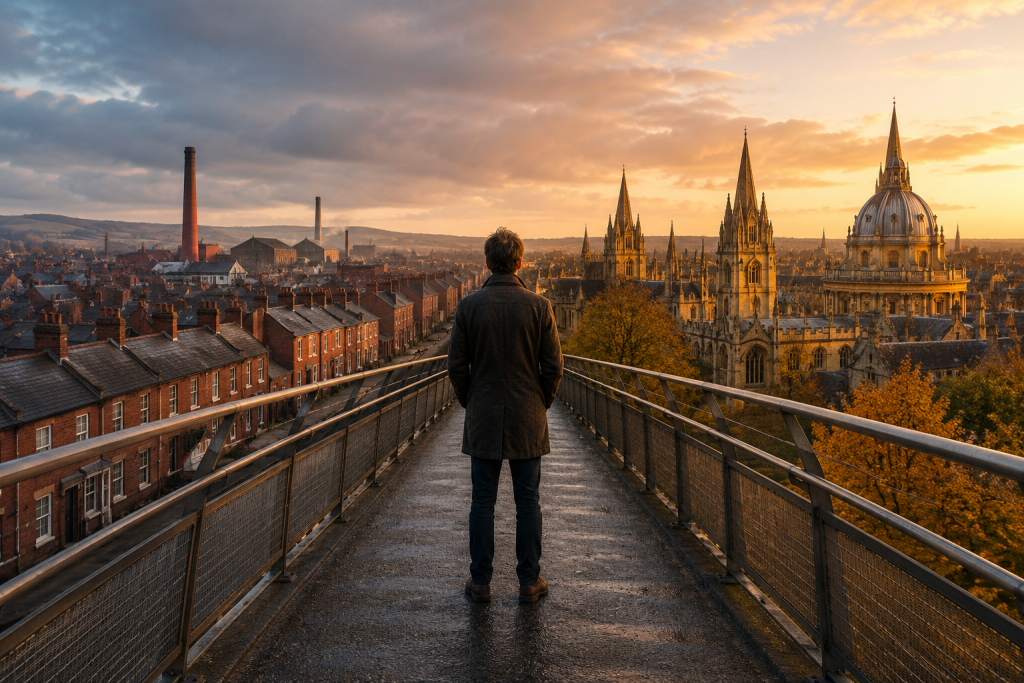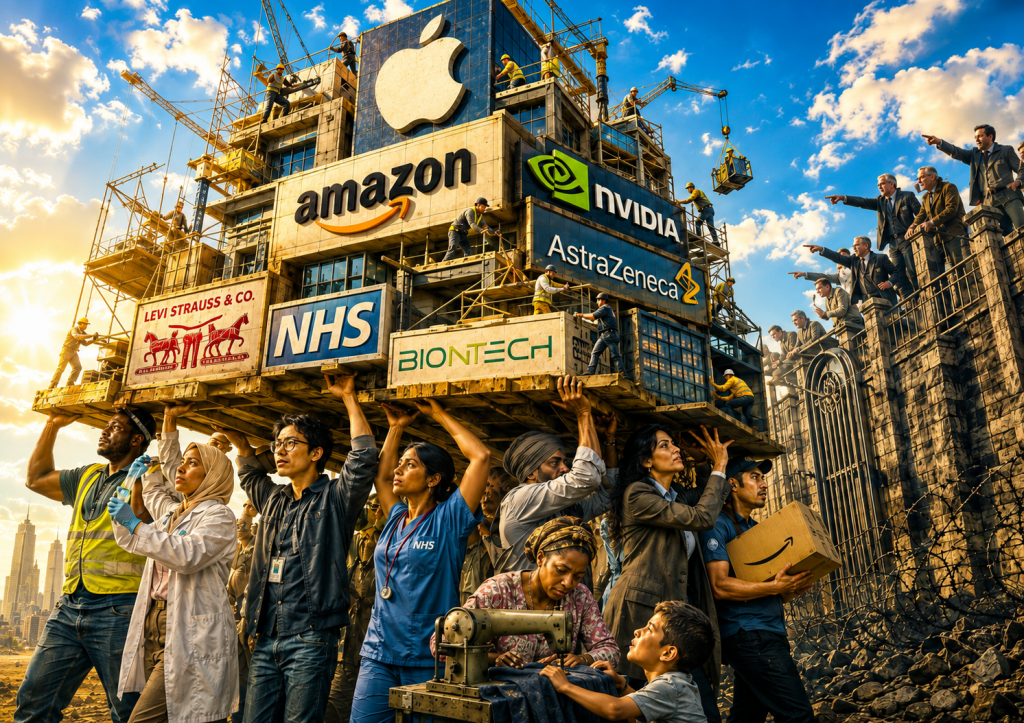
I have come to realise that the most valuable education I ever received was learning to see the same country from two completely different points of view.
I was reminded of this recently while listening to Andy Burnham speak about the “Makerfield test”: his promise that national policy should be judged by whether it improves life in places such as Makerfield, rather than merely satisfying the economic and political orthodoxies of Westminster.
I was attracted to the idea immediately. That was not altogether surprising. Burnham and I have several things in common.
We both came from relatively humble backgrounds in the North of England. We both went on to study humanities at Oxbridge — English at Cambridge in his case, French and German at Oxford in mine. We both entered worlds far removed from those in which we had grown up. And both of us, in very different ways and on vastly different public stages, appear to have become increasingly interested in the distance between the Britain described by its institutions and the Britain experienced by many of its people.
That does not mean I agree with Burnham on every issue. I don’t.
What interests me is the journey between two social worlds, and what that journey allows a person to see.
Learning to see two Britains
Social mobility is normally described as movement in one direction.
A child from an ordinary background works hard, receives a good education, enters a prestigious university and rises into a more prosperous or influential part of society. The story is presented as an escape: departure from one world and successful arrival in another.
But that is not quite how it feels. You do not necessarily leave the first world behind. Instead, you acquire a second vantage point.
At Oxford, I encountered people whose intelligence and talent were undeniable. But I also encountered people who had been prepared from childhood to enter rooms in which power was exercised. They understood the vocabulary, the conventions and the unwritten rules. They spoke to professors, employers and authority figures with an assurance that did not always reflect greater ability. It often reflected something simpler: nobody had ever suggested to them that the room might not belong to them.
This is one of the least discussed advantages of privilege.
Privilege does not always announce itself as wealth. Sometimes it appears as confidence. It appears as ease in unfamiliar surroundings, freedom from embarrassment, fluency in the language of institutions and the assumption that one’s opinions will be heard.
To the person who possesses these advantages, they may feel like competence.
To the person who does not, the absence of them may feel like personal failure.
Crossing the class divide teaches you to recognise the difference.
You remember the families for whom an unexpected bill is not an inconvenience, but a crisis. You remember people who are intelligent but have never been encouraged to think of universities, professions or public life as places for them. You remember how authority looks from below.
But you also begin to understand the people who design policies, manage institutions, allocate capital and shape public debate. You learn their language. Sometimes you become one of them.
You see Britain from both sides.
What economic success looks like from below
This double vision changes the meaning of economic statistics.
A government announces that the economy is growing. The stock market rises. Corporate profits increase. Property becomes more valuable. Ministers point to employment figures and national averages as evidence that the country is succeeding.
All of these measurements may be accurate.
But they do not answer the most important question:
Who is experiencing the success?
A rise in property prices is good news for someone who owns several properties. It may be disastrous for somebody trying to buy a first home.
A strong stock market enriches people with substantial investments and pensions. It means far less to families who own no financial assets and are struggling to pay their electricity bills.
Growth can take place while public services deteriorate. Average wealth can rise while wealth becomes more concentrated. Employment can remain high while wages fail to provide security, housing or hope.
Seen from Westminster, these may appear to be complications within an otherwise successful economic model.
Seen from Makerfield, or from many towns across northern England such as Runcorn where I grew up, they may be the model’s most important result.
This is why Burnham’s test has such immediate emotional force. It asks politicians to stop treating people as supporting evidence for an economic theory and instead ask whether the theory is improving their lives.
But it also reflects a more general truth: your assessment of any system depends partly on where you are standing inside it.
The education hidden inside the humanities
There may be another reason Burnham and I are drawn towards this way of thinking.
Neither of us studied economics, management, law or PPE. We studied humanities.
In modern public debate, the humanities are often treated as decorative. Science, technology and economics are described as useful, while literature, languages, history and philosophy are expected to justify their existence.
But the humanities teach something our political and economic systems desperately need.
They teach us to enter realities other than our own.
A novel asks us to inhabit another person’s consciousness. History asks how people and societies arrived at their present condition. Philosophy asks what we owe one another. A foreign language teaches that our own way of dividing, naming and expressing reality is not the only possible one.
Studying French and German did more than enable me to communicate in other languages. It challenged the unconscious assumption that the British way of seeing the world was the natural or neutral one.
Living abroad later deepened that lesson.
After 16 years in Germany, and now beginning a new life in Spain with an Indonesian husband, I no longer see Britain entirely from within Britain. Europe is not an abstract bureaucracy called “Brussels”. Migration is not simply a number in a newspaper. Borders, residence rights and administrative systems are no longer theoretical matters. Foreign policy is no longer conducted in distant countries inhabited by anonymous populations.
To live between countries is to acquire another form of double vision. You become what I term “an accidental outsider.”
You see your own nation more clearly because you are no longer surrounded by its assumptions, something I had experienced at an abstract level in the writings of Diderot and Voltaire.
You also become more suspicious of political systems that can calculate the economic cost of a decision while remaining curiously unable to imagine its human consequences.
Data can tell us where poverty exists.
Literature may help us understand what poverty does to a person.
Economics can measure migration.
Languages and lived experience may help us understand what it means to become a migrant.
Statistics can tell us that a region is declining.
History can explain why its people no longer trust the institutions announcing the latest programme for their renewal.
The humanities are not a retreat from the real world. They are among our best defences against governing that world without sufficiently understanding the people who live in it.
Britain’s geography of power
The same question of perspective applies to the way Britain is governed.
The United Kingdom remains extraordinarily centralised. Regions with distinct histories, economies and identities are repeatedly expected to apply for funding, permission or attention from London.
The underlying assumption is rarely questioned: wisdom and legitimacy become more concentrated as one moves closer to Whitehall.
Burnham’s political experience in Greater Manchester has led him towards a different conclusion. His argument for greater devolution is not merely that Westminster sometimes makes the wrong decisions. It is that Westminster makes too many decisions in the first place.
This matters because the centre inevitably sees places differently from the people who live there.
From London, a town may appear as a collection of indicators: productivity, employment, educational attainment, transport connectivity and levels of deprivation.
From inside that town, it is a network of memory, identity, family, opportunity and loss.
Policies designed remotely may be rational in aggregate and destructive in practice. They may improve a national average while hollowing out a particular community. They may create efficiencies that look impressive in a report and feel like abandonment on the ground.
Perhaps Britain’s problem is not simply that Westminster has forgotten the North.
Perhaps the deeper problem is that Westminster still believes it has the right to remember the North on the North’s behalf.
Social mobility is not enough
For decades, Britain has presented social mobility as the answer to inequality.
Find talented children from modest backgrounds. Help them reach excellent universities. Allow them to enter professions and institutions previously closed to them.
That is worthwhile. My own life was transformed by educational opportunity.
But there is an uncomfortable limitation to this model.
Social mobility can help individuals escape an unequal system without making the system itself more equal.
A society cannot solve regional poverty by helping a small number of successful young people leave poorer regions. Nor can it solve class inequality simply by allowing exceptional individuals to join an existing elite.
The question is not only how many people can climb the ladder.
We must also ask who built the ladder, where it leads, and why so many people are expected to remain beneath it.
The greatest social value of mobility may therefore lie not in personal advancement but in the perspective carried across the divide.
Institutions need people who know what those institutions look like from outside.
Universities need people who remember what it felt like to believe university was “not for people like us”.
Governments need people who understand that a policy can be statistically successful and humanly disastrous.
The media need people who recognise that the national conversation is often conducted in a language millions of citizens neither use nor trust.
And prosperous societies need people who understand that poverty is not merely the absence of money. It is often the absence of margin, choice, confidence and the expectation of being heard.
The responsibility of seeing both sides
There is, however, no automatic virtue in crossing a social boundary.
People can enter privileged institutions and adopt their assumptions completely. They can use education to distance themselves from their origins. They can become more contemptuous of those who did not make the same journey, imagining that personal success proves the system is fair.
Indeed, meritocracy can create a particularly unforgiving elite.
If successful people believe they reached the top entirely through talent and effort, they may conclude that everybody who remained below simply failed to try hard enough.
Double vision, or becoming an accidental outsider, must therefore be preserved deliberately. It requires memory. It requires humility.
It requires an awareness that intelligence is widely distributed even when opportunity is not.
It also requires resisting the comforting idea that entering a powerful institution means fully understanding the people over whom that institution exercises power.
This may be the most valuable thing a person from a modest background can carry into an elite room: not authenticity as a performance, nor a sentimental claim to represent everyone they grew up alongside, but the knowledge that the world looks radically different depending on which side of the door you occupy.
The most important education
Oxford changed my life.
It gave me knowledge, confidence and opportunities my younger self could scarcely have imagined. It introduced me to languages, cultures and ways of thinking that eventually carried me far beyond the country in which I was born.
But Oxford was only one part of my education.
The North taught me how power looks from a distance.
Oxford taught me how power explains itself.
Teaching showed me how institutions affect individual lives.
Living abroad taught me to see Britain from the outside.
And moving between these worlds taught me that no single vantage point is sufficient.
This is what I recognised in Burnham’s Makerfield test: not a complete political philosophy, and certainly not an answer to every difficult national and international question, but an insistence that perspective matters.
Who is speaking?
Where are they standing?
What can they see from there?
And what remains invisible to them?
We spend a great deal of time asking how to help more people cross Britain’s class divide.
Perhaps we should ask an additional question: how do we ensure that those who cross it employ their experience to create a fairer society?
“I thought about the breaks that had scored the rhythm of my life. Expansion through rupture. Where others built continuity, I built awareness. And though that awareness didn’t make me happy, it had made me lucid. These breaks had been my real education — violent scholarships in the art of seeing.” — Níco Durón, Teacher, there are things that I don’t want to learn.


The British government has this week announced plans to ban social media access for under-16s. Ministers describe it as a historic intervention to protect children. Newspapers are full of discussion about algorithms, screen addiction and online harms. Yet as I watched the announcement unfold, I found myself asking a different question entirely. Why are we once again arguing about what children