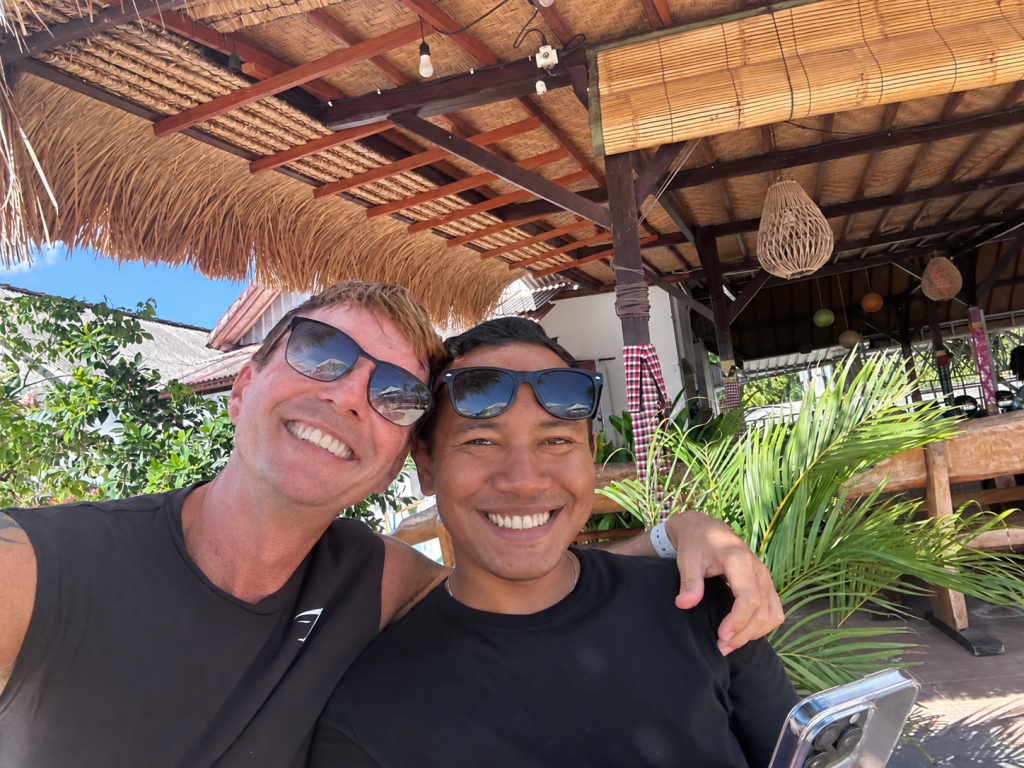
In December 2023, I travelled to Bali for the first time with my son George. One evening, back at our hotel, he gave in to jet-lag while I grew restless.
This is how I later described what happened next:
A pulse of energy insisted I go out, as though adventure were tapping me on the shoulder. I searched online and discovered Seminyak, a district with some nightlife forty-five minutes away. I wasn’t looking for romance, or so I told myself, but for connection. I simply wanted to live every moment to the full, having travelled to this captivating island on the other side of the world.
The bars were nearly empty at nine. It was too early. I circled them nervously, pretending disinterest, until I stepped inside one called The Banyan. A narrow aisle, high tables on either side, cigarette smoke hanging under the lights.
A young Indonesian man waved me over. His name was Buyung. He was thirty-three, from Sumatra. His English was light but fluent, his smile the kind that illuminated his whole being.
We spoke. His father had died when he was three, his mother bent over rice fields, sometimes with nothing to put on the table. Bullied at school, excluded from opportunity, he left to apprentice as a mechanic, but a hatred of automotive grease and conflict with his sister-in-law drove him away. In internet cafés, he met Europeans online; one paid for his first flight to Bali. Since then, he had returned home to Sumatra several times, during COVID, and to care for his dying mother. Now he was back, looking for work.
“What about the future?” I asked.
“I want to meet a bule,” he said—a white man who might take him to Europe.
I laughed, gently. “That won’t be me.”
He grinned, unfazed. “They all say that. We’ll see.”
He was right. I was wrong.
The man I called Buyung is the man I married in Berlin on 4 April 2025.
I had gone out that evening looking for company. I certainly had not gone looking for a husband, still less for a relationship that would carry me from Bali to Berlin, through marriage and the upheaval of building a new life together, and eventually towards another journey across Southeast Asia.
Yet that brief decision to leave the hotel changed the direction of both our lives.
Now, almost three years later, we are going back to Bali, but taking the long way around.
Why this journey?
Part of the answer is personal. Indonesia is no longer merely a country I once visited. It is where my husband was born, where his family still lives and where our own story began. It has become connected to my life in ways I could never have imagined as I wandered uncertainly into that smoky bar.
Our journey will begin not in Indonesia, but in Bangkok.
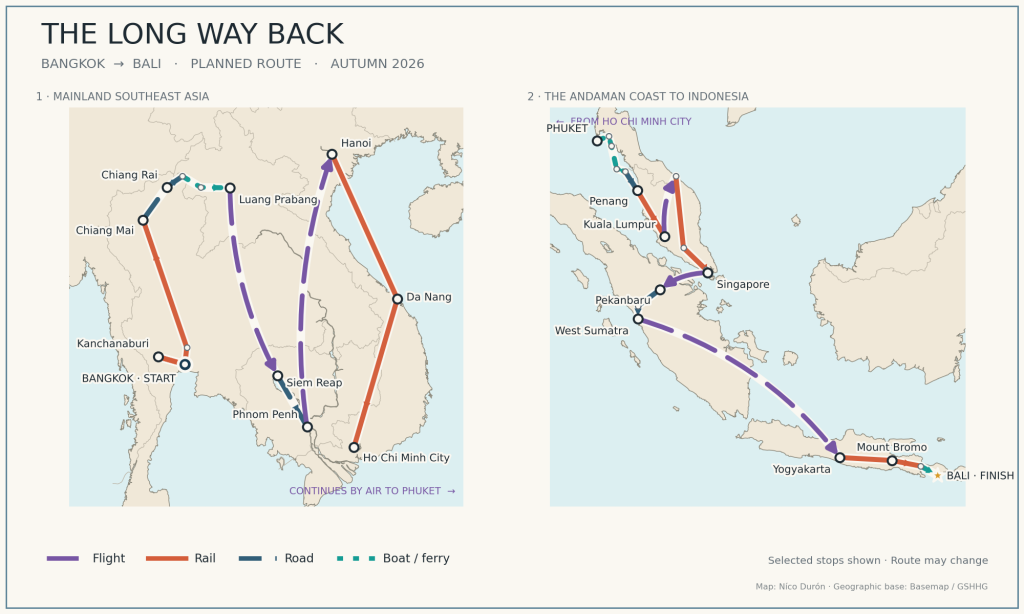
From there, we plan to travel roughly along the Banana Pancake Trail: north through Thailand, cross into Laos and take the slow boat down the Mekong to Luang Prabang. We will continue through Cambodia and then travel through Vietnam from north to south. After that, the route should take us through southern Thailand, Malaysia and maybe Singapore before we finally enter Indonesia.
There, the journey will become more personal still. We hope to spend time in Sumatra, where my husband grew up and where much of his family remains, before continuing through Java and eventually crossing by ferry to Bali.
That, at least, is the plan.
Routes have a way of changing once they encounter missed trains, tropical rain, exhaustion, unexpected invitations and the discovery that somewhere deserves more time than we gave it on a spreadsheet. This is not an expedition with every hour accounted for. We know the general direction. Much of the rest will reveal itself along the way.
What are we expecting?
There are the obvious expectations: heat, monsoon rain, extraordinary food, crowded cities, long train journeys, temples, mosques, rivers, islands and traffic that may make us reconsider some of our life choices.
But I am also expecting to discover how much I do not understand. I have many important questions:
-
- Why have people repeatedly built some of the world’s most densely populated societies along the Pacific Ring of Fire, despite the constant threat of volcanic eruptions, earthquakes and tsunamis? What does this dangerous landscape offer in return?
- Why does animal life change so abruptly between Bali and neighbouring Lombok, despite the islands being separated by only a narrow strait? What can Wallace’s Line teach us about evolution, ancient geography and the movement of species?
- How did Southeast Asia’s modern nations emerge from older kingdoms, colonial borders and struggles for independence? Why have their political paths diverged so dramatically? Why is Myanmar still trapped in civil war, why did Vietnam become a battleground of the Cold War, and how did Thailand avoid formal colonisation?
- How did landlocked, officially neutral Laos become the most heavily bombed country per capita in history, with American aircraft dropping more than two million tonnes of ordnance between 1964 and 1973? Why was this “Secret War” fought? And how do unexploded bombs continue to shape farming, development and everyday life more than half a century later?
- What drove successive outside powers — from imperial China and the European empires to Japan and the United States — to conquer, colonise, occupy or dominate parts of Southeast Asia? What did they want, and how did they justify taking it?
- How did Hinduism, Buddhism, Islam and Christianity reach the region, and how did they interact with the older animist traditions already there? If most people inherit the religion dominant where they happen to be born, to what extent is religious belief ultimately a consequence of geography and history?
- Can ASEAN turn Southeast Asia’s extraordinary diversity into genuine collective power? Could the expansion of BRICS — now including Indonesia— signal a longer-term shift away from Western dominance, and have Donald Trump’s tariffs and “America First” policies accelerated that shift?
- How did Singapore rise from a colonial trading port—and from the catastrophic 1942 defeat that Winston Churchill called “the worst disaster and largest capitulation in British history”—to become one of the world’s richest and most successful states?
- Why have seas so often connected Southeast Asia while mountains and jungles divided it, and how has that shaped everything from language and religion to trade and political power?
- Has the constant meeting and mixing of peoples made Southeast Asia more creative, prosperous and resilient, or has it also produced new forms of inequality, conflict and exclusion?
I do not expect one journey to provide definitive answers. But these are some of the questions I want us to carry from Bangkok to Bali, and to keep asking whenever the realities we encounter challenge what we thought we understood.
For months, I have been reading and writing about Southeast Asia: its geography, its early peoples, the influence of India and China, the arrival of Buddhism, Hinduism and Islam, the struggle for trade and empire, and the extraordinary differences hidden beneath one convenient regional name.
Research can tell us why a temple was built, how a kingdom became powerful or why a religion spread along a particular trading route. It cannot tell us what it feels like to stand there. It cannot reproduce the sound of a city waking, the taste of the local food, the silence inside a sacred place or the conversation that begins when a stranger decides to talk to you. The history will travel with us, but reality will be allowed to contradict it.
I am also curious about what my husband will see. This is partly a return home for him, but it is also a journey through countries he has never visited, yet for which he needs no visa. How will he experience Indonesia after living in Europe? What will it feel like to return to Sumatra with me as his husband? What will be familiar, and what may now appear different? I know from my own experience that leaving your native land to live in a different country means that both nowhere and anywhere can feel like home.
And then there is the smaller but by no means insignificant question of what will happen when two people carry backpacks through Southeast Asia together for several months. Travel reveals landscapes and cultures. It also has a habit of revealing the people doing the travelling.
Understanding what we see
This series grows out of a larger writing project called Understanding Southeast Asia: The Essential Companion to Our Bangkok–Bali Journey.
As I prepared for the trip, I realised how little many of us in Europe know about this enormous and important part of the world. We recognise some of its images such as golden temples, rice terraces, beaches, monks, motorbikes and tropical forests, yet without necessarily understanding the forces that created the societies behind them.
Southeast Asia has stood for centuries at a crossroads between India and China and between the Pacific and Indian Oceans. Its peoples carried languages and cultures across immense stretches of sea. Merchants brought religions, ideas, technologies and empires. Volcanoes created fertile land; rivers supported kingdoms; monsoons governed agriculture and trade. Later came European colonialism, Japanese occupation, wars of independence and some of the defining conflicts of the Cold War.
All of that history remains present in the places through which we will travel. Sometimes it survives in monuments and museums. Sometimes it is visible in food, language, religious practice or the shape of a city. Sometimes it lies beneath the surface and has to be looked for.
We do not only want to see Southeast Asia. We want to understand what we are seeing. Or at least to try.
That attempt will form one part of this series. Some entries will draw upon the historical project, shortened and reshaped into readable introductions to the countries, religions and places along our route.
Other entries will be written from the road: what happened, whom we met, what surprised us, what went wrong and whether the reality resembled anything we had imagined beforehand.
There will also be photographs and short videos — not polished television documentaries, but attempts to capture something words cannot: the sounds, movement, faces, weather and ordinary details through which a place becomes real.
Together, I hope these pieces will become more than a record of where we went. They will be an account of what we noticed, what we learned and where our assumptions proved inadequate.
The long way back
If everything goes approximately according to plan, our journey will end with a ferry crossing from Java to Bali.
I will return to the island where, in December 2023, I left my sleeping son at the hotel and followed an inexplicable pulse of energy into the night. This time, the young man who waved me over will be travelling beside me.
I told him that night that I was not the man who would take him to Europe.
He smiled and said, “We’ll see.”
He was right about me. But neither of us could have known that, nearly three years later, we would be setting out together on the long way back to where it all began.