The Accidental Outsiders

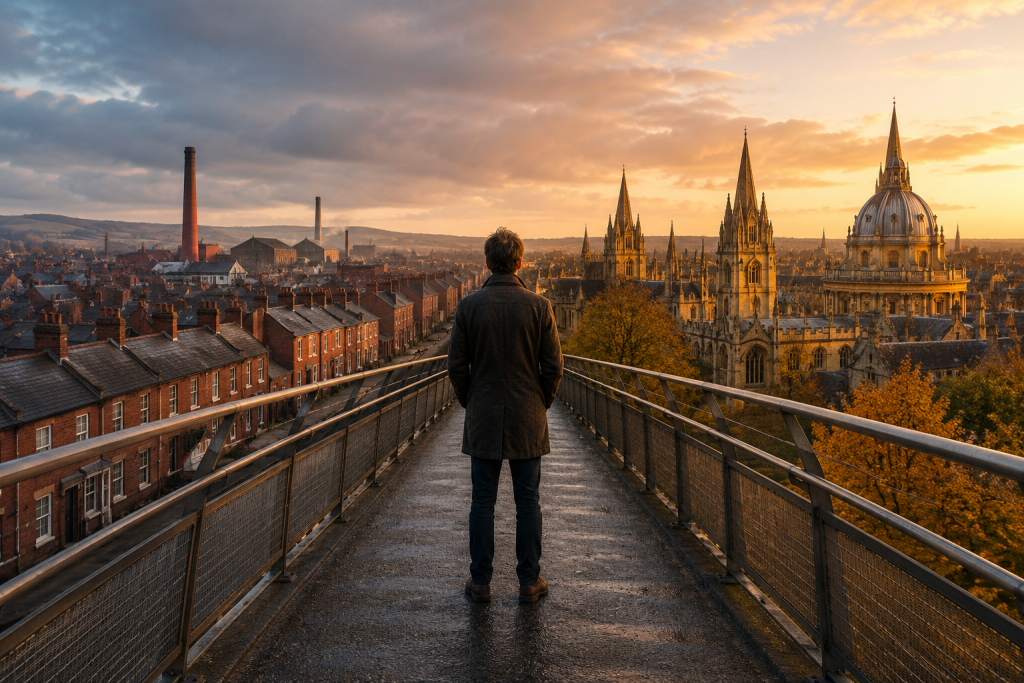
Accidental outsider on a bridge with the University of Oxford University on the right and a northern English town on the left.
Why We Need More Than One Perspective

I have come to realise that the most valuable education I ever received was learning to see the same country from two completely different points of view.

I was reminded of this recently while listening to Andy Burnham speak about the “Makerfield test”: his promise that national policy should be judged by whether it improves life in places such as Makerfield, rather than merely satisfying the economic and political orthodoxies of Westminster.

I was attracted to the idea immediately. That was not altogether surprising. Burnham and I have several things in common.

We both came from relatively humble backgrounds in the North of England. We both went on to study humanities at Oxbridge — English at Cambridge in his case, French and German at Oxford in mine. We both entered worlds far removed from those in which we had grown up. And both of us, in very different ways and on vastly different public stages, appear to have become increasingly interested in the distance between the Britain described by its institutions and the Britain experienced by many of its people.

That does not mean I agree with Burnham on every issue. I don’t.

What interests me is the journey between two social worlds, and what that journey allows a person to see.

Learning to see two Britains

Social mobility is normally described as movement in one direction.

A child from an ordinary background works hard, receives a good education, enters a prestigious university and rises into a more prosperous or influential part of society. The story is presented as an escape: departure from one world and successful arrival in another.

But that is not quite how it feels. You do not necessarily leave the first world behind. Instead, you acquire a second vantage point.

At Oxford, I encountered people whose intelligence and talent were undeniable. But I also encountered people who had been prepared from childhood to enter rooms in which power was exercised. They understood the vocabulary, the conventions and the unwritten rules. They spoke to professors, employers and authority figures with an assurance that did not always reflect greater ability. It often reflected something simpler: nobody had ever suggested to them that the room might not belong to them.

This is one of the least discussed advantages of privilege.

Privilege does not always announce itself as wealth. Sometimes it appears as confidence. It appears as ease in unfamiliar surroundings, freedom from embarrassment, fluency in the language of institutions and the assumption that one’s opinions will be heard.

To the person who possesses these advantages, they may feel like competence.

To the person who does not, the absence of them may feel like personal failure.

Crossing the class divide teaches you to recognise the difference.

You remember the families for whom an unexpected bill is not an inconvenience, but a crisis. You remember people who are intelligent but have never been encouraged to think of universities, professions or public life as places for them. You remember how authority looks from below.

But you also begin to understand the people who design policies, manage institutions, allocate capital and shape public debate. You learn their language. Sometimes you become one of them.

You see Britain from both sides.

What economic success looks like from below

This double vision changes the meaning of economic statistics.

A government announces that the economy is growing. The stock market rises. Corporate profits increase. Property becomes more valuable. Ministers point to employment figures and national averages as evidence that the country is succeeding.

All of these measurements may be accurate.

But they do not answer the most important question:

Who is experiencing the success?

A rise in property prices is good news for someone who owns several properties. It may be disastrous for somebody trying to buy a first home.

A strong stock market enriches people with substantial investments and pensions. It means far less to families who own no financial assets and are struggling to pay their electricity bills.

Growth can take place while public services deteriorate. Average wealth can rise while wealth becomes more concentrated. Employment can remain high while wages fail to provide security, housing or hope.

Seen from Westminster, these may appear to be complications within an otherwise successful economic model.

Seen from Makerfield, or from many towns across northern England such as Runcorn where I grew up, they may be the model’s most important result.

This is why Burnham’s test has such immediate emotional force. It asks politicians to stop treating people as supporting evidence for an economic theory and instead ask whether the theory is improving their lives.

But it also reflects a more general truth: your assessment of any system depends partly on where you are standing inside it.

The education hidden inside the humanities

There may be another reason Burnham and I are drawn towards this way of thinking.

Neither of us studied economics, management, law or PPE. We studied humanities.

In modern public debate, the humanities are often treated as decorative. Science, technology and economics are described as useful, while literature, languages, history and philosophy are expected to justify their existence.

But the humanities teach something our political and economic systems desperately need.

They teach us to enter realities other than our own.

A novel asks us to inhabit another person’s consciousness. History asks how people and societies arrived at their present condition. Philosophy asks what we owe one another. A foreign language teaches that our own way of dividing, naming and expressing reality is not the only possible one.

Studying French and German did more than enable me to communicate in other languages. It challenged the unconscious assumption that the British way of seeing the world was the natural or neutral one.

Living abroad later deepened that lesson.

After 16 years in Germany, and now beginning a new life in Spain with an Indonesian husband, I no longer see Britain entirely from within Britain. Europe is not an abstract bureaucracy called “Brussels”. Migration is not simply a number in a newspaper. Borders, residence rights and administrative systems are no longer theoretical matters. Foreign policy is no longer conducted in distant countries inhabited by anonymous populations.

To live between countries is to acquire another form of double vision. You become what I term “an accidental outsider.”

You see your own nation more clearly because you are no longer surrounded by its assumptions, something I had experienced at an abstract level in the writings of Diderot and Voltaire.

You also become more suspicious of political systems that can calculate the economic cost of a decision while remaining curiously unable to imagine its human consequences.

Data can tell us where poverty exists.

Literature may help us understand what poverty does to a person.

Economics can measure migration.

Languages and lived experience may help us understand what it means to become a migrant.

Statistics can tell us that a region is declining.

History can explain why its people no longer trust the institutions announcing the latest programme for their renewal.

The humanities are not a retreat from the real world. They are among our best defences against governing that world without sufficiently understanding the people who live in it.

Britain’s geography of power

The same question of perspective applies to the way Britain is governed.

The United Kingdom remains extraordinarily centralised. Regions with distinct histories, economies and identities are repeatedly expected to apply for funding, permission or attention from London.

The underlying assumption is rarely questioned: wisdom and legitimacy become more concentrated as one moves closer to Whitehall.

Burnham’s political experience in Greater Manchester has led him towards a different conclusion. His argument for greater devolution is not merely that Westminster sometimes makes the wrong decisions. It is that Westminster makes too many decisions in the first place.

This matters because the centre inevitably sees places differently from the people who live there.

From London, a town may appear as a collection of indicators: productivity, employment, educational attainment, transport connectivity and levels of deprivation.

From inside that town, it is a network of memory, identity, family, opportunity and loss.

Policies designed remotely may be rational in aggregate and destructive in practice. They may improve a national average while hollowing out a particular community. They may create efficiencies that look impressive in a report and feel like abandonment on the ground.

Perhaps Britain’s problem is not simply that Westminster has forgotten the North.

Perhaps the deeper problem is that Westminster still believes it has the right to remember the North on the North’s behalf.

Social mobility is not enough

For decades, Britain has presented social mobility as the answer to inequality.

Find talented children from modest backgrounds. Help them reach excellent universities. Allow them to enter professions and institutions previously closed to them.

That is worthwhile. My own life was transformed by educational opportunity.

But there is an uncomfortable limitation to this model.

Social mobility can help individuals escape an unequal system without making the system itself more equal.

A society cannot solve regional poverty by helping a small number of successful young people leave poorer regions. Nor can it solve class inequality simply by allowing exceptional individuals to join an existing elite.

The question is not only how many people can climb the ladder.

We must also ask who built the ladder, where it leads, and why so many people are expected to remain beneath it.

The greatest social value of mobility may therefore lie not in personal advancement but in the perspective carried across the divide.

Institutions need people who know what those institutions look like from outside.

Universities need people who remember what it felt like to believe university was “not for people like us”.

Governments need people who understand that a policy can be statistically successful and humanly disastrous.

The media need people who recognise that the national conversation is often conducted in a language millions of citizens neither use nor trust.

And prosperous societies need people who understand that poverty is not merely the absence of money. It is often the absence of margin, choice, confidence and the expectation of being heard.

The responsibility of seeing both sides

There is, however, no automatic virtue in crossing a social boundary.

People can enter privileged institutions and adopt their assumptions completely. They can use education to distance themselves from their origins. They can become more contemptuous of those who did not make the same journey, imagining that personal success proves the system is fair.

Indeed, meritocracy can create a particularly unforgiving elite.

If successful people believe they reached the top entirely through talent and effort, they may conclude that everybody who remained below simply failed to try hard enough.

Double vision, or becoming an accidental outsider, must therefore be preserved deliberately. It requires memory. It requires humility.

It requires an awareness that intelligence is widely distributed even when opportunity is not.

It also requires resisting the comforting idea that entering a powerful institution means fully understanding the people over whom that institution exercises power.

This may be the most valuable thing a person from a modest background can carry into an elite room: not authenticity as a performance, nor a sentimental claim to represent everyone they grew up alongside, but the knowledge that the world looks radically different depending on which side of the door you occupy.

The most important education

Oxford changed my life.

It gave me knowledge, confidence and opportunities my younger self could scarcely have imagined. It introduced me to languages, cultures and ways of thinking that eventually carried me far beyond the country in which I was born.

But Oxford was only one part of my education.

The North taught me how power looks from a distance.

Oxford taught me how power explains itself.

Teaching showed me how institutions affect individual lives.

Living abroad taught me to see Britain from the outside.

And moving between these worlds taught me that no single vantage point is sufficient.

This is what I recognised in Burnham’s Makerfield test: not a complete political philosophy, and certainly not an answer to every difficult national and international question, but an insistence that perspective matters.

Who is speaking?

Where are they standing?

What can they see from there?

And what remains invisible to them?

We spend a great deal of time asking how to help more people cross Britain’s class divide.

Perhaps we should ask an additional question: how do we ensure that those who cross it employ their experience to create a fairer society?

“I thought about the breaks that had scored the rhythm of my life. Expansion through rupture. Where others built continuity, I built awareness. And though that awareness didn’t make me happy, it had made me lucid. These breaks had been my real education — violent scholarships in the art of seeing.”  — Níco Durón, Teacher, there are things that I don’t want to learn.

When I Lost God, I Found the Universe

God declares his glory at the rising of the sun.
Photo taken with Oppo X9 on 7th July 2026 at 06:37 am, f2, 15 mm.

“The heavens declare the glory of God.”

For almost ten years, belief in God shaped the way I looked at the night sky.

This morning, at six o’clock, I realised how completely that has changed.

I began my usual jog while Torremolinos was still asleep. The promenade along La Carihuela was almost empty. The only sounds were the rhythmic slap of my trainers against the pavement and the gentle breathing of the Mediterranean.

I reached the harbour wall at Benalmádena just before sunrise.

The sea looked like polished, rippled glass.

Above me, Venus still shone brightly in the deep blue sky while the first orange light slowly crept over the mountains of the Sierra Nevada. They didn’t merely look beautiful. Those mountains are themselves the product of millions of years of continental collision, uplift and erosion. Even the backdrop to an ordinary sunrise carries an almost unimaginable history.

I sat. I started my meditation. I breathed. Then I opened my eyes and watched.

As the Sun finally appeared above the horizon, I found myself overwhelmed — not with worship, but with wonder.

Not because I imagined someone had painted the sunrise for me.

But because I knew what I was actually looking at.


Seven facts that never fail to humble me

Brian Cox has a wonderful gift.

He reminds us that reality is almost always far more astonishing than fiction.

Here are six examples.

1. You are travelling faster than a bullet…

…while sitting perfectly still.

The Earth rotates at about 1,670 km/h at the equator.

It orbits the Sun at roughly 107,000 km/h.

Our Solar System orbits the centre of the Milky Way at about 828,000 km/h.

Meanwhile, the Milky Way itself is hurtling through space at over two million kilometres per hour relative to the cosmic microwave background.

Right now, we are moving through the universe at extraordinary speed. We  simply don’t notice because everything around us is travelling with us.


2. There are ten billion times more planets than hours since the Big Bang

Astronomers now estimate that our Milky Way alone contains around 100–400 billion stars, with most stars likely possessing planets.

Across the observable universe there may be around 10²⁴ planets.

That is one septillion planets.

If every second since the beginning of the universe represented one planet, you would still not have counted even a microscopic fraction of them.


3. Every atom inside your body is older than the Earth

The iron in our blood, the calcium in our bones, the oxygen we are breathing were all forged inside ancient stars that exploded billions of years before the Sun even existed. We are literally made of stardust.

Carl Sagan famously summarised it beautifully:

“We are a way for the cosmos to know itself.”

Literally.


4. The Mycoplasma cell

One of the smallest living things on Earth is a bacterium called Mycoplasma.

Around 5,000 of them placed end to end would stretch only one millimetre.

Yet inside that microscopic cell is a membrane, half a million DNA letters, hundreds of genes, molecular factories called ribosomes, and thousands of proteins performing countless chemical reactions every second.

It isn’t a blob. It is a self-maintaining chemical factory. And it’s alive.

That is magnificent.


5. There are more microbes living inside you than people who have ever lived

The average human body contains roughly 38 trillion bacteria, most living in the gut.

Without them, we couldn’t digest food, produce certain vitamins or even maintain a healthy immune system.

We are not one organism.

We are an ecosystem.


6. Everything alive is literally related.

A blue whale…

an oak tree…

a hummingbird…

a mushroom…

an octopus…

the bacteria living inside your intestine…

and you…

all use essentially the same genetic code.

Every living thing on Earth is related.

Not poetically, metaphorically or mythically.

Literally.


7. Tonight, when we look at the stars…

…we are looking into history.

The light from the Moon is about 1.3 seconds old.

From the Sun? Eight minutes.

From the nearest large galaxy, Andromeda? About 2.5 million years.

The light entering our eyes tonight began its journey when our ancestors were making stone tools.

The James Webb Space Telescope now observes galaxies whose light has travelled for more than 13 billion years.

We do not merely look across space.

We look backwards through time.

I honestly struggle to imagine anything more astonishing than that.


Then I remembered another way of seeing all this

There was a period of my life when I believed something very different.

For nearly ten years I was an evangelical Christian. I believed that God had created the heavens and the earth by speaking.

Genesis begins:

“And God said, ‘Let there be light,’ and there was light.”
— Genesis 1:3 (NIV)

I was taught that the universe ultimately existed to reveal God’s glory.

That human beings had been created to worship Him.

That no sunset, no mountain and no star could ever truly satisfy unless it led us to thank its Creator.

One argument particularly stayed with me.

What is the point of experiencing something beautiful, if you have nobody to thank for it?

At the time, that sounded deeply persuasive. Today, it doesn’t.


Wonder no longer needs an author

Ironically, losing my belief in God did not make the universe smaller.

It made it unimaginably larger.

Instead of being told the answers, I discovered questions.

Instead of certainty, I found endless curiosity.

Instead of myth, I found history.

Every mountain. Every whale. Every oak tree. Every coral reef. Every human brain. Every galaxy. Every living cell.

Each became vastly more interesting once I understood that none of them appeared fully formed.

Each carries within it an astonishing history stretching back billions of years.

Reality became deeper than any miracle story I had ever been taught. As I write the last chapter of my first novel:

Yet one certainty remains: we are constellations of atoms, stardust reassembled by chance and time, hurtling around our sun on a rock at 67,000 mph. DNA coils like ancient runes in every cell, issuing silent instructions: become, live, persist. From this choreography comes breath, thought, memory: a mother’s laughter, longing for distant places, a lover’s hand in the dark. We invent gods and heroes, build cathedrals and poems, grieve, and love. All this from fragile molecules wrapped in skin. Just chemistry. An echo of evolution.

And yet: is it not a miracle that matter dreams at all?

Today, I no longer see humanity as separate from nature. I know that the cells in my own body, the bacteria in my intestine, the dolphins swimming off this coastline, the pine trees on the Sierra Nevada and the swallows flying overhead are all distant cousins on one immense family tree stretching back nearly four billion years. Human unity is not simply a moral aspiration. It is a biological fact. So too is our kinship with every other living thing on Earth.


Does meaning require a creator?

I no longer think so.

Watching today’s sunrise did not feel empty because I wasn’t thanking somebody.

Quite the opposite.

It filled me with gratitude.

Not gratitude directed upwards.

But gratitude simply for existing at all.

For having evolved into a creature capable of understanding even a tiny fragment of what the universe is.

That is more than enough for me.


One unintended consequence

There is one further implication that I hadn’t appreciated when I was a Christian.

Some believers sincerely conclude that because God will one day replace this present world with “a new heaven and a new earth” (Revelation 21:1), environmental destruction is ultimately temporary.

Many Christians reject that conclusion and instead argue that humanity has a God-given responsibility to care for creation. I respect that view.

But I have encountered the first attitude often enough to think it matters.

Once this world becomes merely a waiting room for the next, its long-term future can begin to feel less urgent.

My own perspective has moved in the opposite direction.

If this is the only Earth our civilisation will ever inhabit, then every forest matters. Every coral reef matters. Every species matters.

Because this extraordinary planet is not a rehearsal.

It is home. Not just for human beings, but for every sentient fish, every majestic bird, every minuscule Mycoplasma.


Which story leaves you more awestruck?

One story says:

“And God said, ‘Let there be light.'”

The other says:

Hydrogen formed shortly after the Big Bang.

Gravity slowly gathered it into stars.

Those stars forged heavier elements.

Some exploded as supernovae.

Those atoms became planets.

One of those planets developed self-replicating chemistry.

After nearly four billion years of evolution, one species evolved capable of asking where it came from.

I know which story leaves me speechless.

Not because it is comforting.

But because it is true.


“The most beautiful experience we can have is the mysterious. It is the fundamental emotion that stands at the cradle of true art and true science.”
Albert Einstein

Why Did Nobody Teach Me This at School?

What history should really teach
How a Spanish football shirt unexpectedly changed the way I think about history, education and the origins of our globalised world.

I recently bought a Spanish football shirt to wear at a bar while watching Spain’s 3:0 win against Austria on Thursday.

That simple purchase unexpectedly led me down one of the most fascinating rabbit holes I have explored in a while.

It began with two Latin words embroidered on Spain’s coat of arms: Plus Ultra.

I knew from my school-Latin what the words meant, further beyond, but I still needed some context to understand the meaning.

A little research revealed that they are a reference to the Pillars of Hercules at the Strait of Gibraltar. For the ancient world, these marked the edge of the known earth. The old warning was “Non Plus Ultra” nothing lies beyond.

Then came the voyages of exploration.

The warning became an invitation.

There was indeed more beyond.

That discovery prompted another question.

Christopher Columbus sailed for Spain. Yet I vaguely remembered reading somewhere that he was Italian. Was that right?

It was. I kept digging.

Born in Genoa, Columbus spent years trying to persuade different European rulers to finance his ambitious plan to reach Asia by sailing west. It was only when the Spanish Crown agreed to back him that history changed forever.

Then I discovered something even more surprising.

Ferdinand Magellan, whose expedition first circumnavigated the globe, wasn’t Spanish either. He was Portuguese. And he himself was killed in the Philippines before the expedition was completed.

Like Columbus, he simply happened to be sailing under the Spanish flag.

As I kept digging, I also learnt for the first time why America is called America and why the Pacific is called the Pacific. I learnt why Brazil speaks Portuguese while much of South America speaks Spanish, why Spain became one of history’s great global powers, how its sudden enormous wealth became a resource curse, and, most strikingly of all, how all these historical facts are mirrored in the events happening in the world today.

By now, all this led to another kind of question:

Why was I only learning this as I approach retirement?

None of these are obscure historical curiosities.

They explain the world we live in.


The more I thought about it, the more I realised that perhaps history has often been taught backwards.

Schools understandably devote considerable attention to national history. In Britain, we studied the Tudors, the Industrial Revolution and the Second World War. In Germany, where I spent many years teaching, National Socialism understandably occupies a central place throughout secondary education.

These are all profoundly important topics.

But too often history becomes an exercise in remembering names, dates, battles and treaties.

The examination rewards recall.

Real understanding often comes later.

History is not simply the story of what happened.

History can be the highly relevant explanation of why today’s world looks the way it does.

Why does almost an entire continent speak Spanish?

Why is Brazil different?

Why was Córdoba (Spain) once much bigger and more important than London?

Why are Europe and Latin America still so culturally intertwined?

Why and how did globalisation begin centuries before the Internet?

Those are historical questions too.

They just happen to illuminate the present rather than merely describe the past.


While I was training teachers at the University of Sussex, one of the finest history lessons I have ever witnessed contained almost no conventional history.

The young trainee teacher warned parents in advance that the lesson would be unusual.

She darkened the classroom. She played the sound of air-raid sirens followed by distant explosions. Beforehand, she asked the children to climb underneath their desks and lie silently on the floor with their eyes closed.

For several minutes they simply listened.

Afterwards she asked them to write, not about dates, military strategy or political leaders, but about how they had felt.

For a brief moment, those children had experienced uncertainty, vulnerability and fear. Not the reality of war, of course, but enough to begin imagining what it might feel like to be a child living through one.

I have forgotten countless historical dates since leaving school. I have never forgotten that lesson.

Nor, I suspect, have the children who experienced it.

That teacher wasn’t merely teaching history.

She was teaching empathy and vividly demonstrating how history is so relevant to life in the 21st Century.


As I have grown older, I find myself increasingly drawn to education that asks questions rather than rewards memorisation.

The same thought has appeared repeatedly in my recent writing about economics.

Financial literacy is not really about memorising definitions.

It is about understanding why economies behave as they do.

Likewise, history should not simply teach us to remember what happened.

It should help us understand why our world became what it is.

Perhaps that is why I have found these discoveries in Spain so unexpectedly exciting.

I wasn’t simply learning historical facts.

I was discovering connections.

The voyages of Columbus and Magellan were not isolated adventures.

They marked the beginning of the first great wave of globalisation.

Trade routes expanded.

Ideas travelled.

Plants, animals, diseases and cultures crossed oceans.

The Mediterranean outside my window here was once dry land – another fact I was unaware of. It is only thanks to the Zanclean Flood that water entered from the Atlantic through the Strait of Gibraltar and opened up the possibility of a future global trade highway.

The world became permanently interconnected.

Five centuries later we are still living with the consequences.

History also reminds us that no civilisation remains permanently at the top.


Sometimes I wonder whether schools unintentionally leave us with the impression that education ends when we pass our examinations.

In reality, the opposite is true.

The most rewarding learning often begins afterwards.

It begins when curiosity replaces obligation.

When we are no longer asking, “Will this be in the exam?”

Instead we ask, “Why did nobody ever explain this?”

Perhaps that is the real purpose of education.

Not to fill our minds with information.

But to awaken a curiosity that lasts for the rest of our lives.

“The real voyage of discovery consists not in seeking new landscapes, but in having new eyes.”
— Marcel Proust

When a Country Gets Richer, Who Owns the Wealth?

Wealth. A man reading a financial newspaper about who owns Spain's wealth in the background.A newspaper headline over breakfast in Spain made me question something I’d never really considered before. When a country’s economy is booming, who actually owns the wealth that’s being created?

One of the unexpected pleasures of moving to Spain has been rediscovering the lost art of breakfast.

Most mornings I walk to my favourite café, order a café con leche and toasted bread rubbed with fresh tomato and olive oil, then spend half an hour simply watching the town wake up. The same waiter greets familiar faces with effortless warmth. Elderly couples linger over coffee. Shopkeepers raise their shutters. Sunburnt tourists wobble by. There is something reassuring about the rhythm of ordinary life here.

A few mornings ago, however, it wasn’t the people who caught my attention. It was a newspaper.

The gentleman at the next table was reading Expansión, Spain’s financial newspaper. Across the front page was a headline that immediately made me stop.

The real owners of the IBEX 35.

The real owners?

Surely Spain’s largest companies belong to Spain.

I finished my breakfast, but the question followed me home.


The Assumption

Like most people, I have spent much of my life assuming that when a country’s economy grows, its people become wealthier. I’ve lived in Germany for 16 years, which always provided me with the perfect example.

And that is how the news is usually presented.

The economy is booming.

Corporate profits are rising.

The stock market reaches another record.

We instinctively hear those as different ways of saying the same thing.

But they are not.

Companies create wealth where they operate.

Ownership determines where much of that wealth ultimately accumulates.

The distinction sounds almost trivial.

It isn’t.

It changes the way we think about almost everything.


Creating and Owning Wealth

Imagine two people.

One spends forty years working.

The other spends forty years owning.

The first helps create prosperity.

The second receives part of the return from that prosperity.

Sometimes, of course, they are the same person.

Often they are not.

That morning, as I watched the waiter carrying coffees from table to table, it occurred to me that he was helping to create Spain’s prosperity every bit as much as a hotel owner, a banker or a company director. Every tourist welcomed, every breakfast served and every day’s work honestly completed contributes, however modestly, to a nation’s success.

Yet if one of Spain’s largest companies doubles its profits this year, a significant share of those profits may eventually belong to people who have never set foot in Spain.

The wealth is created here.

The ownership may be somewhere else.

For some reason, that simple distinction had never really occurred to me before.


A Global Story

The more I reflected on it, the more I realised that Spain was merely the setting.

This is the story of the modern world.

Capital crosses borders far more easily than people do.

That freedom has transformed our lives. It has financed innovation, built industries, connected economies and lifted hundreds of millions of people out of poverty. Few of us would seriously wish to reverse it.

Yet every system has consequences.

Perhaps the least discussed consequence of global capitalism is that it increasingly separates the place where wealth is created from the place where much of it is ultimately owned.

The two are no longer the same thing.


Britain Taught Me the Lesson Before Spain Did

Ironically, Britain had been teaching me this lesson for decades without my noticing.

Successive governments sold companies, utilities, railways, airports, property and infrastructure into private and often international ownership. We were told that this was modernisation, efficiency and the price of attracting investment. In many respects, it was.

Investment creates jobs.

Investment raises productivity.

Investment helps economies grow.

But every sale also carried another consequence.

A little more of tomorrow’s income would belong to someone else. And if the quality of a service such as buses and railways deteriorates in Manchester when the company owners sit in an office along the Champs Elysées, we should not be too surprised.

At the same time, Britain itself became a major owner of overseas assets. Pension funds, investment companies and multinational businesses accumulated wealth around the world. Perhaps that is one reason Britain has continued to generate considerable income despite producing far fewer of the manufactured goods that once defined its economy.

I had simply never connected those two facts before.

The newspaper in Spain finally joined the dots for me.


The Conversation We Rarely Have About Wealth

Political arguments usually revolve around wages, taxation or redistribution.

The left asks how wealth should be shared.

The right asks how more wealth can be created.

Both debates matter.

But perhaps they both overlook an earlier question.

Who owns the wealth before anyone starts arguing about how to redistribute it?

That seems to me to be one of the defining questions of our age.

Not because ownership should be concentrated within national borders.

Nor because global investment is somehow undesirable.

But because ownership itself has become strangely invisible.

Millions of people spend entire careers helping to create wealth while accumulating very little ownership of the economy they are helping to build.

They earn incomes.

But wages and ownership are not the same thing.

One pays today’s bills.

The other builds tomorrow’s security.


A Fairer Form of Globalisation

I have no desire to retreat into economic nationalism.

The extraordinary prosperity of the modern world owes much to capital flowing freely across borders. The challenge, surely, is not to make investment less global but ownership less exclusive.

Economic growth should not become a spectator sport in which millions of people spend their lives creating wealth they will never meaningfully own.

A healthy economy should produce not only better wages but broader ownership, because ownership is what allows one generation’s work to become the next generation’s security.

That does not require abandoning global markets.

It requires asking whether ordinary citizens have enough opportunities to become long-term owners of the prosperity they spend their lives creating.

What if governments devoted as much energy to widening ownership as they currently devote to encouraging growth?

What if employee share ownership became the norm rather than the exception?

What if ordinary citizens found it easier to build long-term stakes in productive businesses through pension funds, savings schemes and investment accounts?

What if the people whose daily work creates prosperity gradually came to own a larger share of that prosperity?

That strikes me as a far more constructive ambition than trying to turn back the clock on globalisation.


I still remember folding that newspaper and taking one last sip of coffee before walking home.

The headline had answered one question.

But it had raised another.

When we say that a country’s economy is booming, we usually ask how much wealth has been created.

Perhaps the more important question is one we almost never ask.

Who really owns the wealth that a nation’s workforce is creating?

“The political problem of mankind is to combine three things: economic efficiency, social justice and individual liberty.”
— John Maynard Keynes


Spain Governs Immigration. Britain and Germany Perform It.

Living Between Spain, Britain, and Germany

As a British citizen who has lived in Germany for fifteen years and who also has a home in Spain, I find myself moving between different moral climates when it comes to immigration. All three countries depend on migration. All three speak about it constantly. Yet they govern it with very different degrees of conviction.

Spain’s decision to regularise around half a million undocumented migrants has been widely described as bold. What strikes me more is that it feels principled. It reflects a style of leadership associated with Pedro Sánchez. Whether one agrees with him or not, he governs from a recognisable ethical framework. That framework informs domestic policy and foreign stances alike, including Spain’s willingness to articulate an independent position on Gaza. Immigration policy flows from that same seriousness. The law is being aligned with reality rather than used to perform toughness.

Germany approaches integration through procedure and moral discipline. This reflects a political culture now shaped by Friedrich Merz, a self-described capitalist whose flexibility seems to run in one direction only. Long-standing commitments are suddenly negotiable when it comes to rearmament, national debt, welfare retrenchment, or deportation rhetoric, provided wealth hierarchies remain untouched. The result is a system that demands compliance from the vulnerable while offering constant reassurance to capital. Integration becomes conditional, slow, emotionally distant, even hostile.

Britain’s problem is different but no less corrosive. Under Keir Starmer, the country is led by someone who claims a socialist inheritance but governs as a weathervane. Immigration policy shifts according to polling rather than principle. Positions harden according to headlines. The message to migrants is clear: you are needed, resented, and rhetorically punished all at the same time.

Spain, by contrast, currently shows a confidence that much of Europe lacks. It does not deny that immigration produces pressure. Housing shortages and exploitation are real. But regularisation is treated as governance, not surrender. Integration is understood as something that happens socially before it is certified administratively.

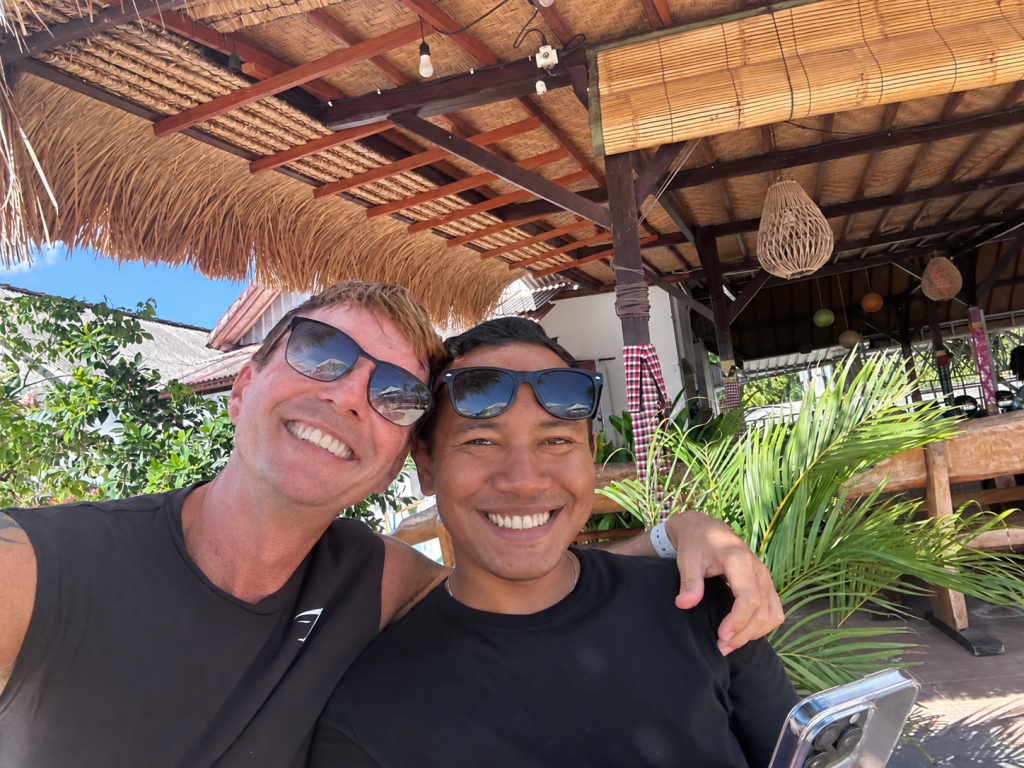
My own perspective here is sharpened by marriage. I am British, resident in Germany, and married to an Indonesian. After a year of marriage, my husband still has no residency or work permit in Germany. He is merely tolerated. In the UK, we cannot apply at all because I no longer live and work there. In Spain, later this year, he would have both residency and the right to work. Sitting together at Luca’s Café in Torremolinos, the contrast is impossible to ignore. Spain does not interrogate our presence. It respects us and welcomes us.

This difference is not accidental. It reflects political leadership. Confidence integrates better than fear. And at the moment, Spain is one of the few Western countries still willing to govern from that truth.

“Hospitality is not a gesture of kindness. It is a measure of political confidence.”
Jacques Derrida

The Electric Car Story We Should All Be Talking About

Electric cars are sold to us as the clean, ethical future: the simple solution to petrol, emissions, and climate collapse. No exhaust pipe. No fumes. No guilt. Drive electric and you’re doing your part.

But the longer I listen to the certainty around EVs — the smug finality, the “case closed” tone — the more I suspect we haven’t solved the problem at all. We’ve simply moved it.

Because “zero emissions” is only true in one narrow sense: electric cars don’t emit at the tailpipe. That matters for city air quality, and it’s not trivial. But climate impact isn’t just about what comes out of the back of the vehicle. It’s about the whole chain: extraction, manufacturing, electricity generation, and end-of-life disposal.

And yes: in many cases, electric cars really are better on the climate. A major life-cycle analysis has estimated that battery electric cars sold in Europe today can produce dramatically lower overall greenhouse-gas emissions than comparable petrol cars. That’s a real advantage, and it’s worth acknowledging.

But “better than petrol” doesn’t automatically mean “clean.” It doesn’t mean “ethical.” And it certainly doesn’t mean “no victims.

The modern electric car runs on more than electricity. It runs on minerals — and minerals have to be ripped out of the earth. The new fuel of the “green future” isn’t oil alone: it’s lithium, nickel, cobalt, graphite, and more. And the extraction doesn’t happen in glossy European showrooms. It happens in places where ecosystems are fragile, water is scarce, and the people who live nearby often have far less power to resist the pressure.

Chile is frequently held up as a symbol of this new reality. In the Atacama region, concerns have been raised for years about lithium extraction and water stress in an already arid landscape. And while “displacement” doesn’t always mean literal bulldozers and forced removals, communities can still be displaced in practice, when resources shrink, livelihoods collapse and the land becomes harder to inhabit. You don’t always need an eviction notice to be pushed off your own future.

Then comes the question nobody wants to picture too clearly: what happens when millions of EV batteries die?

Batteries degrade. Capacity drops. Replacement costs bite. Cars are written off. And suddenly we’re not looking at a futuristic revolution, we’re looking at a looming waste problem. We are manufacturing the next century’s landfill with a smile on our faces, because it feels cleaner today.

Yes, recycling exists. Yes, there are second-life uses for some batteries. Yes, policymakers talk about circular economies. But the scale is the issue. Recycling infrastructure doesn’t magically appear just because consumers feel virtuous. It requires systems, enforcement, investment, and time — and at the moment, the global EV rollout is moving faster than the uncomfortable questions that should be travelling alongside it.

So why does this side of the story still feel strangely muted?

Partly because it’s complex, and complex stories don’t trend. But partly because the car industry is not politically neutral. The automobile sector has been one of the most powerful lobbying forces shaping transport policy, regulation, and public messaging for decades. That doesn’t require a secret conspiracy. It only requires something much more ordinary — influence, money, access, timing, and the gentle steering of what gets taken seriously.

This is the deeper danger: the electric car has become a moral symbol. Question it and you’re treated as pro-oil. Doubt it and you’re dismissed as anti-progress. But this isn’t how ethical responsibility works. A solution isn’t automatically good because it comes wrapped in green language.

Electric cars may reduce emissions. But they don’t end extraction. They don’t end harm.

We’re not transitioning from dirty to clean. We’re transitioning from visible pollution to invisible supply chains, from smoke in our cities to disruption in deserts we’ll never visit.

So yes: electrification may be part of the future. But only if we stop treating it like a miracle and start treating it like what it really is: a trade-off. A compromise. A human project, built inside a world of scarcity, power and competing interests.

If we want an energy transition worthy of the name, we need more than new engines. We need transparency, better public transport, enforceable standards, serious recycling systems and the courage to count the human cost, not as an inconvenient footnote, but as part of the moral equation.

“A thing is right when it tends to preserve the integrity, stability and beauty of the biotic community. It is wrong when it tends otherwise.”
Aldo Leopold

Love, Bureaucracy, and the Borders of Europe

How a perfectly legal couple spends years fighting a system that claims to protect the family

I have always loved Europe.
I still do.

The peace, the democracy, the rule of law — these are extraordinary privileges, and I’m grateful every day to live in a part of the world that, compared to most of the planet, is safe, stable and humane.

But loving a thing does not mean lying about it.
And the deeper my own journey into the European immigration system has taken me, the more convinced I have become that something fundamental is broken — not just in Germany, not just in Britain, but across almost the entire continent.

This is not an anti-German story.
It is a story about what it feels like to do everything legally, responsibly, respectfully — and still find yourself treated as if love were a loophole, marriage an inconvenience, and foreign spouses a threat to be contained.

It is a story that could happen in almost any European capital.

It just happened to us in Berlin.


How Love Became a Test of Endurance

A few years ago, I fell in love with a remarkable man in Indonesia.
Our relationship grew quickly and deeply, and we knew we wanted to build a life together in Europe rather than in Indonesia. We planned to marry anyway, so we assumed — naively, as it turns out — that marriage and legitimacy would make the process of living together straightforward.

We were wrong.
Painfully, spectacularly wrong.


Wedding Bells, Bureaucratic Walls

Because our marriage would not be legally valid in Indonesia, we had to marry in Europe.
What we imagined would be a simple civil ceremony became a six-month odyssey through paperwork, translations, apostilles, appointments, contradictory guidance, and requirements that bordered on the absurd.

Still — we got married.
We thought the hardest part was behind us.

But marriage, we learned, is not a ticket to a shared life.
It is merely the beginning of a long, labyrinthine process designed, it seems, to test whether your relationship can outlast bureaucracy.


The Rule No One Tells You: “Apply in Jakarta, or Don’t Come at All”

Once married, we were informed of something almost nobody tells you in advance:

If you marry an Indonesian and want to live together in Europe, your Indonesian spouse must apply for a family-reunification visa from Jakarta — and only from Jakarta.

Not from Berlin.
Not from any European consulate closer to their home island.
Not from Europe on a tourist visa (which would be logical, humane, and in line with every legal principle about protecting marriage).

Jakarta.
Or nothing.

The waiting list?
One year.
We have the screenshot.

And that’s just the waiting list for you to submit your application — not the processing time afterwards.

Imagine telling any married couple in Europe:

“Congratulations on your marriage.
You will now be forcibly separated for at least 12 months.”

That is the system.
That is the norm.


One Document Wrong? Start All Over Again.

When our turn finally came, the embassy did not approve one of the documents uploaded during the online process. They asked us to delete it — and, indeed, there is a little trash-can icon on the website.

Except the icon doesn’t work.
It never has.

After weeks of emails, calls, and technical back-and-forth, the embassy’s final advice was:

“Delete your entire application and start again.”

Which, in plain language, means:

“Restart the one-year waiting list.”

It is breathtaking to realise that the legal rights of marriage can be instantly overruled by a broken trash-can icon.


Geography as a Financial Weapon

If you are Indonesian and live on Sumatra, you must pay to fly twice to Jakarta — once for biometrics, and once to collect the visa. These costs are enormous relative to Indonesian salaries.

For many families, this is simply impossible.

This is what “legal migration” looks like in practice.


The 90/180 Trap: A Long-Distance Marriage by Law

Some couples try an alternative: the Schengen visitor visa.
But that route comes with its own cruelty:

  • Your spouse can visit for 90 days maximum

  • but must then leave for another 90 days minimum

Meaning:

You may live together for three months, then be forcibly separated for six.
Three on, six off. Three on, six off. Indefinitely.

Assuming, of course, you can afford the flights between Jakarta and Europe.
Most cannot.


The Berlin Immigration Office: A Fortress Without Doors

If the embassy maze is surreal, the immigration office in Berlin is its European twin.

You cannot phone them.
You cannot email them.
You cannot speak to a human being unless you already have an appointment — and you cannot get an appointment without submitting a webform that may sit unanswered for two months.

If you attempt to enter the building to ask for help, security guards turn you away.
“No appointment, no entry.”

It is Kafka with fluorescent lighting.


When Your Appointment Arrives… It’s Too Late

In our case, by the time Berlin offered my husband an appointment, his visitor visa had expired.
They could not — or would not — offer an earlier date.

He was legally in the country.
He had proof of marriage.
He had every document required.

But the system, moving at its own glacial pace, simply shrugged.


The Catch-22: Work to Stay, But You Can’t Work Until You Stay

Here is the cruelest irony:

To obtain residency, the European spouse must prove sufficient income to support both partners.

But the foreign spouse cannot work unless they already have residency.

So if the European partner earns too little, the spouse receives only a six-month Fiktionsbescheinigung — a kind of temporary suspension of deportation, halfway between permission and limbo.

With that document:

  • You cannot work

  • You cannot earn

  • You cannot contribute

  • Therefore you cannot raise household income

  • Therefore you do not qualify for residency

This is not immigration policy.
It is a bureaucratic cul-de-sac.


And Then You Realise: If It’s This Hard for Us… What About Them?

We are educated, organised, legally married, European-based, English-speaking, German-speaking, online-competent, and persistent.

And still we nearly drowned in the system.

What must this system feel like for asylum seekers?
For people fleeing war or persecution?
For couples separated across borders with children in tow?
For those without money, stability, documents, or perfect German?

Oh yes, and in case you’re wondering, I did contemplate moving back to the UK and applied for residency for my English-speaking husband there. Our application was declined.

The system does not merely fail people.
It dehumanises them.


A Quiet Exception: The Spain Nobody Talks About

There is one place in Europe where the logic is different: Spain.

Spain has a little-known rule — almost never advertised — called arraigo social.

If you remain in Spain for two years, stay out of trouble, and integrate into community life, you can obtain legal residency.

No endless separation.
No forced poverty.
No trapdoors disguised as requirements.
No broken webforms or locked doors.

If you are married and have property there, the chances are even better.

Whatever critics say, this is a system that treats people — even undocumented ones — as human beings capable of building a life.

It is the closest thing Europe has to a humane immigration philosophy.


What This Story Is Really About

This is not a rant.
Nor is it an attack on Germany, which continues to offer extraordinary opportunities to millions of people, myself included.

It is a plea.
A testimony.
A reminder that behind every “case number” is a love story, a family, a life.

Europe prides itself on protecting marriage – see ECHR, Article 8 §§1–2.
Courts across the continent insist that “bureaucratic inefficiency is not a legitimate reason to separate spouses.”

But in practice?
The systems built to uphold those principles routinely violate them.

If Europe wants to protect its values — its humanism, its dignity, its rule of law — the immigration system is where it must begin.

Not with walls.
Not with suspicion.
But with the simple recognition that married couples should not have to fight this hard to live under the same roof.

“Bureaucracy is the death of all human action.” — Max Weber

America First, America Finished? How Trump Is Shrinking a Superpower

Trump, Asia and the New World Order

When I was flying back and forth to Indonesia last year, something on the ground kept nagging at me more than the jet lag.

It wasn’t the traffic jams or the humidity. It was the cars.

Jakarta’s new car market is now a sea of logos many Europeans and Americans still barely recognise: BYD, Chery, Geely, Great Wall, Wuling. These aren’t curiosities anymore; they’re the default options on showroom floors and in middle-class driveways. China exported about 5.9 million vehicles in 2024, with Chinese brands now taking around 65% of their own domestic market and leading global export growth.

If you want to understand why Donald Trump’s isolationist “America First” project is actually accelerating America’s relative decline, start in a Jakarta car park, not in Washington.

Because while Trump shouts about greatness into a microphone, the centre of gravity of the real economy is sliding, quietly and empirically, towards Asia.

Asia’s Rise Is No Longer a Prediction — It’s a Measurement

Asia now accounts for around 49% of global GDP (PPP). North America and Europe combined have dropped to about 39%, down from 58% in 1980. The shift isn’t subtle; it’s structural.

China alone produces about 35% of global manufactured goods, more than the next nine countries combined. Its share of global exports has risen from 3.9% in 2000 to over 14% today, while the U.S. has fallen from 12% to under 9%.

This isn’t “cheating”. It’s performance.
And Asia is performing — relentlessly.

“America First” is being matched by “Asia Busy Working”.

Planes, Cars, Chips: The Quiet Transfer of Influence

In Southeast Asia, the consumer economy has already pivoted eastward. Chinese and Korean car brands have become aspirational. Japanese brands remain strong. American brands barely appear.

And in aviation, China’s COMAC is now producing the C919, a credible competitor to Boeing’s 737 — at exactly the moment Boeing faces delays, quality concerns and real reputational damage.

Asia is no longer assembling Western dreams.
It is building its own.

America First = America Alone = America Weaker

Trump’s worldview is dangerously simple:

    • America has been “ripped off”.
    • Trade is zero-sum.
    • Tariffs can restore greatness.
    • Cooperation is weakness.

But the real effects are the opposite:

    • Allies lose trust.
    • Asia builds alternatives.
    • Global supply chains simply route around the U.S.
    • Markets become unstable.
    • The very partners America needs are pushed away.

You do not protect leadership by insulting your allies.
You simply teach them how to live without you.

The Numbers: A Superpower Living Beyond Its Means

A snapshot of America today:

Debt: ~120% of GDP, on track to hit 134% by 2035.

Exports: falling relative to global share.

Education: PISA scores below OECD average in maths.

Health: life expectancy 2 years below other rich countries.

Credit ratings: downgraded due to political dysfunction.

None of this is solely Trump’s fault — but his policies accelerate every downward curve.

The Leadership Problem

The deeper question is moral and cultural:
How does a wealthy democracy choose a leader who is twice impeached, convicted on 34 felony counts, found liable for sexual abuse, repeatedly racist, proudly uninformed — and still treated as a serious statesman?

Even a young  YouTuber like Parkergetajob often articulates policy with more coherence than the President of the United States. That alone tells a story.

The decline of leadership is a decline of standards.
And a decline of standards is the beginning of national decay.

History’s Warning Labels

The fall of great powers follows familiar patterns:

    • Rome: internal corruption, political chaos
    • Ottomans: denial, nostalgia, refusal to modernise
    • Britain: moral exhaustion + economic overstretch

The common thread?
A preference for comforting myths over uncomfortable facts.

Trumpism is exactly that:
a mythology of greatness masking a reality of shrinking influence.

America’s Choice

America is still extraordinary — innovative, creative, wealthy. But greatness today requires cooperation, competence and credibility.

Trump offers none of these.
He offers slogans, anger, division and isolation.

And in a century defined by interconnected systems, a country that isolates itself does not become stronger.
It becomes smaller.

America won’t be destroyed by China or Europe or migrants.
It will be destroyed by the comforting lie that it doesn’t need the rest of the world.


Why Populists Thrive in a Connected World

Why Has Globalisation Increased Division Instead of Unity?

Globalisation should have been our great humanising force. For the first time in history, large numbers of people can travel freely, study abroad, work internationally, and encounter cultures that would once have remained distant and unknown. We have access to films, music, literature, foods, and languages from every continent. On paper, this should have produced an age of empathy. A century in which the old barriers of race, nationality, and religion dissolved into shared humanity.

Yet the opposite has happened. As the world has opened up, political identity has hardened. Populist nationalism has surged: Donald Trump in the United States, Viktor Orbán in Hungary, Vladimir Putin in Russia, and similar strongman figures elsewhere. Racism, religious extremism, conspiracy thinking, and tribal rhetoric are resurgent. The more connected the world becomes, the more threatened people seem to feel.

This contradiction is not new. It is the old story of the Tower of Babel. Human beings build upward toward unity, creativity, and common purpose—yet something in us fractures, resists, and disperses. Even if we don’t read that story religiously, it is psychologically precise. The closer we come to real integration, the more fear arises: fear of loss of identity, loss of control, loss of status.

Globalisation has consistently been experienced not as shared enrichment but as competition. The immigrant is framed not as a neighbour, but as a rival. Cultural diversity is discussed not as dialogue, but as dilution. Political rhetoric encourages the idea that “our” way of life is being erased. The result is defensive nationalism and, increasingly, violence.

This is not inevitable. The problem is not globalisation itself, but the absence of global solidarity to accompany global interdependence. We have integrated our economies, but not our ethics. We have connected our markets, but not our imaginations.

So the question is: How do we reverse the tide? How do we turn globalisation into a force for peace, dignity, and cooperation rather than division and resentment?

Here are three foundations:

1. Global Education that Teaches Perspective, Not Propaganda
International exchange programs cannot simply be tourism or language practice; they must cultivate the ability to see oneself from the outside. To understand how one’s culture appears to others, how history shapes identity, and how dignity must be mutual. Education that only reinforces national narratives will always produce suspicion, not solidarity.

2. Freedom of the Press, Protected by Law, Not Politics
Real democracy depends on the ability to critique power. When the press becomes the instrument of governments, oligarchs, or corporations, societies fracture along invented fears. The crisis at the BBC this week is not a local scandal—it is a warning. If journalism cannot report freely, citizens cannot think freely. And if citizens cannot think freely, they cannot live together freely.

3. Cross-Border Economic Cooperation That Shares, Not Extracts
The problem is not diversity—it is inequality. When globalisation enriches a few and impoverishes many, resentment is inevitable. But when globalisation supports fair wages, sustainable industry, ecological responsibility, and shared growth, it strengthens stability rather than fear.

In short: global interconnectedness must be matched with global empathy.

We already live in one shared world. The question is whether we will learn to behave as if that is true.

Unity is not naïve. It is the only realistic future we have.

“We may have different religions, different languages, different colored skin, but we all belong to one human race.”

–Kofi Annan

The Blueberry Paradox: Why We Keep Destroying the Systems That Could Save Us

On my last day in Spain, I sat at a small café, watching three men take down decorations from the town’s recent festival. The bunting had hung across the square for days, colouring the white-washed walls with celebration. Now the tourists had gone home, and these men — quiet, anonymous, methodical — were returning the square to its ordinary face.

Their work is unremarkable. No one applauds. Yet without people like them, the whole “beautiful tourist city” collapses.
Without them, the photos don’t look charming.
Without them, the streets feel neglected.
Without them, the illusion breaks.

I found myself thinking about fishermen at dawn, hotel cleaners before breakfast, bin collectors at 4am. The quiet labour that keeps the world turning — labour that rarely receives dignity, respect, or fair pay.

Then I looked at my arm.
At the blueberries.

Yes — I have blueberries tattooed on my forearm. And no, it’s not whimsical. Or perhaps it is, but in the way truth sometimes hides inside whimsy.

The blueberries remind me that I cannot enjoy anything alone.
Not even my breakfast.

To eat a blueberry, I depend on soil, weather, farmers, packers, transport workers, supermarket staff, the climate not collapsing this particular year. My pleasure is communal, whether I acknowledge it or not.

Upside down, from a distance, the blueberries form a heart-shape. I didn’t plan that. But perhaps the body speaks before the mind is ready to believe.

The tattoo is a reminder:
You are held. Your life is made by many lives. You are not independent.

And so here’s the question that came to me in that Spanish square:

If we know we are interdependent, why do we build societies that pretend we aren’t?

Why do we reward the illusion of the “self-made individual” while the world is built by the unseen hands of others?

Why does the fisherman earn less than the financier?
The cleaner less than the consultant?
The bin collector less than the politician?

It is not rational.
It is not moral.
It is not even economically coherent.

It is, however, familiar.

And this — whether people like to admit it or not — is where Marx enters the conversation.

Marx’s Point Was Never “Everyone Should Be the Same”

Marx’s central claim was beautifully simple:
Human labour creates value.
So the people who create value should benefit from it.

That’s it.
That’s the hinge.

Marx wasn’t calling for laziness, or enforced sameness, or the death of creativity. He was pointing out that societies become obscene when those who create the conditions for life (food, sanitation, infrastructure, care) are treated as disposable.

He believed in dignity through shared labour.
In contribution as meaning.
In justice as the redistribution of the wealth that labour creates.

Which is why, though he rejected religion, Marx comes surprisingly close to Jesus.

Jesus also preached the reversal of hierarchy:

“The last shall be first, and the first last.”

Not metaphorically — economically, socially, relationally.

Both men looked at society and said:

This is upside down.
We can live differently.

Both pointed to community over competition, relationship over possession, need over greed, dignity over dominance.

And yet —
we have not built the world either of them imagined.

Not once.
Not anywhere.
Not for long.

So the question is no longer Was Marx right?
Or Was Jesus right?

The question is:

What stops us from building the just society both of them saw so clearly?

The Answer Is Not Economic. It’s Psychological.

We call it capitalism vs. communism
but the real struggle is fear vs. trust.

We hoard because we are afraid there won’t be enough.
We compete because we are afraid of being overlooked, replaced, forgotten.
We dominate because we are afraid of being powerless.
We cling to hierarchy because we are afraid of being ordinary.

Fear is the water we swim in.
Fear is the undecorated square after the festival is taken down.
Fear is the silence in the early morning before the day begins.

Marx underestimated fear.
Jesus named it, but was killed for it.

And every system we have built has collapsed for the same reason:

We would prefer to be safe than to be equal.

The Failure Was Never Marx’s. It Was Ours.

We say “communism failed” as if ideology collapsed of its own weight.
But ideas don’t fail.
Systems don’t fail.

People fail.

We fail because we want justice until justice requires something of us.
We want equality until equality asks for our privilege.
We want community until community interrupts our autonomy.

We want the kingdom of God
without the cross.

We want Marx’s dignity of labour
without surrendering status.

So we keep building worlds in which:

  • the blueberry appears magically on the table

  • the labourer remains invisible

  • and we pretend we did this alone.

The Blueberries Again

I look at my arm.
The tattoo.
The accidental heart.

A reminder that interdependence isn’t an ideal —
it’s already true.

We just live as if it isn’t.

The question is not whether a just society is possible.
We already rely on one.
Every day.
Every meal.
Every building.
Every service.
Every breath of shared infrastructure.

The question is simply:

When will we live as though we know it?

And perhaps the first step toward a better society
is simply learning to say:

Thank you.
To the fisherman.
To the street worker.
To the invisible hands.
To the ones who keep the world turning
so that the rest of us can pretend we did it ourselves.