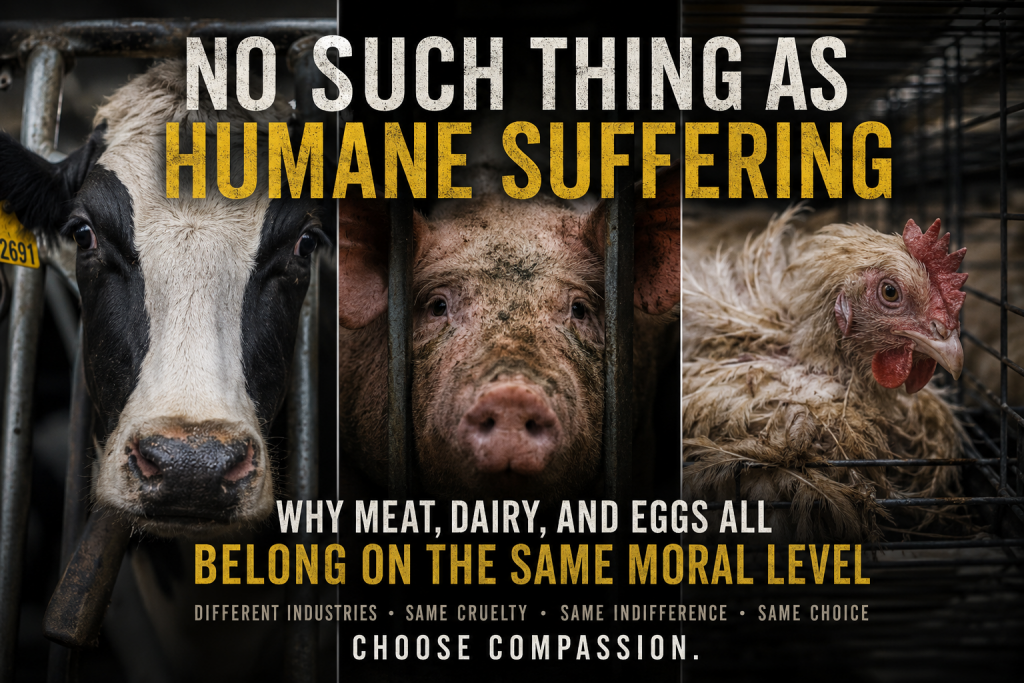
No Such Things As Humane Suffering

On my way to the shops recently, I came across a small group outside the mall. They wore Guy Fawkes masks and held laptops showing videos of animal suffering. Their banner read: Anonymous for the Voiceless.


All my life I had pushed this issue aside and carried on eating meat. But one phrase on their placard stopped me in my tracks:

“Why are my taste buds more important than the suffering and death of another living creature?”

That line wouldn’t leave me. I watched two of the videos they recommended — one by Ed Winters (UK), the other by Gary Yourofsky (USA) — and for the first time I felt obliged to reconsider my standpoint.


What I Didn’t Know

Of course I knew animals were killed for meat. But I had never really thought about the dairy industry.

    • Cows must be artificially inseminated to produce milk.
    • Their calves are taken away soon after birth so humans can consume the milk.
    • The calves’ stomachs are then used for rennet, a key ingredient in many cheeses.
    • Chickens in the egg industry live in conditions so brutal they barely warrant description.
    • Now I understand why vegans put dairy and meat on the same level. There is no such thing as humane suffering or a humane death.

Cultural Defences

In the same week, I read about Air New Zealand serving vegan burgers on flights to the USA. Carnivores were furious. MP Nathan Guy tweeted:

“Disappointing to see Air NZ promoting a GE substitute meat burger. We produce the most delicious steaks and lamb on the planet – GMO and hormone free. The national carrier should be pushing our premium products.”

So — jingoism as a defence for cruelty?


Religion and the Blind Spot

Years ago, when I still believed in God, vegetarian friends asked me why I ate meat. I had no good answer.

Looking back, I see how Christianity itself shaped my indifference. The Bible tells us that:

    • God preferred Abel’s animal sacrifice over Cain’s vegetables (Genesis 4).
    • Humans were given permission to eat meat (Genesis 9).
    • Animals lack souls and need no salvation (Genesis 1).
    • Humans are to rule over animals and nature (Genesis 1).
    • Sacrificed animals were required to cover sin (Hebrews 9).
    • This world will one day be destroyed and replaced (2 Peter 3).

With such narratives, why give thought to the suffering of animals or the destruction of the environment? When was the last time you heard a sermon in church encouraging veganism?

By contrast, many Hindus are vegetarian. In Hinduism, animals are treated with greater respect — perhaps because of reincarnation, perhaps because there is no idea that this world is disposable.


My Challenge

In conclusion, I challenge you to watch either Dominion or Land of Hope and Glory. If you do, you may find yourself with no excuses left to remain a carnivore.

“The greatness of a nation and its moral progress can be judged by the way its animals are treated. The more helpless the creature, the more it is entitled to protection.”
— Mahatma Gandhi

The rise and fall of every Christian revival

Every revival follows the same bell curve: born in protest, swollen with prophecy, and ending in the death it once defied.

Church renewal movements are born in fire, out of dissatisfaction with the lifeless liturgy of the established church, or the suffocating legalism of groups like the Exclusive Brethren. At first they return to the raw text of Scripture and gather in homes, led not by ordained clergy but by men who claim the authority of the Spirit.

Then comes structure. Buildings. Bands. Youth groups. Paid pastors.

At the crest of the curve come the prophecies: revival is coming, just around the corner, greater than anything seen before. Money is given sacrificially. Lives are rearranged. Large buildings bought. Hope is inflated into certainty.

But the revival does not come.

The failed prophecies are rarely named as failures. No serious apology is made for the emotional pressure, the money raised, or the years of expectancy spent on promises that dissolved into air. The people who joined near the beginning often remain inside the system anyway, not because the prophecy came true, but because they have built their lives inside its language. One reason the cycle works is brutally simple: those with living memory of the last false dawn are eventually buried. The cycle renews itself not by repentance, but by funerals.

On the downward slope, the message softens to attract outsiders. The sharp edges are rounded off. Meetings shortened. Speaking in tongues relegated to prayer meetings. Women step into the pulpit. Social projects begin to replace urgent evangelism. By the time the curve flattens, the movement has drifted back into the same spiritual lethargy from which it once broke free.

And somewhere, quietly, the pattern begins again.

This is not new.

The eighteenth-century Methodist revival carried the same internal logic, though in a different register. Prophecy was not usually delivered as spontaneous announcements of imminent awakening, but woven through sermons, hymns and journals. John Wesley spoke of a “work of God” spreading across England; early Methodists read their experience as the fulfilment of biblical promise, the “latter rain of the Spirit poured out again in the last days.

And yet Methodism, too, followed the curve. What began as a disruptive, Spirit-driven renewal gradually became a structured denomination.

It always does.

What is more interesting is what happens before the next rise.

Recent history gives us several variations on the same descent.

Hillsong shows what happens when a movement builds itself around energy, scale and centralised identity. For a time it feels unstoppable — global, confident, culturally dominant. But when leadership fails and the narrative fractures, the fall is sudden. Not total collapse, but deflation. What was once a movement becomes an organisation trying to stabilise itself.

Mark Driscoll represents another version of the curve: charisma outrunning character. The rise is rapid, the influence undeniable, but the culture formed around the leader cannot bear the weight placed upon it. When the collapse comes, what once looked like authority begins to look like control.

Newfrontiers offers a quieter trajectory. No great implosion, no single scandal at the centre — simply dispersal. A movement built around relational authority fragments into multiple streams. It continues, even grows, but the shared identity thins. What was once a single current becomes a cluster of networks, leaving behind a nagging feeling of dissolution.

Vineyard perhaps shows the most stable outcome of all. No collapse, no dramatic fracture — simply absorption. Its innovations in worship and church culture spread so widely that the movement itself becomes less distinct. It survives by dissolving into the mainstream it once helped reshape.

Sudden deflation. Moral collapse. Gradual dispersal. Quiet absorption.

These are different endings, but they belong to the same curve.

And beneath them lies something more uncomfortable.

These movements do not begin with authority. They begin with relief. A sudden sense that life makes sense, that one is seen, located, given purpose. Meaning becomes structure. Structure becomes authority. Authority becomes identity.

Then, slowly, the system outgrows the intensity that created it.

What felt like life begins to feel like maintenance.

What felt like truth begins to feel like language.

What felt like revival becomes, in time, another form of what it once opposed.

The bell curve is not just a pattern in churches.

It is a pattern in us.

“The most terrible thing of all is when a movement that began in passion ends in habit.”  – Søren Kierkegaard

Sovereignty Begins at the Desktop

Linux desktop workspace representing digital sovereignty, privacy and independence from big tech ecosystems

For years, choosing an operating system was treated as a consumer preference: Mac or Windows. Apple or Microsoft. Design or compatibility.

Those days are ending. Indeed, for me, they have already ended.

My move to Linux was not born of practicality. It began as an explicitly political decision: a small personal protest against what I see as the increasingly troubling direction of the United States and my growing discomfort about privacy and with Europe’s dependence on American technology.

What began as principle, however, quickly became something more exciting. An education, even.

In moving away from mainstream platforms, I discovered not merely a political statement but a better way of computing: faster, calmer, less intrusive, more user-controlled—and one that forced me to confront how casually many of us have entrusted vast quantities of personal data to a handful of foreign corporations.

Increasingly, our technology choices are no longer merely about convenience or aesthetics. They are about jurisdiction, sovereignty, dependence and trust.

The Illusion of Neutral Technology

We have spent two decades pretending that software is apolitical. It is not.

Private data is the so-called new oil.
Cloud platforms are geopolitical assets.
Operating systems are instruments of jurisdiction.
App ecosystems are channels of dependency.

To build one’s digital life entirely on American platforms is not simply to use foreign products. It is to place one’s communications, workflows, data and habits inside systems governed elsewhere.

For years, this dependency seemed harmless because America appeared stable, predictable and aligned with European interests. That assumption now looks far less secure.

Why Linux Appeals Beyond the Technically Curious

My own switch to Linux was motivated initially by principle, but sustained by practical reality.

Linux is, quite simply, excellent.

It offers:

    • greater speed and efficiency
    • far less software bloat
    • more user control
    • minimal intrusive advertising or telemetry
    • freedom from forced ecosystem lock-in
    • a calmer, more focused computing experience

It also avoids a growing trend I find exhausting in mainstream software: the transformation of operating systems into hyperactive consumer platforms.

Notifications.
Recommendations.
Prompts.
Pop-ups.
Embedded AI assistants.
Animated interfaces designed less for work than for perpetual engagement.

Linux, by contrast, still feels like a tool. Not a theme park.

My Preferred Distributions: Mint and Arch

For those exploring Linux, I find two distributions particularly compelling.

Linux Mint: Mature Practicality

Mint is Linux at its most civilised.

Stable, polished, intuitive and highly accessible, it offers a reassuringly traditional desktop experience without sacrificing elegance.

It is the Linux distribution I would recommend to most ordinary users and beginners.

Arch Linux: Radical User Ownership

Arch is a different philosophy entirely.

Minimal, modular and deeply configurable, it demands more of the user—but rewards that effort with extraordinary control.

Arch is not merely software.

It is a statement of intent:

I will shape my tools. My tools will not shape me.

Europe Is Beginning to Think This Way Too

What may once have looked like niche hobbyism is increasingly becoming state policy.

The French government has announced plans to migrate large parts of its public administration away from Windows and toward Linux as part of a broader digital sovereignty strategy.

Other European administrations are exploring or implementing similar moves, including regional and national migrations toward open-source alternatives in Germany and Denmark.

Why?

Because governments are recognising what individuals increasingly recognise:

Dependency creates vulnerability.

Reliance on foreign proprietary platforms means reliance on:

    • foreign licensing decisions
    • foreign corporate roadmaps
    • foreign legal jurisdictions
    • foreign political stability

The Great Irony: Linux Already Runs the World

Here is the part casual users often miss: Linux may still be niche on consumer desktops, but it already powers much of the digital world.

Linux runs:

    • most of the web’s server infrastructure
    • the overwhelming majority of supercomputers globally
    • vast portions of cloud computing infrastructure
    • countless embedded and industrial systems
    • even Android is based on a modified version of the Linux kernel

In other words:

Linux is not an outsider technology.

It is the backbone of modern computing.

The desktop is merely catching up.

A Warning to America — And An Opportunity for Europe

The United States should not assume technological dominance is permanent.

Consumers, institutions and governments are increasingly asking difficult questions:

    • Who controls our infrastructure?
    • Who governs our data?
    • What happens if political alignment breaks?
    • Why are we so dependent on foreign platforms for essential digital life?

If American tech firms continue to treat lock-in as strategy and complacency as entitlement, they may discover that dominance breeds resistance.

Meanwhile Europe has an opportunity.

Not necessarily to replace Silicon Valley overnight.

But to build credible alternatives.

To invest in open standards.
To support interoperable software.
To back European cloud and software infrastructure.
To treat digital autonomy as seriously as energy autonomy.

The next decade may not produce a mass exodus from American technology.

But the direction of travel is becoming harder to ignore.

Slowly, unevenly, but unmistakably.

Final Thought

My move to Linux will not alter geopolitics.

But it is, in its own small way, an expression of a wider conviction:

That technology should serve its user.
That infrastructure should remain contestable.
That dependency should never become invisible.

Linux is not merely for hobbyists anymore.

It is increasingly for those asking a larger question:

Who should control the tools on which modern life depends?

“In times of change, the learners inherit the earth, while the learned find themselves beautifully equipped for a world that no longer exists.”
Eric Hoffer

They fuck you up, your mum and dad

The Family: Where Human Flourishing Begins

We live in an age inclined to treat the family as merely one lifestyle choice among many: important perhaps, but ultimately interchangeable with any arrangement sufficiently loving and well-intentioned.

Yet history, psychology and ordinary human experience suggest otherwise.

Before the state, before schools, before therapists and welfare systems, there was the family.

It is there that a child first learns whether the world is safe; whether love is conditional; whether conflict destroys or can be survived; whether authority protects or humiliates; whether they themselves are fundamentally secure and wanted.

Long before formal education begins, the family has already taught its curriculum.

Why Family Matters

Healthy family life gives a child the internal structure from which adulthood is built: security, attachment, discipline, resilience, self-worth, emotional regulation, and a workable model of intimacy.

No family can guarantee psychological health. Human beings are too complex for guarantees and there are always external factors at play beyond the family’s control.

But stable, loving family life remains the environment most likely to produce adults capable of trust, responsibility and emotional maturity.

Children do not simply hear what parents say. They absorb what parents are and often copy what they do.

They learn from atmosphere more than instruction, from example more than ideals, from what is lived more than what is preached.

When Family Fails

But if the family is where health begins, it is also where damage often begins.

The same intimacy that nurtures can wound most deeply. The same bonds that create belonging can transmit fear, shame, addiction, insecurity, emotional neglect, and distorted ideas of love.

And the most dangerous aspect of family dysfunction is that it rarely appears dramatic from the inside. To a child, home is simply normal. What is repeated on a daily basis becomes invisible.

Many adults spend half their lives discovering that what they thought was personality, fate, or bad luck was in fact inherited emotional architecture.

“Until you make the unconscious conscious, it will direct your life and you will call it fate.” ― C.G. Jung

This truth is captured powerfully in the closing moments of the Netflix drama Adolescence, when the parents are left confronting the unbearable possibility that what has gone wrong in their son may not be separable from what was formed in their home. It is a fictional scene, but one recognisable to many families: the dawning awareness that neither parental love nor parental mistakes alone cause damage to a child.

Through a Glass, darkly — Family

From my memoir, Teacher, There Are Things That I Don’t Want to Learn (significantly redacted in order to protect my children)

The family is the first, best, and original department of health, education, and welfare. The question is: what if it goes wrong? What if the wrong is passed on? And how can it ever be put right?

What follows is not accusation, just an inventory of what moved downstream.

In prison, I began to see not only the dysfunction in my own parents, but how faithfully I’d copied it. I had fooled myself by pointing to my rebellion — I didn’t smoke, I voted Labour, I hated football, I jettisoned their culture and accent — yet I had replicated their marriage almost exactly. I was the charismatic workaholic in charge of everything; my wife stayed passively at home. Without discussion, we traded my selfish busyness under the lights for her quiet withdrawal behind the scenes.

I inherited my father’s drinking, his love-hate with public speaking, and his fear of sexual shame; from my mother, her retreat from the world when overwhelmed, and her habit of abandoning people once they’d served their purpose. From my grandmother I learned how to cook, keep house, and draw attention toward myself as the golden boy — the shining charmer whose light dimmed everyone else.

Only what was genuine seems to have survived in our four children: resilience, manners, a hatred of racism, a creative streak, a love of travel and sport, and gratitude. So yes, family goes wrong — and what goes wrong is passed on, along with what was good. Can it ever be put right? I doubt it. Maybe it isn’t meant to be. But I’ve learned, as both son and father, that while you can’t go back or make it up to your children, you can stop it, through self-awareness and responsibility, from getting worse.

Grace in parenting is complicated. We hand down the worst with the best, model life badly, and often fail to hear our children’s cries — like my son’s warning that I “worked to rest.” Yet we cannot control everything: peers, culture, the online world, the strange chemistry of temperament. Our children are miraculous mixtures of countless influences. We must accept our share of responsibility without assuming all the blame.

Grace also looks like this: once we are parents, we remain parents until we die. However badly we fail, that bond is indelible. Our only hope is that our children will become better parents than us — both despite us, and because of us.

Breaking the Chain

No one emerges from family life unmarked. The question is what we will do with that knowledge as we discover it. We cannot undo the past. We cannot parent again the children already grown. We cannot demand retroactive healing from those we wounded.

But we can become conscious. We can tell the truth. We can take responsibility for what is ours without arrogantly assuming all blame for what is not. And we can refuse to pass on everything we received.

That may be the most realistic form of redemption available to any parent. And, in that context, I wish every mother a peaceful and re-assuring Mother’s Day this coming Sunday.

“Every child begins the world again.” — Henry David Thoreau