When I Lost God, I Found the Universe

God declares his glory at the rising of the sun.
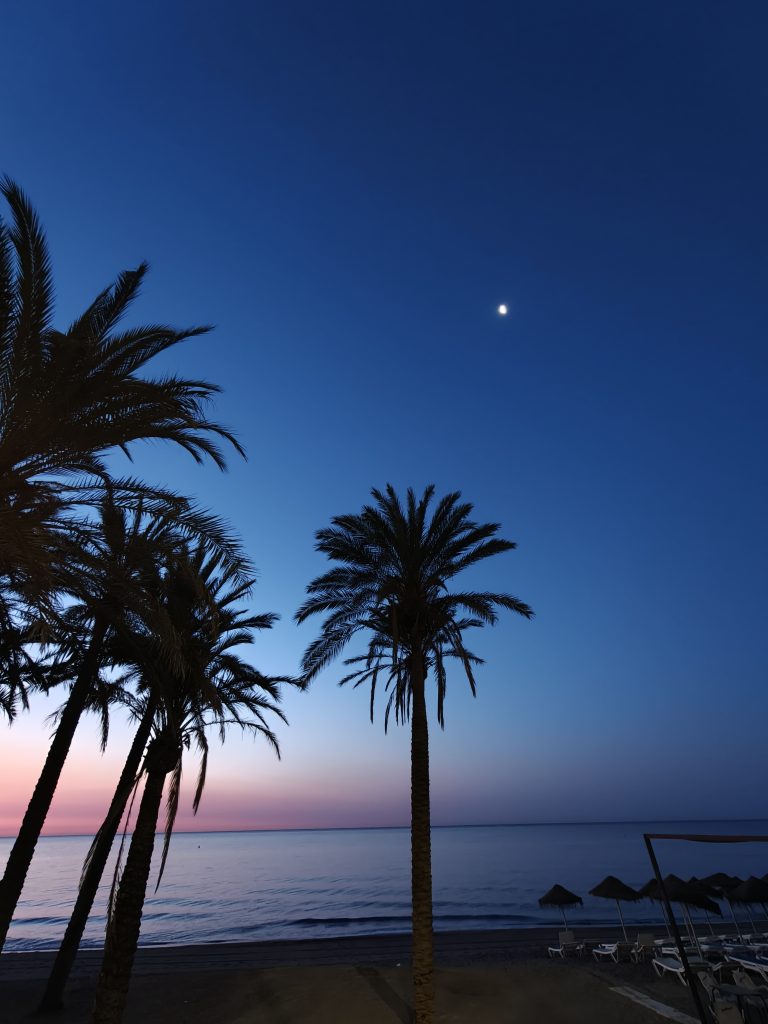
Photo taken with Oppo X9 on 7th July 2026 at 06:37 am, f2, 15 mm.

“The heavens declare the glory of God.”

For almost ten years, belief in God shaped the way I looked at the night sky.

This morning, at six o’clock, I realised how completely that has changed.

I began my usual jog while Torremolinos was still asleep. The promenade along La Carihuela was almost empty. The only sounds were the rhythmic slap of my trainers against the pavement and the gentle breathing of the Mediterranean.

I reached the harbour wall at Benalmádena just before sunrise.

The sea looked like polished, rippled glass.

Above me, Venus still shone brightly in the deep blue sky while the first orange light slowly crept over the mountains of the Sierra Nevada. They didn’t merely look beautiful. Those mountains are themselves the product of millions of years of continental collision, uplift and erosion. Even the backdrop to an ordinary sunrise carries an almost unimaginable history.

I sat. I started my meditation. I breathed. Then I opened my eyes and watched.

As the Sun finally appeared above the horizon, I found myself overwhelmed — not with worship, but with wonder.

Not because I imagined someone had painted the sunrise for me.

But because I knew what I was actually looking at.


Seven facts that never fail to humble me

Brian Cox has a wonderful gift.

He reminds us that reality is almost always far more astonishing than fiction.

Here are six examples.

1. You are travelling faster than a bullet…

…while sitting perfectly still.

The Earth rotates at about 1,670 km/h at the equator.

It orbits the Sun at roughly 107,000 km/h.

Our Solar System orbits the centre of the Milky Way at about 828,000 km/h.

Meanwhile, the Milky Way itself is hurtling through space at over two million kilometres per hour relative to the cosmic microwave background.

Right now, we are moving through the universe at extraordinary speed. We  simply don’t notice because everything around us is travelling with us.


2. There are ten billion times more planets than hours since the Big Bang

Astronomers now estimate that our Milky Way alone contains around 100–400 billion stars, with most stars likely possessing planets.

Across the observable universe there may be around 10²⁴ planets.

That is one septillion planets.

If every second since the beginning of the universe represented one planet, you would still not have counted even a microscopic fraction of them.


3. Every atom inside your body is older than the Earth

The iron in our blood, the calcium in our bones, the oxygen we are breathing were all forged inside ancient stars that exploded billions of years before the Sun even existed. We are literally made of stardust.

Carl Sagan famously summarised it beautifully:

“We are a way for the cosmos to know itself.”

Literally.


4. The Mycoplasma cell

One of the smallest living things on Earth is a bacterium called Mycoplasma.

Around 5,000 of them placed end to end would stretch only one millimetre.

Yet inside that microscopic cell is a membrane, half a million DNA letters, hundreds of genes, molecular factories called ribosomes, and thousands of proteins performing countless chemical reactions every second.

It isn’t a blob. It is a self-maintaining chemical factory. And it’s alive.

That is magnificent.


5. There are more microbes living inside you than people who have ever lived

The average human body contains roughly 38 trillion bacteria, most living in the gut.

Without them, we couldn’t digest food, produce certain vitamins or even maintain a healthy immune system.

We are not one organism.

We are an ecosystem.


6. Everything alive is literally related.

A blue whale…

an oak tree…

a hummingbird…

a mushroom…

an octopus…

the bacteria living inside your intestine…

and you…

all use essentially the same genetic code.

Every living thing on Earth is related.

Not poetically, metaphorically or mythically.

Literally.


7. Tonight, when we look at the stars…

…we are looking into history.

The light from the Moon is about 1.3 seconds old.

From the Sun? Eight minutes.

From the nearest large galaxy, Andromeda? About 2.5 million years.

The light entering our eyes tonight began its journey when our ancestors were making stone tools.

The James Webb Space Telescope now observes galaxies whose light has travelled for more than 13 billion years.

We do not merely look across space.

We look backwards through time.

I honestly struggle to imagine anything more astonishing than that.


Then I remembered another way of seeing all this

There was a period of my life when I believed something very different.

For nearly ten years I was an evangelical Christian. I believed that God had created the heavens and the earth by speaking.

Genesis begins:

“And God said, ‘Let there be light,’ and there was light.”
— Genesis 1:3 (NIV)

I was taught that the universe ultimately existed to reveal God’s glory.

That human beings had been created to worship Him.

That no sunset, no mountain and no star could ever truly satisfy unless it led us to thank its Creator.

One argument particularly stayed with me.

What is the point of experiencing something beautiful, if you have nobody to thank for it?

At the time, that sounded deeply persuasive. Today, it doesn’t.


Wonder no longer needs an author

Ironically, losing my belief in God did not make the universe smaller.

It made it unimaginably larger.

Instead of being told the answers, I discovered questions.

Instead of certainty, I found endless curiosity.

Instead of myth, I found history.

Every mountain. Every whale. Every oak tree. Every coral reef. Every human brain. Every galaxy. Every living cell.

Each became vastly more interesting once I understood that none of them appeared fully formed.

Each carries within it an astonishing history stretching back billions of years.

Reality became deeper than any miracle story I had ever been taught. As I write the last chapter of my first novel:

Yet one certainty remains: we are constellations of atoms, stardust reassembled by chance and time, hurtling around our sun on a rock at 67,000 mph. DNA coils like ancient runes in every cell, issuing silent instructions: become, live, persist. From this choreography comes breath, thought, memory: a mother’s laughter, longing for distant places, a lover’s hand in the dark. We invent gods and heroes, build cathedrals and poems, grieve, and love. All this from fragile molecules wrapped in skin. Just chemistry. An echo of evolution.

And yet: is it not a miracle that matter dreams at all?

Today, I no longer see humanity as separate from nature. I know that the cells in my own body, the bacteria in my intestine, the dolphins swimming off this coastline, the pine trees on the Sierra Nevada and the swallows flying overhead are all distant cousins on one immense family tree stretching back nearly four billion years. Human unity is not simply a moral aspiration. It is a biological fact. So too is our kinship with every other living thing on Earth.


Does meaning require a creator?

I no longer think so.

Watching today’s sunrise did not feel empty because I wasn’t thanking somebody.

Quite the opposite.

It filled me with gratitude.

Not gratitude directed upwards.

But gratitude simply for existing at all.

For having evolved into a creature capable of understanding even a tiny fragment of what the universe is.

That is more than enough for me.


One unintended consequence

There is one further implication that I hadn’t appreciated when I was a Christian.

Some believers sincerely conclude that because God will one day replace this present world with “a new heaven and a new earth” (Revelation 21:1), environmental destruction is ultimately temporary.

Many Christians reject that conclusion and instead argue that humanity has a God-given responsibility to care for creation. I respect that view.

But I have encountered the first attitude often enough to think it matters.

Once this world becomes merely a waiting room for the next, its long-term future can begin to feel less urgent.

My own perspective has moved in the opposite direction.

If this is the only Earth our civilisation will ever inhabit, then every forest matters. Every coral reef matters. Every species matters.

Because this extraordinary planet is not a rehearsal.

It is home. Not just for human beings, but for every sentient fish, every majestic bird, every minuscule Mycoplasma.


Which story leaves you more awestruck?

One story says:

“And God said, ‘Let there be light.'”

The other says:

Hydrogen formed shortly after the Big Bang.

Gravity slowly gathered it into stars.

Those stars forged heavier elements.

Some exploded as supernovae.

Those atoms became planets.

One of those planets developed self-replicating chemistry.

After nearly four billion years of evolution, one species evolved capable of asking where it came from.

I know which story leaves me speechless.

Not because it is comforting.

But because it is true.


“The most beautiful experience we can have is the mysterious. It is the fundamental emotion that stands at the cradle of true art and true science.”
Albert Einstein