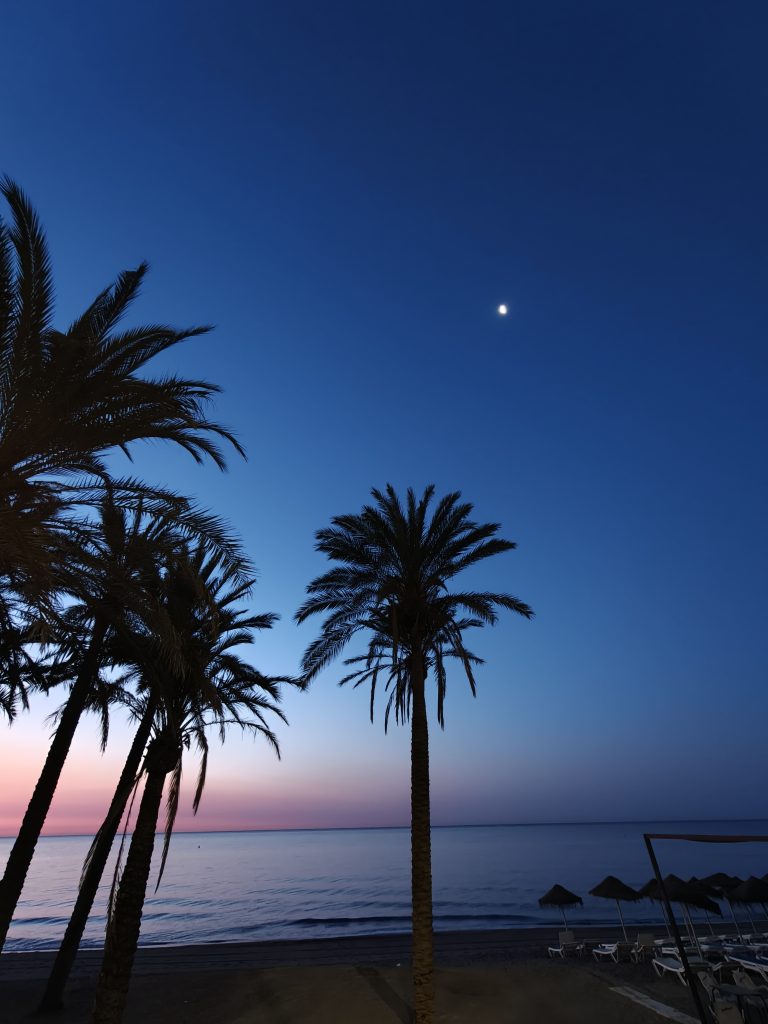
“The heavens declare the glory of God.”
For almost ten years, belief in God shaped the way I looked at the night sky.
This morning, at six o’clock, I realised how completely that has changed.
Reflections on the human condition
Examing key aspects of sociology.
For almost ten years, belief in God shaped the way I looked at the night sky.
This morning, at six o’clock, I realised how completely that has changed.
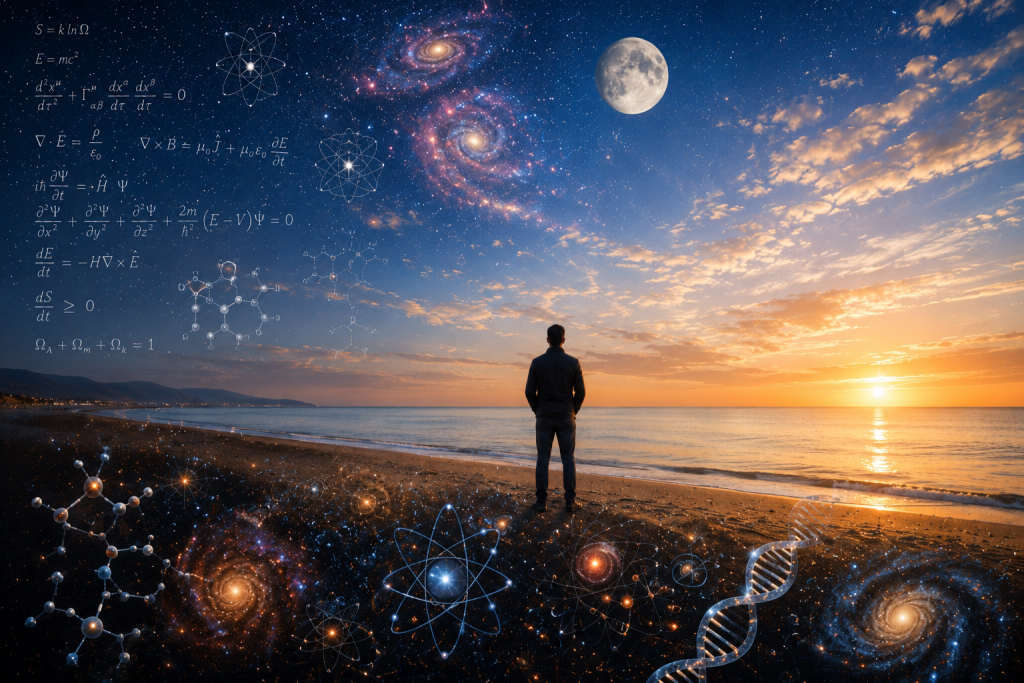
As I settle into my new life in Spain, I wake up before dawn in order to jog along the promenade before it gets too hot, watch the sunrise, contemplate cosmology and meditate.
Last week, to the west above the Carihuela, there was a huge, bright, full moon poised low in the sky before the sunrise.
It wasn’t merely bright. It seemed suspended. As if detached from its control of the tides below. Silver against an increasingly blue sky, refusing — for a few precious minutes — to surrender to the approaching sun.
The sea below was calm. The seagulls were swooping down majestically to collect their breakfast. Somewhere behind me, the town was waking. Yet for a brief moment everything felt strangely timeless.
I stood there on the harbour wall longer than I intended. Not because I understood what I was looking at. Indeed, as I meditated, I was startled by how little I did.
That quiet moment began another of my recent intellectual odysseys. I jogged home and began researching in detail the origins of the universe.
The answers I discovered have profoundly changed the way I see both the universe and humanity.
According to our best scientific understanding, the Universe began around 13.8 billion years ago.
In the first few minutes after the Big Bang, almost all that existed were the simplest elements imaginable: hydrogen, helium and tiny traces of lithium.
There was no carbon.
No oxygen.
No calcium.
No iron.
No chlorine.
No lead.
Nothing from which planets, oceans or living organisms could eventually be built.
Everything else had yet to be created.
The next discovery astonished me even more.
I had always thought of stars as glowing balls of gas.
In reality, they are unimaginably powerful nuclear furnaces.
The identity of every chemical element is determined simply by the number of protons in the nucleus of each atom.
Hydrogen has one proton.
Helium has two.
Carbon has six.
Oxygen has eight.
Iron has twenty-six.
Lead has eighty-two.
Inside stars, gravity compresses matter with such extraordinary force that atomic nuclei are pushed together in a process known as nuclear fusion.
When four hydrogen nuclei fuse together, they produce helium and release enormous amounts of energy.
Later, when stars become even hotter, three helium nuclei combine to create carbon. Carbon can then fuse with helium to produce oxygen. Larger stars continue building heavier and heavier elements through countless further fusion reactions.
Quite literally, the periodic table is assembled one proton at a time.
Eventually, the largest stars manufacture elements all the way to iron. When those stars finally exhaust their fuel, they explode as supernovae, scattering their newly created elements across the galaxy.
During those unimaginably violent explosions, still heavier elements such as gold, lead and uranium are created before being hurled into interstellar space.
Without generations of stars living and dying long before our Solar System existed, neither the Earth nor we ourselves could ever have existed.
Carl Sagan famously said:
“We are a way for the cosmos to know itself.”
He also said that we are made of star stuff.
For years I assumed that was simply a poetic metaphor.
It isn’t.
The hydrogen in the water within my body was formed shortly after the Big Bang itself.
But almost every other element within me has a different origin.
The carbon in my muscles.
The oxygen I breathe.
The calcium in my bones.
The iron carried around my body by my blood.
All of them were forged inside stars that died billions of years before the Earth even formed.
Some of those atoms may once have been part of ancient forests.
Some may have passed through dinosaurs.
Some may have circulated through countless generations of my own ancestors.
Matter itself is endlessly recycled.
The atoms change partners.
The universe never stops reusing its building blocks.
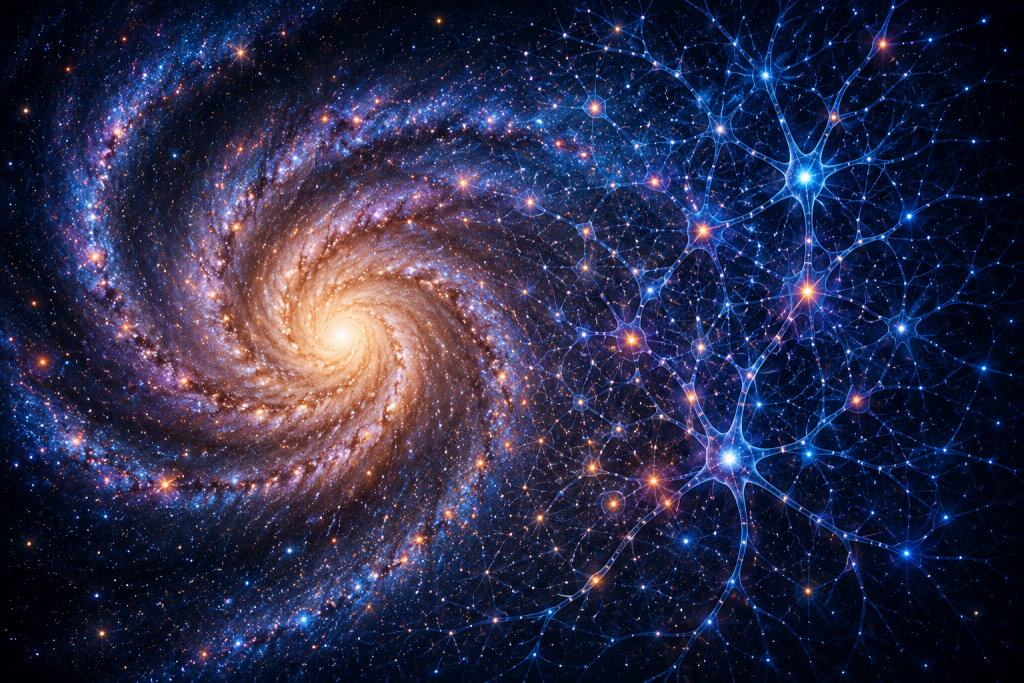
In this way, it is no coincidence that the branching networks of our neurons and the elegant spirals in hurricanes and elements of our DNA echo patterns that also appear throughout the cosmos. Different processes, different scales, yet strikingly familiar forms emerging from the same universe.
Just when I thought the story could not become any more remarkable, genetics added another layer.
Every person alive today shares common ancestry.
Research suggests that all living humans inherited their mitochondrial DNA from one woman who lived in Africa roughly 150,000 to 200,000 years ago.
Likewise, all living men inherited their Y chromosome from one man who lived much later.
They were not the only people alive at the time.
They are simply the individuals whose particular genetic lines survived uninterrupted to the present day.
Meanwhile, every generation doubles the number of our ancestors.
Travel back only a few thousand years and our family trees overlap so extensively that the distinctions between “my ancestors” and “your ancestors” begin to disappear.
In a very real biological sense, humanity is one enormous extended family.
As the moon faded into the brightening Andalusian sky, I found myself asking a question that science itself cannot answer.
If Carl Sagan was right that “we are a way for the cosmos to know itself,” what follows logically from that?
As far as we currently know, nowhere else has the universe organised itself into beings capable of wondering where the universe came from.
Nowhere else has hydrogen learned to write symphonies.
Or paint masterpieces.
Or decode DNA.
Or ask why anything exists at all.
Perhaps intelligent life is common throughout the cosmos.
I hope it is.
But until we know otherwise, we must take seriously the possibility that conscious beings like ourselves are extraordinarily rare. Maybe even unique.
If that is true, then our responsibility extends far beyond ourselves.
Protecting our planet.
Seeking truth.
Advancing knowledge.
Caring for one another.
Safeguarding future generations.
These are not merely useful social conventions.
They become responsibilities entrusted to the very few beings — perhaps the only beings — capable of understanding what is at stake.
The moon itself had not changed that morning.
Nor had the sea.
Nor the rising sun.
What changed was my understanding.
For the first time, I began to see humanity not as something standing apart from the universe, but as one of the most extraordinary things the universe has so far produced.
Perhaps, after all, the starry heavens above us do not merely invite our curiosity. They really can provide us with the most rational basis for human ethics that we will ever discover.
“Two things fill the mind with ever new and increasing admiration and awe… the starry heavens above me and the moral law within me.”
— Immanuel Kant
 The British government has this week announced plans to ban social media access for under-16s. Ministers describe it as a historic intervention to protect children. Newspapers are full of discussion about algorithms, screen addiction and online harms. Yet as I watched the announcement unfold, I found myself asking a different question entirely. Why are we once again arguing about what children should be prevented from doing rather than what they should be taught?
The discussion is presented as a matter of national importance. Ministers speak gravely about online harms. Newspapers speculate about restrictions and enforcement. Experts are summoned to television studios. Committees are established. Reports are commissioned.
But all of my experience as a student and teacher tells me that we are arguing passionately about the wrong problem. At sixty-five years of age, having attended good schools, won a scholarship to Oxford, taught for decades and worked in several countries, I have reached an uncomfortable conclusion: almost nobody ever taught me how money works.
Nobody explained investing. Nobody explained compound interest. Nobody explained pensions. Nobody explained the long-term consequences of inflation. Nobody explained the relationship between taxation and public services. Nobody explained mortgages beyond the most superficial level. Nobody explained the astonishing difference between acquiring assets and merely consuming income.
Yet these are not specialist concerns. They are among the most important forces shaping the lives of ordinary citizens.
They influence where people live, when they retire, whether they accumulate wealth, how vulnerable they are to economic shocks and, ultimately, the degree of freedom they enjoy throughout their lives.
The strange thing is that this educational failure is almost invisible. Some parents complain if their children leave school unable to read Shakespeare. Politicians worry if socially constructed examination results fall.
Universities debate decolonisation, inclusion, safe spaces and artificial intelligence.
Meanwhile, millions of young adults enter the world with little understanding of debt, investment, taxation, pensions or wealth creation.
Nobody seems particularly alarmed. But as a teacher, I find this extraordinary. And as a citizen, I find it deeply disturbing.
As someone who grew up in a working-class family, I find it difficult to avoid an even more uncomfortable observation.
Those who grow up in affluent families often learn these things anyway.
They hear conversations around the dinner table. They observe parents discussing property, investments, inheritance and taxation. They absorb financial knowledge almost by osmosis.
Those from less privileged backgrounds are often far less fortunate.
The result is that schools, which are supposed to reduce inequality of opportunity, usually end up reinforcing it.
I studied languages, theology, literature and philosophy. I do not regret a moment of it. Education transformed my life and broadened my horizons in ways I shall always be grateful for.
Yet if I am completely honest, my grandfather, a builder with far less formal education, may well have understood practical wealth creation better than I did. He understood property. He understood value. He understood patience. Most importantly, he understood that money is not primarily about income. It is about what income becomes over time. That lesson alone may be worth more than half the curriculum I studied. Unfortunately, he passed away when I was five years old, so he could never pass on his wisdom.
The question therefore is not whether children should be protected from harmful content online. Of course they should.
The question is why governments find it easier to regulate TikTok than to ask whether the curriculum itself is preparing young people for adult life.
Why is there endless discussion about screen time but comparatively little discussion about economic literacy?
Why do we devote thousands of classroom hours to subjects that many pupils will never use again while allocating almost no serious time to understanding mortgages, pensions, inflation, taxation, investing and economic reasoning?
And why, after decades of educational reform, do so many intelligent, capable and highly educated adults still feel financially illiterate?
These are not merely personal questions. They are political questions. They are social questions.
And they are ultimately questions about power.
A population that cannot critically evaluate economic arguments is easier to persuade, easier to frighten and easier to divide. It becomes dependent upon experts, commentators and politicians to interpret reality on its behalf.
A population that understands economics is harder to manipulate.
Perhaps that is why the seven economic myths I recently encountered fascinated me so much. I will share them here next week.
These seven myths didn’t just reveal something about economics, but they revealed something about education.
And perhaps, more importantly, about what education still fails to teach.
“Education is not the filling of a pail, but the lighting of a fire.”
— W. B. Yeats
If Yeats was right, then perhaps we need to ask whether we are lighting the wrong fires.
Every revival follows the same bell curve: born in protest, swollen with prophecy, and ending in the death it once defied.
Church renewal movements are born in fire, out of dissatisfaction with the lifeless liturgy of the established church, or the suffocating legalism of groups like the Exclusive Brethren. At first they return to the raw text of Scripture and gather in homes, led not by ordained clergy but by men who claim the authority of the Spirit.
Then comes structure. Buildings. Bands. Youth groups. Paid pastors.
At the crest of the curve come the prophecies: revival is coming, just around the corner, greater than anything seen before. Money is given sacrificially. Lives are rearranged. Large buildings bought. Hope is inflated into certainty.
But the revival does not come.
The failed prophecies are rarely named as failures. No serious apology is made for the emotional pressure, the money raised, or the years of expectancy spent on promises that dissolved into air. The people who joined near the beginning often remain inside the system anyway, not because the prophecy came true, but because they have built their lives inside its language. One reason the cycle works is brutally simple: those with living memory of the last false dawn are eventually buried. The cycle renews itself not by repentance, but by funerals.
On the downward slope, the message softens to attract outsiders. The sharp edges are rounded off. Meetings shortened. Speaking in tongues relegated to prayer meetings. Women step into the pulpit. Social projects begin to replace urgent evangelism. By the time the curve flattens, the movement has drifted back into the same spiritual lethargy from which it once broke free.
And somewhere, quietly, the pattern begins again.
This is not new.
The eighteenth-century Methodist revival carried the same internal logic, though in a different register. Prophecy was not usually delivered as spontaneous announcements of imminent awakening, but woven through sermons, hymns and journals. John Wesley spoke of a “work of God” spreading across England; early Methodists read their experience as the fulfilment of biblical promise, the “latter rain” of the Spirit poured out again in the last days.
And yet Methodism, too, followed the curve. What began as a disruptive, Spirit-driven renewal gradually became a structured denomination.
It always does.
What is more interesting is what happens before the next rise.
Recent history gives us several variations on the same descent.
Hillsong shows what happens when a movement builds itself around energy, scale and centralised identity. For a time it feels unstoppable — global, confident, culturally dominant. But when leadership fails and the narrative fractures, the fall is sudden. Not total collapse, but deflation. What was once a movement becomes an organisation trying to stabilise itself.
Mark Driscoll represents another version of the curve: charisma outrunning character. The rise is rapid, the influence undeniable, but the culture formed around the leader cannot bear the weight placed upon it. When the collapse comes, what once looked like authority begins to look like control.
Newfrontiers offers a quieter trajectory. No great implosion, no single scandal at the centre — simply dispersal. A movement built around relational authority fragments into multiple streams. It continues, even grows, but the shared identity thins. What was once a single current becomes a cluster of networks, leaving behind a nagging feeling of dissolution.
Vineyard perhaps shows the most stable outcome of all. No collapse, no dramatic fracture — simply absorption. Its innovations in worship and church culture spread so widely that the movement itself becomes less distinct. It survives by dissolving into the mainstream it once helped reshape.
Sudden deflation. Moral collapse. Gradual dispersal. Quiet absorption.
These are different endings, but they belong to the same curve.
And beneath them lies something more uncomfortable.
These movements do not begin with authority. They begin with relief. A sudden sense that life makes sense, that one is seen, located, given purpose. Meaning becomes structure. Structure becomes authority. Authority becomes identity.
Then, slowly, the system outgrows the intensity that created it.
What felt like life begins to feel like maintenance.
What felt like truth begins to feel like language.
What felt like revival becomes, in time, another form of what it once opposed.
The bell curve is not just a pattern in churches.
It is a pattern in us.
“The most terrible thing of all is when a movement that began in passion ends in habit.” – Søren Kierkegaard