Gregor Gysi: The Best Chancellor Germany Never Had

Why Friedrich Merz Is Sealing Germany’s Coffin

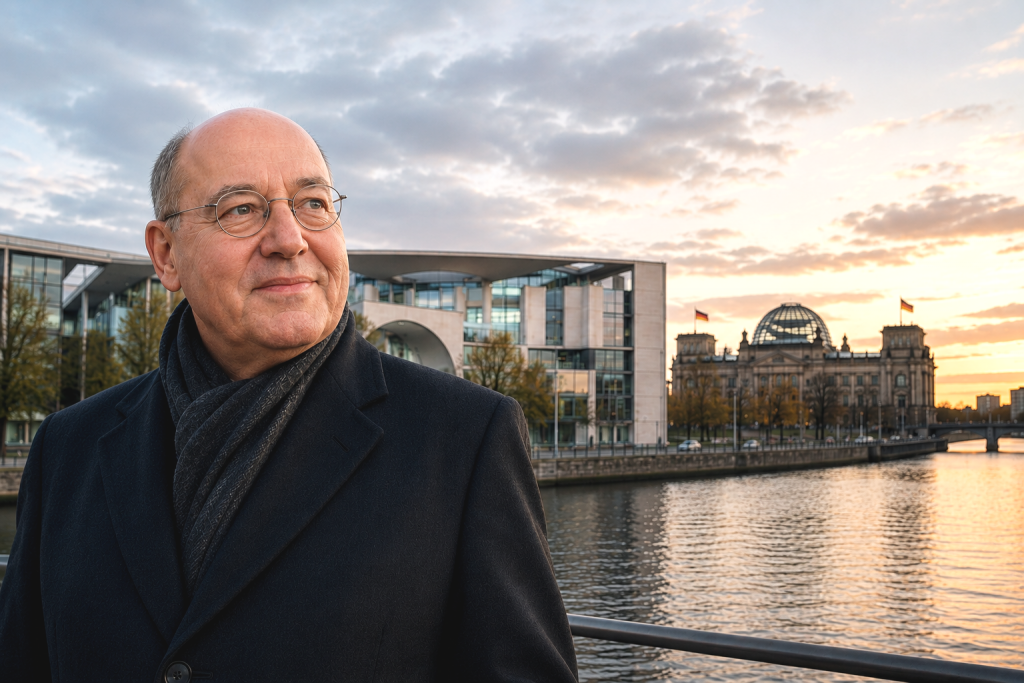
Recently, Gregor Gysi made an observation that deserves far more attention than it has received. According to Gysi, Friedrich Merz’s political strategy is increasingly based on finding new groups of people to blame for Germany’s socio-economic problems rather than confronting the deeper causes of the country’s decline.

First it was immigrants and refugees.

Then it was the healthcare system.

Now it is Germany’s workforce.

Whether one agrees with Gregor Gysi on everything or not, his criticism exposes a troubling pattern. Whenever Germany faces a serious challenge, Merz appears more interested in identifying a convenient target than offering either a compelling vision for the future or consistent decisions aligned with clear political and ethical values.

The Refugees Who Helped Germany

Germany welcomed around one million refugees during the migration crisis of 2015 and 2016. The decision was controversial then and remains controversial today, stoked up by the nationalism of the AfD.

Yet ten years later, many of these refugees have integrated successfully. They have learned German, entered the labour market, started businesses, paid taxes, contributed to the pension system and become part of German society.

Some arrived as highly qualified professionals: doctors, engineers, academics and lawyers. Others filled essential jobs that Germany struggles to recruit for itself.

Germany’s demographic crisis is not a future problem. It is happening now. Employers across the country face labour shortages. The pension system depends on a shrinking workforce supporting a growing retired population.

Against this background, treating refugees primarily as a burden rather than as contributors makes little economic sense.

I recently thought of a young Syrian woman I know. She now speaks fluent German, as well as English and Arabic. She is completing a doctorate in law and has every prospect of becoming a highly productive member of German society.

Yet she is planning her future elsewhere, most likely in the United States.

Germany invested in her integration. Germany benefited from her talent. Germany may now lose her altogether.

That is not a success story. It is a failure of political imagination.

Scapegoating Healthcare

The same pattern appears in healthcare.

Germany undoubtedly faces major financial pressures in its health and social insurance systems. An ageing population, rising costs and economic stagnation create genuine challenges.

But the answer cannot simply be to reduce protections that millions of people rely upon.

The principle that families should have access to healthcare regardless of income has long been one of the strengths of the German social model. Weakening that principle may save money in the short term, but it risks creating greater social and economic costs in the future.

What is particularly striking is the contrast between the urgency applied to military spending and the hesitation shown towards investments in social infrastructure.

Politicians readily describe defence spending as an investment in the future. Yet healthcare, education and social stability are investments too.

A nation is not defended only by weapons. It is defended by healthy, educated and confident citizens.

The Myth of Working Longer

The latest target appears to be Germany’s workforce.

Merz has argued that Germans need to work more hours and remain economically active for longer. On the surface, this sounds practical and responsible.

In reality, it reflects a remarkably outdated understanding of productivity.

Human beings are not machines.

Productivity depends upon motivation, trust, leadership, skills, technology and working conditions. A well-managed and valued employee working thirty-five hours per week can often contribute more than an exhausted and disengaged employee working fifty-five.

The most successful economies do not necessarily have the longest working weeks. They have the most productive working hours.

Germany’s challenge is not primarily that its people are lazy. It is that investment in digitalisation, reducing bureaucracy, promoting infrastructure and innovation has lagged behind many competitors for years.

Blaming workers is easier than fixing structural problems. But it is also less effective.

Germany Needs Leadership, Not Scapegoats

Friedrich Merz undoubtedly possesses ambition. He looks like a statesman. He speaks confidently. He projects authority.

Yet genuine leadership requires more than authority.

It requires empathy.

It requires vision.

It requires values.

The CDU once prided itself on balancing economic responsibility with social responsibility. Today, that balance often seems absent. The willingness to embrace large-scale borrowing while simultaneously questioning social protections creates the impression not of strategic thinking but of political inconsistency.

Germany faces enormous challenges: demographic decline, economic stagnation, digital backwardness, labour shortages and growing political polarisation.

None of these problems will be solved by blaming refugees, healthcare recipients or workers.

They require something much rarer.

They require a government willing to unite rather than divide.

For all his political flaws, Gregor Gysi has long understood one simple truth: a society becomes stronger when it expands the circle of belonging rather than narrowing it. He truly is the best chancellor Germany never had.

Germany’s future will depend on whether more of its leaders understand that truth as well.

“When five people own more wealth than the poorer half of an entire nation, the problem is not refugees, nurses or workers. The problem is where the wealth has gone.”
— Gregor Gysi (paraphrased from his speeches on wealth inequality)

Sovereignty Begins at the Desktop

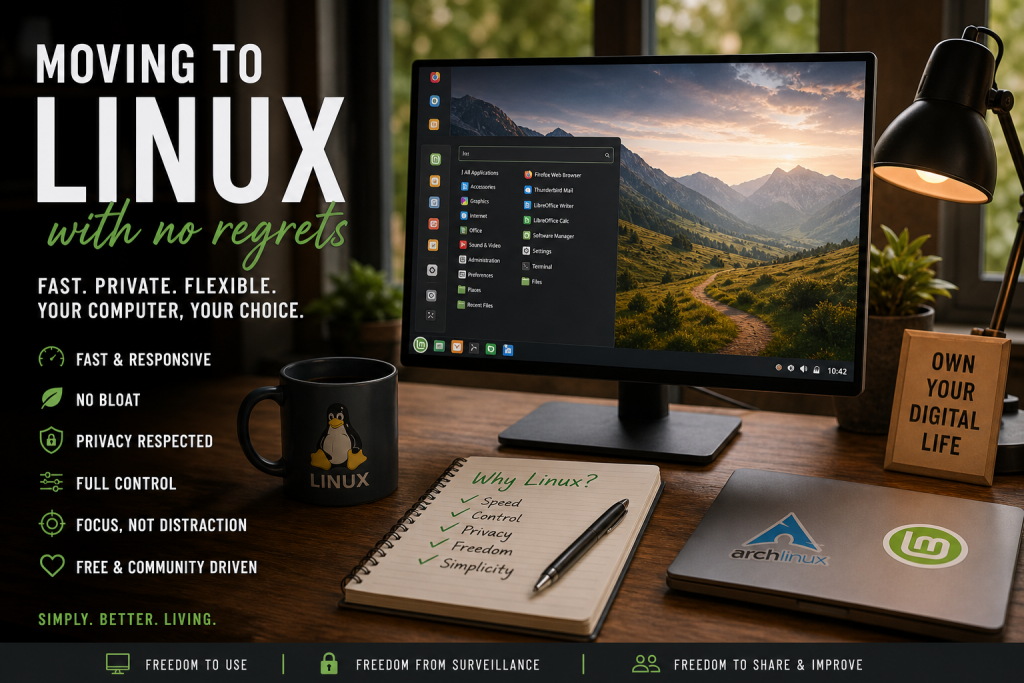
Linux desktop workspace representing digital sovereignty, privacy and independence from big tech ecosystems

For years, choosing an operating system was treated as a consumer preference: Mac or Windows. Apple or Microsoft. Design or compatibility.

Those days are ending. Indeed, for me, they have already ended.

My move to Linux was not born of practicality. It began as an explicitly political decision: a small personal protest against what I see as the increasingly troubling direction of the United States and my growing discomfort about privacy and with Europe’s dependence on American technology.

What began as principle, however, quickly became something more exciting. An education, even.

In moving away from mainstream platforms, I discovered not merely a political statement but a better way of computing: faster, calmer, less intrusive, more user-controlled—and one that forced me to confront how casually many of us have entrusted vast quantities of personal data to a handful of foreign corporations.

Increasingly, our technology choices are no longer merely about convenience or aesthetics. They are about jurisdiction, sovereignty, dependence and trust.

The Illusion of Neutral Technology

We have spent two decades pretending that software is apolitical. It is not.

Private data is the so-called new oil.
Cloud platforms are geopolitical assets.
Operating systems are instruments of jurisdiction.
App ecosystems are channels of dependency.

To build one’s digital life entirely on American platforms is not simply to use foreign products. It is to place one’s communications, workflows, data and habits inside systems governed elsewhere.

For years, this dependency seemed harmless because America appeared stable, predictable and aligned with European interests. That assumption now looks far less secure.

Why Linux Appeals Beyond the Technically Curious

My own switch to Linux was motivated initially by principle, but sustained by practical reality.

Linux is, quite simply, excellent.

It offers:

    • greater speed and efficiency
    • far less software bloat
    • more user control
    • minimal intrusive advertising or telemetry
    • freedom from forced ecosystem lock-in
    • a calmer, more focused computing experience

It also avoids a growing trend I find exhausting in mainstream software: the transformation of operating systems into hyperactive consumer platforms.

Notifications.
Recommendations.
Prompts.
Pop-ups.
Embedded AI assistants.
Animated interfaces designed less for work than for perpetual engagement.

Linux, by contrast, still feels like a tool. Not a theme park.

My Preferred Distributions: Mint and Arch

For those exploring Linux, I find two distributions particularly compelling.

Linux Mint: Mature Practicality

Mint is Linux at its most civilised.

Stable, polished, intuitive and highly accessible, it offers a reassuringly traditional desktop experience without sacrificing elegance.

It is the Linux distribution I would recommend to most ordinary users and beginners.

Arch Linux: Radical User Ownership

Arch is a different philosophy entirely.

Minimal, modular and deeply configurable, it demands more of the user—but rewards that effort with extraordinary control.

Arch is not merely software.

It is a statement of intent:

I will shape my tools. My tools will not shape me.

Europe Is Beginning to Think This Way Too

What may once have looked like niche hobbyism is increasingly becoming state policy.

The French government has announced plans to migrate large parts of its public administration away from Windows and toward Linux as part of a broader digital sovereignty strategy.

Other European administrations are exploring or implementing similar moves, including regional and national migrations toward open-source alternatives in Germany and Denmark.

Why?

Because governments are recognising what individuals increasingly recognise:

Dependency creates vulnerability.

Reliance on foreign proprietary platforms means reliance on:

    • foreign licensing decisions
    • foreign corporate roadmaps
    • foreign legal jurisdictions
    • foreign political stability

The Great Irony: Linux Already Runs the World

Here is the part casual users often miss: Linux may still be niche on consumer desktops, but it already powers much of the digital world.

Linux runs:

    • most of the web’s server infrastructure
    • the overwhelming majority of supercomputers globally
    • vast portions of cloud computing infrastructure
    • countless embedded and industrial systems
    • even Android is based on a modified version of the Linux kernel

In other words:

Linux is not an outsider technology.

It is the backbone of modern computing.

The desktop is merely catching up.

A Warning to America — And An Opportunity for Europe

The United States should not assume technological dominance is permanent.

Consumers, institutions and governments are increasingly asking difficult questions:

    • Who controls our infrastructure?
    • Who governs our data?
    • What happens if political alignment breaks?
    • Why are we so dependent on foreign platforms for essential digital life?

If American tech firms continue to treat lock-in as strategy and complacency as entitlement, they may discover that dominance breeds resistance.

Meanwhile Europe has an opportunity.

Not necessarily to replace Silicon Valley overnight.

But to build credible alternatives.

To invest in open standards.
To support interoperable software.
To back European cloud and software infrastructure.
To treat digital autonomy as seriously as energy autonomy.

The next decade may not produce a mass exodus from American technology.

But the direction of travel is becoming harder to ignore.

Slowly, unevenly, but unmistakably.

Final Thought

My move to Linux will not alter geopolitics.

But it is, in its own small way, an expression of a wider conviction:

That technology should serve its user.
That infrastructure should remain contestable.
That dependency should never become invisible.

Linux is not merely for hobbyists anymore.

It is increasingly for those asking a larger question:

Who should control the tools on which modern life depends?

“In times of change, the learners inherit the earth, while the learned find themselves beautifully equipped for a world that no longer exists.”
Eric Hoffer

Social Media Bans for Under 16s

Why banning social media for under-16s may feel right — but fails to address the real issue

There is a growing political appetite to ban social media for under-16s. Governments in countries such as Australia and Indonesia have already moved in this direction, driven by rising concern about anxiety, depression, and the psychological effects of digital life.

The instinct is understandable. But it may also be wrong.

The comfort of the ban

A ban is politically attractive because it is clear, decisive and easy to communicate. It signals protection. It tells a worried public that something is being done.

But it also avoids a harder question.

Why has social media become so central to childhood in the first place?

Policy without evidence

The Cambridge psychologist Sander van der Linden has been unusually blunt. There is, he argues, “zero empirical evidence” that banning social media for teenagers improves outcomes.

His warning is not ideological but methodological:

“Blindly instituting wholesale bans for teens takes the ‘evidence’ out of evidence-based policy.”

This matters. Because once policy is driven primarily by anxiety, it becomes vulnerable to simplification.

And simplification is exactly what this issue does not need.

The variability problem

Social media does not affect all children in the same way.

For some, it amplifies vulnerability: comparison, exclusion, anxiety.
For others, it provides connection, identity and support. As well as of course access to information for school work.

The outcome depends on:

    • personality
    • patterns of use
    • existing mental health
    • social environment

A blanket ban assumes uniform harm where there is, in reality, radical variation.

The misdiagnosis

More fundamentally, a ban risks targeting the wrong thing.

The problem is not simply that children use social media. It is that social media have been designed to capture attention:

    • infinite scroll
    • algorithmic reinforcement
    • intermittent rewards

These are not neutral features. They are behavioural systems.

Yet instead of regulating the environment, we regulate the child.

We restrict the user because we do not confront the system.

The illusion of control

Even on practical grounds, bans are fragile.

    • Teenagers will bypass them
    • Peer groups will remain online
    • The demand for connection will persist
    • Evidence shows that the dangers are greater once hidden underground

The behaviour does not disappear. It relocates. More importantly, a ban does not teach navigation. It postpones exposure.

From protection to preparation

Van der Linden’s alternative is not permissiveness, but preparation:

    • early digital literacy
    • gradual exposure
    • critical thinking
    • resilience

In short:

Not protection through restriction, but protection through competence.

The question beneath the question

But even this may not be the deepest layer because the focus on social media obscures a more uncomfortable possibility.

Over recent decades, childhood has changed:

    • less independent movement
    • less unsupervised play
    • more adult control
    • more structured time

Children are safer, and yet less free.

We did not simply give children smartphones.
We removed much of the world they would otherwise have enjoyed.

Social media did not replace childhood.
In some respects, it stepped into a space that had already been narrowed.

Conclusion

The case for concern about social media is strong.
The case for banning it is not.

As Sander van der Linden argues, policy should be guided by evidence, not urgency or political posturing. At present, the evidence for bans is thin, while the complexity of the problem is substantial.

If we want children to spend less time online, we will have to do something more difficult than passing laws.

We will have to ask what kind of childhood we are willing to allow.

“Of all tyrannies, a tyranny sincerely exercised for the good of its victims may be the most oppressive.”              – C.S. Lewis

Bürgergeldempfänger als Deutschlands liebste Sündeböcke

Die kleinste Ausgabe des deutschen Sozialstaates erzeugt die lauteste politische Empörung.

Die deutsche Debatte über das Bürgergeld wird meist im Ton gereizter Empörung geführt. Zu viel Geld, zu wenig Druck, zu wenige Anreize, zu viel Nachsicht. Das Bild dahinter ist simpel: Der Staat verteilt Geld – und dann ist es weg.

Doch dieses Bild ist sowohl ökonomisch grob als auch eine politisch bequeme und polarisierende Ablenkung.

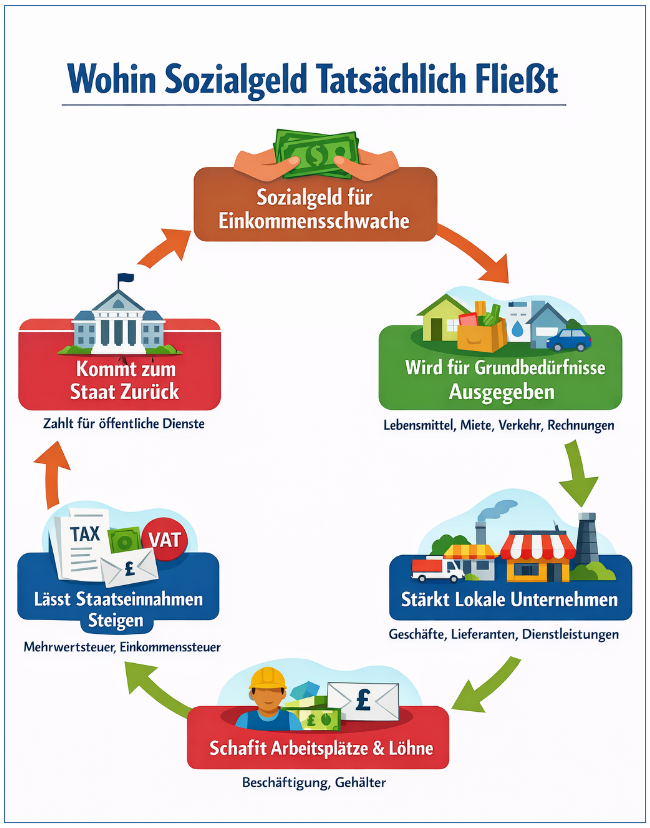
Geld, das an einkommensschwache Haushalte gezahlt wird, verschwindet nicht. Es zirkuliert. Ein Teil fließt sofort über die Mehrwertsteuer zurück zum Staat. Ein größerer Teil landet bei Supermärkten, Lieferanten, Vermietern, Dienstleistern – und damit wiederum in Löhnen, Gewinnen und Steuereinnahmen. Sobald man aufhört, Sozialleistungen so zu betrachten, als würden sie einfach in einem schwarzen Loch verschwinden, sieht die Rechnung plötzlich ganz anders aus.

Der unmittelbare Rückfluss über Steuern

Beginnen wir mit dem Offensichtlichen. In Deutschland zahlt der Endverbraucher die Mehrwertsteuer. Der reguläre Satz beträgt 19 Prozent; für viele Grundbedürfnisse gilt der ermäßigte Satz von 7 Prozent.

Wenn ein Haushalt mit niedrigem Einkommen sein Geld für Lebensmittel, Kleidung, Hygieneartikel, Verkehr oder andere Alltagsausgaben verwendet, fließt ein Teil dieses Geldes unmittelabar zurück in die öffentlichen Kassen. Bei einem Einkauf von einem Euro mit 7 Prozent Mehrwertsteuer stecken etwa 6,5 Cent Steuer im Endpreis. Bei 19 Prozent sind es rund 16 Cent.

Schon bevor man die weiteren wirtschaftlichen Effekte betrachtet, ist also klar: Die Vorstellung, Sozialtransfers seien reine Einbahnstraßenverluste, stimmt schlicht nicht.

Warum ärmere Haushalte mehr ausgeben

Der wichtigere Punkt kommt danach: Menschen mit geringem Einkommen geben Geld aus. Meistens müssen sie das auch.

Ökonomen beschreiben dieses Verhalten mit dem Begriff der marginalen Konsumneigung – also dem Anteil eines zusätzlichen Euro, der tatsächlich ausgegeben statt gespart wird. Der Befund aus zahlreichen Studien ist eindeutig: Haushalte unter finanziellem Druck geben einen größeren Teil zusätzlicher Einnahmen aus, während wohlhabendere Haushalte ihr überschüssiges Geld eher sparen oder steuerlich begünstigt investieren.

Eine Studie des Internationalen Währungsfonds zeigt beispielsweise, dass finanziell belastete Haushalte Transferzahlungen mit einer um mehr als 20 Prozent höheren Konsumneigung verwenden als Haushalte ohne solche Sorgen. Eine andere Analyse kommt zu dem Schluss, dass Transfers über mehrere Jahre hinweg gesamtwirtschaftliche Multiplikatoreffekte deutlich über eins erzeugen können.

In einfachen Worten: Ein ausgezahlter Euro kann mehr als einen Euro wirtschaftliche Aktivität erzeugen.

Die Zirkulation des Geldes

Genau deshalb ist die klassische konservative Kritik am Bürgergeld oft nur halb blind. Sie zählt die Bruttoausgaben – aber nicht die Zirkulation danach.

Der Empfänger kauft Lebensmittel. Der Supermarkt bezahlt Personal und Großhändler. Der Großhändler bezahlt Transport und Lager. Beschäftigte geben ihre Löhne aus. Unternehmen zahlen Mehrwertsteuer, Gewerbesteuer, Körperschaftsteuer und Sozialabgaben.

Kein seriöser Ökonom würde behaupten, dass jeder ausgezahlte Euro sich vollständig selbst finanziert. Aber ebenso wenig ist es ehrlich, so zu tun, als würde der Staat das Geld einfach verbrennen.

Marx und die „Reservearmee“

Es gibt noch einen tieferen gesellschaftlichen Punkt. Karl Marx’ alte Idee von der „industriellen Reservearmee“ hat bis heute eine gewisse Erklärungskraft. Kapitalismus stabilisiere sich, argumentierte Marx, unter anderem durch die Existenz einer Bevölkerung, die arbeitslos, unterbeschäftigt oder wirtschaftlich unsicher genug ist, um Druck auf diejenigen auszuüben, die Arbeit haben.

„Je größer der gesellschaftliche Reichtum … desto größer die industrielle Reservearmee.“
— Karl Marx, Das Kapital, Band I

Man muss kein Marxist sein, um die Relevanz dieses Gedankens zu erkennen. Arbeitsmärkte brauchen immer eine gewisse Zone der Verwundbarkeit: Menschen, die verfügbar sind; Menschen, die unsicher sind; Menschen, die daran erinnert werden, was passiert, wenn sie herausfallen.

Auch deshalb werden Debatten über soziale Mindeststandards so emotional geführt. Beim Bürgergeld geht es nie nur um Haushaltszahlen. Es geht auch darum, welches Maß an Unsicherheit eine Gesellschaft für akzeptabel – oder sogar nützlich – hält.

Die Zahlen des deutschen Sozialstaates

Und hier werden die deutschen Zahlen politisch aufschlussreich.

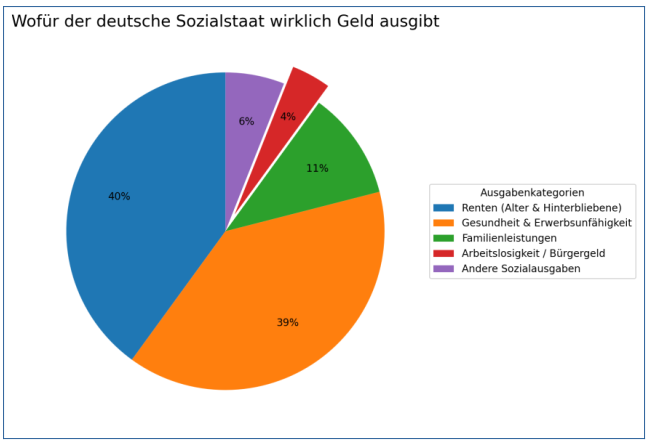
Laut Sozialbudget 2024 des Bundesministeriums für Arbeit und Soziales beliefen sich die gesamten Sozialausgaben Deutschlands auf rund 1,345 Billionen Euro. Davon entfielen etwa 58,2 Milliarden Euro auf das Bürgergeld – rund 4,3 Prozent der Gesamtausgaben.

Zum Vergleich: Allein für Alter und Hinterbliebene wurden 533 Milliarden Euro ausgegeben. Für Krankheit und Invalidität rund 523 Milliarden Euro.

„Die kleinste Scheibe des Sozialstaates erzeugt die lauteste politische Empörung.“

Wie auch immer man den Haushalt betrachtet – die Vorstellung, Bürgergeld sei das zentrale finanzielle Monster des deutschen Sozialstaates, ist schlicht absurd. Es ist sichtbar, ja. Politisch verwertbar, sicherlich. Aber es ist nicht die Hauptgeschichte.

Politische Obsession und reale Probleme

Und das ist nicht trivial. Politische Obsession kostet Zeit.

Zeit, die damit verbracht wird, über Bürgergeld zu moralisieren, fehlt bei der Auseinandersetzung mit den wirklich großen Herausforderungen der deutschen Wirtschaft: schwaches industrielles Wachstum, lähmende Bürokratie, schleppende Digitalisierung, überforderte Verwaltungen, unzureichende Qualifizierungssysteme, ein angespanntes Gesundheitssystem, steigende Rentenlasten und die fiskalischen Entscheidungen rund um Verteidigung und Staatsverschuldung.

Den Blick unverhältnismäßig stark auf die unterste Stufe der Einkommensleiter zu richten, ist keine nüchterne Realpolitik. Es ist eine politische Ersatzhandlung.

Die Lehre aus der Kurzarbeit

Deutschland selbst hat übrigens bereits gezeigt, wie die Logik solcher wirtschaftlichen Multiplikatoren funktionieren kann. Während der Pandemie setzte der Staat nicht allein auf moralische Appelle zur Eigenverantwortung, sondern nutzte Kurzarbeit, um Einkommen an Beschäftigung zu binden.

Auf dem Höhepunkt befanden sich fast sechs Millionen Menschen in Kurzarbeit. Studien des Instituts für Arbeitsmarkt- und Berufsforschung legen nahe, dass das Instrument dauerhaft Arbeitsplätze gesichert hat.

Die Lehre daraus ist einfach: Wenn der Staat Einkommen stabilisiert, stabilisiert er auch Nachfrage, Unternehmen und Beschäftigung.

Bürgergeld ist ein anderes Instrument. Aber das Prinzip ist ähnlich.

Einkommenssicherung ist oft billiger als gesellschaftlicher Absturz.

Ein ehrlicher Ausgangspunkt

Eine ehrlichere Debatte über Grundsicherung müsste deshalb mit einem einfachen Satz beginnen:

Dieses Geld verschwindet nicht.

Ein Teil fließt sofort über Steuern zurück. Ein größerer Teil hält Nachfrage in der realen Wirtschaft aufrecht. Und alles zusammen verhindert die weitaus höheren Kosten von Armut: schlechtere Gesundheit, geringere Beschäftigungsfähigkeit, soziale Demütigung, familiären Stress und langfristigen Vertrauensverlust in staatliche Institutionen.

Wenn Deutschland wirklich weniger Menschen im Bürgergeld haben möchte, lautet die Antwort nicht moralische Empörung.

Sie lautet: Wachstum, Kompetenz, Qualifizierung, funktionierende Verwaltung und ein Arbeitsmarkt, der Menschen tatsächlich wieder in stabile Beschäftigung aufnehmen kann.

Bis dahin sagt das höhnische Reden über diejenigen, die gezwungen sind, vom Minimum zu leben, vielleicht weniger über sie aus als über die Armut der Debatte selbst.

„Die Ideen von Ökonomen und politischen Philosophen, ob richtig oder falsch, sind mächtiger, als gemeinhin angenommen wird.“
— John Maynard Keynes