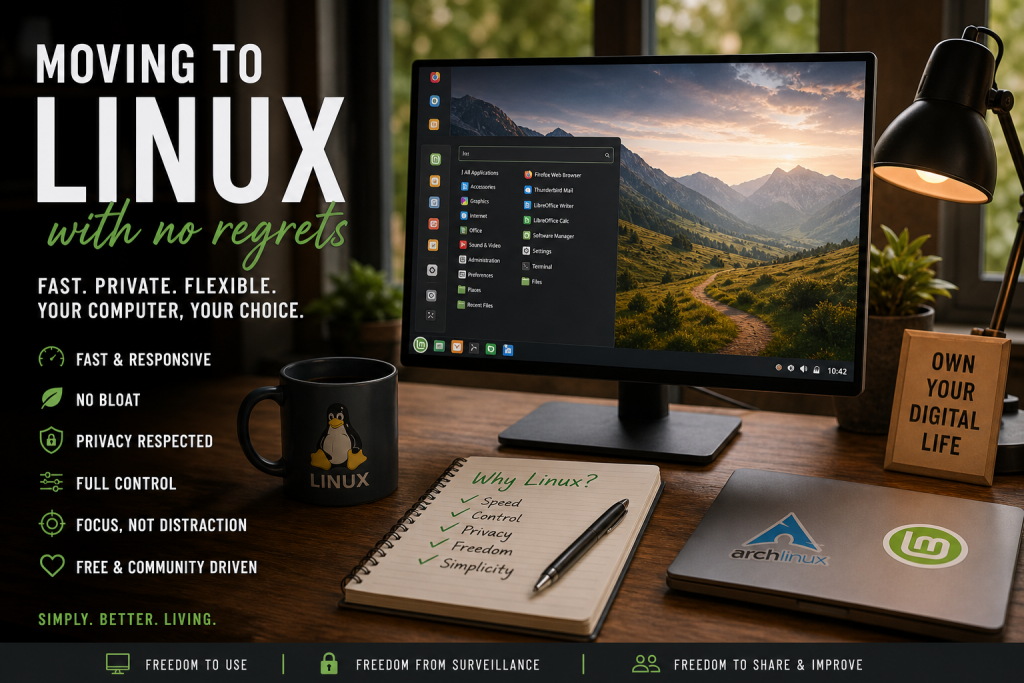
For years, choosing an operating system was treated as a consumer preference: Mac or Windows. Apple or Microsoft. Design or compatibility.
Those days are ending. Indeed, for me, they have already ended.
My move to Linux was not born of practicality. It began as an explicitly political decision: a small personal protest against what I see as the increasingly troubling direction of the United States and my growing discomfort about privacy and with Europe’s dependence on American technology.
What began as principle, however, quickly became something more exciting. An education, even.
In moving away from mainstream platforms, I discovered not merely a political statement but a better way of computing: faster, calmer, less intrusive, more user-controlled—and one that forced me to confront how casually many of us have entrusted vast quantities of personal data to a handful of foreign corporations.
Increasingly, our technology choices are no longer merely about convenience or aesthetics. They are about jurisdiction, sovereignty, dependence and trust.
The Illusion of Neutral Technology
We have spent two decades pretending that software is apolitical. It is not.
Private data is the so-called new oil.
Cloud platforms are geopolitical assets.
Operating systems are instruments of jurisdiction.
App ecosystems are channels of dependency.
To build one’s digital life entirely on American platforms is not simply to use foreign products. It is to place one’s communications, workflows, data and habits inside systems governed elsewhere.
For years, this dependency seemed harmless because America appeared stable, predictable and aligned with European interests. That assumption now looks far less secure.
Why Linux Appeals Beyond the Technically Curious
My own switch to Linux was motivated initially by principle, but sustained by practical reality.
Linux is, quite simply, excellent.
It offers:
-
- greater speed and efficiency
- far less software bloat
- more user control
- minimal intrusive advertising or telemetry
- freedom from forced ecosystem lock-in
- a calmer, more focused computing experience
It also avoids a growing trend I find exhausting in mainstream software: the transformation of operating systems into hyperactive consumer platforms.
Notifications.
Recommendations.
Prompts.
Pop-ups.
Embedded AI assistants.
Animated interfaces designed less for work than for perpetual engagement.
Linux, by contrast, still feels like a tool. Not a theme park.
My Preferred Distributions: Mint and Arch
For those exploring Linux, I find two distributions particularly compelling.
Linux Mint: Mature Practicality
Mint is Linux at its most civilised.
Stable, polished, intuitive and highly accessible, it offers a reassuringly traditional desktop experience without sacrificing elegance.
It is the Linux distribution I would recommend to most ordinary users and beginners.
Arch Linux: Radical User Ownership
Arch is a different philosophy entirely.
Minimal, modular and deeply configurable, it demands more of the user—but rewards that effort with extraordinary control.
Arch is not merely software.
It is a statement of intent:
I will shape my tools. My tools will not shape me.
Europe Is Beginning to Think This Way Too
What may once have looked like niche hobbyism is increasingly becoming state policy.
The French government has announced plans to migrate large parts of its public administration away from Windows and toward Linux as part of a broader digital sovereignty strategy.
Other European administrations are exploring or implementing similar moves, including regional and national migrations toward open-source alternatives in Germany and Denmark.
Why?
Because governments are recognising what individuals increasingly recognise:
Dependency creates vulnerability.
Reliance on foreign proprietary platforms means reliance on:
-
- foreign licensing decisions
- foreign corporate roadmaps
- foreign legal jurisdictions
- foreign political stability
The Great Irony: Linux Already Runs the World
Here is the part casual users often miss: Linux may still be niche on consumer desktops, but it already powers much of the digital world.
Linux runs:
-
- most of the web’s server infrastructure
- the overwhelming majority of supercomputers globally
- vast portions of cloud computing infrastructure
- countless embedded and industrial systems
- even Android is based on a modified version of the Linux kernel
In other words:
Linux is not an outsider technology.
It is the backbone of modern computing.
The desktop is merely catching up.
A Warning to America — And An Opportunity for Europe
The United States should not assume technological dominance is permanent.
Consumers, institutions and governments are increasingly asking difficult questions:
-
- Who controls our infrastructure?
- Who governs our data?
- What happens if political alignment breaks?
- Why are we so dependent on foreign platforms for essential digital life?
If American tech firms continue to treat lock-in as strategy and complacency as entitlement, they may discover that dominance breeds resistance.
Meanwhile Europe has an opportunity.
Not necessarily to replace Silicon Valley overnight.
But to build credible alternatives.
To invest in open standards.
To support interoperable software.
To back European cloud and software infrastructure.
To treat digital autonomy as seriously as energy autonomy.
The next decade may not produce a mass exodus from American technology.
But the direction of travel is becoming harder to ignore.
Slowly, unevenly, but unmistakably.
Final Thought
My move to Linux will not alter geopolitics.
But it is, in its own small way, an expression of a wider conviction:
That technology should serve its user.
That infrastructure should remain contestable.
That dependency should never become invisible.
Linux is not merely for hobbyists anymore.
It is increasingly for those asking a larger question:
Who should control the tools on which modern life depends?
“In times of change, the learners inherit the earth, while the learned find themselves beautifully equipped for a world that no longer exists.”
— Eric Hoffer