When a Country Gets Richer, Who Owns the Wealth?

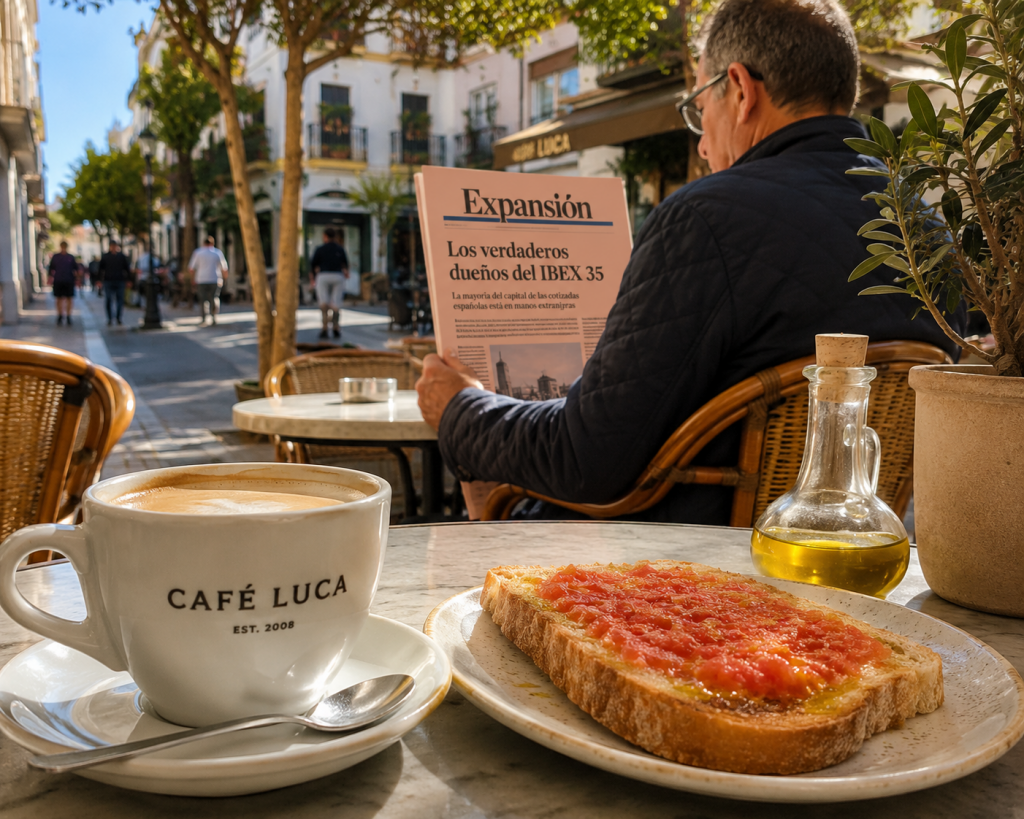
Wealth. A man reading a financial newspaper about who owns Spain's wealth in the background.A newspaper headline over breakfast in Spain made me question something I’d never really considered before. When a country’s economy is booming, who actually owns the wealth that’s being created?

One of the unexpected pleasures of moving to Spain has been rediscovering the lost art of breakfast.

Most mornings I walk to my favourite café, order a café con leche and toasted bread rubbed with fresh tomato and olive oil, then spend half an hour simply watching the town wake up. The same waiter greets familiar faces with effortless warmth. Elderly couples linger over coffee. Shopkeepers raise their shutters. Sunburnt tourists wobble by. There is something reassuring about the rhythm of ordinary life here.

A few mornings ago, however, it wasn’t the people who caught my attention. It was a newspaper.

The gentleman at the next table was reading Expansión, Spain’s financial newspaper. Across the front page was a headline that immediately made me stop.

The real owners of the IBEX 35.

The real owners?

Surely Spain’s largest companies belong to Spain.

I finished my breakfast, but the question followed me home.


The Assumption

Like most people, I have spent much of my life assuming that when a country’s economy grows, its people become wealthier. I’ve lived in Germany for 16 years, which always provided me with the perfect example.

And that is how the news is usually presented.

The economy is booming.

Corporate profits are rising.

The stock market reaches another record.

We instinctively hear those as different ways of saying the same thing.

But they are not.

Companies create wealth where they operate.

Ownership determines where much of that wealth ultimately accumulates.

The distinction sounds almost trivial.

It isn’t.

It changes the way we think about almost everything.


Creating and Owning Wealth

Imagine two people.

One spends forty years working.

The other spends forty years owning.

The first helps create prosperity.

The second receives part of the return from that prosperity.

Sometimes, of course, they are the same person.

Often they are not.

That morning, as I watched the waiter carrying coffees from table to table, it occurred to me that he was helping to create Spain’s prosperity every bit as much as a hotel owner, a banker or a company director. Every tourist welcomed, every breakfast served and every day’s work honestly completed contributes, however modestly, to a nation’s success.

Yet if one of Spain’s largest companies doubles its profits this year, a significant share of those profits may eventually belong to people who have never set foot in Spain.

The wealth is created here.

The ownership may be somewhere else.

For some reason, that simple distinction had never really occurred to me before.


A Global Story

The more I reflected on it, the more I realised that Spain was merely the setting.

This is the story of the modern world.

Capital crosses borders far more easily than people do.

That freedom has transformed our lives. It has financed innovation, built industries, connected economies and lifted hundreds of millions of people out of poverty. Few of us would seriously wish to reverse it.

Yet every system has consequences.

Perhaps the least discussed consequence of global capitalism is that it increasingly separates the place where wealth is created from the place where much of it is ultimately owned.

The two are no longer the same thing.


Britain Taught Me the Lesson Before Spain Did

Ironically, Britain had been teaching me this lesson for decades without my noticing.

Successive governments sold companies, utilities, railways, airports, property and infrastructure into private and often international ownership. We were told that this was modernisation, efficiency and the price of attracting investment. In many respects, it was.

Investment creates jobs.

Investment raises productivity.

Investment helps economies grow.

But every sale also carried another consequence.

A little more of tomorrow’s income would belong to someone else. And if the quality of a service such as buses and railways deteriorates in Manchester when the company owners sit in an office along the Champs Elysées, we should not be too surprised.

At the same time, Britain itself became a major owner of overseas assets. Pension funds, investment companies and multinational businesses accumulated wealth around the world. Perhaps that is one reason Britain has continued to generate considerable income despite producing far fewer of the manufactured goods that once defined its economy.

I had simply never connected those two facts before.

The newspaper in Spain finally joined the dots for me.


The Conversation We Rarely Have About Wealth

Political arguments usually revolve around wages, taxation or redistribution.

The left asks how wealth should be shared.

The right asks how more wealth can be created.

Both debates matter.

But perhaps they both overlook an earlier question.

Who owns the wealth before anyone starts arguing about how to redistribute it?

That seems to me to be one of the defining questions of our age.

Not because ownership should be concentrated within national borders.

Nor because global investment is somehow undesirable.

But because ownership itself has become strangely invisible.

Millions of people spend entire careers helping to create wealth while accumulating very little ownership of the economy they are helping to build.

They earn incomes.

But wages and ownership are not the same thing.

One pays today’s bills.

The other builds tomorrow’s security.


A Fairer Form of Globalisation

I have no desire to retreat into economic nationalism.

The extraordinary prosperity of the modern world owes much to capital flowing freely across borders. The challenge, surely, is not to make investment less global but ownership less exclusive.

Economic growth should not become a spectator sport in which millions of people spend their lives creating wealth they will never meaningfully own.

A healthy economy should produce not only better wages but broader ownership, because ownership is what allows one generation’s work to become the next generation’s security.

That does not require abandoning global markets.

It requires asking whether ordinary citizens have enough opportunities to become long-term owners of the prosperity they spend their lives creating.

What if governments devoted as much energy to widening ownership as they currently devote to encouraging growth?

What if employee share ownership became the norm rather than the exception?

What if ordinary citizens found it easier to build long-term stakes in productive businesses through pension funds, savings schemes and investment accounts?

What if the people whose daily work creates prosperity gradually came to own a larger share of that prosperity?

That strikes me as a far more constructive ambition than trying to turn back the clock on globalisation.


I still remember folding that newspaper and taking one last sip of coffee before walking home.

The headline had answered one question.

But it had raised another.

When we say that a country’s economy is booming, we usually ask how much wealth has been created.

Perhaps the more important question is one we almost never ask.

Who really owns the wealth that a nation’s workforce is creating?

“The political problem of mankind is to combine three things: economic efficiency, social justice and individual liberty.”
— John Maynard Keynes
 

Spain Governs Immigration. Britain and Germany Perform It.

Living Between Spain, Britain, and Germany

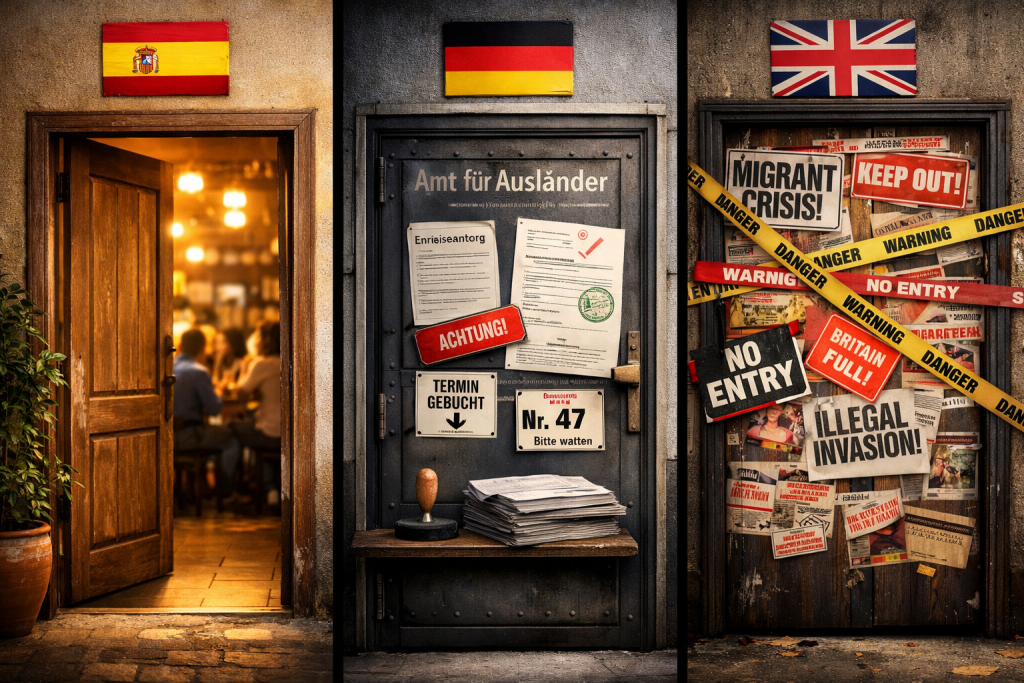
As a British citizen who has lived in Germany for fifteen years and who also has a home in Spain, I find myself moving between different moral climates when it comes to immigration. All three countries depend on migration. All three speak about it constantly. Yet they govern it with very different degrees of conviction.

Spain’s decision to regularise around half a million undocumented migrants has been widely described as bold. What strikes me more is that it feels principled. It reflects a style of leadership associated with Pedro Sánchez. Whether one agrees with him or not, he governs from a recognisable ethical framework. That framework informs domestic policy and foreign stances alike, including Spain’s willingness to articulate an independent position on Gaza. Immigration policy flows from that same seriousness. The law is being aligned with reality rather than used to perform toughness.

Germany approaches integration through procedure and moral discipline. This reflects a political culture now shaped by Friedrich Merz, a self-described capitalist whose flexibility seems to run in one direction only. Long-standing commitments are suddenly negotiable when it comes to rearmament, national debt, welfare retrenchment, or deportation rhetoric, provided wealth hierarchies remain untouched. The result is a system that demands compliance from the vulnerable while offering constant reassurance to capital. Integration becomes conditional, slow, emotionally distant, even hostile.

Britain’s problem is different but no less corrosive. Under Keir Starmer, the country is led by someone who claims a socialist inheritance but governs as a weathervane. Immigration policy shifts according to polling rather than principle. Positions harden according to headlines. The message to migrants is clear: you are needed, resented, and rhetorically punished all at the same time.

Spain, by contrast, currently shows a confidence that much of Europe lacks. It does not deny that immigration produces pressure. Housing shortages and exploitation are real. But regularisation is treated as governance, not surrender. Integration is understood as something that happens socially before it is certified administratively.

My own perspective here is sharpened by marriage. I am British, resident in Germany, and married to an Indonesian. After a year of marriage, my husband still has no residency or work permit in Germany. He is merely tolerated. In the UK, we cannot apply at all because I no longer live and work there. In Spain, later this year, he would have both residency and the right to work. Sitting together at Luca’s Café in Torremolinos, the contrast is impossible to ignore. Spain does not interrogate our presence. It respects us and welcomes us.

This difference is not accidental. It reflects political leadership. Confidence integrates better than fear. And at the moment, Spain is one of the few Western countries still willing to govern from that truth.

“Hospitality is not a gesture of kindness. It is a measure of political confidence.”
— Jacques Derrida

The Electric Car Story We Should All Be Talking About

Electric cars are sold to us as the clean, ethical future: the simple solution to petrol, emissions, and climate collapse. No exhaust pipe. No fumes. No guilt. Drive electric and you’re doing your part.

But the longer I listen to the certainty around EVs — the smug finality, the “case closed” tone — the more I suspect we haven’t solved the problem at all. We’ve simply moved it.

Because “zero emissions” is only true in one narrow sense: electric cars don’t emit at the tailpipe. That matters for city air quality, and it’s not trivial. But climate impact isn’t just about what comes out of the back of the vehicle. It’s about the whole chain: extraction, manufacturing, electricity generation, and end-of-life disposal.

And yes: in many cases, electric cars really are better on the climate. A major life-cycle analysis has estimated that battery electric cars sold in Europe today can produce dramatically lower overall greenhouse-gas emissions than comparable petrol cars. That’s a real advantage, and it’s worth acknowledging.

But “better than petrol” doesn’t automatically mean “clean.” It doesn’t mean “ethical.” And it certainly doesn’t mean “no victims.”

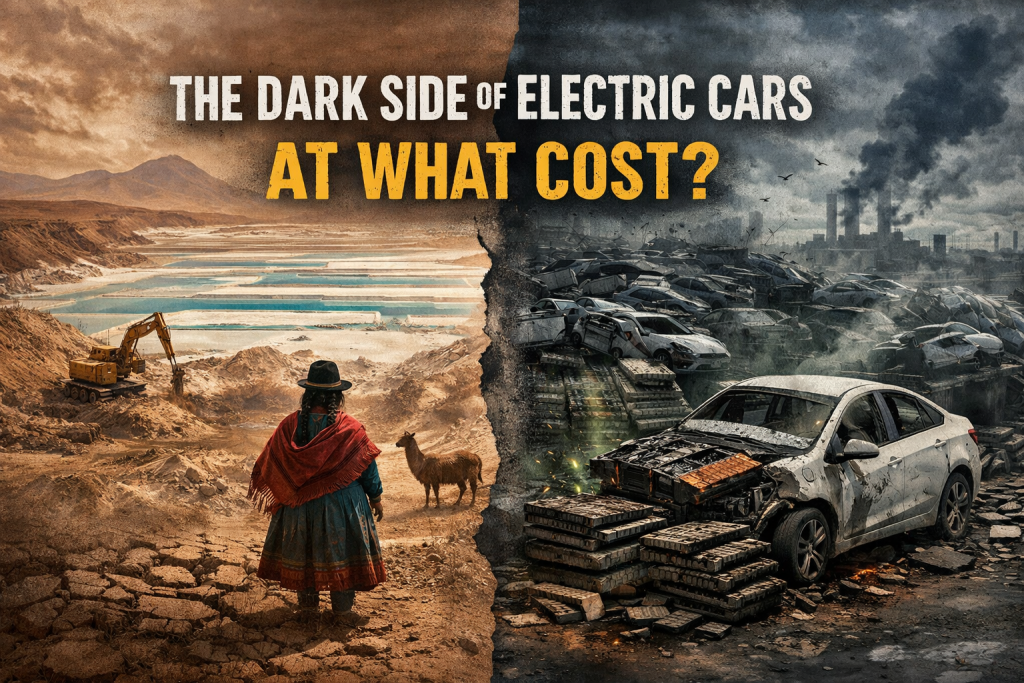
The modern electric car runs on more than electricity. It runs on minerals — and minerals have to be ripped out of the earth. The new fuel of the “green future” isn’t oil alone: it’s lithium, nickel, cobalt, graphite, and more. And the extraction doesn’t happen in glossy European showrooms. It happens in places where ecosystems are fragile, water is scarce, and the people who live nearby often have far less power to resist the pressure.

Chile is frequently held up as a symbol of this new reality. In the Atacama region, concerns have been raised for years about lithium extraction and water stress in an already arid landscape. And while “displacement” doesn’t always mean literal bulldozers and forced removals, communities can still be displaced in practice, when resources shrink, livelihoods collapse and the land becomes harder to inhabit. You don’t always need an eviction notice to be pushed off your own future.

Then comes the question nobody wants to picture too clearly: what happens when millions of EV batteries die?

Batteries degrade. Capacity drops. Replacement costs bite. Cars are written off. And suddenly we’re not looking at a futuristic revolution, we’re looking at a looming waste problem. We are manufacturing the next century’s landfill with a smile on our faces, because it feels cleaner today.

Yes, recycling exists. Yes, there are second-life uses for some batteries. Yes, policymakers talk about circular economies. But the scale is the issue. Recycling infrastructure doesn’t magically appear just because consumers feel virtuous. It requires systems, enforcement, investment, and time — and at the moment, the global EV rollout is moving faster than the uncomfortable questions that should be travelling alongside it.

So why does this side of the story still feel strangely muted?

Partly because it’s complex, and complex stories don’t trend. But partly because the car industry is not politically neutral. The automobile sector has been one of the most powerful lobbying forces shaping transport policy, regulation, and public messaging for decades. That doesn’t require a secret conspiracy. It only requires something much more ordinary — influence, money, access, timing, and the gentle steering of what gets taken seriously.

This is the deeper danger: the electric car has become a moral symbol. Question it and you’re treated as pro-oil. Doubt it and you’re dismissed as anti-progress. But this isn’t how ethical responsibility works. A solution isn’t automatically good because it comes wrapped in green language.

Electric cars may reduce emissions. But they don’t end extraction. They don’t end harm.

We’re not transitioning from dirty to clean. We’re transitioning from visible pollution to invisible supply chains, from smoke in our cities to disruption in deserts we’ll never visit.

So yes: electrification may be part of the future. But only if we stop treating it like a miracle and start treating it like what it really is: a trade-off. A compromise. A human project, built inside a world of scarcity, power and competing interests.

If we want an energy transition worthy of the name, we need more than new engines. We need transparency, better public transport, enforceable standards, serious recycling systems and the courage to count the human cost, not as an inconvenient footnote, but as part of the moral equation.

“A thing is right when it tends to preserve the integrity, stability and beauty of the biotic community. It is wrong when it tends otherwise.”
— Aldo Leopold

Love, Bureaucracy, and the Borders of Europe

How a perfectly legal couple spends years fighting a system that claims to protect the family

I have always loved Europe.
I still do.

The peace, the democracy, the rule of law — these are extraordinary privileges, and I’m grateful every day to live in a part of the world that, compared to most of the planet, is safe, stable and humane.

But loving a thing does not mean lying about it.
And the deeper my own journey into the European immigration system has taken me, the more convinced I have become that something fundamental is broken — not just in Germany, not just in Britain, but across almost the entire continent.

This is not an anti-German story.
It is a story about what it feels like to do everything legally, responsibly, respectfully — and still find yourself treated as if love were a loophole, marriage an inconvenience, and foreign spouses a threat to be contained.

It is a story that could happen in almost any European capital.

It just happened to us in Berlin.


How Love Became a Test of Endurance

A few years ago, I fell in love with a remarkable man in Indonesia.
Our relationship grew quickly and deeply, and we knew we wanted to build a life together in Europe rather than in Indonesia. We planned to marry anyway, so we assumed — naively, as it turns out — that marriage and legitimacy would make the process of living together straightforward.

We were wrong.
Painfully, spectacularly wrong.


Wedding Bells, Bureaucratic Walls

Because our marriage would not be legally valid in Indonesia, we had to marry in Europe.
What we imagined would be a simple civil ceremony became a six-month odyssey through paperwork, translations, apostilles, appointments, contradictory guidance, and requirements that bordered on the absurd.

Still — we got married.
We thought the hardest part was behind us.

But marriage, we learned, is not a ticket to a shared life.
It is merely the beginning of a long, labyrinthine process designed, it seems, to test whether your relationship can outlast bureaucracy.


The Rule No One Tells You: “Apply in Jakarta, or Don’t Come at All”

Once married, we were informed of something almost nobody tells you in advance:

If you marry an Indonesian and want to live together in Europe, your Indonesian spouse must apply for a family-reunification visa from Jakarta — and only from Jakarta.

Not from Berlin.
Not from any European consulate closer to their home island.
Not from Europe on a tourist visa (which would be logical, humane, and in line with every legal principle about protecting marriage).

Jakarta.
Or nothing.

The waiting list?
One year.
We have the screenshot.

And that’s just the waiting list for you to submit your application — not the processing time afterwards.

Imagine telling any married couple in Europe:

“Congratulations on your marriage.
You will now be forcibly separated for at least 12 months.”

That is the system.
That is the norm.


One Document Wrong? Start All Over Again.

When our turn finally came, the embassy did not approve one of the documents uploaded during the online process. They asked us to delete it — and, indeed, there is a little trash-can icon on the website.

Except the icon doesn’t work.
It never has.

After weeks of emails, calls, and technical back-and-forth, the embassy’s final advice was:

“Delete your entire application and start again.”

Which, in plain language, means:

“Restart the one-year waiting list.”

It is breathtaking to realise that the legal rights of marriage can be instantly overruled by a broken trash-can icon.


Geography as a Financial Weapon

If you are Indonesian and live on Sumatra, you must pay to fly twice to Jakarta — once for biometrics, and once to collect the visa. These costs are enormous relative to Indonesian salaries.

For many families, this is simply impossible.

This is what “legal migration” looks like in practice.


The 90/180 Trap: A Long-Distance Marriage by Law

Some couples try an alternative: the Schengen visitor visa.
But that route comes with its own cruelty:

  • Your spouse can visit for 90 days maximum

  • but must then leave for another 90 days minimum

Meaning:

You may live together for three months, then be forcibly separated for six.
Three on, six off. Three on, six off. Indefinitely.

Assuming, of course, you can afford the flights between Jakarta and Europe.
Most cannot.


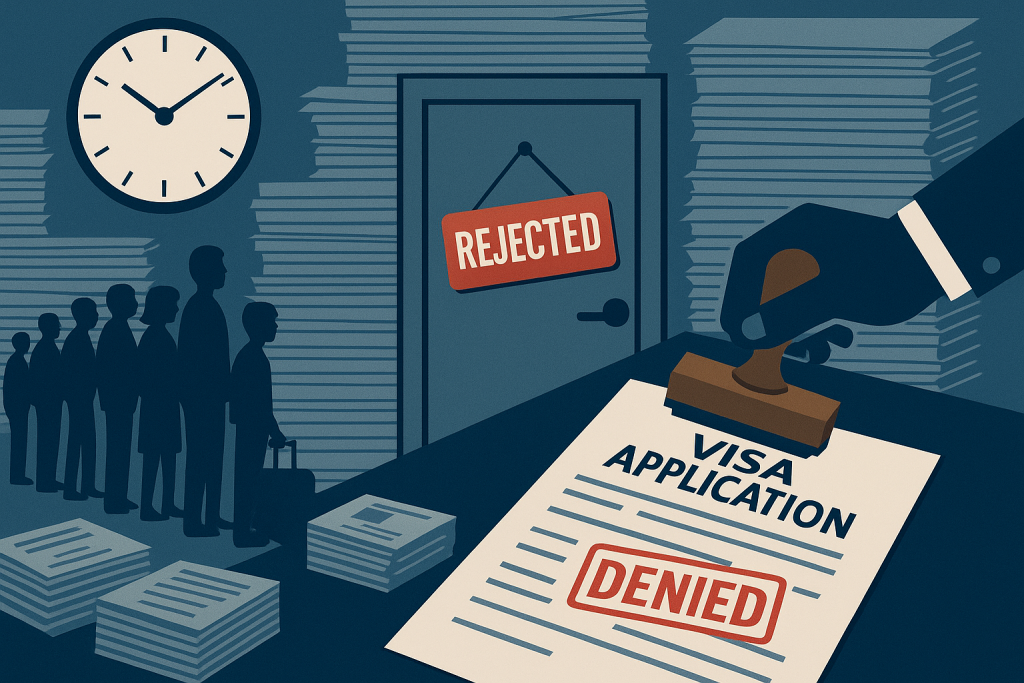
The Berlin Immigration Office: A Fortress Without Doors

If the embassy maze is surreal, the immigration office in Berlin is its European twin.

You cannot phone them.
You cannot email them.
You cannot speak to a human being unless you already have an appointment — and you cannot get an appointment without submitting a webform that may sit unanswered for two months.

If you attempt to enter the building to ask for help, security guards turn you away.
“No appointment, no entry.”

It is Kafka with fluorescent lighting.


When Your Appointment Arrives… It’s Too Late

In our case, by the time Berlin offered my husband an appointment, his visitor visa had expired.
They could not — or would not — offer an earlier date.

He was legally in the country.
He had proof of marriage.
He had every document required.

But the system, moving at its own glacial pace, simply shrugged.


The Catch-22: Work to Stay, But You Can’t Work Until You Stay

Here is the cruelest irony:

To obtain residency, the European spouse must prove sufficient income to support both partners.

But the foreign spouse cannot work unless they already have residency.

So if the European partner earns too little, the spouse receives only a six-month Fiktionsbescheinigung — a kind of temporary suspension of deportation, halfway between permission and limbo.

With that document:

  • You cannot work

  • You cannot earn

  • You cannot contribute

  • Therefore you cannot raise household income

  • Therefore you do not qualify for residency

This is not immigration policy.
It is a bureaucratic cul-de-sac.


And Then You Realise: If It’s This Hard for Us… What About Them?

We are educated, organised, legally married, European-based, English-speaking, German-speaking, online-competent, and persistent.

And still we nearly drowned in the system.

What must this system feel like for asylum seekers?
For people fleeing war or persecution?
For couples separated across borders with children in tow?
For those without money, stability, documents, or perfect German?

Oh yes, and in case you’re wondering, I did contemplate moving back to the UK and applied for residency for my English-speaking husband there. Our application was declined.

The system does not merely fail people.
It dehumanises them.


A Quiet Exception: The Spain Nobody Talks About

There is one place in Europe where the logic is different: Spain.

Spain has a little-known rule — almost never advertised — called arraigo social.

If you remain in Spain for two years, stay out of trouble, and integrate into community life, you can obtain legal residency.

No endless separation.
No forced poverty.
No trapdoors disguised as requirements.
No broken webforms or locked doors.

If you are married and have property there, the chances are even better.

Whatever critics say, this is a system that treats people — even undocumented ones — as human beings capable of building a life.

It is the closest thing Europe has to a humane immigration philosophy.


What This Story Is Really About

This is not a rant.
Nor is it an attack on Germany, which continues to offer extraordinary opportunities to millions of people, myself included.

It is a plea.
A testimony.
A reminder that behind every “case number” is a love story, a family, a life.

Europe prides itself on protecting marriage – see ECHR, Article 8 §§1–2.
Courts across the continent insist that “bureaucratic inefficiency is not a legitimate reason to separate spouses.”

But in practice?
The systems built to uphold those principles routinely violate them.

If Europe wants to protect its values — its humanism, its dignity, its rule of law — the immigration system is where it must begin.

Not with walls.
Not with suspicion.
But with the simple recognition that married couples should not have to fight this hard to live under the same roof.

“Bureaucracy is the death of all human action.” — Max Weber