Why Populists Thrive in a Connected World

Why Has Globalisation Increased Division Instead of Unity?

Globalisation should have been our great humanising force. For the first time in history, large numbers of people can travel freely, study abroad, work internationally, and encounter cultures that would once have remained distant and unknown. We have access to films, music, literature, foods, and languages from every continent. On paper, this should have produced an age of empathy. A century in which the old barriers of race, nationality, and religion dissolved into shared humanity.

Yet the opposite has happened. As the world has opened up, political identity has hardened. Populist nationalism has surged: Donald Trump in the United States, Viktor Orbán in Hungary, Vladimir Putin in Russia, and similar strongman figures elsewhere. Racism, religious extremism, conspiracy thinking, and tribal rhetoric are resurgent. The more connected the world becomes, the more threatened people seem to feel.

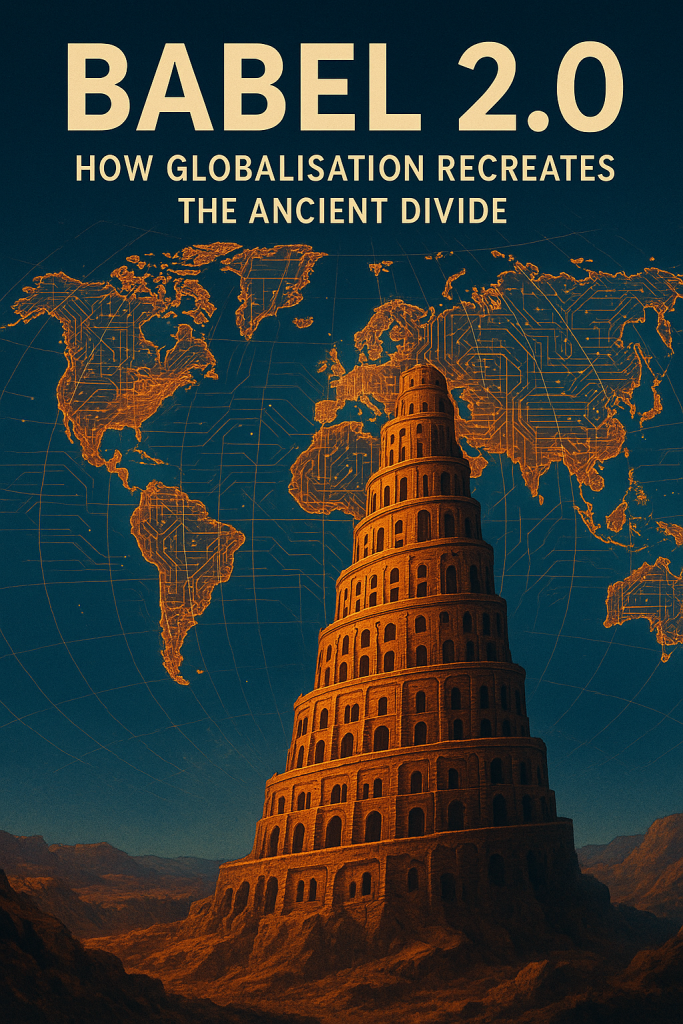
This contradiction is not new. It is the old story of the Tower of Babel. Human beings build upward toward unity, creativity, and common purpose—yet something in us fractures, resists, and disperses. Even if we don’t read that story religiously, it is psychologically precise. The closer we come to real integration, the more fear arises: fear of loss of identity, loss of control, loss of status.

Globalisation has consistently been experienced not as shared enrichment but as competition. The immigrant is framed not as a neighbour, but as a rival. Cultural diversity is discussed not as dialogue, but as dilution. Political rhetoric encourages the idea that “our” way of life is being erased. The result is defensive nationalism and, increasingly, violence.

This is not inevitable. The problem is not globalisation itself, but the absence of global solidarity to accompany global interdependence. We have integrated our economies, but not our ethics. We have connected our markets, but not our imaginations.

So the question is: How do we reverse the tide? How do we turn globalisation into a force for peace, dignity, and cooperation rather than division and resentment?

Here are three foundations:

1. Global Education that Teaches Perspective, Not Propaganda
International exchange programs cannot simply be tourism or language practice; they must cultivate the ability to see oneself from the outside. To understand how one’s culture appears to others, how history shapes identity, and how dignity must be mutual. Education that only reinforces national narratives will always produce suspicion, not solidarity.

2. Freedom of the Press, Protected by Law, Not Politics
Real democracy depends on the ability to critique power. When the press becomes the instrument of governments, oligarchs, or corporations, societies fracture along invented fears. The crisis at the BBC this week is not a local scandal—it is a warning. If journalism cannot report freely, citizens cannot think freely. And if citizens cannot think freely, they cannot live together freely.

3. Cross-Border Economic Cooperation That Shares, Not Extracts
The problem is not diversity—it is inequality. When globalisation enriches a few and impoverishes many, resentment is inevitable. But when globalisation supports fair wages, sustainable industry, ecological responsibility, and shared growth, it strengthens stability rather than fear.

In short: global interconnectedness must be matched with global empathy.

We already live in one shared world. The question is whether we will learn to behave as if that is true.

Unity is not naïve. It is the only realistic future we have.

“We may have different religions, different languages, different colored skin, but we all belong to one human race.”

–Kofi Annan
The Blueberry Paradox: Why We Keep Destroying the Systems That Could Save Us

On my last day in Spain, I sat at a small café, watching three men take down decorations from the town’s recent festival. The bunting had hung across the square for days, colouring the white-washed walls with celebration. Now the tourists had gone home, and these men — quiet, anonymous, methodical — were returning the square to its ordinary face.

Their work is unremarkable. No one applauds. Yet without people like them, the whole “beautiful tourist city” collapses.
Without them, the photos don’t look charming.
Without them, the streets feel neglected.
Without them, the illusion breaks.

I found myself thinking about fishermen at dawn, hotel cleaners before breakfast, bin collectors at 4am. The quiet labour that keeps the world turning — labour that rarely receives dignity, respect, or fair pay.

Then I looked at my arm.
At the blueberries.

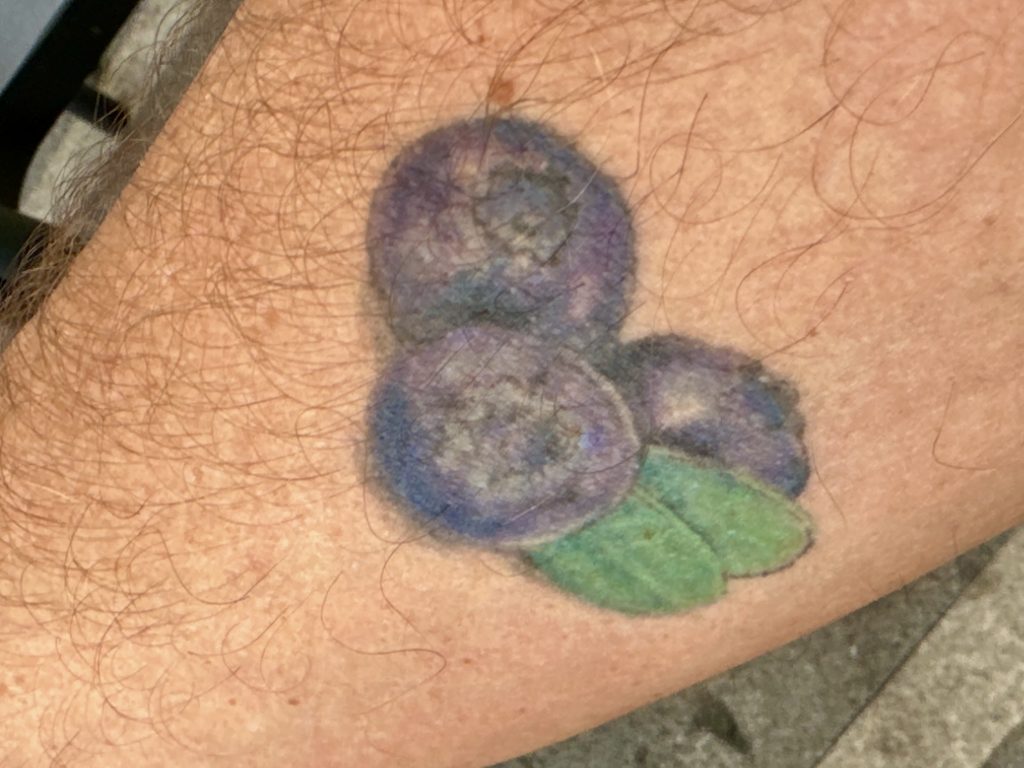
Yes — I have blueberries tattooed on my forearm. And no, it’s not whimsical. Or perhaps it is, but in the way truth sometimes hides inside whimsy.

The blueberries remind me that I cannot enjoy anything alone.
Not even my breakfast.

To eat a blueberry, I depend on soil, weather, farmers, packers, transport workers, supermarket staff, the climate not collapsing this particular year. My pleasure is communal, whether I acknowledge it or not.

Upside down, from a distance, the blueberries form a heart-shape. I didn’t plan that. But perhaps the body speaks before the mind is ready to believe.

The tattoo is a reminder:
You are held. Your life is made by many lives. You are not independent.

And so here’s the question that came to me in that Spanish square:

If we know we are interdependent, why do we build societies that pretend we aren’t?

Why do we reward the illusion of the “self-made individual” while the world is built by the unseen hands of others?

Why does the fisherman earn less than the financier?
The cleaner less than the consultant?
The bin collector less than the politician?

It is not rational.
It is not moral.
It is not even economically coherent.

It is, however, familiar.

And this — whether people like to admit it or not — is where Marx enters the conversation.

Marx’s Point Was Never “Everyone Should Be the Same”

Marx’s central claim was beautifully simple:
Human labour creates value.
So the people who create value should benefit from it.

That’s it.
That’s the hinge.

Marx wasn’t calling for laziness, or enforced sameness, or the death of creativity. He was pointing out that societies become obscene when those who create the conditions for life (food, sanitation, infrastructure, care) are treated as disposable.

He believed in dignity through shared labour.
In contribution as meaning.
In justice as the redistribution of the wealth that labour creates.

Which is why, though he rejected religion, Marx comes surprisingly close to Jesus.

Jesus also preached the reversal of hierarchy:

“The last shall be first, and the first last.”

Not metaphorically — economically, socially, relationally.

Both men looked at society and said:

This is upside down.
We can live differently.

Both pointed to community over competition, relationship over possession, need over greed, dignity over dominance.

And yet —
we have not built the world either of them imagined.

Not once.
Not anywhere.
Not for long.

So the question is no longer Was Marx right?
Or Was Jesus right?

The question is:

What stops us from building the just society both of them saw so clearly?

The Answer Is Not Economic. It’s Psychological.

We call it capitalism vs. communism
but the real struggle is fear vs. trust.

We hoard because we are afraid there won’t be enough.
We compete because we are afraid of being overlooked, replaced, forgotten.
We dominate because we are afraid of being powerless.
We cling to hierarchy because we are afraid of being ordinary.

Fear is the water we swim in.
Fear is the undecorated square after the festival is taken down.
Fear is the silence in the early morning before the day begins.

Marx underestimated fear.
Jesus named it, but was killed for it.

And every system we have built has collapsed for the same reason:

We would prefer to be safe than to be equal.

The Failure Was Never Marx’s. It Was Ours.

We say “communism failed” as if ideology collapsed of its own weight.
But ideas don’t fail.
Systems don’t fail.

People fail.

We fail because we want justice until justice requires something of us.
We want equality until equality asks for our privilege.
We want community until community interrupts our autonomy.

We want the kingdom of God
without the cross.

We want Marx’s dignity of labour
without surrendering status.

So we keep building worlds in which:

  • the blueberry appears magically on the table

  • the labourer remains invisible

  • and we pretend we did this alone.

The Blueberries Again

I look at my arm.
The tattoo.
The accidental heart.

A reminder that interdependence isn’t an ideal —
it’s already true.

We just live as if it isn’t.

The question is not whether a just society is possible.
We already rely on one.
Every day.
Every meal.
Every building.
Every service.
Every breath of shared infrastructure.

The question is simply:

When will we live as though we know it?

And perhaps the first step toward a better society
is simply learning to say:

Thank you.
To the fisherman.
To the street worker.
To the invisible hands.
To the ones who keep the world turning
so that the rest of us can pretend we did it ourselves.

Faith and doubt

The Bible defines faith in strikingly absolute terms:

“Now faith is confidence in what we hope for and assurance about what we do not see.”
— Hebrews 11:1

For years, I lived inside that definition. To believe in God, in the death and resurrection of Jesus, in heaven and hell, was not to speculate but to be certain. I remember how real that certainty felt — as if the ground beneath me could not possibly give way.

Looking back, I can still see why conviction is so attractive. It simplifies life. It gives you direction. There’s something reassuring about being guided by a strong sense of rightness, rather than drifting on vague, half-formed notions. For a time, I admired that in myself and in others — the courage to stand firm, to be sure.

But certainty has a darker side. It divides the world into believers and non-believers, insiders and outsiders. I’ve seen how quickly that division hardens into judgment, superiority, even hostility. History is full of examples where religious certainty did not just separate communities but helped justify oppression and war. That recognition has been painful for me, because I once participated in the same mindset.

Doubt, by contrast, has never started wars. It doesn’t silence art or suppress science. If anything, doubt has opened doors — for creativity, for discovery, for dialogue. In my own life, doubt has forced me to pause, to ask questions I once thought dangerous. Strangely enough, it has made me more compassionate. To give someone the benefit of the doubt, even in ordinary relationships, is to allow space for understanding rather than condemnation. On a larger scale, when whole cultures are willing to live with doubt, it creates the possibility of cooperation instead of conflict.

For me, the shift from certainty to doubt has not been easy. It feels like stepping off firm ground into open air. But it also feels more honest. Faith, I now see, is not always confidence; it can just as easily be the refusal to face uncomfortable truths. Doubt, far from being weakness, has become — for me — a condition of dignity, the beginning of humility, the chance to meet others without the armour of superiority.

Voltaire once wrote:

“Si Dieu n’existait pas, il faudrait l’inventer.”
If God did not exist, it would be necessary to invent him.

Perhaps he was right. But if we are honest with ourselves, we may also need to invent doubt — not as a threat to our humanity, but as its safeguard.

False Fundamentalism: Erasmus v. Luther

Hans Holbein the Younger, Portrait of Erasmus of Rotterdam

Erasmus of Rotterdam (1466–1536) is often regarded as the pioneer of historical-biblical criticism — a discipline that continues to polarise attitudes to the Bible today.

A highly gifted academic, a Catholic priest, and in many ways one of the first genuine citizens of Europe, Erasmus was also the illegitimate son of a priest. Both his parents died of the plague when he was a teenager. These hardships helped shape his lifelong belief in synergism (salvation is a work of both  God and human co-operation), in contrast to the monergism (salvation is a work of God alone) preached by Luther and many Protestants since the Reformation.


Erasmus the Humanist

Erasmus was a pacifist who wanted Christianity to be lived out in daily practice. He feared that Luther’s belligerence would fracture the church — which is exactly what happened. Yet Erasmus was also a product of his time: a humanist who sought to move faith away from lofty scholastic debates and root it once again in the lives of ordinary people.

That concern drove him to produce accurate translations of the Bible from authentic manuscripts, placing them into the hands of ordinary believers.


The Problem of the Vulgate

For centuries the church relied on the Vulgate, a 4th-century Latin translation. When Erasmus compared it with manuscripts in Greek and Hebrew, he found countless errors — mistranslations, omissions, outright mistakes.

This raises uncomfortable questions for fundamentalists:

  1. If the Bible is the infallible Word of God, why did God permit flawed versions for the first 1,500 years of church history?

  2. If Christians are meant to base their lives on Scripture, what did they do during the early centuries when no agreed New Testament even existed — and when its canon was decided by human choices?

  3. What if more accurate manuscripts were discovered tomorrow? Would faith collapse?

  4. Why did God wait until the 18th century for scholars to unearth more reliable manuscripts, leaving believers with errant texts for nearly 1,700 years?


Pragmatists vs. Fundamentalists

These questions split Christians into two camps. Erasmus and his heirs take the pragmatic view: human errors in transmission do not negate the central message of Jesus.

Fundamentalists, by contrast, insist that every word of Scripture is directly inspired, perfectly preserved, and must be correctly interpreted in “synergy with the Spirit.” They claim a monopoly on truth while conveniently overlooking the centuries of textual mistakes God apparently permitted.


Seeds of Criticism

Erasmus thus planted the seeds of modern historical-biblical criticism. If the text contains human flaws, then textual criticism is necessary. From there follow source, form, and literary criticism.

To many fundamentalists, these methods are “tools of the devil.” But the devil himself is a mythical construct — a figure invented by those in power to keep ordinary people in fear and obedience. What fundamentalists really fear is the erosion of their authority over naïve believers.


Erasmus Ahead of His Time

Erasmus held on to his synergistic convictions, alienating many theologians of his day. In hindsight, he was far ahead of his time.

And the core question remains: Which kind of Christian most resembles Jesus?

  • The one who lives daily in gratitude, prayer, and service, applying the main tenets of Scripture with humility?

  • Or the one who thunders fundamentalist slogans while ignoring beggars, railing against minorities, and collaborating in the destruction of the planet?

Which vision reflects the heart of Jesus more closely: Erasmus’ synergism, where humans freely cooperate with God to make the world better, or Luther’s monergism, where salvation is a matter of predestined grace and the rest are damned from birth?

After all, in Matthew 19, Jesus gave the rich young man a choice.


“The test of a first-rate intelligence is the ability to hold two opposed ideas in mind at the same time and still retain the ability to function.”
— F. Scott Fitzgerald