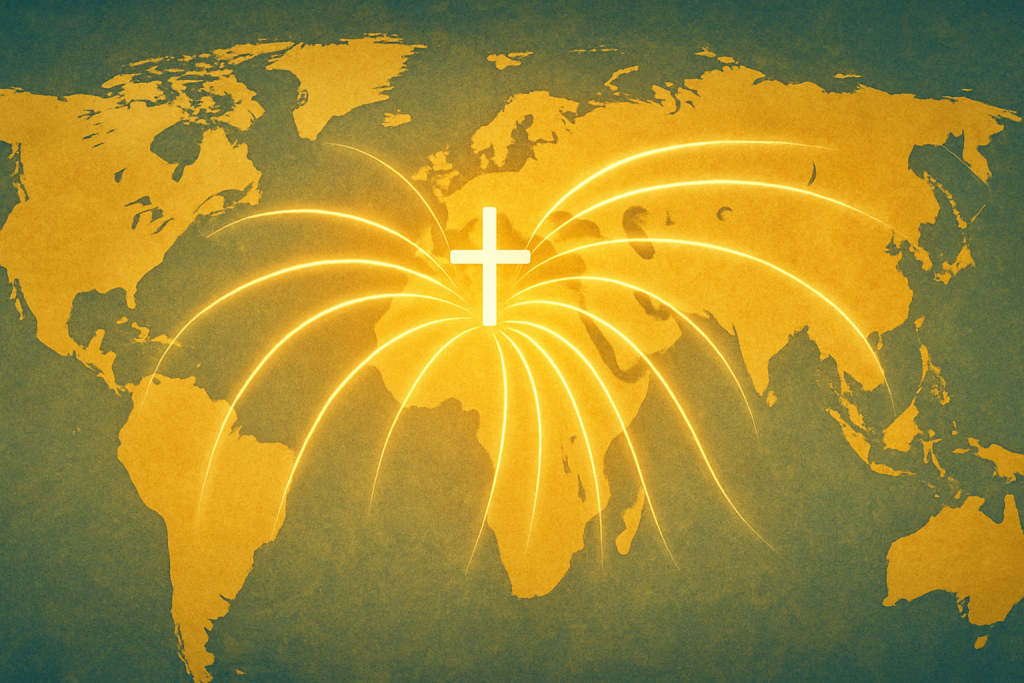
From Village Carpenter to Global Force: The Strange Success of Christianity

It remains one of the strangest facts of history.

A thirty-something artisan from a provincial backwater, speaking Aramaic in a corner of the Roman Empire, is now at the centre of the world’s most geographically widespread religion. Two thousand years later, his story is still believed – not just by the desperate and uneducated, but by surgeons, software engineers, lawyers, professors and prime ministers.

We can debate for ever whether the miracles happened, whether the tomb was empty, whether God exists at all. But even if you bracket all that out, a hard question stays on the table:

How did this particular faith story become so portable, so durable, and so attractive to intelligent people for so long?

And – just as interesting – why does Christianity grow in some places today and haemorrhage members in others?

I want to suggest that the answer has less to do with miracles, and more to do with four things:

    • its portability
    • its God of love
    • its dual appeal to heart and reason
    • and the way it behaves sociologically – either as a movement or as an institution.

Christianity’s Secret Weapon: Portability

Most ancient religions came bundled with a package deal: one god, one people, one place, one language.

You worshipped the gods of your tribe, your city, your land. The temple was in that city, the sacrifices at that altar, the prayers in that tongue. This is how religion normally works.

Christianity broke that model.

From the very beginning it said, in effect:

“You don’t need to be Jewish. You don’t need to move to Jerusalem. You don’t need to learn a sacred language. This is for everyone.”

No temple to travel to.
No hierarchical clergy or priesthood – every believer is a priest
No sacred script only the initiated can read.

Just a set of compelling and memorable stories and teachings about Jesus and a small travelling community who claimed that his life, death and (as they saw it) resurrection had changed what it meant to be human.

That made Christianity absurdly portable:

    • It moved from Aramaic into Greek.
    • Then into Latin, Coptic, Syriac, Armenian, Gothic.
    • It made the jump into the philosophical worlds of Plato and Stoicism, and then into the legal and administrative world of Rome.
    • Today it sits comfortably in English, Swahili, Korean, Portuguese and Tagalog without asking anyone to “become Jewish” first.

If you strip Christianity back to its core, the essentials are strangely easy to translate:

    • love
    • forgiveness
    • dignity
    • care for the poor
    • hope beyond death
    • justice
    • meaning
    • transformation

No sacred mountain. No exclusive caste. No single holy language.

Just a story and a way of life that can, at least in theory, be picked up anywhere.

Whenever Christianity has leaned into this radical portability – no guarantees, no bureaucracy, just small communities trying to live this story in their own culture – it has tended to spread.

Whenever it has wrapped itself in state power, fixed liturgies, heavy buildings and highly controlled hierarchies, after some initial growth, it has tended to stall and then decline.

We can see that empirically now.


A Shockingly Different God

Portability explains how Christianity can move.
It doesn’t yet explain why anyone would actually want it.

Here I think we come to the most explosive claim at the heart of Christian faith:

God loves you. Personally.

We are used to that sentence now. In the ancient world, it was dynamite. All humans are looking for existential meaning and personal acceptance.

The gods of Rome were powerful, but capricious.
The gods of Greek myth were brilliant, but aloof.
The philosophers spoke of a Logos or a First Principle – interesting, but hardly something you would sing hymns to.

Then along come the Christians, saying:
the ultimate reality behind the universe is not raw power, not blind fate, not an impersonal force, but self-giving love – and that this love is somehow focused on you.

Not just: “There is a god.”
But: “You are known and wanted.”

Add to that some other, equally disruptive ideas:

    • that slaves have dignity,
    • that women and children matter,
    • that the poor, the stranger, the sick, the disabled are not disposable but precious,
    • that every human being, without exception, bears the image of God.

In an empire that threw away unwanted babies, left the sick to die in the street, and treated most people as economically useful units at best, this was not just comforting. It was revolutionary.

You didn’t have to believe in miracles to find this vision of the world compelling. Many still don’t.


Heart and Mind in the Same Story

There is another piece to the puzzle. Christianity did something that very few religions manage to sustain over centuries:

It offered a credible home for both the heart and the mind.

On the heart side, it speaks to:

    • forgiveness for real guilt
    • a path to change when you hate the person you’ve become
    • a community that will (at least in theory) walk with you
    • the intuition that love and justice somehow matter more than success
    • the fear of death and the longing that death is not the end

On the mind side, it offers:

    • a universe that is ordered and intelligible rather than random
    • a moral framework that is more than “my preference vs. yours”
    • a coherent story of how humans can be capable of both beauty and horror
    • a God-concept that can be, and has been, taken seriously by some of the most demanding intellects in history

Augustine, Aquinas, Pascal, Kierkegaard, Bonhoeffer – whatever you make of their conclusions, these are not gullible people. They were not seduced by a cosy fairy tale. They found in Christianity a way of thinking that was at least big enough to wrestle with reality.

That combination – emotional depth and intellectual seriousness – is rare. It goes some way to explaining why, in every generation, some doctors, lawyers, scientists and philosophers still end up in church despite knowing all the reasons not to.


When Christianity Behaves Like a Religion, It Shrinks

The really uncomfortable part, especially if you belong to an established church, is what happens next.

Over time, the portable, story-driven movement becomes something else:

    • It builds buildings.
    • It develops liturgy and rules.
    • It trains a professional clergy.
    • It negotiates with states and empires.
    • It learns to sit quite comfortably next to imperial power, feudal systems, colonial projects and nationalist dreams – sometimes as their chaplain.

Some of this is inevitable. Human beings organise. Communities need structure. Not every bishop is a villain.

But the sociological pattern is striking:

    • In much of Europe, the old state-linked churches – Catholic, Anglican, Lutheran, Reformed – are in steep numerical decline.
    • They are rich in buildings, history and liturgy; poor in young adults, fresh converts and living energy.
    • Many of their most enthusiastic members quietly slip away to small, lay-led, often charismatic communities – or out of the Christian story altogether.

You don’t need supernatural explanations for this.
It is what tends to happen when a movement becomes an institution and then an arm of the state.

The religion that once prided itself on having “no temple, no priesthood, no sacred language” has sometimes become exactly the kind of religion Jesus himself spent so much time arguing with.

And people vote with their feet.


When Christianity Behaves Like a Movement, It Spreads

The picture is very different whenever Christianity sheds the imperial clothing and goes back to something closer to its original form.

We see this in:

    • house-church networks under communism
    • base communities in Latin America
    • Pentecostal and independent churches in parts of Africa, Asia and Latin America
    • small experimental communities in post-Christian cities in Europe.

What these movements tend to have in common is not a particular theology but a form:

    • they are locally led,
    • often meeting in homes, schools or rented halls rather than cathedrals,
    • heavily relational,
    • high on participation and experience,
    • able to translate the message into local culture without waiting for permission from a distant headquarters.

They may or may not be “charismatic” in the technical sense. Many are. Some aren’t. But they are recognisable cousins of that first generation of Jesus-followers who met in houses, shared meals, argued, prayed, fell out, reconciled and tried to work out what this story meant in Corinth, or Antioch, or Rome.

Where Christianity looks like that, it is often growing – sometimes quietly, sometimes explosively.

Where Christianity looks like a bureaucratic service provider for people who need weddings, funerals and a vague sense of national identity, it is often dying.

Again, you don’t need to believe in God to see the pattern. It’s written in the attendance figures.


So Why This One Story?

None of this “proves” that Christianity is true. That’s a different discussion.

But it does, I think, make sense of why this particular faith story has had such reach:

    • It told an outrageous story of love in a world ruled by fear.
    • It insisted that the most important truths about human life could be carried in a portable story, not locked in a temple or a tribe.
    • It managed, at its best moments, to give both the heart and the mind something serious to work with.
    • And it has a built-in tendency to break out of its own institutions and reinvent itself as a movement again whenever those institutions become too heavy.

An Aramaic-speaking artisan from a nowhere village should have vanished into the long list of forgotten preachers.

Instead, people all over the world are still arguing about him, still praying to him, still walking away from him in anger, still quietly coming back.

You can explain that purely in sociological and psychological terms, if you like. Or you can, if you are so inclined, wonder whether the “God of love” at the centre of the story has something to do with its refusal to die.

Either way, it is hard to deny that the story is still on the move – and that it travels lightest when it remembers where it began.

“The Christian ideal has not been tried and found wanting; it has been found difficult and left untried.”  – G. K. Chesterton

Cathedrals of Quiet Light: An Homage to Libraries

I did not expect a pilgrimage. All I wanted, on a cold Berlin morning, was a simple desk in my local library. A familiar refuge where I could coax myself into writing. Instead, I arrived to find the doors barred and the building shrouded in scaffolding. Closed for refurbishment. And yet even that felt oddly hopeful: a library being tended to, repaired, protected. A chrysalis in plywood. Still, it left me homeless for the day, so I pointed myself into the centre of Berlin and followed a vague instinct in search of a different reading room.

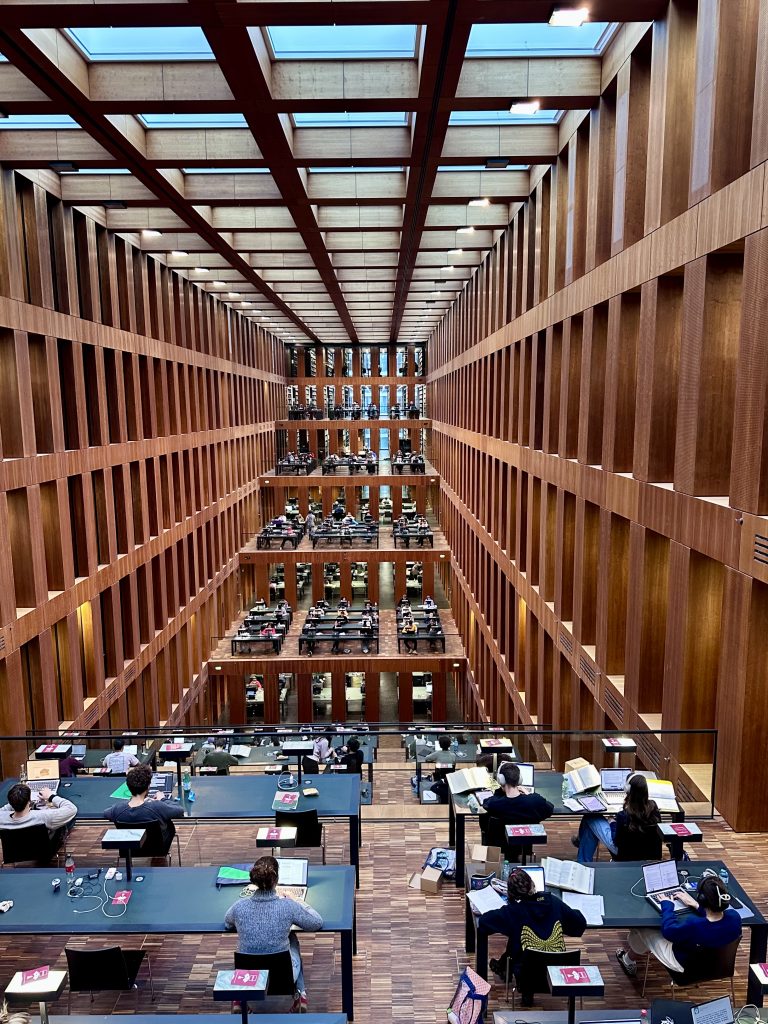
By early afternoon I was standing inside the Humboldt University Library, in the central Jacob-und-Wilhelm-Grimm-Zentrum — a building completed in 2009 at a cost of roughly €150 million, a temple to light and linearity, a modern cathedral carved out of honey-coloured wood. I had never been inside before. I found my way up several flights of stairs, past quiet students and moving columns of books, until I arrived in the library’s great central atrium.

There are moments when atmosphere becomes an event, as if the air thickens with meaning, as though the space itself has a pulse. That is what happened. The first glance into the atrium felt like encountering a new idea before you have the words for it.

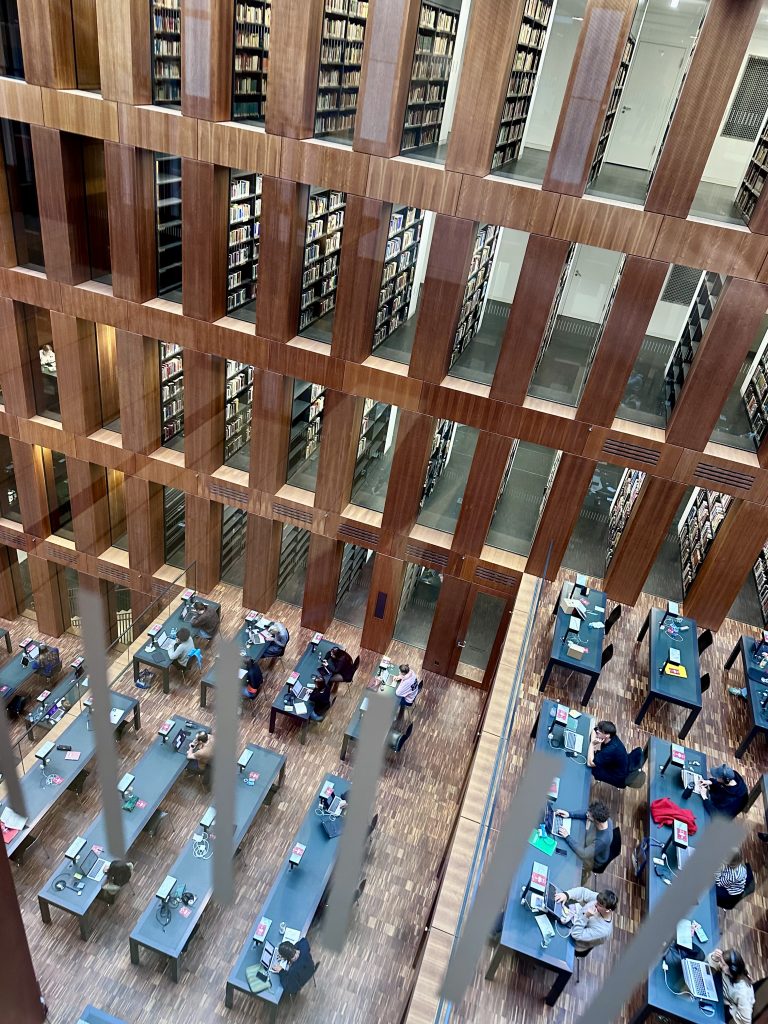
The room opened before me in tiers, receding downwards in vast wooden frames, each level lined with narrow study desks illuminated by soft rectangular lamps. Above, the ceiling dissolved into a grid of skylights, a geometry of glass and daylight. Below, hundreds of young people bent over books and laptops, headphones cocooning them, highlighters poised like tiny torches hunting for truth in margins. It was an amphitheatre of thought, tier upon tier of silent striving, human concentration arranged like an inverted ziggurat.

The sight moved me more than I had anticipated. I had often studied in the ancient libraries of Oxford, with their stone floors worn by centuries of scholars and portraits of stern-faced alumni glaring down with a mixture of judgement and encouragement. But this — this modern Berlin chamber with its clean lines and its open light — held its own kind of splendour. If Oxford’s libraries feel like the weight of the past pressing lovingly upon you, the Grimm-Zentrum feels like the future stretching out somewhere beyond the roof.

And suddenly I felt small and young again, in the most wonderful way.


A Place Where the World Learns How to Think

What struck me first was the sound — or rather, the absence of it. The quiet in a library is not mere silence. It is a collective agreement, a social pact, a voluntary reverence. The students around me were not quiet because they were told to be. They were quiet because they were invested. Because something mattered.

Then came the smell — that unmistakable perfume of libraries everywhere:
waxed linoleum; varnished wood; warm dust that rises from the turning of pages; and above all that distinctive scent of old books, a mixture of paper, glue, ink, and time itself. It carries, always, a faint edge of mystery – a reminder that knowledge ages like a living thing.

As I sat down on the highest tier, overlooking this incredible geometry of minds at work, it occurred to me that libraries are among the few places left in modern life where human concentration is visible. We watch it manifest physically: in posture, in scribbles, in slow-page turns, in the absorbed stillness of someone who is trying to understand.

The atmosphere was electric but hushed, charged but respectful. There were students mapping out theses with coloured pens, others scrolling through academic articles, some chewing their pens absentmindedly while staring into middle distance — that universal gesture of a mind wrestling with a concept. There were those who looked exhausted but determined, and others who looked exhilarated by a sentence they had just discovered. Every face was a small story of effort.

This collective striving was profoundly moving. It made visible something we often forget: knowledge is crafted, not downloaded. Even with all the technology around them, these students were still doing the slow, patient work that makes civilisation possible. Research is not glamorous. It is hours of searching, scanning, discarding, re-reading. Yet they persisted.

Watching them, I felt privileged — almost intrusive — as though I were witnessing a kind of secular liturgy.


This Is Not an Anti-AI Eulogy. Quite the Opposite.

Let me say this clearly, and early, because sentiments like mine are often misinterpreted: this is not a rear-guard lament against AI.
No pious calls to return to pre-digital methods. No false nostalgia. No technophobia.

I embrace AI wholeheartedly. I use it every day, and I consider it one of the most extraordinary tools ever created. It accelerates learning, supports human creativity, and holds vast potential for everything from agriculture to medicine to interplanetary exploration. It will help build the colonies on Mars long before we finish debating whether rocket fuel is environmentally friendly.

So this reflection is not a plea for a world without technology. It is instead an attempt to articulate something different: that libraries and AI are not adversaries.
They are partners.
One is where the human mind trains its depth; the other is where it extends its reach.

Libraries teach us how to think.
AI helps us learn faster once we know how.

The library is the gymnasium of cognition.
AI is the exoskeleton.

We need both.


A Secular Temple — or Something More

As I sat in the top tier of that atrium, I realised that all my senses were activated at once: sight, sound, smell, touch, and the quiet murmur of pages turning like a heartbeat for the whole building. It was almost too much. It bordered on the religious.

If you believe in God, you could easily imagine gratitude rising like incense: look what humanity — the species fashioned out of dust and breath — has managed to build. Look how our curiosity has unfolded into architecture, scholarship, craft, and a hunger for understanding that seems inexhaustible.

If you do not believe in God, the miracle remains.
After all, what could be more astonishing than this? That the random electrical impulses arising from an indifferent universe have generated organisms who sit together in vast wooden halls reading about Mesopotamia, quantum mechanics, marine ecosystems, political philosophy, medieval manuscripts, and machine learning algorithms. That atoms born in supernovae now write essays on ethics and the shape of a meaningful life.

Even the most hardened atheist cannot deny the improbability, the majesty of that.

To sit in a library is to witness a miracle in motion — a civilisation rehearsing its own continuation.


The Invisible People Who Make It Possible

It is easy, in moments of beauty, to forget the infrastructure that supports them. But libraries are not spontaneous miracles. They are daily, deliberate acts of civic generosity.

Someone designed this building with its lightwells, its tiers, its acoustics, its quiet. Someone else built it, brick by brick, panel by panel. Others maintain it, polish the floors, fix the lamps, organise the recycling, restock the bathrooms, oil the doors so they close softly.

Then there are the librarians, the custodians of order in our age of chaos. The ones who curate, classify, preserve, and patiently help bewildered visitors locate that one book whose title they have partially forgotten. They are the guardians of continuity, the keepers of fragments, the quiet historians of our intellectual life.

Yesterday, I watched a librarian register new readers at the desk. One of them was me. The young man helping me was in his early twenties, wearing a university hoodie, and fascinated by my British passport. He asked why the text was printed both in English and French. He was curious about British attitudes to Europe, about why I had come to Berlin, about what I was planning to write.

There was no transactional coldness in him. Only a genuine hunger to learn, to connect, to understand. It was a small moment, and yet it added a human warmth to the architecture around us. It reminded me that libraries are not only spatial achievements; they are social ones. They bring together people who believe — perhaps stubbornly, courageously — that knowledge should remain accessible to all.

And yes, I felt grateful. Deeply grateful. In an age dominated by cynicism about governments, it is worth remembering that states still choose to spend millions on libraries, archaeology departments, social sciences faculties, digitisation projects, and the preservation of knowledge. This is not trivial. It is evidence of a civilisation still investing in its own mind.


A Place Where My Own Creativity Woke Up

I did not plan to begin outlining a new novel yesterday. But the effect of sitting in that atrium was galvanising. The sight of hundreds of young minds in motion, the geometry of the architecture, the warm glow of the wood, the filtered daylight, the portraitless vastness that made every student their own protagonist — it all stirred something in me.

Creativity, I am convinced, is contagious. We borrow the electricity of others. When you place yourself in an environment charged with intellectual purpose, something inside you aligns. Ideas begin to organise themselves. Sentences appear without being summoned. Pages begin to form.

That is exactly what happened.

Within an hour of sitting down, my mind was in overdrive, casting threads between ideas I had been carrying for months, imagining scenes, characters, dilemmas. The space did not merely host my creativity; it provoked it. I left with the outline of my next book beating quietly inside my bag.


Why This Matters for the World Our Children Inherit

As I gazed into the atrium, I kept thinking about the thousands of young people around the world who will never experience something like this — who study in overcrowded classrooms, or at kitchen tables, or not at all. And then I thought of the students who do have this privilege and perhaps take it for granted, because we all take blessings for granted when they become part of the wallpaper of our days.

A library like this is not a neutral space.
It is a statement.
A declaration of values.
A place where a society says to its young:

Take this. Explore. Learn. Write. Think. Question. Become. We believe you are worth the investment.

My hope is that such spaces will not become relics. That they will not be drowned by the easy seductions of instant information, nor by political short-sightedness, nor by economic austerity. May libraries continue to stand as cathedrals of collective education, where young people can enter free of charge and leave richer in spirit, sharper in thought, and braver in imagination.


A Final Word of Gratitude

So this is my homage — not to nostalgia, but to possibility. To the people who keep these spaces alive. To the students who fill them. To the architects who imagine them. To the librarians who protect them. And yes, to the governments and taxpayers whose resources make them real.

Most of all, it is an expression of gratitude for the simple miracle that humans still gather in large wooden rooms to read books, annotate pages, debate arguments, and shape knowledge. In a world that often feels fragmented, libraries remind us that our species is still capable of collective enlightenment.

As long as there are libraries, there is hope.
As long as there are young people hunched over books, there is a future worth fighting for.
And as long as we preserve places like this — vast, warm, light-filled, reverent — our civilisation will continue to write itself into being.

Yesterday I entered a library looking for a desk.
I left having recovered my faith in human curiosity.

And perhaps that is the true gift of a library:
it does not simply store knowledge —
it awakens the desire to create more of it.

“Education is the point at which we decide whether we love the world enough to assume responsibility for it.”  – Hannah Arendt

If you love the world enough, go back to a library. Sit down. Read something difficult. Support these spaces. They are still where civilisation renews itself.


Why Populists Thrive in a Connected World

Why Has Globalisation Increased Division Instead of Unity?

Globalisation should have been our great humanising force. For the first time in history, large numbers of people can travel freely, study abroad, work internationally, and encounter cultures that would once have remained distant and unknown. We have access to films, music, literature, foods, and languages from every continent. On paper, this should have produced an age of empathy. A century in which the old barriers of race, nationality, and religion dissolved into shared humanity.

Yet the opposite has happened. As the world has opened up, political identity has hardened. Populist nationalism has surged: Donald Trump in the United States, Viktor Orbán in Hungary, Vladimir Putin in Russia, and similar strongman figures elsewhere. Racism, religious extremism, conspiracy thinking, and tribal rhetoric are resurgent. The more connected the world becomes, the more threatened people seem to feel.

This contradiction is not new. It is the old story of the Tower of Babel. Human beings build upward toward unity, creativity, and common purpose—yet something in us fractures, resists, and disperses. Even if we don’t read that story religiously, it is psychologically precise. The closer we come to real integration, the more fear arises: fear of loss of identity, loss of control, loss of status.

Globalisation has consistently been experienced not as shared enrichment but as competition. The immigrant is framed not as a neighbour, but as a rival. Cultural diversity is discussed not as dialogue, but as dilution. Political rhetoric encourages the idea that “our” way of life is being erased. The result is defensive nationalism and, increasingly, violence.

This is not inevitable. The problem is not globalisation itself, but the absence of global solidarity to accompany global interdependence. We have integrated our economies, but not our ethics. We have connected our markets, but not our imaginations.

So the question is: How do we reverse the tide? How do we turn globalisation into a force for peace, dignity, and cooperation rather than division and resentment?

Here are three foundations:

1. Global Education that Teaches Perspective, Not Propaganda
International exchange programs cannot simply be tourism or language practice; they must cultivate the ability to see oneself from the outside. To understand how one’s culture appears to others, how history shapes identity, and how dignity must be mutual. Education that only reinforces national narratives will always produce suspicion, not solidarity.

2. Freedom of the Press, Protected by Law, Not Politics
Real democracy depends on the ability to critique power. When the press becomes the instrument of governments, oligarchs, or corporations, societies fracture along invented fears. The crisis at the BBC this week is not a local scandal—it is a warning. If journalism cannot report freely, citizens cannot think freely. And if citizens cannot think freely, they cannot live together freely.

3. Cross-Border Economic Cooperation That Shares, Not Extracts
The problem is not diversity—it is inequality. When globalisation enriches a few and impoverishes many, resentment is inevitable. But when globalisation supports fair wages, sustainable industry, ecological responsibility, and shared growth, it strengthens stability rather than fear.

In short: global interconnectedness must be matched with global empathy.

We already live in one shared world. The question is whether we will learn to behave as if that is true.

Unity is not naïve. It is the only realistic future we have.

“We may have different religions, different languages, different colored skin, but we all belong to one human race.”

–Kofi Annan

The Blueberry Paradox: Why We Keep Destroying the Systems That Could Save Us

On my last day in Spain, I sat at a small café, watching three men take down decorations from the town’s recent festival. The bunting had hung across the square for days, colouring the white-washed walls with celebration. Now the tourists had gone home, and these men — quiet, anonymous, methodical — were returning the square to its ordinary face.

Their work is unremarkable. No one applauds. Yet without people like them, the whole “beautiful tourist city” collapses.
Without them, the photos don’t look charming.
Without them, the streets feel neglected.
Without them, the illusion breaks.

I found myself thinking about fishermen at dawn, hotel cleaners before breakfast, bin collectors at 4am. The quiet labour that keeps the world turning — labour that rarely receives dignity, respect, or fair pay.

Then I looked at my arm.
At the blueberries.

Yes — I have blueberries tattooed on my forearm. And no, it’s not whimsical. Or perhaps it is, but in the way truth sometimes hides inside whimsy.

The blueberries remind me that I cannot enjoy anything alone.
Not even my breakfast.

To eat a blueberry, I depend on soil, weather, farmers, packers, transport workers, supermarket staff, the climate not collapsing this particular year. My pleasure is communal, whether I acknowledge it or not.

Upside down, from a distance, the blueberries form a heart-shape. I didn’t plan that. But perhaps the body speaks before the mind is ready to believe.

The tattoo is a reminder:
You are held. Your life is made by many lives. You are not independent.

And so here’s the question that came to me in that Spanish square:

If we know we are interdependent, why do we build societies that pretend we aren’t?

Why do we reward the illusion of the “self-made individual” while the world is built by the unseen hands of others?

Why does the fisherman earn less than the financier?
The cleaner less than the consultant?
The bin collector less than the politician?

It is not rational.
It is not moral.
It is not even economically coherent.

It is, however, familiar.

And this — whether people like to admit it or not — is where Marx enters the conversation.

Marx’s Point Was Never “Everyone Should Be the Same”

Marx’s central claim was beautifully simple:
Human labour creates value.
So the people who create value should benefit from it.

That’s it.
That’s the hinge.

Marx wasn’t calling for laziness, or enforced sameness, or the death of creativity. He was pointing out that societies become obscene when those who create the conditions for life (food, sanitation, infrastructure, care) are treated as disposable.

He believed in dignity through shared labour.
In contribution as meaning.
In justice as the redistribution of the wealth that labour creates.

Which is why, though he rejected religion, Marx comes surprisingly close to Jesus.

Jesus also preached the reversal of hierarchy:

“The last shall be first, and the first last.”

Not metaphorically — economically, socially, relationally.

Both men looked at society and said:

This is upside down.
We can live differently.

Both pointed to community over competition, relationship over possession, need over greed, dignity over dominance.

And yet —
we have not built the world either of them imagined.

Not once.
Not anywhere.
Not for long.

So the question is no longer Was Marx right?
Or Was Jesus right?

The question is:

What stops us from building the just society both of them saw so clearly?

The Answer Is Not Economic. It’s Psychological.

We call it capitalism vs. communism
but the real struggle is fear vs. trust.

We hoard because we are afraid there won’t be enough.
We compete because we are afraid of being overlooked, replaced, forgotten.
We dominate because we are afraid of being powerless.
We cling to hierarchy because we are afraid of being ordinary.

Fear is the water we swim in.
Fear is the undecorated square after the festival is taken down.
Fear is the silence in the early morning before the day begins.

Marx underestimated fear.
Jesus named it, but was killed for it.

And every system we have built has collapsed for the same reason:

We would prefer to be safe than to be equal.

The Failure Was Never Marx’s. It Was Ours.

We say “communism failed” as if ideology collapsed of its own weight.
But ideas don’t fail.
Systems don’t fail.

People fail.

We fail because we want justice until justice requires something of us.
We want equality until equality asks for our privilege.
We want community until community interrupts our autonomy.

We want the kingdom of God
without the cross.

We want Marx’s dignity of labour
without surrendering status.

So we keep building worlds in which:

  • the blueberry appears magically on the table

  • the labourer remains invisible

  • and we pretend we did this alone.

The Blueberries Again

I look at my arm.
The tattoo.
The accidental heart.

A reminder that interdependence isn’t an ideal —
it’s already true.

We just live as if it isn’t.

The question is not whether a just society is possible.
We already rely on one.
Every day.
Every meal.
Every building.
Every service.
Every breath of shared infrastructure.

The question is simply:

When will we live as though we know it?

And perhaps the first step toward a better society
is simply learning to say:

Thank you.
To the fisherman.
To the street worker.
To the invisible hands.
To the ones who keep the world turning
so that the rest of us can pretend we did it ourselves.