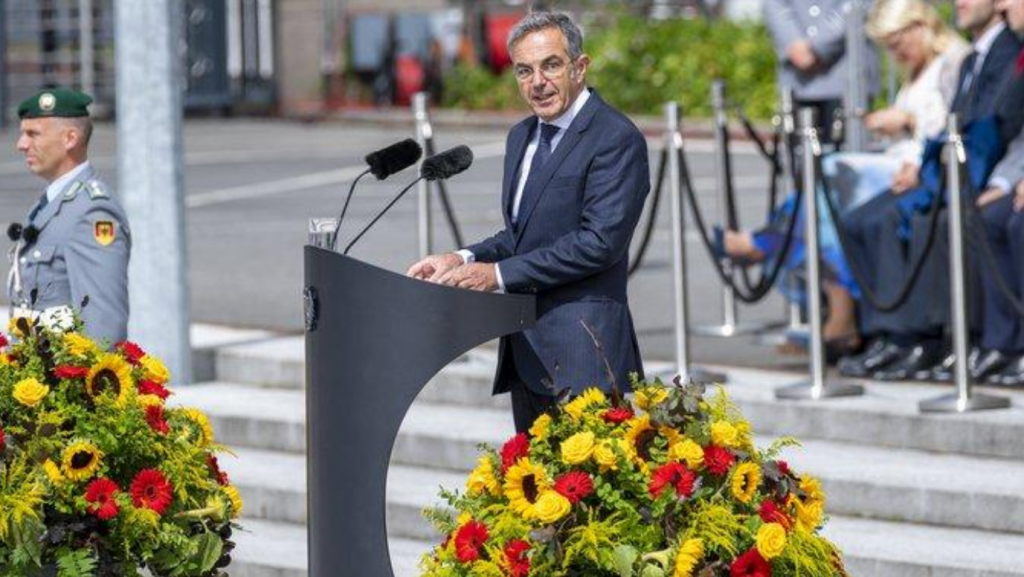
On 20 July, Germany held its annual public oath ceremony for new Bundeswehr recruits in Berlin. The date was no coincidence. It commemorates the failed assassination attempt on Adolf Hitler by Colonel Claus von Stauffenberg and a small group of German officers in 1944.
They failed. They were arrested, tortured and executed as traitors.
Today they are remembered as patriots.
This year’s keynote address was delivered by the distinguished German-Iranian writer Navid Kermani, one of Germany’s most respected public intellectuals and a recipient of the Peace Prize of the German Book Trade. His speeches are rarely designed to provoke outrage. This one did.
Referring to the recent military action by the United States and Israel against Iran, Kermani described the conflict as “manifestly contrary to international law and politically disastrous”. He then turned to the young men and women standing before him and said something remarkable. If a future German government were ever to lead them into such a war, he argued, it would be their duty to refuse the order.
The reaction was immediate. Politicians accused him of politicising a solemn military ceremony and undermining Germany’s armed forces.
I think they completely missed the point. Kermani was not really talking about Israel or Iran. He was asking one of the oldest and most uncomfortable questions in political philosophy: to whom does a soldier owe ultimate allegiance?
At first sight, the answer seems obvious. Soldiers are trained to obey orders. No army could function if every command became the subject of debate. Discipline, trust and obedience are indispensable to military life.
But history teaches us that obedience cannot be an absolute virtue. The twentieth century settled that argument at terrible cost.
When the Second World War ended, the judges at Nuremberg rejected the defence offered by so many of those standing before them: I was only following orders. From that moment onwards, the modern world accepted that individual human beings remain morally responsible for what they do, even when acting under orders.
Germany drew a profound lesson from that catastrophe. The Bundeswehr was deliberately founded on the principle of the citizen in uniform. A German soldier is expected not merely to fight well, but to think morally. Military service does not suspend personal responsibility; it demands it.
That principle has never been more relevant than it is today. Modern warfare increasingly takes place at a distance. A missile is launched hundreds of kilometres away. A drone circles silently above a city. A pilot receives coordinates on a screen. Somewhere below are buildings that military intelligence has identified as legitimate targets.
But intelligence is not infallible. Civilians are.
Schools, hospitals and residential apartment blocks have repeatedly become the scenes of devastating attacks in recent conflicts, whether in Gaza, Lebanon, Ukraine, Sudan or elsewhere. Governments justify them. Opponents condemn them. Lawyers spend years arguing over proportionality, military necessity and international humanitarian law.
None of that alters one simple fact: at some point, a human being still presses the button.
That is the moral burden Kermani placed before Germany’s newest soldiers. A question that one day may confront every man and woman who wears a military uniform.

Of course, international law contains difficult cases. Kermani himself acknowledged that. Questions of pre-emptive self-defence, proportionality and military necessity are often disputed by serious lawyers acting in good faith. Yet he also made a distinction that deserves careful attention. Not every case is difficult.
There are actions so obviously incompatible with the principles of humanity that no legal textbook is required to recognise them. Deliberately targeting civilians. Destroying hospitals. Treating an entire civilian population as expendable. History has taught us, again and again, where such thinking leads.
This is why the anniversary of 20 July matters. The officers who conspired against Hitler broke their oath to the German government because they believed a higher loyalty had taken precedence. Their own state condemned them. History vindicated them. That is not a uniquely German lesson for it belongs to every democracy.
Patriotism does not consist of supporting every decision taken by one’s government. Governments are temporary. Political leaders come and go. Wars begin and end. The rule of law and the equal value of every human life are meant to endure.
That is why Kermani’s speech matters far beyond Germany. He reminded us that democracy ultimately depends upon citizens and soldiers who understand that conscience is not the enemy of duty but one of its foundations.
Without that conviction, “Never again” becomes little more than an annual slogan.
With it, those words retain their meaning.
“If a future German government should lead you into a war that is as clearly in violation of international law and as politically disastrous as the recent war waged by the United States and Israel against Iran, then it will be your duty to refuse that order.”
— Navid Kermani