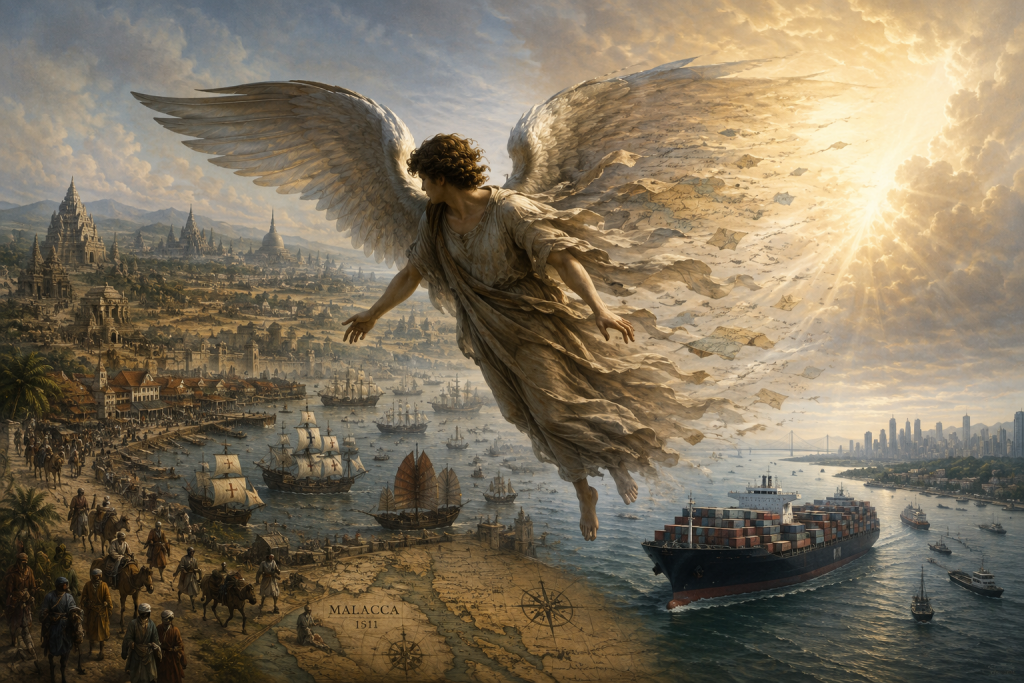
Why I am finally discovering what history is for
I cheated in history at school.
It is not something I am particularly proud of, but in retrospect I am not sure whether it says more about me or about the way history was taught.
Until about the age of thirteen, history seemed to consist largely of the Tudors, trenches and the First World War. Our teacher, who was also the deputy headmaster, stood at the front of the classroom and recounted dates, battles, monarchs and numbers of dead with awesome boredom. Because he was the deputy head, we behaved impeccably. We copied things down. We learnt them. We reproduced them in tests.
Or, in my case on at least one occasion, I wrote some of the dates and numbers on a tiny piece of paper and concealed it up my shirt sleeve.
It was the only subject in which I ever cheated.
What strikes me now is that I cannot remember being encouraged to ask that one question that makes history fascinating: Why?
Why did these things happen? Why did one country invade another? Why did European countries colonise countries thousands of miles away? Why did empires emerge in particular places? Why did some cities become extraordinarily rich while others remained peripheral? Why did religions spread across continents, shaping faith by location? Why did millions of people migrate? Why did apparently stable societies suddenly collapse into violence?
At fourteen, I gave up history altogether because of a peculiarity of our school curriculum. If I wanted to learn German, I could not continue with history. I chose German.
I have never regretted learning the language. But I increasingly regret the absurdity of having had to choose between the two. What better way could there have been to understand German than alongside the extraordinary history of the people who spoke it? Language without history gives you words and grammar. History tells you why those words are being spoken in that particular country, by those particular people, carrying those particular memories.
More than half a century later, I think I am finally discovering what I missed.
Discovering a World I Didn’t Know
This autumn, my husband and I are planning a long backpacking journey through Southeast Asia: Thailand, Laos, Vietnam, Cambodia, Singapore and Indonesia.
I decided that I did not simply want to arrive in these countries as a tourist. I wanted to understand something about them first. So what began as fairly modest preparation for a journey has turned into an enormous personal project on the history, religions, languages, cultures and politics of Southeast Asia.
I have been riveted. I have also been repeatedly embarrassed by my ignorance.
I had never properly understood how central Southeast Asia had been to world history. I knew vaguely about European colonialism. I knew a little about the Vietnam War. I knew that Singapore had once been British. I knew that Indonesia had been a Dutch colony.
But these were isolated facts floating around in my head. I had never connected them I hadn’t understood Southeast Asia as one of the great crossroads of the world: a region shaped for centuries by trade between India and China; by Hinduism, Buddhism and Islam; by Arab, Persian, Indian and Chinese merchants; by Portuguese, Dutch, British, French and Spanish imperial ambitions; by Japanese expansion; by the Second World War, the Cold War, American power, Chinese power and Soviet influence.
Suddenly Europe, Russia, China, Japan and Southeast Asia were no longer separate chapters in separate textbooks. They were part of the same story, some of which had been unfolding during my own lifetime.
The Vietnam War was not ancient history. Nor is the civil war still devastating Myanmar. The Cold War politics that shaped so much of modern Southeast Asia were taking place while I was growing up, going to university and beginning my career. Yet I had never really understood how the pieces fitted together.
That has made me realise something I wish somebody had managed to teach me when I was thirteen: history is not only about remembering the past, but also about understanding the present.
History as Pattern Recognition
One of the greatest rewards of studying history properly is that things in today’s newspapers suddenly stop looking quite so unprecedented.
Without history, every political crisis can appear new. Every war seems to have erupted from nowhere. Every migration crisis is unprecedented. Every economic confrontation is a unique emergency. History gives us pattern recognition and encourages us to ask:
What does this resemble? What forces produced something similar before? What happened next? And, equally importantly, what is different this time?
History does not repeat itself mechanically. There are no historical laws guaranteeing that because A once led to B, it will do so again.
But human beings remain human beings. States still seek security. Political leaders still seek power. Traders still seek markets. Populations still migrate in response to opportunity, persecution, poverty and war. Technologies change dramatically, but geography, resources and many human incentives change much more slowly.
One of my favourite recent discoveries illustrates this beautifully. In 1511, the Portuguese commander Afonso de Albuquerque captured Malacca because Malacca sat beside one of the most important stretches of water on Earth.
The Strait of Malacca links the Indian Ocean with the South China Sea. For centuries, ships carrying goods between China, Southeast Asia, India, the Middle East and ultimately Europe passed through or close to this narrow maritime corridor. Control of Malacca therefore offered Portugal something much more valuable than possession of another distant city: it offered influence over trade.
More than five hundred years later, the ships are vastly different. We have satellites, aircraft carriers, container vessels, fibre-optic cables and global financial markets. Yet the Strait of Malacca still matters enormously.
China depends heavily on maritime trade and on imported energy and raw materials, much of which travels through this region. Chinese strategists have consequently worried about the country’s vulnerability should access through the strait ever be seriously disrupted.
The Portuguese conquest of a city in 1511 and contemporary Chinese investment in ports and maritime infrastructure are emphatically not the same thing. One involved military conquest. However, modern port investments normally involve companies acquiring stakes, leases or operating rights through commercial agreements under the laws of sovereign states. Historical analogy becomes dangerous when it erases such distinctions.
But beneath the enormous differences, the geographical logic is remarkably familiar. Trade routes create wealth. Chokepoints acquire strategic value. Powerful states seek influence over those chokepoints. Ships change. Empires change. Geography doesn’t.
The World Is Still Surprisingly Physical
Studying history has also reminded me how easy it is to forget the physical foundations of our supposedly digital world.
Living in modern Europe, international trade can seem almost immaterial. I click a button. Money moves electronically. A parcel appears at my door.
Yet around 80 per cent of international trade in goods by volume is carried by sea. Our laptops, cars, clothes, coffee, grain, iron ore, oil, liquefied natural gas and countless other products are continuously moving around the planet on ships.
Suddenly those names such as Malacca, Hormuz, Suez, Panama, Bab el-Mandeb, that periodically appear in the news begin to mean something.
I now look at a map and history starts explaining the newspaper.
The Strait of Hormuz matters because of what passes through it. The Suez Canal matters because of the enormous journey ships avoid by using it. The Panama Canal transformed trade because geography had previously forced ships around an entire continent.
The technology changes. The strategic importance of geography often does not. Now that I understand that, a newspaper report about a tanker in the Persian Gulf or a container ship in the Red Sea becomes part of a much longer story.
History Connects the Subjects We Keep Separating
Perhaps this is why history becomes more rewarding as we get older. At school, knowledge was divided into subjects. History happened in the history classroom. Geography happened in the geography classroom. Economics, politics, religion and languages occupied their own boxes.
The real world, however, is not organised like a school timetable.
-
- Economics helps us understand incentives, resources and markets.
- Politics helps us understand how power is organised and contested.
- Geography tells us where resources, peoples and strategic routes are located.
- Religion helps explain identities, values and conflicts that have shaped societies for centuries.
- Journalism tells us what is happening today.
And history tells us how we got here. Without the historical dimension, contemporary events can become strangely two-dimensional.
Consider languages. Why do Malay and Indonesian contain Sanskrit, Arabic, Portuguese, Dutch and English influences? Why do languages that are now geographically far apart belong to the same family? Why do Austronesian languages stretch all the way from Southeast Asia across the Pacific and westwards to Madagascar? Through the study of history, language becomes almost an archaeological record of human movement.
Consider migration. It is almost impossible to understand modern Southeast Asia without understanding centuries of movement by Chinese, Indian, Arab, Persian, European and other peoples. Nor can we properly understand Britain, the United States or much of modern Europe without histories of migration, empire, slavery, trade and cultural exchange.
Consider religion. Islam in Indonesia makes much more sense when we understand the maritime trading networks through which it spread. Buddhism in Southeast Asia cannot simply be separated from India, Sri Lanka and centuries of political and cultural exchange.
Consider animal migration. How did tigers get from their evolutionary origins into India and Southeast Asia? Why do we not find monkeys, elephants and rhinoceroses in Australia? What role did the Ice Age play in all of this? Even the apparently simple question “Why are there tigers in Malaysia?” turns out to have a history.
Finally, consider modern borders. Many become comprehensible only when we discover who drew them, which empire controlled them and what happened when colonial rule ended. The present is always layered on top of the past, so history becomes the link that connects all of the subjects we keep separating.
History Should Make Us More Cautious, Not More Certain
There is another reason why historical knowledge matters, particularly in an age of increasingly polarised political debate. It should make us suspicious of simple explanations. History is messy.
Good people sometimes support terrible policies. Oppressed peoples can become oppressors. Empires can exploit and simultaneously build institutions. Migration can produce extraordinary economic and cultural creativity while also creating tension and conflict. Revolutions inspired by ideals can descend into tyranny. Political decisions can have consequences nobody intended.
The more history I learn, the less convincing I find sentences beginning with “The reason this happened was…” There is rarely only one reason. Historical understanding should therefore produce intellectual humility rather than certainty.
It teaches us to distinguish analogy from equivalence. China today is not Portugal in 1511. Contemporary Russia is not the Soviet Union. Every authoritarian politician is not Hitler. Every geopolitical rivalry is not another Cold War. History gives us comparisons, and it should also teach us where those comparisons break down.
That may be one of its most valuable contributions to contemporary political discussion.
We Are Living in Someone Else’s History Lesson
Perhaps the strangest realisation is that the distinction between “history” and “current affairs” is entirely artificial.
The people living through the fall of Singapore in 1942 did not know they were living through a history lesson. Nor did people watching the helicopters leave Saigon in 1975. Nor did those living through the collapse of the Soviet Union in 1991. They were watching the news. So are we.
The war in Ukraine, China’s rise, tensions in the South China Sea, conflict in the Middle East, mass migration, climate change and the changing balance of global power are current affairs to us. To somebody born in 2100, they will simply be history, and that thought alone should perhaps make us pay more attention.
What I Wish I Had Been Taught
I do not blame my history teacher for my ignorance. He was teaching within an educational culture that often treated knowledge as something transmitted by an expert and reproduced by a pupil.
But I do wish somebody had told that thirteen-year-old boy with the piece of paper hidden up his sleeve that the dates were not really the point.
Dates matter because sequence matters. Facts matter because evidence matters. But the real excitement lies in the connections.
-
- Why there?
- Why then?
- Why did those people behave as they did?
- What changed because of it?
- And what traces of it can we still see today?
More than fifty years after giving up history to learn German, I have returned to it almost accidentally through preparing for a backpacking journey around Southeast Asia. I am discovering that the subject I once found almost uniquely boring has become one of the most intellectually exciting things I have ever studied.
I am finally learning history backwards. I start with the world I see around me and ask: how on earth did we get here? And history begins to answer.
“The past is never dead. It’s not even past.”
— William Faulkner, Requiem for a Nun (1951)