Does the Makerfield Test Really Work?

When Local Justice Meets National Responsibility

One of the most attractive political ideas to emerge in Britain this year is also one of the simplest.

Andy Burnham calls it the Makerfield Test.

His argument is straightforward: government should judge its success not merely by economic growth, favourable statistics or the approval of financial markets, but by whether life genuinely improves for ordinary people in communities such as Makerfield and thousands of places like it.

At first glance, it is difficult to disagree.

After all, what is the purpose of economic growth if it never reaches the people politicians claim to serve?

What does a rising GDP mean to a family struggling to pay its bills?

What comfort is a buoyant stock market to someone unable to afford their first home?

For too long, British politics has often spoken as though national success could be measured from Westminster, the Treasury or the City of London. Burnham’s challenge is refreshingly different. He asks us to begin where people actually live.

It is a powerful idea, but it is also a deceptively difficult one.

Because the moment we move from slogans to governing, the Makerfield Test encounters questions for which there are no easy answers.

Beyond Makerfield

Imagine Britain needs to increase defence spending dramatically because the international situation has become more dangerous.

The additional money has to come from somewhere. Taxes rise. Public spending elsewhere is reduced.

Does the Makerfield Test say this is the wrong decision because local communities feel poorer?

Or does national security sometimes require short-term sacrifice?

Consider trade.

A new agreement with another country creates thousands of jobs nationwide but causes one manufacturing town to lose its largest employer.

Has the policy succeeded?

Or failed?

Or what about climate policy?

Higher carbon taxes may increase household costs today while helping avoid much greater environmental damage tomorrow.

Should governments refuse such policies because today’s voters bear the immediate pain?

Or should they ask communities to accept temporary hardship for future generations?

The same questions arise with infrastructure.

A high-speed rail line may transform one region while another loses investment and homes are demolished.

A new airport may create prosperity for hundreds of thousands while disrupting the lives of nearby residents.

Every major decision produces winners and losers.

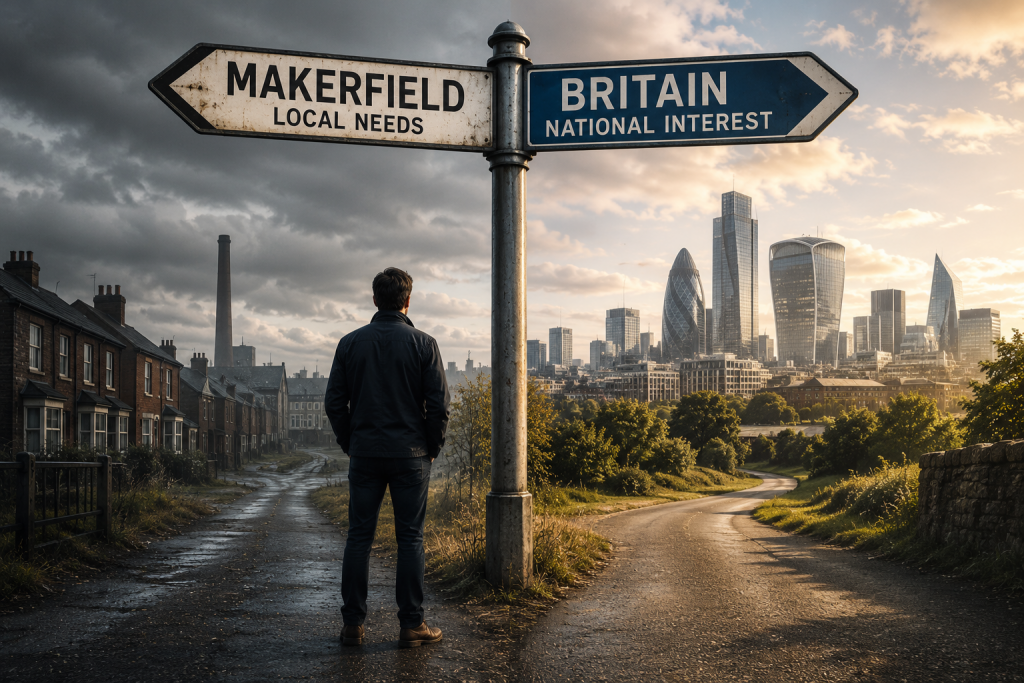
The Makerfield Test asks us to judge policy locally.

But governments must also govern nationally, and of course internationally.

The immigration dilemma

Immigration presents perhaps the clearest example.

Economists frequently argue that immigration strengthens Britain’s economy over the long term by addressing labour shortages, increasing tax revenues and supporting an ageing population.

Yet those national benefits may be accompanied by genuine local pressures.

Schools become more crowded. GP appointments become harder to obtain. Housing demand increases. Communities experience rapid cultural change.

These concerns deserve neither dismissal nor exaggeration.

But they exist alongside equally real national needs.

Which perspective should prevail?

Should government prioritise the immediate experience of individual communities?

Or the country’s long-term economic and demographic interests?

The Makerfield Test offers an important moral instinct, but it  doesn’t automatically provide an answer.

The burden of hope

There is another challenge.

Political hope can be a dangerous thing because expectations have a habit of outrunning reality.

Following Burnham’s emergence on the national stage, several commentators observed that his rhetoric was generating extraordinary optimism. Communities neglected for decades understandably wanted to believe that someone had finally recognised their experience.

Yet history offers a warning. The higher the expectations, the greater the disappointment when government inevitably encounters limits.

This is not unique to Burnham. It happened to Tony Blair, Barack Obama and Emmanuel Macron.

Democratic politics has a recurring pattern: campaigns promise transformation > Government discovers constraint > Voters experience frustration > The cycle begins again.

If Burnham persuades people that every decision will pass the Makerfield Test, he has also created a standard against which every decision will be judged.

That is both politically courageous and politically risky.

Judging the government by its own standard

This is where the Makerfield Test becomes genuinely useful.

If governments ask to be judged by the lives of ordinary people, then ordinary people are entitled to ask difficult questions.

Why was this policy chosen?

Why this priority rather than another?

Who benefits first?

Who waits?

Who pays?

Who gains?

These are very reasonable democratic questions.

Indeed, they are precisely the questions the Makerfield Test encourages us to ask.

The standard should apply not only to previous governments but also to those who introduce it.

The unavoidable dilemma

Ultimately, every government confronts the same uncomfortable reality.

Resources are finite.

Competing priorities are unavoidable.

Perfect fairness is impossible.

Sooner or later, ministers must decide that one place receives investment before another.

One project proceeds while another is delayed.

One industry expands while another declines.

One generation bears costs that another generation may eventually enjoy.

No political philosophy can eliminate these choices.

It can only explain how they should be made.

That is why I find the Makerfield Test both so compelling and so incomplete.

It reminds us that statistics are not people and that national prosperity means little if communities experience only decline.

But governing Britain also requires another perspective.

Sometimes a difficult national decision genuinely serves the country’s long-term interests, even when particular communities understandably object.

Sometimes today’s sacrifice becomes tomorrow’s prosperity.

Sometimes it doesn’t.

The difficulty lies in knowing the difference.

The real test

The most important question raised by the Makerfield Test is:

Who decides when Makerfield should lose for Britain’s long-term benefit?

That question has no comfortable answer.

Every government, whatever its political colour, will eventually ask one town, one industry, one region or one generation to accept sacrifice for a wider national goal.

The challenge is not avoiding those moments.

The challenge is ensuring they are honest, proportionate, accountable and genuinely necessary. And, better still, that they line up with a clear vision and values for which politicians have been elected.

“Parliament is not a congress of ambassadors from different and hostile interests… but a deliberative assembly of one nation, with one interest, that of the whole.”
Edmund Burke

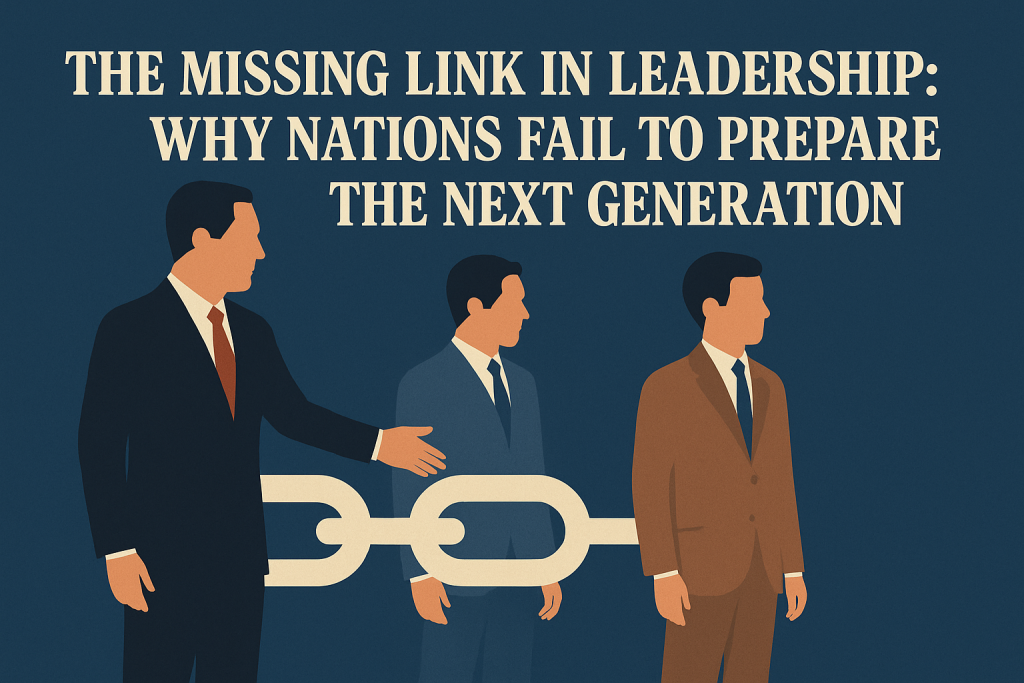
The Missing Link in Leadership: Who are you preparing to replace you?

Over the last few days, I’ve been reflecting on something that almost nobody talks about, yet it quietly shapes the political and economic stability of entire nations: the absence of intentional discipleship—or whatever secular term we prefer—among significant leaders.

Call it mentoring, call it succession planning, call it “forming the next generation.” But the idea itself is ancient: I do it and you watch me; you do it and I watch you; now you do it on your own. Most successful cultures in history depended on it. Yet today, it is almost entirely absent in politics, business, and public life.

And we are paying the price.


1. Politics Without Apprenticeship: Why Every Transition Is a Crisis

Look at almost any Western democracy and you’ll notice the same pattern: when a leader falls, nobody has the faintest idea who will replace them.

    • When Boris Johnson collapsed, nobody was preparing themselves—or being prepared—to step in.
    • Liz Truss, Rishi Sunak, and even Theresa May were not household names with long apprenticeships behind them. They were simply the next names in a Rolodex that nobody had ever looked at.
    • In the corporate world, nobody outside Cupertino had ever heard of Tim Cook until Steve Jobs died. Cook was extremely competent—but invisible.

Leadership emerges by accident, not formation.

Even in Germany—historically better at structured, team-based governance—the same problem now shows. Under Angela Merkel, we at least knew her ministers. If health, education, or foreign affairs made the news, it was the responsible minister speaking, not Merkel herself. There was a sense of team, of distributed competence, of the German belief that no one person can or should dominate every conversation.

But even then, there was no visible apprentice. No one standing next to her, learning, questioning, absorbing, preparing. When she stepped down, the vacuum opened.

Fast-forward to today, and the contrast is severe. Germany has ended up with Friedrich Merz—almost the polar opposite of Merkel in style, values, and public ethos. The shift is not just political; it’s generational and philosophical. It is what happens when leadership is not passed on but simply replaced.


2. The Danger of Blind Replacements

A country cannot thrive if every transition resembles a blind date.

Democracies need continuity, not clones—but at least a thread connecting one chapter to the next:

    • Shared institutional memory
    • A carried-forward vision
    • Stability in economic and social policy
    • Someone who has made mistakes privately before making them publicly

Instead, we jump from one unfamiliar figure to another. We “discover” a new potential leader the same way we discover a new toothpaste at the supermarket: whatever is placed at eye level becomes the default option.

And voters are expected to trust people they have never had the chance to watch, listen to, or grow accustomed to.


3. Corporate Life: Exactly the Same Problem

The same dysfunction exists in industry.

Most FTSE100 or Fortune500 companies have:

    • “leadership pipelines”
    • “talent funnels”
    • “succession plans” in binders

But very few have real relational apprenticeship:

    • Nobody spends two years shadowing a CEO.
    • Nobody grows up inside a leader’s thinking.
    • Nobody is intentionally shown how to hold the weight of power.

So transitions become fragile. Massive instability follows. Cultures collapse when their figureheads move on.

You saw it with Jobs → Cook.
You saw it with Gates → Ballmer.
You saw it with nearly every major bank pre-2008.

This is not an HR problem. It’s a civilisational one.


4. Why Discipleship (Not Just Mentoring) Actually Matters

Mentoring can be a coffee once a month. Coaching can be transactional. Consulting can be outsourced.

Discipleship is different: it means forming someone through proximity, vulnerability, imitation, failure, and shared responsibility.

It means:

    1. I do it; you watch.
      The next generation witnesses how problems are carried, how crises are handled, how decisions are made.
    2. You do it; I watch.
      Mistakes happen in a safeguarded environment where correction is possible without public humiliation.
    3. Now you do it on your own.
      By the time leadership is handed over, the nation already knows who this person is—and why they should be trusted.

This is not religious; it is simply human. Every craft, every guild, every durable culture has always worked this way.

Except modern politics and modern corporations.


5. Preparing One Generation Down

If we want stability, we must think at least one generation down:

    • Who is learning the skills?
    • Who is absorbing the vision?
    • Who is gaining credibility in public life before holding office?
    • Who is confident enough to lead, not because they are ambitious, but because they are prepared?

Nations fall apart when nobody knows who is next.
Nations thrive when leadership is a relay race, not a wrestling match.

We cannot talk about the future without preparing the people who will carry it.

“There is no success without a successor.”  –  Peter Drucker
Beyond Schadenfreude: Britain After the Wind

Past: How We Talked Ourselves Into a Corner

We never really argued Europe on first principles—peace, prosperity, human rights, freedom of movement, shared standards. We argued on slogans. We outsourced the national imagination to tabloids and demagogues, and then acted surprised when magical thinking produced real-world bills. By the time the dust settled, “sovereignty” had become a vibe, not a plan.


Present: The Pragmatism Trap

Today’s politics feels relentlessly utilitarian: manage the spreadsheet, massage the headline, survive the next 24-hour cycle. Vision is treated as a risk factor. Meanwhile, the structural problems keep stacking up:

  • Debt at 60-year highs. Public sector net debt sits around 96% of GDP, a level last seen in the early 1960s.

  • A health service running hot. NHS elective waiting lists hover at 7.36 million despite record treatment volumes.

  • Inflation cooled, but prices didn’t. CPI is down to 3.8% (from an 11.1% peak in 2022), but households are still living with the permanent shift in costs.

  • Housing approvals at record lows. The pipeline is shrinking, even as the government talks up 1.5 million new homes.

  • The politics of optics. “Small boats” dominate the agenda, while coherent policies on growth, migration and industry are sacrificed to tabloid storms.

This is what happens when governments treat governing like crisis PR: you chase the loudest gust of wind. The result is performative toughness—hotel bans, punitive rhetoric—while the fundamentals (growth, productivity, health, housing, skills) remain under-powered.


Future: A Grown-Up Programme for Renewal

We don’t need new messiahs; we need competent, credentialed reformers with an ethic. A country can’t live forever on services, inflated rates and an isolationist shrug.

1. Industrial base fit for AI.
Ten-year strategy on AI, clean energy, advanced materials, with support for both “frontier” research and everyday adoption by small firms.

2. Education and skills as national infrastructure.
Support teacher retention, technical education pipelines, lifelong learning accounts, apprenticeships with genuine ladders into growth clusters.

3. Health and care joined up.
Integrate NHS and social-care budgets, expand surgical hubs, measure success by reduced emergency admissions.

4. Housing built where people need it.
Make the 1.5m homes target binding, with planning reform and public-interest land value capture.

5. Europe, soberly.
Step back in functionally: science programmes, youth mobility, security cooperation, sector agreements—trust rebuilt by substance, not symbols.

6. Migration with adult supervision.
Break smuggling, speed up asylum decisions, create lawful routes, stop governing by hotel headlines.


Closing

Pragmatism is a virtue only when it’s anchored in principle. Otherwise, it’s drift. Britain needs leaders who can hold a compass in high wind—and citizens ready to reward them for it.