Is It Time For A Peaceful Revolution?

The return of Donald Trump is not merely a political event. It is a moral diagnostic.

It tells us something deeply unsettling about the state of our world: that values, principles, and ethics have slipped from the centre of public life. They have been displaced largely by financial gain, grievance politics, racialised fear, and the steady erosion of democratic norms.

This is not an American problem alone. It is a global one.

Trump is not the cause of this collapse; he is its most conspicuous symptom, like a mirror held up to societies that have quietly traded moral seriousness for spectacle, responsibility for outrage and truth for tribal loyalty.


The Disappearance of Principle

Where are the people of principle?

Where are the politicians who speak honestly about limits, responsibility, and restraint, rather than promising everything while meaning nothing? Where are the leaders willing to say “this is wrong” even when doing so costs them popularity, office, or power?

And where, more troubling still, are the faith communities — Christian, Jewish, Muslim, secular humanist — when democracy is undermined and human dignity reduced to a slogan?

Too often, there is silence.
Or worse: rationalisation.


Ethics in a ‘Post-God’ World

We increasingly describe ourselves as living in a “post-God” world. Whatever one’s beliefs, this framing carries an uncomfortable implication.

If there is no higher authority to appeal to, no divine judgement, no metaphysical reckoning, then responsibility does not disappear. It intensifies.

In such a world, ethics cannot be outsourced to tradition, scripture or institutions. They must be embodied in individuals.

We are fully and finally accountable for what we tolerate, excuse, and normalise.

The collapse of shared ethical frameworks does not free us. It leaves us more exposed.


When Systems Fail

When political systems fail, when institutions rot from within, when law bends to power and truth bends to profit, waiting politely is no longer a virtue.

Peaceful resistance is not extremism.
Civic courage is not disorder.
Refusing to normalise injustice is not naïveté.

History does not judge societies kindly for their patience in the face of moral collapse.


The GDR: Proof That Change Is Possible

I live in the former German Democratic Republic.

Within my own lifetime, I have seen proof that enormous social change is not only possible, but inevitable, when large numbers of ordinary people rise up peacefully and say: Enough.

No tanks.
No violence.
Just people.

The fall of the GDR was not engineered by heroes or generals. It was brought about by teachers, factory workers, church groups, writers, engineers: people who withdrew their consent from a system that no longer deserved it.

That lesson should haunt us and teach us.


Have We Gone Mad?

As a warning light on the dashboard of history, young Germans are once again being asked whether they are prepared to fight for their country.

After everything Europe has lived through: after the ruins, the camps, the mass graves, the promises of Nie wieder — have we learned nothing?

The question should not be how to prepare the next generation for war, but how we allowed ourselves to drift back towards the conditions that make war imaginable again.


Democracy Belongs to the Ordinary

Democracy does not belong to elites.
It does not belong to parties, platforms, or billionaires.

It belongs to writers.
Teachers.
Lawyers.
Nurses and doctors.
Construction workers.
Refuse collectors.

It belongs to all of us.

When democratic systems disintegrate, it is not because “the people” failed. It is because too many people were persuaded that their voice no longer mattered.


Silence Is Not Neutral

Some of us are old enough to know where silence, blame-shifting, and passivity lead.

Writing from exile as Europe collapsed around him, Stefan Zweig issued a warning that has lost none of its force:

“The greatest danger threatening humanity today is not fanaticism itself, but the silent toleration of fanaticism.”

Zweig understood that history is not undone by villains alone, but by the quiet compliance of the reasonable.


So Where Is the Line?

If Zweig was right, then the question is no longer whether we see what is happening.

The question is this:

Where do you draw the line?
What responsibility do professionals, educators, faith communities, and citizens have when institutions fail?
What does peaceful resistance look like now?

Enough silence.
Enough normalisation.
Enough waiting.

History does not move only through great men. It moves when ordinary people decide that they will no longer cooperate with the unacceptable.

The moment is not coming.

It is already here.

“Truth to tell, we are all criminals if we remain silent.”

—Stefan Zweig

The Trump Presidency: A Legacy of Lawlessness, Chaos and Global Instability

The return of Donald Trump to the White House was sold as a revival of American strength and clarity. Instead, it has produced a presidency defined by lawlessness abroad, institutional corrosion at home, economic volatility and moral collapse at the top.

From the unlawful military assault on a sovereign nation to the degradation of public discourse and democratic norms, Trump’s tenure increasingly resembles not leadership, but deranged instability — driven less by coherent strategy than by impulse, grievance and personal spectacle.


1. The Unlawful Attack on Venezuela: A Crime Against Sovereignty

In January 2026, Trump authorised a U.S. military operation in Venezuela resulting in the capture of President Nicolás Maduro and his wife, who were flown to New York to face charges. Trump openly stated that the United States would “run the country” during a transition and signalled willingness to deploy ground troops if necessary.

International law experts were unequivocal: the operation violated the UN Charter, which prohibits the use of force against a sovereign state absent self-defence or explicit UN Security Council authorisation. Venezuela was not at warwith the United States. No imminent threat was demonstrated. Congress was not meaningfully consulted.

This was not law enforcement. It was executive force projection without legal basis — the kind of unilateral action the post-1945 international order was designed to prevent. Trump is considering similar illegal aggression in Colombia and Greenland.


2. Failed Peace in Palestine, Ukraine, and Beyond

Trump’s claim to be a “peacemaker” collapses under scrutiny.

In Gaza, he floated proposals involving U.S. control of territory and the relocation of civilian populations — ideas widely condemned as unlawful, destabilising, and ethically indefensible.

In Ukraine, his approach has leaned toward freezing conflict on terms favourable to Russian territorial gains, weakening Ukrainian sovereignty while undermining the principle that borders cannot be changed by force.

In both cases, Trump has confused domination with diplomacy, mistaking coercion and spectacle for peacebuilding.


3. Character Matters: A President Unfit for the World Stage

Before economics, before diplomacy, before markets, one must confront a more basic question:

Is this man fit to exercise power at all?

Trump is:

    • Twice impeached by the U.S. House of Representatives
    • Convicted on 34 felony counts in a New York criminal court
    • Found civilly liable for sexual abuse by a jury
    • A man with a long public record of racist rhetoric, including attacks on judges, migrants, foreign leaders, and entire nations
    • Someone who displays proud incuriosity, routinely dismissing expert briefings, intelligence assessments, and scientific consensus

Beyond legality lies a deeper problem: Trump lacks the intellectual and rhetorical equipment required of a statesman on the world stage.

His speech is repetitive, grievance-driven, factually loose and emotionally reactive. He substitutes insult for argument, volume for substance, and loyalty tests for reasoning. Complex geopolitical realities are reduced to slogans. Allies are treated as stupid inferiors. Democratic institutions are treated as obstacles to his dictatorship.

This is not merely a stylistic issue. Language is how power is exercised, alliances are sustained, and crises are defused. A leader unable or unwilling  to speak with precision, restraint and moral seriousness inevitably degrades the office itself.

The chaos of the Trump presidency is not accidental. It is character made policy.


4. Isolation of the United States Abroad

Under Trump, the United States has shifted from coalition-builder to disruptor.

Long-standing allies describe Washington as unpredictable and transactional. NATO cohesion has been strained. European leaders increasingly speak of “strategic autonomy” — diplomatic language for no longer trusting the United States to act responsibly.

International institutions once anchored by U.S. leadership are now treated with open hostility or contempt. The result is not strength, but diminished influence and accelerated fragmentation of global norms.


5. Damage to International Markets and Global Stability

Trump’s foreign policy volatility has produced tangible economic consequences.

The Venezuela intervention rattled energy markets and increased geopolitical risk premiums. Unpredictable rhetoric on trade, sanctions, and conflict has made long-term investment planning harder — not just abroad, but at home.

Meanwhile, China flourishes with BYD overtaking Tesla as just one indicator.

Markets dislike uncertainty. Trump manufactures it.


6. The Myth of Economic Mastery

Trump continues to claim unparalleled economic success. The data tells a more restrained story:

    • GDP growth has been moderate, not exceptional
    • Unemployment has risen relative to prior post-pandemic lows
    • Stock market gains largely reflect global cycles rather than presidential policy
    • Wage growth continues to struggle against persistent inflation

Outside healthcare and a few protected sectors, job quality remains uneven, household debt is rising, and borrowing costs remain high.

This is not an economic renaissance. It is fragile performance sustained by volatility and lies on ‘Truth’ Social.


Conclusion: Not Statesmanship, But Spectacle

Trump is still treated by parts of the media and political class as a “serious statesman.” This is perhaps the most dangerous illusion of all.

A man repeatedly found to have violated the law, to have abused power and to have debased public discourse does not become presidential through repetition or normalization. Power does not cleanse character; it exposes it.

If any American voice should frame this moment, let it be that of Dwight D. Eisenhower, a Republican, a general, and a president who understood the cost of reckless leadership:

“When peace has been lost, when confidence in the persistence of orderly government has gone, cities are sacked, institutions fail, and men perish.”

Trump’s presidency will not be remembered as a defence of America — but as a warning of what happens when spectacle replaces judgment, and character is dismissed as irrelevant.

Meaning Before Language

At the start of the New Year, I began growing mung bean sprouts on the kitchen counter. Nothing ambitious: a glass jar, a handful of dry beans, water, patience. It was partly practical — a small attempt to eat better — and partly seasonal, a gesture of beginning again.

But as so often happens, attention did the rest.

Each morning and evening I rinsed the beans, drained the water, and tilted the jar back into place. Within a day, change began. Roots appeared. Pale shoots followed. By the third day, the jar was quietly alive with direction and momentum. Nothing dramatic. Nothing expressive. Just steady response.

Watching this simple process unfold gave rise to a set of thoughts that have stayed with me.

There is something quietly reassuring in discovering that:

    • order doesn’t require intention
    • meaning can emerge from conditions
    • responsiveness is not the same as consciousness

A seed doesn’t care —
but it is exquisitely attuned.

That distinction matters far beyond botany.

A mung bean has no brain, no awareness, no sense of purpose. It does not want to grow. It does not know that it is growing. And yet, when the conditions are right — moisture, warmth, oxygen — it responds. Enzymes activate, stored energy is released, cells divide, and a process begins that looks uncannily like purpose.

But it isn’t.

What the seed demonstrates is something both humbling and quietly radical: meaning can arise from structure rather than intention. Order can appear without a planner. Direction can emerge without desire. Life can move forward without knowing why.

“Life is not obliged to make sense to us.”
Richard Dawkins

We tend to assume the opposite about ourselves.

Much of modern human anxiety is rooted in the belief that meaning must be consciously created: unless we are constantly choosing, narrating, justifying, our lives risk becoming meaningless. We speak as if significance must always be meant by someone, preferably articulated, preferably defensible.

And yet, much of what shapes us most deeply happens long before we have words for it.

Which brings us to language.

There is a quiet assumption, widely shared and rarely examined, that meaning only exists where language exists. I certainly absorbed this idea early on: that without words, symbols, and narratives there could be no meaning, only blind mechanism. Animals, plants, seeds may be somehow alive, but they are not conscious of their existence because they do not have language. But is this assumption true under closer attention? Language does not so much create meaning as name it. Long before we describe a situation as safe or threatening, nourishing or hostile, our bodies are already responding. Long before a child can articulate belonging or neglect, those conditions are shaping who they become. Meaning, in this sense, precedes language. Language arrives later, not as the origin of significance, but as its echo.

Taken seriously, this idea does not just reshape education or psychology; it also presses uncomfortably on our concepts of religion.

If meaning precedes language, then religion becomes structurally vulnerable in a way it rarely acknowledges. Religious systems depend on language to define, order, and sanctify a reality that was already unfolding long before it was named. Just as the seed germinates without reference to our metaphors, doctrines, or reverence, the world generates complexity, order, and awe without requiring theological narration. Religion, in this light, does not create meaning but gathers around it — stabilising, preserving, and sometimes claiming ownership of what would otherwise continue unbothered. The danger is not that religion is false, but that it mistakes itself for the source rather than the afterimage of meaning: a linguistic architecture built around processes that do not need to be spoken in order to be real.

“There are no facts, only interpretations.”
Friedrich Nietzsche

Seen this way, the seed is not a lower form of life waiting for consciousness to redeem it. It is a reminder that attunement comes before articulation.

This has implications for how we think about human agency. To say that meaning can emerge from conditions is not to deny responsibility or choice. It is to relocate them. Agency is not constant control; it is responsiveness within constraints. The skill is not to will meaning into existence, but to recognise what kinds of environments allow growth — in ourselves and in others.

And this is where education enters the picture.

Much of contemporary schooling still reflects a modernist inheritance: knowledge divided into discrete subjects, timetabled and assessed in isolation. Biology here. Chemistry there. Physics somewhere else. Meaning nowhere in particular.

We teach biology largely as a catalogue of facts — cell structures, taxonomies, cycles, pathways — accurate, necessary, and often lifeless. Rarely do we teach it as the study of responsive systems. We talk about genes, but not environments. About mechanisms, but not emergence. Students learn that a seed needs water, warmth, and oxygen, yet miss the astonishing implication: life does not need a mind in order to organise itself.

By separating biology from physics and chemistry, we also reinforce a subtle illusion — that life is something apart from the rest of reality, rather than a continuation of it. As if metabolism were not chemistry in motion. As if growth were not physics slowed down and shaped by constraint. As if living systems did not obey the same laws as rivers and stars, only at a different scale.

A more truthful curriculum would dissolve these boundaries.

“What we observe is not nature itself, but nature exposed to our method of questioning.”
Werner Heisenberg

Imagine teaching “life” as a conversation between disciplines:
chemistry becoming organised,
physics learning to linger,
energy flowing through matter long enough to notice itself.

In such a curriculum, a sprouting seed would not be a marginal example but a foundational one. Students would be invited to ask not only what happens, but what it reveals: that responsiveness predates consciousness, that attunement is older than intention, that meaning does not need to be imposed in order to arise.

The ethical consequences would follow naturally. Instead of moralising failure, students might ask better questions: What conditions were missing? What environments are we creating? What do we reward, nourish, neglect?

Education, at its best, does not manufacture outcomes.
It creates conditions.

A seed doesn’t care.
But it responds.

So do children.
So do communities.
And, more often than we like to admit, so do we.

Perhaps part of the task of education — and of adult life — is to relearn this modest, hopeful truth: that meaning does not always need to be pursued or declared. Sometimes it only needs the right conditions in which to emerge.

“The most incomprehensible thing about the universe is that it is comprehensible.”
Albert Einstein

Love, Bureaucracy, and the Borders of Europe

How a perfectly legal couple spends years fighting a system that claims to protect the family

I have always loved Europe.
I still do.

The peace, the democracy, the rule of law — these are extraordinary privileges, and I’m grateful every day to live in a part of the world that, compared to most of the planet, is safe, stable and humane.

But loving a thing does not mean lying about it.
And the deeper my own journey into the European immigration system has taken me, the more convinced I have become that something fundamental is broken — not just in Germany, not just in Britain, but across almost the entire continent.

This is not an anti-German story.
It is a story about what it feels like to do everything legally, responsibly, respectfully — and still find yourself treated as if love were a loophole, marriage an inconvenience, and foreign spouses a threat to be contained.

It is a story that could happen in almost any European capital.

It just happened to us in Berlin.


How Love Became a Test of Endurance

A few years ago, I fell in love with a remarkable man in Indonesia.
Our relationship grew quickly and deeply, and we knew we wanted to build a life together in Europe rather than in Indonesia. We planned to marry anyway, so we assumed — naively, as it turns out — that marriage and legitimacy would make the process of living together straightforward.

We were wrong.
Painfully, spectacularly wrong.


Wedding Bells, Bureaucratic Walls

Because our marriage would not be legally valid in Indonesia, we had to marry in Europe.
What we imagined would be a simple civil ceremony became a six-month odyssey through paperwork, translations, apostilles, appointments, contradictory guidance, and requirements that bordered on the absurd.

Still — we got married.
We thought the hardest part was behind us.

But marriage, we learned, is not a ticket to a shared life.
It is merely the beginning of a long, labyrinthine process designed, it seems, to test whether your relationship can outlast bureaucracy.


The Rule No One Tells You: “Apply in Jakarta, or Don’t Come at All”

Once married, we were informed of something almost nobody tells you in advance:

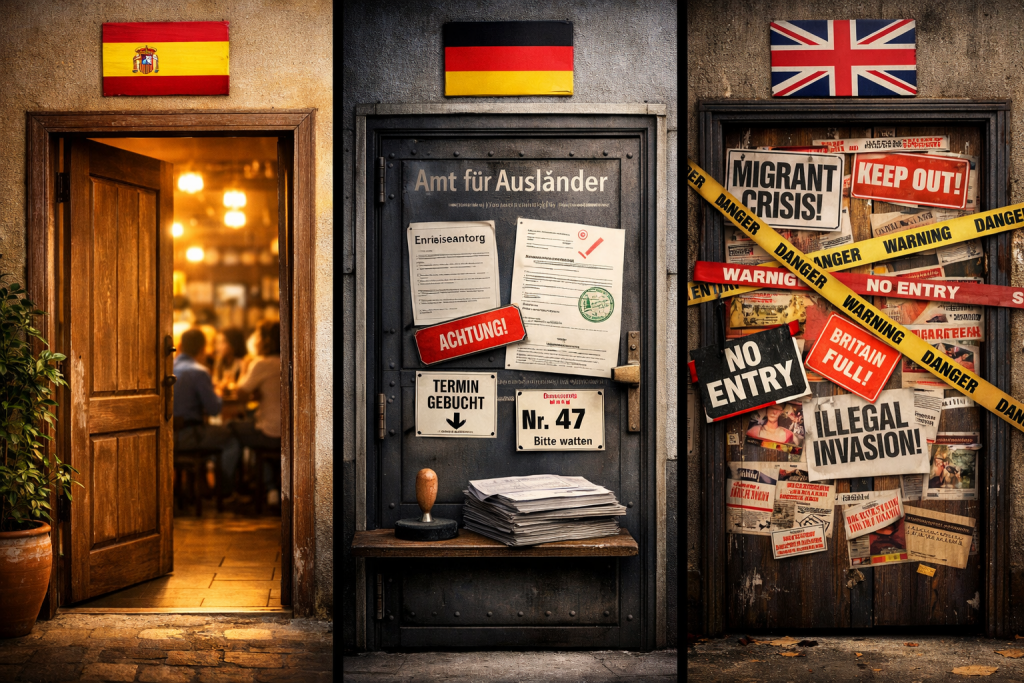
If you marry an Indonesian and want to live together in Europe, your Indonesian spouse must apply for a family-reunification visa from Jakarta — and only from Jakarta.

Not from Berlin.
Not from any European consulate closer to their home island.
Not from Europe on a tourist visa (which would be logical, humane, and in line with every legal principle about protecting marriage).

Jakarta.
Or nothing.

The waiting list?
One year.
We have the screenshot.

And that’s just the waiting list for you to submit your application — not the processing time afterwards.

Imagine telling any married couple in Europe:

“Congratulations on your marriage.
You will now be forcibly separated for at least 12 months.”

That is the system.
That is the norm.


One Document Wrong? Start All Over Again.

When our turn finally came, the embassy did not approve one of the documents uploaded during the online process. They asked us to delete it — and, indeed, there is a little trash-can icon on the website.

Except the icon doesn’t work.
It never has.

After weeks of emails, calls, and technical back-and-forth, the embassy’s final advice was:

“Delete your entire application and start again.”

Which, in plain language, means:

“Restart the one-year waiting list.”

It is breathtaking to realise that the legal rights of marriage can be instantly overruled by a broken trash-can icon.


Geography as a Financial Weapon

If you are Indonesian and live on Sumatra, you must pay to fly twice to Jakarta — once for biometrics, and once to collect the visa. These costs are enormous relative to Indonesian salaries.

For many families, this is simply impossible.

This is what “legal migration” looks like in practice.


The 90/180 Trap: A Long-Distance Marriage by Law

Some couples try an alternative: the Schengen visitor visa.
But that route comes with its own cruelty:

  • Your spouse can visit for 90 days maximum

  • but must then leave for another 90 days minimum

Meaning:

You may live together for three months, then be forcibly separated for six.
Three on, six off. Three on, six off. Indefinitely.

Assuming, of course, you can afford the flights between Jakarta and Europe.
Most cannot.


The Berlin Immigration Office: A Fortress Without Doors

If the embassy maze is surreal, the immigration office in Berlin is its European twin.

You cannot phone them.
You cannot email them.
You cannot speak to a human being unless you already have an appointment — and you cannot get an appointment without submitting a webform that may sit unanswered for two months.

If you attempt to enter the building to ask for help, security guards turn you away.
“No appointment, no entry.”

It is Kafka with fluorescent lighting.


When Your Appointment Arrives… It’s Too Late

In our case, by the time Berlin offered my husband an appointment, his visitor visa had expired.
They could not — or would not — offer an earlier date.

He was legally in the country.
He had proof of marriage.
He had every document required.

But the system, moving at its own glacial pace, simply shrugged.


The Catch-22: Work to Stay, But You Can’t Work Until You Stay

Here is the cruelest irony:

To obtain residency, the European spouse must prove sufficient income to support both partners.

But the foreign spouse cannot work unless they already have residency.

So if the European partner earns too little, the spouse receives only a six-month Fiktionsbescheinigung — a kind of temporary suspension of deportation, halfway between permission and limbo.

With that document:

  • You cannot work

  • You cannot earn

  • You cannot contribute

  • Therefore you cannot raise household income

  • Therefore you do not qualify for residency

This is not immigration policy.
It is a bureaucratic cul-de-sac.


And Then You Realise: If It’s This Hard for Us… What About Them?

We are educated, organised, legally married, European-based, English-speaking, German-speaking, online-competent, and persistent.

And still we nearly drowned in the system.

What must this system feel like for asylum seekers?
For people fleeing war or persecution?
For couples separated across borders with children in tow?
For those without money, stability, documents, or perfect German?

Oh yes, and in case you’re wondering, I did contemplate moving back to the UK and applied for residency for my English-speaking husband there. Our application was declined.

The system does not merely fail people.
It dehumanises them.


A Quiet Exception: The Spain Nobody Talks About

There is one place in Europe where the logic is different: Spain.

Spain has a little-known rule — almost never advertised — called arraigo social.

If you remain in Spain for two years, stay out of trouble, and integrate into community life, you can obtain legal residency.

No endless separation.
No forced poverty.
No trapdoors disguised as requirements.
No broken webforms or locked doors.

If you are married and have property there, the chances are even better.

Whatever critics say, this is a system that treats people — even undocumented ones — as human beings capable of building a life.

It is the closest thing Europe has to a humane immigration philosophy.


What This Story Is Really About

This is not a rant.
Nor is it an attack on Germany, which continues to offer extraordinary opportunities to millions of people, myself included.

It is a plea.
A testimony.
A reminder that behind every “case number” is a love story, a family, a life.

Europe prides itself on protecting marriage – see ECHR, Article 8 §§1–2.
Courts across the continent insist that “bureaucratic inefficiency is not a legitimate reason to separate spouses.”

But in practice?
The systems built to uphold those principles routinely violate them.

If Europe wants to protect its values — its humanism, its dignity, its rule of law — the immigration system is where it must begin.

Not with walls.
Not with suspicion.
But with the simple recognition that married couples should not have to fight this hard to live under the same roof.

“Bureaucracy is the death of all human action.” — Max Weber