The Bells of Decline Are Already Ringing

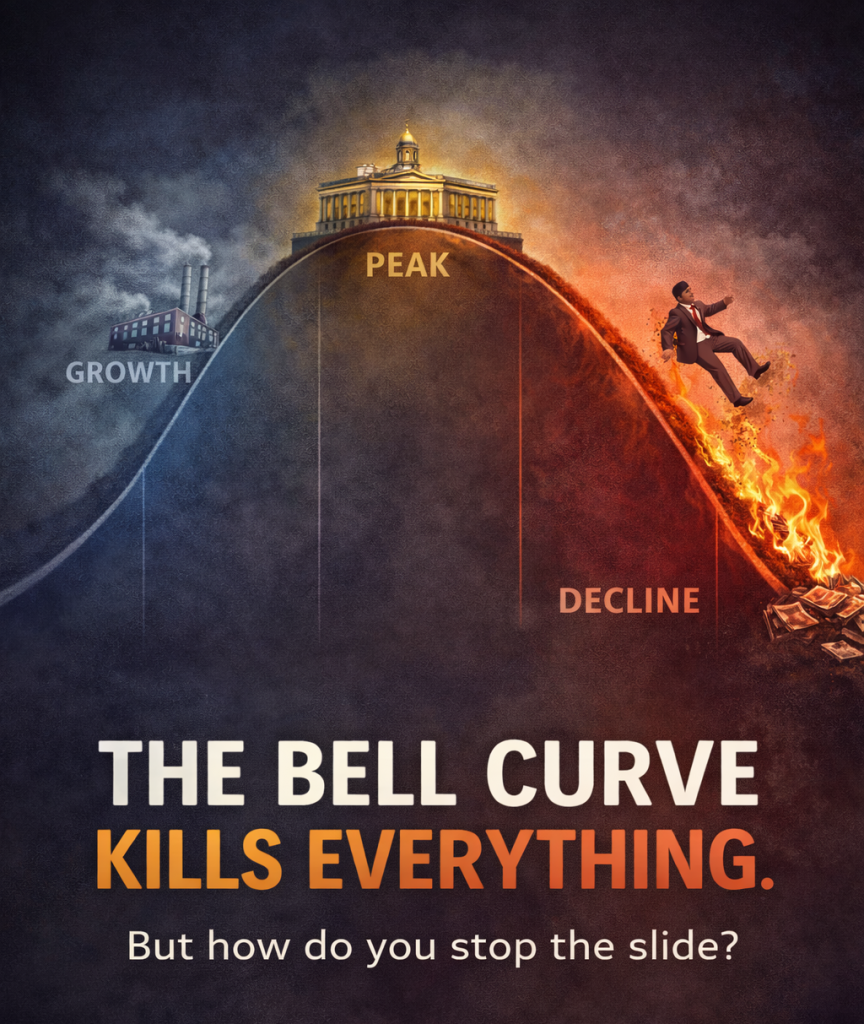
Every organisation has a bell curve.

From the smallest start-up in Berlin… to the United States of America.
From a school, a church, a university department, a political party to an empire.

It’s always the same arc:

    1. Growth (energy, hunger, imagination)
    2. Peak (confidence, dominance, self-belief)
    3. Decline (bureaucracy, complacency, fear, decay)

This is not cynicism. It’s recognising a pattern of reality.

The question most leaders avoid

Be brutally honest: where is your organisation right now on the curve?
And when did you last hear your senior team ask that question out loud?

Because the bell curve isn’t a risk. It’s a default trajectory. It is what happens when success turns into comfort, comfort turns into protectionism, and protectionism turns into denial.

So what will you do? Ignore it and die quietly? Be honest about it and decline anyway? Or be honest about it and start building renewal structures now—before the slide becomes irreversible?

And there’s a sharper option leaders rarely admit exists: leave. Sometimes the most rational decision is to step off a sinking ship and stop lending it your competence.

History suggests the curve can’t be stopped.
And right now we’re watching it at scale—a global shift in momentum from West to East.

But I do think decline can be slowed. Here are my ideas:


1) Limit oligarchy. Increase real democracy.

When power concentrates, reality gets filtered. Bad news stops travelling upward. Loyalty becomes more valuable than truth. A leadership class forms that primarily exists to keep itself in place.

That’s not a theory. It’s the story of countless organisations—and empires.

When decision-making is captured by an inner circle, the mission becomes secondary. The organisation starts protecting status rather than producing value.

Democracy inside an organisation doesn’t mean chaos. It means distributed intelligence: people closest to customers, systems, classrooms or frontline work have meaningful influence over what must change.


2) Build for the next generation, not the next quarter.

Short-termism is a slow form of self-harm.

A company can hit its numbers while hollowing itself out: talent loss, declining product quality, decaying trust, shrinking learning capacity. The spreadsheet looks fine—until it doesn’t.

And there’s a more subtle failure inside that: leaders often build for their own peer generation, when they should be studying the people 10–20 years younger. That’s where the next expectations, habits, technologies, and cultural defaults are forming, long before they show up in your revenue chart.

What feels “risky” to today’s leadership often feels obvious to the next cohort.
And what feels “obvious” to today’s leadership can look obsolete almost overnight.

This is why so many organisations are blindsided by disruption: they optimise for the present, then act shocked when the future arrives.

If your planning horizon is shorter than your product lifecycle or your employees’ careers, you’re not sowing. You’re only maintaining and harvesting.


3) Hold ethical values steady (don’t drift in panic).

Organisations rarely collapse because of one mistake. They collapse because of moral improvisation.

In a crisis, values become “flexible.”
In growth, values become “optional.”
At the peak, values become “PR.”

Trust doesn’t usually die in a scandal. It dies in a thousand rationalisations.

Ethical steadiness isn’t virtue-signalling. It’s strategic. Trust is a form of capital, and once it’s spent, it is brutally slow to rebuild.


4) Respect history, but don’t worship it.

Tradition can be wisdom. Or it can be a velvet coffin.

The most dangerous sentence in any institution is:
“But this is how we’ve always done it.”

That phrase has probably been spoken in every declining empire, every decaying school system, every complacent corporation, and every institution that mistakes inertia for stability.

Keep the lessons of history—but don’t let history become your excuse for refusing change.


5) Reward truth-tellers, not loyalists.

Cultures fail when honesty becomes career suicide.

When an organisation punishes uncomfortable truth, it trains people to produce comforting noise. Metrics get gamed. Problems get rebranded. Rot gets managed instead of removed.

If your culture doesn’t actively protect dissenters, you don’t have “alignment.” You have fear.

One of the clearest predictors of decline is a leadership team that only hears what it wants to hear and then mistakes that for reality.


6) Break the organisation on purpose (real renewal, not cosmetic change).

Here’s the missing lever most leaders refuse to pull:

Healthy organisations schedule their own disruption.
Unhealthy ones wait until disruption happens to them.

This is deeper than “innovation.” It’s constitutional design:

    • sunset clauses on programmes and teams
    • rotation of leadership roles
    • independent internal “red teams” tasked with challenging assumptions
    • simplification by cutting products, meetings, layers and rules
    • and, when needed, radical reinvention of mission, structures, and incentives—not just a new logo

There’s a famous story about Steve Jobs in a meeting, sweeping clutter off a table and saying, in effect: start again—what actually matters? Whether or not the anecdote is perfectly literal, the point is real:

Most organisations don’t fail because they lack intelligence.
They fail because they can’t bear to delete what once made them successful.

“How did you go bankrupt?”
“Two ways. Gradually, then suddenly.”
Ernest Hemingway

The Electric Car Story We Should All Be Talking About

Electric cars are sold to us as the clean, ethical future: the simple solution to petrol, emissions, and climate collapse. No exhaust pipe. No fumes. No guilt. Drive electric and you’re doing your part.

But the longer I listen to the certainty around EVs — the smug finality, the “case closed” tone — the more I suspect we haven’t solved the problem at all. We’ve simply moved it.

Because “zero emissions” is only true in one narrow sense: electric cars don’t emit at the tailpipe. That matters for city air quality, and it’s not trivial. But climate impact isn’t just about what comes out of the back of the vehicle. It’s about the whole chain: extraction, manufacturing, electricity generation, and end-of-life disposal.

And yes: in many cases, electric cars really are better on the climate. A major life-cycle analysis has estimated that battery electric cars sold in Europe today can produce dramatically lower overall greenhouse-gas emissions than comparable petrol cars. That’s a real advantage, and it’s worth acknowledging.

But “better than petrol” doesn’t automatically mean “clean.” It doesn’t mean “ethical.” And it certainly doesn’t mean “no victims.

The modern electric car runs on more than electricity. It runs on minerals — and minerals have to be ripped out of the earth. The new fuel of the “green future” isn’t oil alone: it’s lithium, nickel, cobalt, graphite, and more. And the extraction doesn’t happen in glossy European showrooms. It happens in places where ecosystems are fragile, water is scarce, and the people who live nearby often have far less power to resist the pressure.

Chile is frequently held up as a symbol of this new reality. In the Atacama region, concerns have been raised for years about lithium extraction and water stress in an already arid landscape. And while “displacement” doesn’t always mean literal bulldozers and forced removals, communities can still be displaced in practice, when resources shrink, livelihoods collapse and the land becomes harder to inhabit. You don’t always need an eviction notice to be pushed off your own future.

Then comes the question nobody wants to picture too clearly: what happens when millions of EV batteries die?

Batteries degrade. Capacity drops. Replacement costs bite. Cars are written off. And suddenly we’re not looking at a futuristic revolution, we’re looking at a looming waste problem. We are manufacturing the next century’s landfill with a smile on our faces, because it feels cleaner today.

Yes, recycling exists. Yes, there are second-life uses for some batteries. Yes, policymakers talk about circular economies. But the scale is the issue. Recycling infrastructure doesn’t magically appear just because consumers feel virtuous. It requires systems, enforcement, investment, and time — and at the moment, the global EV rollout is moving faster than the uncomfortable questions that should be travelling alongside it.

So why does this side of the story still feel strangely muted?

Partly because it’s complex, and complex stories don’t trend. But partly because the car industry is not politically neutral. The automobile sector has been one of the most powerful lobbying forces shaping transport policy, regulation, and public messaging for decades. That doesn’t require a secret conspiracy. It only requires something much more ordinary — influence, money, access, timing, and the gentle steering of what gets taken seriously.

This is the deeper danger: the electric car has become a moral symbol. Question it and you’re treated as pro-oil. Doubt it and you’re dismissed as anti-progress. But this isn’t how ethical responsibility works. A solution isn’t automatically good because it comes wrapped in green language.

Electric cars may reduce emissions. But they don’t end extraction. They don’t end harm.

We’re not transitioning from dirty to clean. We’re transitioning from visible pollution to invisible supply chains, from smoke in our cities to disruption in deserts we’ll never visit.

So yes: electrification may be part of the future. But only if we stop treating it like a miracle and start treating it like what it really is: a trade-off. A compromise. A human project, built inside a world of scarcity, power and competing interests.

If we want an energy transition worthy of the name, we need more than new engines. We need transparency, better public transport, enforceable standards, serious recycling systems and the courage to count the human cost, not as an inconvenient footnote, but as part of the moral equation.

“A thing is right when it tends to preserve the integrity, stability and beauty of the biotic community. It is wrong when it tends otherwise.”
Aldo Leopold

Is It Time For A Peaceful Revolution?

The return of Donald Trump is not merely a political event. It is a moral diagnostic.

It tells us something deeply unsettling about the state of our world: that values, principles, and ethics have slipped from the centre of public life. They have been displaced largely by financial gain, grievance politics, racialised fear, and the steady erosion of democratic norms.

This is not an American problem alone. It is a global one.

Trump is not the cause of this collapse; he is its most conspicuous symptom, like a mirror held up to societies that have quietly traded moral seriousness for spectacle, responsibility for outrage and truth for tribal loyalty.


The Disappearance of Principle

Where are the people of principle?

Where are the politicians who speak honestly about limits, responsibility, and restraint, rather than promising everything while meaning nothing? Where are the leaders willing to say “this is wrong” even when doing so costs them popularity, office, or power?

And where, more troubling still, are the faith communities — Christian, Jewish, Muslim, secular humanist — when democracy is undermined and human dignity reduced to a slogan?

Too often, there is silence.
Or worse: rationalisation.


Ethics in a ‘Post-God’ World

We increasingly describe ourselves as living in a “post-God” world. Whatever one’s beliefs, this framing carries an uncomfortable implication.

If there is no higher authority to appeal to, no divine judgement, no metaphysical reckoning, then responsibility does not disappear. It intensifies.

In such a world, ethics cannot be outsourced to tradition, scripture or institutions. They must be embodied in individuals.

We are fully and finally accountable for what we tolerate, excuse, and normalise.

The collapse of shared ethical frameworks does not free us. It leaves us more exposed.


When Systems Fail

When political systems fail, when institutions rot from within, when law bends to power and truth bends to profit, waiting politely is no longer a virtue.

Peaceful resistance is not extremism.
Civic courage is not disorder.
Refusing to normalise injustice is not naïveté.

History does not judge societies kindly for their patience in the face of moral collapse.


The GDR: Proof That Change Is Possible

I live in the former German Democratic Republic.

Within my own lifetime, I have seen proof that enormous social change is not only possible, but inevitable, when large numbers of ordinary people rise up peacefully and say: Enough.

No tanks.
No violence.
Just people.

The fall of the GDR was not engineered by heroes or generals. It was brought about by teachers, factory workers, church groups, writers, engineers: people who withdrew their consent from a system that no longer deserved it.

That lesson should haunt us and teach us.


Have We Gone Mad?

As a warning light on the dashboard of history, young Germans are once again being asked whether they are prepared to fight for their country.

After everything Europe has lived through: after the ruins, the camps, the mass graves, the promises of Nie wieder — have we learned nothing?

The question should not be how to prepare the next generation for war, but how we allowed ourselves to drift back towards the conditions that make war imaginable again.


Democracy Belongs to the Ordinary

Democracy does not belong to elites.
It does not belong to parties, platforms, or billionaires.

It belongs to writers.
Teachers.
Lawyers.
Nurses and doctors.
Construction workers.
Refuse collectors.

It belongs to all of us.

When democratic systems disintegrate, it is not because “the people” failed. It is because too many people were persuaded that their voice no longer mattered.


Silence Is Not Neutral

Some of us are old enough to know where silence, blame-shifting, and passivity lead.

Writing from exile as Europe collapsed around him, Stefan Zweig issued a warning that has lost none of its force:

“The greatest danger threatening humanity today is not fanaticism itself, but the silent toleration of fanaticism.”

Zweig understood that history is not undone by villains alone, but by the quiet compliance of the reasonable.


So Where Is the Line?

If Zweig was right, then the question is no longer whether we see what is happening.

The question is this:

Where do you draw the line?
What responsibility do professionals, educators, faith communities, and citizens have when institutions fail?
What does peaceful resistance look like now?

Enough silence.
Enough normalisation.
Enough waiting.

History does not move only through great men. It moves when ordinary people decide that they will no longer cooperate with the unacceptable.

The moment is not coming.

It is already here.

“Truth to tell, we are all criminals if we remain silent.”

—Stefan Zweig

The Trump Presidency: A Legacy of Lawlessness, Chaos and Global Instability

The return of Donald Trump to the White House was sold as a revival of American strength and clarity. Instead, it has produced a presidency defined by lawlessness abroad, institutional corrosion at home, economic volatility and moral collapse at the top.

From the unlawful military assault on a sovereign nation to the degradation of public discourse and democratic norms, Trump’s tenure increasingly resembles not leadership, but deranged instability — driven less by coherent strategy than by impulse, grievance and personal spectacle.


1. The Unlawful Attack on Venezuela: A Crime Against Sovereignty

In January 2026, Trump authorised a U.S. military operation in Venezuela resulting in the capture of President Nicolás Maduro and his wife, who were flown to New York to face charges. Trump openly stated that the United States would “run the country” during a transition and signalled willingness to deploy ground troops if necessary.

International law experts were unequivocal: the operation violated the UN Charter, which prohibits the use of force against a sovereign state absent self-defence or explicit UN Security Council authorisation. Venezuela was not at warwith the United States. No imminent threat was demonstrated. Congress was not meaningfully consulted.

This was not law enforcement. It was executive force projection without legal basis — the kind of unilateral action the post-1945 international order was designed to prevent. Trump is considering similar illegal aggression in Colombia and Greenland.


2. Failed Peace in Palestine, Ukraine, and Beyond

Trump’s claim to be a “peacemaker” collapses under scrutiny.

In Gaza, he floated proposals involving U.S. control of territory and the relocation of civilian populations — ideas widely condemned as unlawful, destabilising, and ethically indefensible.

In Ukraine, his approach has leaned toward freezing conflict on terms favourable to Russian territorial gains, weakening Ukrainian sovereignty while undermining the principle that borders cannot be changed by force.

In both cases, Trump has confused domination with diplomacy, mistaking coercion and spectacle for peacebuilding.


3. Character Matters: A President Unfit for the World Stage

Before economics, before diplomacy, before markets, one must confront a more basic question:

Is this man fit to exercise power at all?

Trump is:

    • Twice impeached by the U.S. House of Representatives
    • Convicted on 34 felony counts in a New York criminal court
    • Found civilly liable for sexual abuse by a jury
    • A man with a long public record of racist rhetoric, including attacks on judges, migrants, foreign leaders, and entire nations
    • Someone who displays proud incuriosity, routinely dismissing expert briefings, intelligence assessments, and scientific consensus

Beyond legality lies a deeper problem: Trump lacks the intellectual and rhetorical equipment required of a statesman on the world stage.

His speech is repetitive, grievance-driven, factually loose and emotionally reactive. He substitutes insult for argument, volume for substance, and loyalty tests for reasoning. Complex geopolitical realities are reduced to slogans. Allies are treated as stupid inferiors. Democratic institutions are treated as obstacles to his dictatorship.

This is not merely a stylistic issue. Language is how power is exercised, alliances are sustained, and crises are defused. A leader unable or unwilling  to speak with precision, restraint and moral seriousness inevitably degrades the office itself.

The chaos of the Trump presidency is not accidental. It is character made policy.


4. Isolation of the United States Abroad

Under Trump, the United States has shifted from coalition-builder to disruptor.

Long-standing allies describe Washington as unpredictable and transactional. NATO cohesion has been strained. European leaders increasingly speak of “strategic autonomy” — diplomatic language for no longer trusting the United States to act responsibly.

International institutions once anchored by U.S. leadership are now treated with open hostility or contempt. The result is not strength, but diminished influence and accelerated fragmentation of global norms.


5. Damage to International Markets and Global Stability

Trump’s foreign policy volatility has produced tangible economic consequences.

The Venezuela intervention rattled energy markets and increased geopolitical risk premiums. Unpredictable rhetoric on trade, sanctions, and conflict has made long-term investment planning harder — not just abroad, but at home.

Meanwhile, China flourishes with BYD overtaking Tesla as just one indicator.

Markets dislike uncertainty. Trump manufactures it.


6. The Myth of Economic Mastery

Trump continues to claim unparalleled economic success. The data tells a more restrained story:

    • GDP growth has been moderate, not exceptional
    • Unemployment has risen relative to prior post-pandemic lows
    • Stock market gains largely reflect global cycles rather than presidential policy
    • Wage growth continues to struggle against persistent inflation

Outside healthcare and a few protected sectors, job quality remains uneven, household debt is rising, and borrowing costs remain high.

This is not an economic renaissance. It is fragile performance sustained by volatility and lies on ‘Truth’ Social.


Conclusion: Not Statesmanship, But Spectacle

Trump is still treated by parts of the media and political class as a “serious statesman.” This is perhaps the most dangerous illusion of all.

A man repeatedly found to have violated the law, to have abused power and to have debased public discourse does not become presidential through repetition or normalization. Power does not cleanse character; it exposes it.

If any American voice should frame this moment, let it be that of Dwight D. Eisenhower, a Republican, a general, and a president who understood the cost of reckless leadership:

“When peace has been lost, when confidence in the persistence of orderly government has gone, cities are sacked, institutions fail, and men perish.”

Trump’s presidency will not be remembered as a defence of America — but as a warning of what happens when spectacle replaces judgment, and character is dismissed as irrelevant.