The rise and fall of every Christian revival

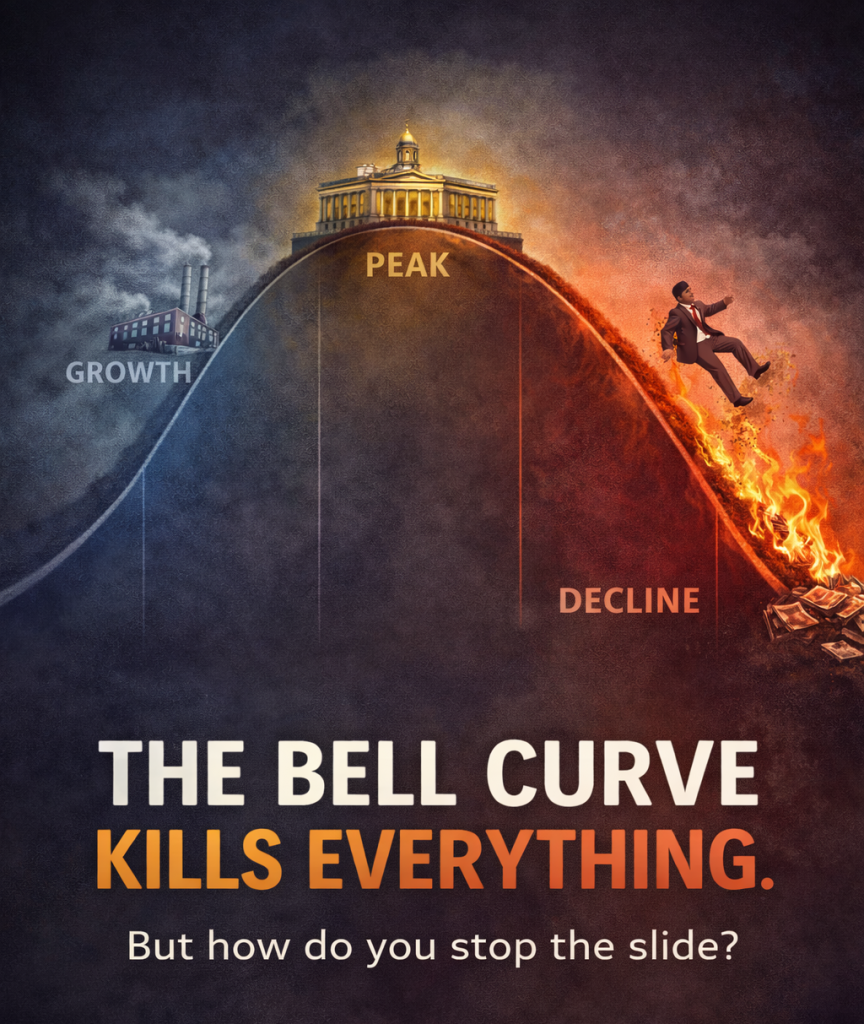
Every revival follows the same bell curve: born in protest, swollen with prophecy, and ending in the death it once defied.

Church renewal movements are born in fire, out of dissatisfaction with the lifeless liturgy of the established church, or the suffocating legalism of groups like the Exclusive Brethren. At first they return to the raw text of Scripture and gather in homes, led not by ordained clergy but by men who claim the authority of the Spirit.

Then comes structure. Buildings. Bands. Youth groups. Paid pastors.

At the crest of the curve come the prophecies: revival is coming, just around the corner, greater than anything seen before. Money is given sacrificially. Lives are rearranged. Large buildings bought. Hope is inflated into certainty.

But the revival does not come.

The failed prophecies are rarely named as failures. No serious apology is made for the emotional pressure, the money raised, or the years of expectancy spent on promises that dissolved into air. The people who joined near the beginning often remain inside the system anyway, not because the prophecy came true, but because they have built their lives inside its language. One reason the cycle works is brutally simple: those with living memory of the last false dawn are eventually buried. The cycle renews itself not by repentance, but by funerals.

On the downward slope, the message softens to attract outsiders. The sharp edges are rounded off. Meetings shortened. Speaking in tongues relegated to prayer meetings. Women step into the pulpit. Social projects begin to replace urgent evangelism. By the time the curve flattens, the movement has drifted back into the same spiritual lethargy from which it once broke free.

And somewhere, quietly, the pattern begins again.

This is not new.

The eighteenth-century Methodist revival carried the same internal logic, though in a different register. Prophecy was not usually delivered as spontaneous announcements of imminent awakening, but woven through sermons, hymns and journals. John Wesley spoke of a “work of God” spreading across England; early Methodists read their experience as the fulfilment of biblical promise, the “latter rain of the Spirit poured out again in the last days.

And yet Methodism, too, followed the curve. What began as a disruptive, Spirit-driven renewal gradually became a structured denomination.

It always does.

What is more interesting is what happens before the next rise.

Recent history gives us several variations on the same descent.

Hillsong shows what happens when a movement builds itself around energy, scale and centralised identity. For a time it feels unstoppable — global, confident, culturally dominant. But when leadership fails and the narrative fractures, the fall is sudden. Not total collapse, but deflation. What was once a movement becomes an organisation trying to stabilise itself.

Mark Driscoll represents another version of the curve: charisma outrunning character. The rise is rapid, the influence undeniable, but the culture formed around the leader cannot bear the weight placed upon it. When the collapse comes, what once looked like authority begins to look like control.

Newfrontiers offers a quieter trajectory. No great implosion, no single scandal at the centre — simply dispersal. A movement built around relational authority fragments into multiple streams. It continues, even grows, but the shared identity thins. What was once a single current becomes a cluster of networks, leaving behind a nagging feeling of dissolution.

Vineyard perhaps shows the most stable outcome of all. No collapse, no dramatic fracture — simply absorption. Its innovations in worship and church culture spread so widely that the movement itself becomes less distinct. It survives by dissolving into the mainstream it once helped reshape.

Sudden deflation. Moral collapse. Gradual dispersal. Quiet absorption.

These are different endings, but they belong to the same curve.

And beneath them lies something more uncomfortable.

These movements do not begin with authority. They begin with relief. A sudden sense that life makes sense, that one is seen, located, given purpose. Meaning becomes structure. Structure becomes authority. Authority becomes identity.

Then, slowly, the system outgrows the intensity that created it.

What felt like life begins to feel like maintenance.

What felt like truth begins to feel like language.

What felt like revival becomes, in time, another form of what it once opposed.

The bell curve is not just a pattern in churches.

It is a pattern in us.

“The most terrible thing of all is when a movement that began in passion ends in habit.”  – Søren Kierkegaard

Who is God, really?

A man lies on the floor, staring up at heaven.
Light breaks through painted clouds. A hand reaches toward another — creation, divinity, meaning itself, captured in a single moment.

But from another angle, the sky is a ceiling. The divine is pigment. The gesture, for all its beauty, is human.

And the question for me, after two decades of fundamentalist Christianity, began there: have we been looking at our own creation all along?

If we look at everything that human beings have produced — art, language, moral codes, religion — God looks, in many ways, like our most sophisticated mirror. Literally every culture has invented (or discovered) some concept of a higher order: the ground of being, the ultimate judge, the cosmic parent. These images shift according to what any given society most needs or fears. In that sense, the God we talk about, the God with attributes, motives and commandments, is a human construction: a symbolic language for meaning, morality and mortality.

But that doesn’t automatically mean there is nothing beyond us. There’s a second, deeper question: whether our intuition that there is something conscious, ordering or transcendent that points to reality or whether it is simply an evolved illusion. Science can’t answer that question yet. What it can say is that mystical experience, moral intuition and awe all register in human brains as real and powerful phenomena. Whether they’re merely responses to something external or to our own depth is open.

If you push me personally, based on everything I’ve seen, read and experiences — I’d say this:

“What we call God may not be the source of our meaning, but the shape our need for meaning takes when we project it beyond ourselves.”

That’s not neutral. It’s a conviction that the word God is man-made, but the intuition behind it may be a genuine encounter with the structure of reality itself.

If there is something real behind the intuition of God, but it’s not a personal deity with emotions, commandments and preferences, then we have to rethink what faith, morality and meaning mean.

1. Ethically

Without a personal God, morality stops being obedience to an external authority and becomes alignment with reality itself.
If the “ground of being” is the structure out of which everything arises — consciousness, life, relationship — then to live morally is to live in harmony with that structure: honesty instead of delusion, compassion instead of domination, truth instead of manipulation.
Sin, in that framework, isn’t breaking divine rules; it’s acting against the grain of reality, damaging what is most real in ourselves and others.

2. Existentially

It removes the childish comfort of a sky-parent, but also the terror of divine punishment.
You can’t bargain with such a God; you can only participate in it.
Prayer becomes attention.
Worship becomes awe and gratitude.
Salvation becomes awakening: the recognition that you were never separate from the source to begin with.

3. Psychologically

Humans projected “God” outward because it’s hard to face the abyss of meaning and fear of death alone. But if the transcendent is immanent, built into consciousness itself, then our experience moves from obedience to discovery.
The “voice of God” becomes conscience, insight, intuition, the part of you that knows when you are betraying truth. That’s not delusion; it’s evolution giving us a compass.

4. Culturally

It explains why religions keep being both beautiful and dangerous. They are metaphors that became institutions — attempts to express the ineffable that hardened into dogma.
The task of a spiritually mature species might be to keep the poetry and let go of the literalism: to treat scripture as myth that reveals truth, not as truth that forbids doubt and causes division.

So:

If there is a real ground of being but no personal deity, then “God” is not Someone to worship but Something to wake up to.
The ethical life becomes an act of participation, not submission.
Heaven is clarity, not geography.

If we strip away the idea of a personal God but keep the intuition that there is a real ground of being, something that is truth, consciousness and life itself, then guilt, forgiveness and redemption become psychological-spiritual processes, not legal or supernatural ones.

1. Guilt

In this view, guilt isn’t a divine sentence; it’s the psyche’s alarm system.
It signals that you’ve moved out of alignment with what is real and life-affirming. When you deceive, harm, or instrumentalise others, you challenge your own coherence. The pain of guilt is not punishment but feedback: reality pushing you to restore integrity.

The problem is that most people either drown in guilt or silence it.
Religion often worsened that by turning guilt into debt, something owed to an external judge.
But in this framework, guilt is diagnostic, not damnatory.
You listen to it, trace it to its cause, and let it guide you back to truth.

2. Forgiveness

If there’s no divine being to forgive, then forgiveness must emerge within consciousness itself.
You can’t erase the past, but you can integrate it, see it truthfully, feel the pain, and let understanding dissolve the need for vengeance.
Forgiveness becomes a recognition of shared brokenness: that whoever harmed you (or whoever you harmed) was acting from ignorance, fear, or distortion.

Forgiving doesn’t mean excusing; it means releasing your identity as either the guilty or the victim.
You step out of the narrative of debt and punishment and into the reality that everyone is stumbling toward wholeness.

3. Redemption

Without a divine judge, redemption is not being declared clean — it’s becoming real again.
It’s the return to inner coherence after self-betrayal.
You redeem yourself by telling the truth, repairing what you can, and allowing compassion, not self-pity, to re-root you in reality.
It’s the same pattern you see in psychotherapy, art, confession, and love: the movement from concealment → exposure → integration.

4. The Shape of Grace

Even without a theistic God, something like “grace” still exists.
When you tell the truth, life has a way of meeting you with unexpected gentleness, not because someone decides to forgive you, but because truth itself is healing.
Reality is merciless with lies but merciful with honesty.

If you accept that, then the task of the guilty person is no longer to appease a deity but to become whole, to stop fragmenting themselves with denial.
And the task of the forgiver is not to absolve but to see: to understand enough that hatred dissolves into clarity.

Redemption isn’t about being declared innocent. It’s about becoming real again. The moment I stopped trying to defend the person I had been, something in me unclenched. The shards started fitting together, not into the old shape, but into something rougher, truer, almost beautiful in its fractures.

Grace, I realised, isn’t God sparing you. It’s reality allowing you to continue, to try again, to live in truth instead of illusion.

The glass doesn’t become clean; it becomes transparent. And through it, you see both your own reflection and the world beyond, no longer separate, no longer opposed.

We may never know whether there is something beyond us. But we can know this: the God we speak of bears an unmistakable human shape.

We painted the ceiling. We lay beneath it. And over time, we forgot that we had done so.

What remains is not emptiness, but a more difficult honesty: the possibility that meaning does not descend from above, but emerges from within, asking not for worship, but for a truth that is higher than faith.

“Theology is anthropology… the object of any subject is nothing else than the subject’s own nature taken objectively.”  – Ludwig Feuerbach

When breaking the law is the right thing to do

When Absolutes Meet Life: The Ten Commandments in a World of Grey Zones

Introduction: Granite Pillars, Shifting Ground

The Ten Commandments stand like granite pillars in the moral imagination of the West. Their clarity and simplicity — do not lie, do not steal, do not kill — promise a moral compass that transcends culture, time and circumstance.

Yet the moment we bring them into the tangle of real life, absolutes begin to rub against exceptions.

Take truth-telling: you shall not bear false witness. But if lying spares the hunted from a tyrant’s soldiers, can we still call it sin?

Or killing: you shall not murder. What of the soldier who fires not from hatred but to liberate, or the doctor who relieves excruciating suffering when life is otherwise ebbing away?

The commandments do not disappear. But they begin to bend under the weight of reality.

Where the Commandments Begin to Fracture

Each commandment, when examined closely, reveals a fault line:

    • Do not lie → What if a lie saves a life?
    • Do not kill → What about self-defence, war, euthanasia?
    • Do not steal → What if a starving person takes bread?
    • Honour your parents → What if they are abusive?
    • Keep the Sabbath → What if healing or survival requires breaking it?

Even the Hebrew scriptures acknowledge this tension:
David eats sacred bread when starving. Rahab lies and is praised.

The pattern is consistent: when strict obedience collides with human dignity, compassion begins to override rule.

Modern Grey Zones: Where Ethics Gets Uncomfortable

The ancient dilemmas have not disappeared. They have intensified.

1. Civil Disobedience and Tax Resistance

If citizens believe a war is unjust, are they morally obliged to fund it?

If millions refused to pay taxes in protest, would that be:

    • theft from the state?
    • or moral courage against injustice?

History complicates the answer. Figures like Gandhi and Martin Luther King Jr. framed civil disobedience not as lawlessness, but as obedience to a higher law.

Yet the danger is obvious: if everyone decides individually which laws to obey, social order collapses. So where is the line — between conscience and chaos?

2. State Policies and Human Life

Consider population control policies that have led, directly or indirectly, to the killing of female infants. Is this:

    • a utilitarian attempt to manage resources?
    • or a violation of the most basic moral law — the sanctity of life?

Here the commandment “do not kill” confronts the brutal logic of state planning.

3. Wealth, Environment, and Collective Harm

We do not steal — and yet entire economies extract from the planet in ways that may destroy future generations.

    • Is environmental destruction a form of theft from the unborn?
    • Does profit justify long-term harm?

The commandments were written for individuals.
But today, systems commit what individuals once did.

4. Truth in the Age of Power

“Do not bear false witness” once meant lying in court. Now it includes:

    • political disinformation
    • media manipulation
    • algorithmic distortion

When truth itself becomes a battlefield, the commandment remains, but its application becomes infinitely more complex.

A Personal Dilemma: When Every Commandment Collides

There was a moment when all of this ceased to be theoretical for me.

My mother came to visit me in Germany. At the airport, she was pushed over by an impatient passenger in one of those electric buggies. The fall seemed minor at the time, but it accelerated everything. Her health declined rapidly. Incontinence. Dementia. Depression.

Her GP made a suggestion. We could simulate a bladder infection. That would justify a hospital admission. From there, she would be transferred to a care home for short-term recovery — and, most likely, remain there long-term.

It would mean lying. It would mean manipulating the system. It would mean, in some sense, taking resources that were not strictly ours.

And yet the alternative was to watch her deteriorate without adequate care.

In that moment, the commandments did not line up neatly. They collided.

    • Do not lie — and yet the lie would open the door to care.
    • Do not steal — and yet the system existed precisely to care for the vulnerable.
    • Do not covet — and yet I envied those whose lives were not constrained by such responsibility.
    • Do not kill — and yet I felt flashes of rage toward the woman who had pushed her, a dark instinct that shocked me.

In the end, I followed the doctor’s advice.

My mother received excellent care. She lived for another seven years, safe, supported, and dignified in ways that would not otherwise have been possible.

Looking back, I still ask the question: was it right?

In the language of absolute rules, perhaps not.
In the language of lived reality, I believe it was.

And yet I cannot prove it was right.
I can only say that it was human.

The Real Question: Rules or Responsibility?

The deeper issue is not whether the commandments are right.

It is whether they can ever be applied without interpretation.

    • Absolute rules offer clarity.
    • Real life demands judgment.

Too much rigidity → cruelty in the name of morality.
Too much flexibility → chaos disguised as freedom.

We are left in tension.

A Different Way to Read the Commandments

Perhaps the commandments were never meant to function as rigid laws in every conceivable situation.

Perhaps they are moral directions rather than mechanical rules:

    • not “never lie,” but protect truth and trust
    • not “never kill,” but honour the sacredness of life
    • not “never steal,” but respect what belongs to others

In this reading, the spirit matters more than the letter.

But that raises a dangerous possibility: who decides what the “spirit” requires?

Between Fanaticism and Relativism

This is where modern ethics fractures into two extremes:

    • Fanaticism → rigid obedience, even when it harms
    • Relativism → anything can be justified

Neither is sufficient.

The real challenge is harder: to hold onto moral clarity without losing moral intelligence.

Conclusion: The Burden of Being Human

The commandments remain.

But they no longer stand untouched on distant stone tablets.
They stand within us — contested, interpreted, lived.

To be human is not simply to obey rules.
It is to carry the burden of deciding when, and how, they apply.

And that burden cannot be escaped.

Closing quotation

“He who fights with monsters should see to it that he himself does not become a monster… for when you gaze long into the abyss, the abyss gazes also into you.”
Friedrich Nietzsche

Saved, Not Straight

For a time in my early thirties, I believed I had been changed. From the inside out. Born again. A new beginning and fresh start.

I had undergone what, in the language of the Christian evangelical world, could only be called a genuine conversion. It did not feel theatrical or socially induced. It felt seismic. My life changed in a moment. Shame receded. Purpose arrived. The scattered pieces of my identity seemed, at last, to lock into place. My life mattered and I had a destiny.

I re-organised my life accordingly. I took the Bible seriously and literally. I reordered my habits, my friendships, my ambitions. At one point I sold almost everything and moved countries to help start a church. None of this was half-hearted. I was, by temperament, never capable of half-belief.

And for a while — and this is the part I misunderstood — it worked.

The chaos that had previously marked my inner life settled into a kind of disciplined calm. The evangelical framework gave me structure, language, community and a powerful moral narrative in which to locate myself. I was no longer drifting. I knew who I was supposed to be. Most importantly, Jesus had healed me of my homosexuality.

Looking back now, with the cooler eye of age and a good deal more psychological literacy, I can see that what changed most dramatically was not my sexuality but my behaviour, my identity story, and the level of internal containment I was able to sustain.

Yet at that time, it did not feel like containment. It felt like healing.

This distinction between what feels like transformation and what actually is, sits at the heart of many sincere but ultimately fragile “healing” narratives.

Human behaviour is extraordinarily plastic under conditions of high meaning and strong community reinforcement. A sufficiently immersive belief system can re-organise daily life with impressive speed. It can quieten compulsions, redirect attention and produce periods of genuine stability. I experienced all of that. Many others have too.

What it did not do, what it could not do, was re-write the underlying structure of my sexual orientation.

That structure had been there long before my conversion, and it remained long after the emotional intensity of that period began, slowly and almost imperceptibly at first, to cool.

This is the point at which some readers, particularly those still inside strongly theological frameworks, may feel the ground shifting uncomfortably beneath their feet. Because it requires holding two truths at once. And fundamentlist Christianity cannot do that.

The first is that the conversion experience can be entirely sincere. Mine was. I was not pretending. I was not cynically managing appearances as I felt God supernaturally call me to the fro of the meeting to repent. I believed what I believed with the full force of my personality.

The second is that sincerity, however intense, does not grant the human nervous system unlimited plasticity. There are layers of the self that respond readily to new narratives, new communities, engaging worship music, charismatic preaching, new disciplines. And there are layers that are markedly more stubborn.

Sexual orientation appears, for the vast majority of people, to belong to the latter category.

Over time, not suddenly, not dramatically, but with the slow persistence of something that had never actually left, the old patterns of attraction reasserted themselves. Not because I had secretly wished them to. Not because I lacked discipline. Not because I had prayed incorrectly or insufficiently. But because the earlier sense of “healing” had been, in important respects, a narrative laid over something more deeply wired.

None of this, I should say, requires contempt for religion. Religious conversion can do many things remarkably well. It can stabilise chaotic lives. It can interrupt destructive habits. It can support sobriety. It can give people a moral and communal framework strong enough to hold them together during extremely fragile periods.

It did some of those things for me.

But in my case, it did not and could not perform the more ambitious miracle that was quietly hoped for beneath the surface language of discipleship and obedience.

It did not make me straight.

Looking back now, the word narrative has acquired a deeper significance for me than it had at the time.

During those years of faith, the Christian story did not feel like a narrative at all. It felt like reality itself. God was not a concept but a presence; Jesus was not a historical figure interpreted through centuries of theology, but the living centre of the universe. Seated on the throne of God and ruling over both my life and the world. That conviction organised my moral life, my ambitions, my sense of purpose, even the geography of my life.

Today I see that experience differently.

What I once experienced as divine intervention I now understand as the extraordinary human capacity to live inside powerful linguistic and cultural frameworks. Human beings are storytelling animals. Through language we build moral worlds, sacred histories, and identities that feel as solid as the physical world around us. Religion is perhaps the most sophisticated expression of that capacity.

From my present perspective, the God I once believed had healed me now appears less as a supernatural agent and more as a compelling narrative structure — one created, transmitted, and sustained through communities of belief over many centuries. That does not mean the experience of faith is trivial or insincere. My own certainly was not. But it does mean that the transformative power I felt then came not from a divine rewiring of my biology, but from the immense psychological force of a story that I had come to inhabit completely.

And stories, however powerful, cannot re-engineer the deeper architecture of human sexuality.

With the perspective I now hold, I no longer believe there was ever any supernatural mechanism in play capable of doing so. Human sexuality, in all its stubborn biological embeddedness across species and cultures, does not appear to be the kind of system that yields to prayer, however fervent, or to theological conviction, however sincere.

What religion offered me was not rewiring but narrative — powerful, coherent, temporarily life-organising narrative.

And narrative can carry a person a very long way.

For some, perhaps, it carries them a lifetime. For others, particularly those of us whose temperaments strain toward a rather unforgiving internal consistency, the gap between story and structure eventually becomes too wide to ignore.

When that happens, the earlier sense of miraculous change often has to be reinterpreted, not as fraud, and not as self-deception in any crude sense, but as something more human and more psychologically intelligible: a period of intense behavioural reorganisation under the influence of an immensely compelling meaning system.

That may sound less dramatic than the language of healing.

But it is, I think, more accurate.

And accuracy, however sobering, has at least this advantage: it allows us to understand how thoroughly decent, educated and sincere people can believe that something fundamental has been remade, only to discover later that what changed was real but partial: powerful enough to re-organise behaviour, but not powerful enough to re-write the deeper biological architecture of desire.

If my own story illustrates anything, it is not that religious experience is fake or emotionally insignificant. My conversion was neither. It re-organised my life, gave me discipline, purpose and community, and for a time it steadied an inner world that had previously been chaotic.

But what it did not do was alter the deeper grammar of my sexuality.

What I once interpreted as divine intervention I now understand as the extraordinary psychological force of a narrative fully inhabited, a story powerful enough to guide behaviour, but not powerful enough to redesign the organism that was living inside it.

And that, I have come to think, is the truth behind many testimonies of healing.

Conversion can change the story we tell about ourselves.

It cannot rewrite the nature we never chose in the first place.

“The most powerful stories are not those we tell others, but those we tell ourselves about who we are.”
Daniel Kahneman