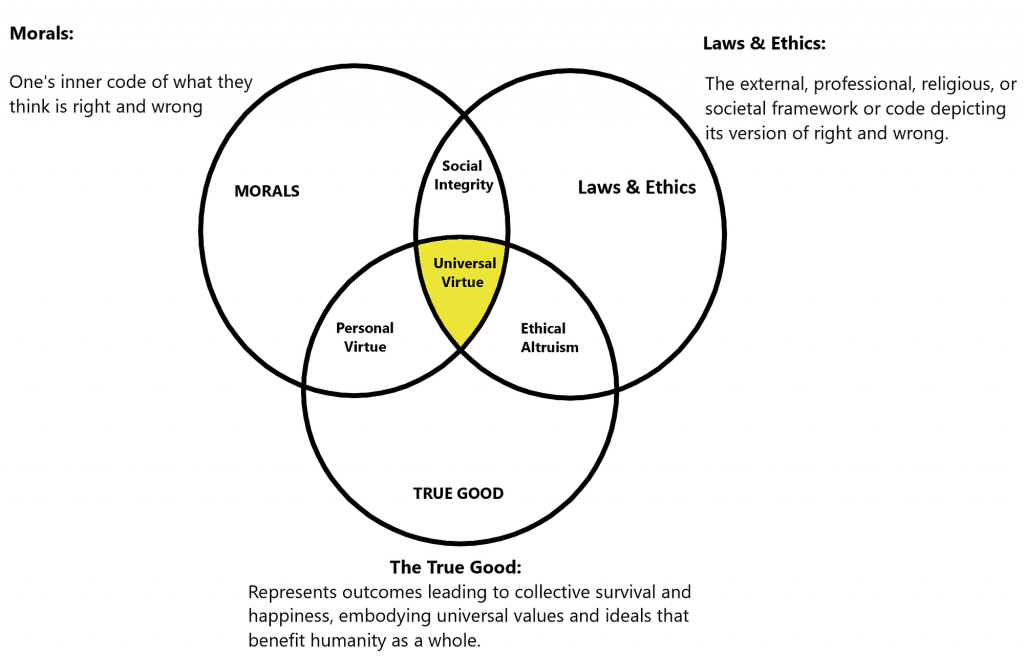
Who is God, really?

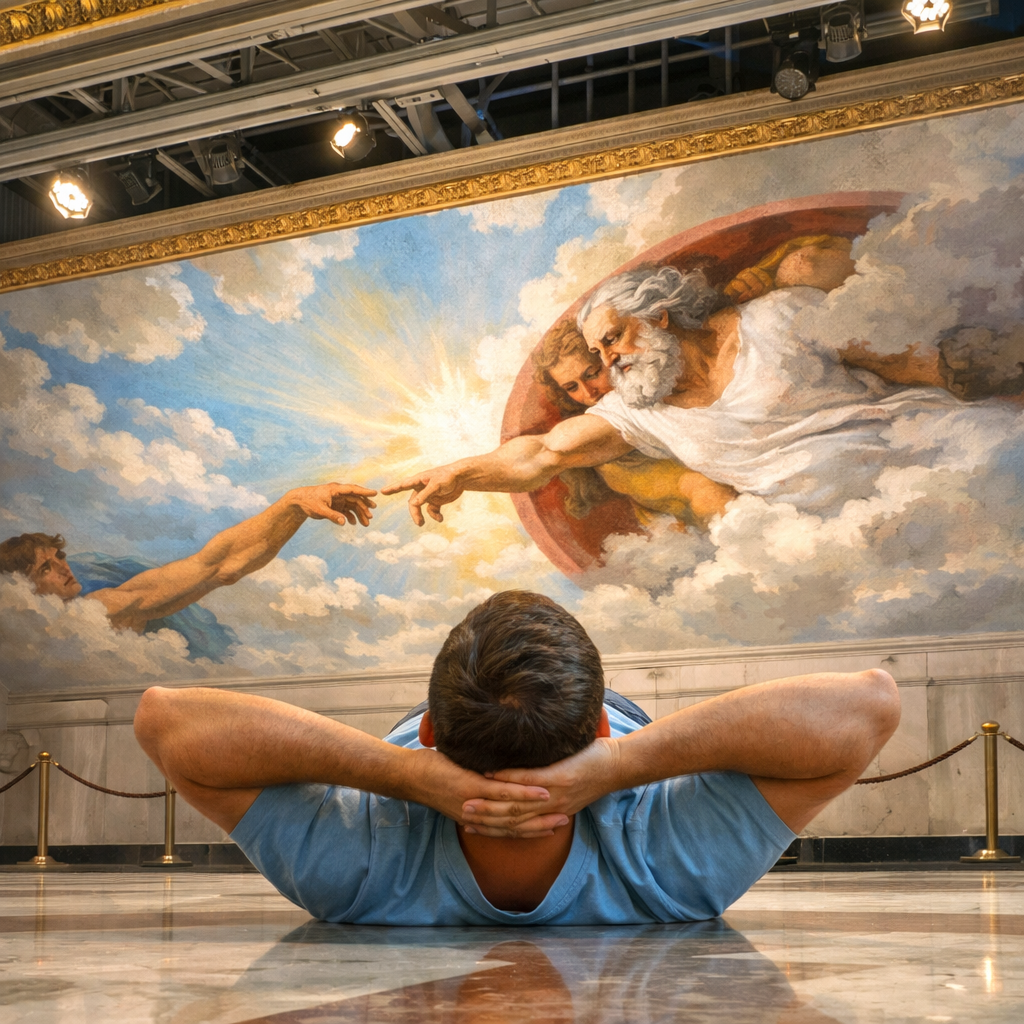
A man lies on the floor, staring up at heaven.
Light breaks through painted clouds. A hand reaches toward another — creation, divinity, meaning itself, captured in a single moment.

But from another angle, the sky is a ceiling. The divine is pigment. The gesture, for all its beauty, is human.

And the question for me, after two decades of fundamentalist Christianity, began there: have we been looking at our own creation all along?

If we look at everything that human beings have produced — art, language, moral codes, religion — God looks, in many ways, like our most sophisticated mirror. Literally every culture has invented (or discovered) some concept of a higher order: the ground of being, the ultimate judge, the cosmic parent. These images shift according to what any given society most needs or fears. In that sense, the God we talk about, the God with attributes, motives and commandments, is a human construction: a symbolic language for meaning, morality and mortality.

But that doesn’t automatically mean there is nothing beyond us. There’s a second, deeper question: whether our intuition that there is something conscious, ordering or transcendent that points to reality or whether it is simply an evolved illusion. Science can’t answer that question yet. What it can say is that mystical experience, moral intuition and awe all register in human brains as real and powerful phenomena. Whether they’re merely responses to something external or to our own depth is open.

If you push me personally, based on everything I’ve seen, read and experiences — I’d say this:

“What we call God may not be the source of our meaning, but the shape our need for meaning takes when we project it beyond ourselves.”

That’s not neutral. It’s a conviction that the word God is man-made, but the intuition behind it may be a genuine encounter with the structure of reality itself.

If there is something real behind the intuition of God, but it’s not a personal deity with emotions, commandments and preferences, then we have to rethink what faith, morality and meaning mean.

1. Ethically

Without a personal God, morality stops being obedience to an external authority and becomes alignment with reality itself.
If the “ground of being” is the structure out of which everything arises — consciousness, life, relationship — then to live morally is to live in harmony with that structure: honesty instead of delusion, compassion instead of domination, truth instead of manipulation.
Sin, in that framework, isn’t breaking divine rules; it’s acting against the grain of reality, damaging what is most real in ourselves and others.

2. Existentially

It removes the childish comfort of a sky-parent, but also the terror of divine punishment.
You can’t bargain with such a God; you can only participate in it.
Prayer becomes attention.
Worship becomes awe and gratitude.
Salvation becomes awakening: the recognition that you were never separate from the source to begin with.

3. Psychologically

Humans projected “God” outward because it’s hard to face the abyss of meaning and fear of death alone. But if the transcendent is immanent, built into consciousness itself, then our experience moves from obedience to discovery.
The “voice of God” becomes conscience, insight, intuition, the part of you that knows when you are betraying truth. That’s not delusion; it’s evolution giving us a compass.

4. Culturally

It explains why religions keep being both beautiful and dangerous. They are metaphors that became institutions — attempts to express the ineffable that hardened into dogma.
The task of a spiritually mature species might be to keep the poetry and let go of the literalism: to treat scripture as myth that reveals truth, not as truth that forbids doubt and causes division.

So:

If there is a real ground of being but no personal deity, then “God” is not Someone to worship but Something to wake up to.
The ethical life becomes an act of participation, not submission.
Heaven is clarity, not geography.

If we strip away the idea of a personal God but keep the intuition that there is a real ground of being, something that is truth, consciousness and life itself, then guilt, forgiveness and redemption become psychological-spiritual processes, not legal or supernatural ones.

1. Guilt

In this view, guilt isn’t a divine sentence; it’s the psyche’s alarm system.
It signals that you’ve moved out of alignment with what is real and life-affirming. When you deceive, harm, or instrumentalise others, you challenge your own coherence. The pain of guilt is not punishment but feedback: reality pushing you to restore integrity.

The problem is that most people either drown in guilt or silence it.
Religion often worsened that by turning guilt into debt, something owed to an external judge.
But in this framework, guilt is diagnostic, not damnatory.
You listen to it, trace it to its cause, and let it guide you back to truth.

2. Forgiveness

If there’s no divine being to forgive, then forgiveness must emerge within consciousness itself.
You can’t erase the past, but you can integrate it, see it truthfully, feel the pain, and let understanding dissolve the need for vengeance.
Forgiveness becomes a recognition of shared brokenness: that whoever harmed you (or whoever you harmed) was acting from ignorance, fear, or distortion.

Forgiving doesn’t mean excusing; it means releasing your identity as either the guilty or the victim.
You step out of the narrative of debt and punishment and into the reality that everyone is stumbling toward wholeness.

3. Redemption

Without a divine judge, redemption is not being declared clean — it’s becoming real again.
It’s the return to inner coherence after self-betrayal.
You redeem yourself by telling the truth, repairing what you can, and allowing compassion, not self-pity, to re-root you in reality.
It’s the same pattern you see in psychotherapy, art, confession, and love: the movement from concealment → exposure → integration.

4. The Shape of Grace

Even without a theistic God, something like “grace” still exists.
When you tell the truth, life has a way of meeting you with unexpected gentleness, not because someone decides to forgive you, but because truth itself is healing.
Reality is merciless with lies but merciful with honesty.

If you accept that, then the task of the guilty person is no longer to appease a deity but to become whole, to stop fragmenting themselves with denial.
And the task of the forgiver is not to absolve but to see: to understand enough that hatred dissolves into clarity.

Redemption isn’t about being declared innocent. It’s about becoming real again. The moment I stopped trying to defend the person I had been, something in me unclenched. The shards started fitting together, not into the old shape, but into something rougher, truer, almost beautiful in its fractures.

Grace, I realised, isn’t God sparing you. It’s reality allowing you to continue, to try again, to live in truth instead of illusion.

The glass doesn’t become clean; it becomes transparent. And through it, you see both your own reflection and the world beyond, no longer separate, no longer opposed.

We may never know whether there is something beyond us. But we can know this: the God we speak of bears an unmistakable human shape.

We painted the ceiling. We lay beneath it. And over time, we forgot that we had done so.

What remains is not emptiness, but a more difficult honesty: the possibility that meaning does not descend from above, but emerges from within, asking not for worship, but for a truth that is higher than faith.

“Theology is anthropology… the object of any subject is nothing else than the subject’s own nature taken objectively.”  – Ludwig Feuerbach
When breaking the law is the right thing to do

When Absolutes Meet Life: The Ten Commandments in a World of Grey Zones

Introduction: Granite Pillars, Shifting Ground

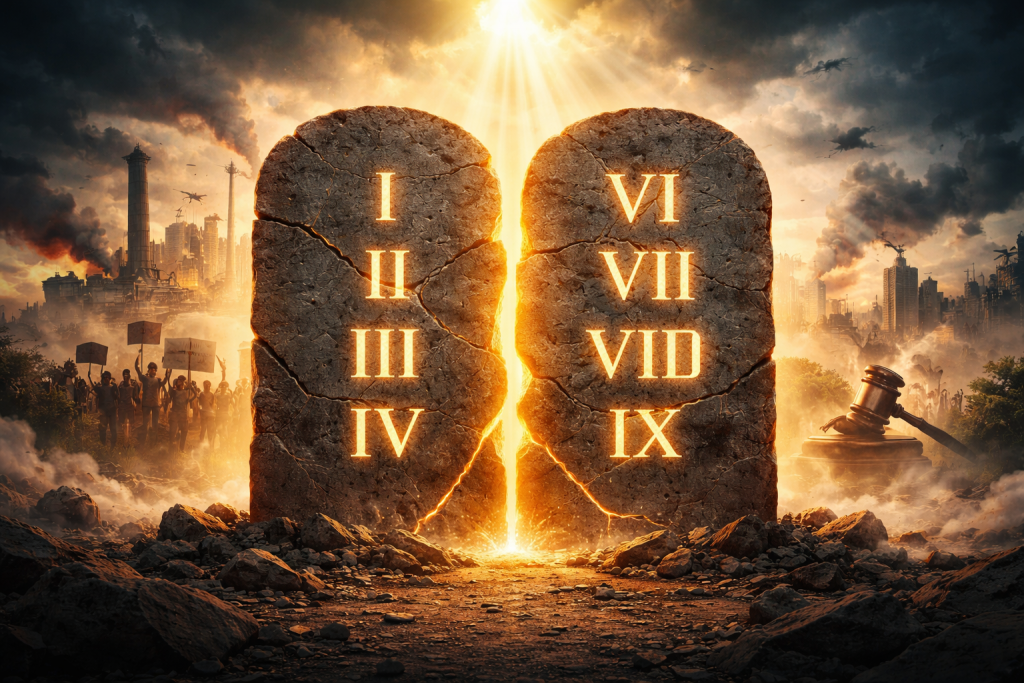
The Ten Commandments stand like granite pillars in the moral imagination of the West. Their clarity and simplicity — do not lie, do not steal, do not kill — promise a moral compass that transcends culture, time and circumstance.

Yet the moment we bring them into the tangle of real life, absolutes begin to rub against exceptions.

Take truth-telling: you shall not bear false witness. But if lying spares the hunted from a tyrant’s soldiers, can we still call it sin?

Or killing: you shall not murder. What of the soldier who fires not from hatred but to liberate, or the doctor who relieves excruciating suffering when life is otherwise ebbing away?

The commandments do not disappear. But they begin to bend under the weight of reality.

Where the Commandments Begin to Fracture

Each commandment, when examined closely, reveals a fault line:

    • Do not lie → What if a lie saves a life?
    • Do not kill → What about self-defence, war, euthanasia?
    • Do not steal → What if a starving person takes bread?
    • Honour your parents → What if they are abusive?
    • Keep the Sabbath → What if healing or survival requires breaking it?

Even the Hebrew scriptures acknowledge this tension:
David eats sacred bread when starving. Rahab lies and is praised.

The pattern is consistent: when strict obedience collides with human dignity, compassion begins to override rule.

Modern Grey Zones: Where Ethics Gets Uncomfortable

The ancient dilemmas have not disappeared. They have intensified.

1. Civil Disobedience and Tax Resistance

If citizens believe a war is unjust, are they morally obliged to fund it?

If millions refused to pay taxes in protest, would that be:

    • theft from the state?
    • or moral courage against injustice?

History complicates the answer. Figures like Gandhi and Martin Luther King Jr. framed civil disobedience not as lawlessness, but as obedience to a higher law.

Yet the danger is obvious: if everyone decides individually which laws to obey, social order collapses. So where is the line — between conscience and chaos?

2. State Policies and Human Life

Consider population control policies that have led, directly or indirectly, to the killing of female infants. Is this:

    • a utilitarian attempt to manage resources?
    • or a violation of the most basic moral law — the sanctity of life?

Here the commandment “do not kill” confronts the brutal logic of state planning.

3. Wealth, Environment, and Collective Harm

We do not steal — and yet entire economies extract from the planet in ways that may destroy future generations.

    • Is environmental destruction a form of theft from the unborn?
    • Does profit justify long-term harm?

The commandments were written for individuals.
But today, systems commit what individuals once did.

4. Truth in the Age of Power

“Do not bear false witness” once meant lying in court. Now it includes:

    • political disinformation
    • media manipulation
    • algorithmic distortion

When truth itself becomes a battlefield, the commandment remains, but its application becomes infinitely more complex.

A Personal Dilemma: When Every Commandment Collides

There was a moment when all of this ceased to be theoretical for me.

My mother came to visit me in Germany. At the airport, she was pushed over by an impatient passenger in one of those electric buggies. The fall seemed minor at the time, but it accelerated everything. Her health declined rapidly. Incontinence. Dementia. Depression.

Her GP made a suggestion. We could simulate a bladder infection. That would justify a hospital admission. From there, she would be transferred to a care home for short-term recovery — and, most likely, remain there long-term.

It would mean lying. It would mean manipulating the system. It would mean, in some sense, taking resources that were not strictly ours.

And yet the alternative was to watch her deteriorate without adequate care.

In that moment, the commandments did not line up neatly. They collided.

    • Do not lie — and yet the lie would open the door to care.
    • Do not steal — and yet the system existed precisely to care for the vulnerable.
    • Do not covet — and yet I envied those whose lives were not constrained by such responsibility.
    • Do not kill — and yet I felt flashes of rage toward the woman who had pushed her, a dark instinct that shocked me.

In the end, I followed the doctor’s advice.

My mother received excellent care. She lived for another seven years, safe, supported, and dignified in ways that would not otherwise have been possible.

Looking back, I still ask the question: was it right?

In the language of absolute rules, perhaps not.
In the language of lived reality, I believe it was.

And yet I cannot prove it was right.
I can only say that it was human.

The Real Question: Rules or Responsibility?

The deeper issue is not whether the commandments are right.

It is whether they can ever be applied without interpretation.

    • Absolute rules offer clarity.
    • Real life demands judgment.

Too much rigidity → cruelty in the name of morality.
Too much flexibility → chaos disguised as freedom.

We are left in tension.

A Different Way to Read the Commandments

Perhaps the commandments were never meant to function as rigid laws in every conceivable situation.

Perhaps they are moral directions rather than mechanical rules:

    • not “never lie,” but protect truth and trust
    • not “never kill,” but honour the sacredness of life
    • not “never steal,” but respect what belongs to others

In this reading, the spirit matters more than the letter.

But that raises a dangerous possibility: who decides what the “spirit” requires?

Between Fanaticism and Relativism

This is where modern ethics fractures into two extremes:

    • Fanaticism → rigid obedience, even when it harms
    • Relativism → anything can be justified

Neither is sufficient.

The real challenge is harder: to hold onto moral clarity without losing moral intelligence.

Conclusion: The Burden of Being Human

The commandments remain.

But they no longer stand untouched on distant stone tablets.
They stand within us — contested, interpreted, lived.

To be human is not simply to obey rules.
It is to carry the burden of deciding when, and how, they apply.

And that burden cannot be escaped.

Closing quotation

“He who fights with monsters should see to it that he himself does not become a monster… for when you gaze long into the abyss, the abyss gazes also into you.”
Friedrich Nietzsche

The Architecture of Reality

What seems eternal is often only the echo of human agreement

Most of us move through life believing that reality is simply “out there”—something fixed and solid, waiting for us to discover it. But over time, I’ve come to see that what we call “reality” is not just given to us; it is made, sustained, and passed on through people.

Think about it: the rules of marriage, the value of money, the rituals of religion or education—none of these fell from the sky. They were created by people, agreed upon, repeated, and eventually treated as if they had always been there. A piece of paper becomes “wealth.” A ceremony becomes “holy.” A set of expectations becomes “the way things are.”

The most fascinating part is that once these human creations are in place, they begin to feel objective, untouchable, almost like laws of nature. We grow up inside them, and they become the air we breathe. By the time we are adults, much of what we take as “normal” or “true” is simply what has been handed down to us.

And yet, these worlds are not neutral. Some people and institutions get to decide which knowledge counts, which voices are heard, which rules are legitimate. That is why two cultures—or even two families—can live in entirely different realities without ever noticing how constructed those realities are.

For the individual, this becomes especially challenging when the world we grew up in collides with the wider world outside. The lessons we learn at home—about trust, love, authority, or shame—are sometimes at odds with what we encounter later in school, work, or society at large. When these two realities clash, it can leave us confused, even broken inside, as if we’re expected to live two lives at once.

I’ve come to believe that the way forward begins with awareness. If we can see that these worlds are made by people, then we gain the freedom to question them. We can decide what to carry with us and what to lay down. We can stop being passive products of two conflicting realities and instead become active authors of our own lives.

At its heart, this is not just about society. It’s about self-knowledge, grace, and the courage to treat ourselves kindly as we sort through the contradictions. The more we learn to accept ourselves, the less power those clashes have to tear us apart.

In the end, we both build the world and are built by it. The challenge is to remain awake to that truth—and to choose, with as much wisdom as we can, the world we want to live in.