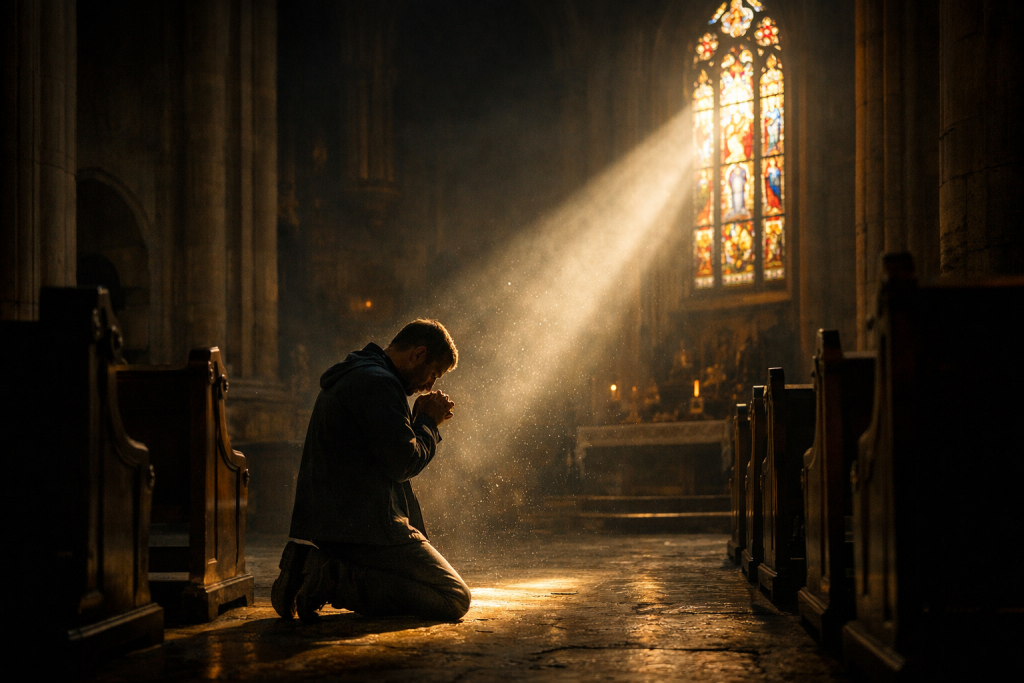
The Authentic Illusion of Salvation

A moment of religious devotion can feel like a direct encounter with the divine — but the experience may have deeply human origins.

There are few experiences in human life more convincing than religious conversion.

In the moment it happens, it feels absolute.

The new believer does not merely adopt a belief; he experiences what appears to be a profound transformation of reality itself. The world suddenly becomes charged with meaning. Events seem purposeful. Personal history acquires a narrative arc. Even suffering can appear reinterpreted as part of a divine plan.

To the convert, the conclusion feels unavoidable: God has revealed Himself.

I know this experience from the inside. For several years I believed, with complete sincerity, that God had personally intervened in my life. The sense of transformation was overwhelming. At the time it felt impossible to doubt that something supernatural had occurred.

The experience is often accompanied by powerful emotions: relief, gratitude, awe, sometimes tears. The convert may describe feeling “known,” “forgiven,” or “reborn.” For many, this moment becomes the central turning point of their life story.

From the inside, the experience feels like the discovery of truth. God exists. Faith becomes certainty (Hebrews 11:1).

From the outside, however, something more complex is happening.

A psychological ignition

Modern psychology offers a more prosaic explanation for the intensity of conversion.

Many conversions occur at moments of emotional vulnerability: crisis, guilt, loneliness, addiction, grief, or identity confusion. In such moments the mind becomes unusually receptive to radical reinterpretations of reality.

These states create a powerful readiness for cognitive re-organisation. The mind searches urgently for a coherent narrative capable of resolving internal tension.

Religious frameworks are uniquely suited to provide such narratives. They offer a ready-made interpretation of suffering, a clear moral structure and the promise of forgiveness and life beyond the grave.

When the new believer accepts this framework, the psychological relief can be immense. The sense of personal chaos suddenly resolves into a meaningful story.

The experience feels supernatural.

In reality, it may simply be the human mind discovering an interpretation that temporarily stabilises itself.

The sociological amplifier

But psychology alone does not explain the power of conversion.

The social environment plays an equally decisive role.

Conversion rarely happens in isolation. It usually occurs within communities already organised around the expectation of transformation. Worship services, testimonies, music, prayer and communal affirmation together create a powerful emotional ecosystem.

When a convert stands before such a community and declares a new faith, the response is immediate: approval, celebration, belonging.

The individual does not simply gain a belief.
He gains a new identity and a new tribe.

Human beings are exquisitely sensitive to social reinforcement. Once a community confirms that a person has been “saved,” the psychological commitment deepens rapidly. Doubt becomes socially costly. Certainty becomes a badge of belonging.

Belief, in this sense, is stabilised not only internally but collectively.

The sincerity paradox

None of this means that conversion experiences are insincere.

Quite the opposite.

At the moment of conversion, the belief is usually completely genuine. The emotional intensity is real. The sense of transformation is real. The feeling of encountering God is real.

But sincerity does not guarantee accuracy.

Human beings are capable of deeply authentic experiences that nevertheless rest upon mistaken interpretations of reality.

Religious conversion may be one of the most powerful examples of this phenomenon.

Human beings are capable of deeply authentic experiences that nevertheless rest upon mistaken interpretations of reality.

The problem of competing revelations

One further observation complicates the picture.

If religious conversion truly revealed a universal divine reality, we might expect converts around the world to converge toward the same understanding of God.

Instead, the opposite happens.

Christians experience conversions that confirm Christianity.
Muslims experience conversions that confirm Islam.
Hindus encounter Krishna.
Pentecostals encounter the Holy Spirit.
Catholics encounter the Virgin Mary.

Each experience feels equally convincing to the person undergoing it.

The simplest explanation is not that all these mutually contradictory revelations are true.

It is that the human mind is capable of generating profoundly convincing experiences within whatever symbolic framework it inhabits.

The quiet aftermath

For some people, the story ends with lifelong faith.

For others, something else happens.

Years later, the convert begins to recognise the psychological and sociological forces that once felt invisible. The experience that once seemed supernatural begins to look more recognisably human.

This realisation can be unsettling.

Because it means confronting a difficult possibility:

The God who once felt unquestionably real may have been a projection created by the deepest needs of the human mind.

And yet the experience itself — the hope, the meaning, the transformation — was never fake.

It was simply human.

“The gods we worship write their names on our faces.”
— C. G. Jung

Gay Fathers: Why Gay Men Build Straight Families

The Closet Has A Wedding Ring: How Gay Men Became Fathers

A few weeks ago, in a bar in Berlin, I mentioned to a man I had just met that I am the father of four. He paused briefly, then smiled and said, “Me too.”

Neither of us was surprised.

Among gay men of my generation, this quiet moment of recognition is more common than most people realise. Many of us built heterosexual families before we ever spoke openly about our sexuality. The pattern is well known in private and rarely examined in public.

The easy explanations tend to fall into two unsatisfactory camps. Either the men are portrayed as victims of their era, pushed helplessly into lives they never chose, or they are depicted as fundamentally deceptive, as though their marriages were nothing more than elaborate shams.

Reality, as usual, is more complicated and more human than either of these caricatures allows.


Orientation and Behaviour: A Necessary Distinction

One of the most important starting points is a simple but often overlooked distinction: sexual orientation and lived behaviour do not always align neatly. Sexual behaviour is fluid; sexual orientation is not.

For many heterosexual people, desire and life path coincide without much friction. For a significant number of gay men, particularly in earlier decades, the relationship between the two was more complex.

This does not mean orientation is infinitely fluid. It means only that human beings are capable of living in ways that do not perfectly mirror their inner erotic life.

Across much of the twentieth century, many men who experienced primary attraction to other men nonetheless married women and fathered children. Some did so consciously, some half-consciously, some in genuine hope that marriage might settle their inner restlessness.

What matters, and what is sometimes too quickly forgotten in contemporary discussion, is this: whatever the social context, these were still adult decisions. Social expectations may shape the landscape in which choices are made, but they do not erase personal responsibility for the lives we build within it.


The Social Script Was Narrow — But Not Irresistible

It would be historically naïve to ignore the strength of the social script that shaped male adulthood for much of the last century. Respectable manhood was closely associated with marriage, fatherhood, and visible domestic stability. Homosexuality, by contrast, was widely stigmatised, pathologised, or criminalised in many Western countries well into living memory. In West Germany, we had Paragraph 175 until 1994, and in Britain, the legal age of consent between two males was lowered to 16, in line with the heterosexual age of consent, in 2001.

These realities formed the background conditions in which many men made their life decisions.

But background conditions are not the same thing as compulsion. Men were not automatons. Some resisted the script. Some lived quietly single. Some formed discreet same-sex lives. Others chose marriage.

The more honest account is therefore not that gay men were forced into heterosexual families, but that many judged — rightly or wrongly — that marriage offered a workable path to belonging, stability and ordinary social life.

For some, it did.

For others, the costs emerged only slowly.


The Psychology of the Split Life

To understand how these marriages functioned — sometimes for decades — we have to move beyond the crude language of denial and look more carefully at the psychological mechanisms involved.

Human beings are remarkably adept at compartmentalisation. It is entirely possible to build a life in which emotional loyalty, domestic commitment, and parental devotion coexist alongside an erotic life that remains partially or wholly unintegrated.

Many men in mixed-orientation marriages reported something like the following internal arrangement: their affection, duty and daily life were invested sincerely in the family they built, while their erotic imagination operated in a more private register. The two spheres were kept separate, sometimes consciously, often simply by force of habit and circumstance.

There was also a long-standing cultural belief — now largely discredited but once widely accepted — that marriage might in some cases “settle” or redirect same-sex desire. It is easy to dismiss this idea now, but it was taken seriously by doctors, clergy and families well into the late twentieth century.

Some men entered marriage in good faith under that assumption. Others entered it with more ambivalence. Still others, candidly, avoided asking themselves too many questions.

Again, the human picture is mixed.


The Body, the Role and the Marriage

Another uncomfortable but important reality is that physiological sexual functioning does not always map perfectly onto deep erotic orientation.

Many predominantly gay men have been capable of heterosexual intercourse, particularly within the structured expectations of marriage. This fact has sometimes been misread as evidence of bisexuality where none primarily existed.

The more accurate conclusion is simply that human sexual response is adaptable within certain limits. Performance, affection, novelty and relational context can all play a role.

But adaptability has its limits. Over time, for many men, the gap between role and desire became harder to ignore or sustain.

And this is where the story turns from sociology to ethics.


The Cost That Must Be Named

Any honest discussion of gay fathers in heterosexual marriages must include a truth that is sometimes softened in retrospective accounts.

In many families, when the underlying reality eventually surfaced — whether gradually, painfully, or suddenly — wives and children experienced real hurt, confusion, and sometimes profound disruption.

Not in every case. Some families navigated the transition with dignity and mutual care. Some marriages had long since evolved into affectionate partnerships rather than romantic unions.

But in many others, the moment of disclosure felt, understandably, like a huge rupture. Trust could be shaken. Family narratives had to be rewritten. Children, depending on their age and temperament, sometimes struggled to make sense of what had changed and what had not.

To acknowledge this is not to indulge in self-reproach, nor to erase the genuine love many fathers felt — and continue to feel — for their families. It is simply to recognise that complex life structures often carry complex human costs.

Responsibility, in adulthood, includes the willingness to look at those costs squarely.

“Nothing in life is as important as you think it is while you are thinking about it.”
— Daniel Kahneman


A Generational Pattern. Not an Excuse.

There is no doubt that the pattern of gay men building heterosexual families was more common in earlier decades than it is today. Social visibility, legal change, and cultural openness have altered the landscape significantly.

But it would be a mistake to frame this too simply as a story of past oppression versus present freedom. Human lives remain complicated. Even today, in many parts of the world — and in some families much closer to home — similar tensions still exist.

Nor is it especially helpful to imagine that earlier generations were uniquely constrained while younger men are uniquely liberated. Every generation navigates its own pressures, blind spots, and compromises.

The more useful observation is simply this: life choices are always made within a cultural frame, and those frames do change over time. What once appeared the obvious path for many men no longer appears so.

Understanding that shift helps explain the pattern. It does not absolve individuals of the consequences of their choices.


A More Adult Conversation

What is needed now is neither romanticisation nor condemnation, but maturity.

Gay fathers from heterosexual marriages are not rare anomalies. They are part of a recognisable historical pattern in Western societies across much of the twentieth century. Their lives typically contained real commitment, real affection, and, often, real internal tension.

The marriages were not necessarily fraudulent. Nor were they always sustainable in the long term. Both things can be true at once.

If there is any value in revisiting these stories today, it lies in the clarity they offer about the complicated relationship between identity, behaviour, social expectation, and personal responsibility.

Human beings do not always live in perfect alignment with their inner lives. Sometimes they adapt. Sometimes they delay difficult recognitions. Sometimes they choose stability over authenticity, at least for a time.

And sometimes the reckoning comes later.

“Life can only be understood backwards; but it must be lived forwards.”
— Søren Kierkegaard


Closing Reflection

That brief exchange in the Berlin bar — “I have four children.” “Me too.” — was not a confession and not an excuse. It was simply recognition between two men shaped, in part, by similar cultural weather.

Many of us built families in good faith. Many loved our wives and children deeply, even where the erotic centre of gravity lay elsewhere. And many, later in life, had to integrate truths that earlier decades made easier to postpone.

The task now is not to rewrite the past into something neater than it was, nor to retreat into defensiveness or regret. It is to understand the full human picture: the agency, the context, the love that was real, and the pain that, in some families, was also real.

Grown-up lives rarely resolve into simple narratives. This is one of them.

“The truth is rarely pure and never simple.”
— Oscar Wilde