A great company always looks inevitable in retrospect.
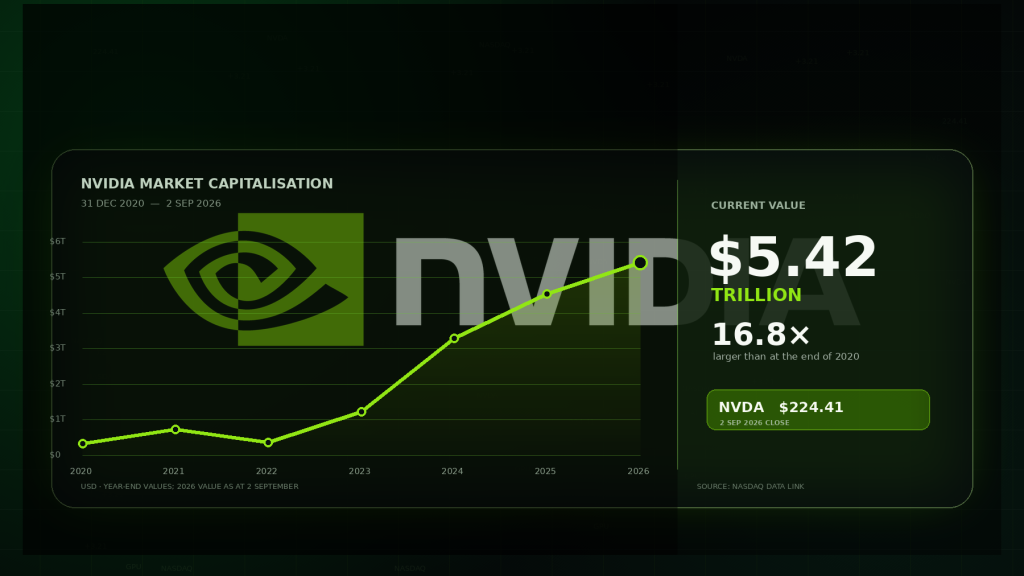
Nvidia now sits at the centre of the artificial intelligence revolution. Its chips power data centres, scientific research, self-driving technology and many of the AI tools that are beginning to reshape our lives. As I write, the company is valued at roughly $5.3 trillion. In its latest quarter alone, it reported revenue of $96.2 billion.
But Nvidia did not begin in a gleaming Silicon Valley headquarters. It began with three engineers, one bottomless cup of coffee and a booth in Denny’s.
Three men in a diner
Jensen Huang was born in Taiwan, spent part of his childhood in Thailand and was sent to the United States at the age of nine. As a teenager, he washed dishes, cleared tables and waited on customers at Denny’s. He later studied electrical engineering and worked at AMD and LSI Logic.
Chris Malachowsky, an American engineer of Polish descent, had worked at Hewlett-Packard and Sun Microsystems. Curtis Priem, also at Sun, had already helped design an important graphics system for IBM. Malachowsky and Priem understood graphics architecture. Huang understood chips, customers and the commercial side of the industry.
None of them possessed everything they needed. Together, they possessed enough.
In 1993 they began meeting at a Denny’s in East San Jose. They could sit for hours over the restaurant’s bottomless coffee while they tried to imagine what ordinary people might one day want from a personal computer. Their answer was video games.
At the time, the market for three-dimensional PC graphics barely existed. The three men came from the world of expensive workstations and, by Huang’s own account, had hardly any experience of personal computers. They bought a Gateway 2000, took it apart and began learning.
That was the first great gamble: not finding a gap in an established market, but believing that an entirely new market was about to appear.
“The best way to predict the future is to invent it.” — Alan Kay
The brilliant mistake
Nvidia’s first chip, the NV1, was an impressive piece of engineering. Yet it was also a commercial disaster.
It tried to do too much: graphics, sound, video and game controls, all in one expensive package. More seriously, Nvidia had built its system around four-sided shapes, while Microsoft’s new DirectX standard and the rest of the industry were moving towards triangles. The technology worked, but he ecosystem had moved in another direction.
One customer ordered 250,000 NV1 chips. According to Huang, 249,000 came back. By then, Nvidia had a contract with the Japanese games company Sega to develop another chip for its next console. That should have saved the business. Instead, Huang realised that Nvidia was about to spend two precious years perfecting the wrong technology.
If the company completed the contract, it would fall hopelessly behind. If it abandoned the contract, it would run out of money immediately. So Huang flew to Japan and told Sega’s chief executive, Shoichiro Irimajiri, the truth: Nvidia could not deliver the right product. Then he made an extraordinary request. Would Sega release Nvidia from the contract and continue paying it anyway?
Irimajiri thought for several days and agreed. The remaining payment, around $5 million, gave Nvidia one final chance.
It is tempting to celebrate Huang’s audacity. But the deeper lesson lies in the combination of honesty and trust. Huang admitted that his company had been wrong. Irimajiri chose to help rather than punish him. Nvidia survived because one man told the truth and another man responded with generosity.
A company thirty days from extinction
Nvidia abandoned its original architecture and started again. It cut its workforce and concentrated its remaining resources on a new chip, the RIVA 128. There was no money for a second attempt. The chip had to work the first time. Fortunately, it did.
The RIVA 128 sold one million units in its first four months. In 1999 Nvidia launched the GeForce 256, which it described as the world’s first graphics processing unit, or GPU. The company had finally found the technology that would transform computer gaming.
But the next leap took even greater patience. In 2006 Nvidia introduced CUDA, allowing programmers to use GPUs for work far beyond graphics. Scientists began employing relatively inexpensive gaming cards to perform calculations that had once required supercomputers. In 2012 Nvidia hardware helped power AlexNet, the breakthrough neural network that accelerated the modern AI revolution. The apparent overnight success had taken almost twenty years.
The lessons in the story
Nvidia’s history is not a cosy fable in which optimism guarantees success. Its founders were exceptionally talented, found investors willing to back them and benefited from Sega’s remarkable kindness. Many equally brave businesses fail.
But its story teaches us some important lessons:
-
- To succeed, you have to take risks, but do not become so attached to your bold idea that you cannot admit it is wrong
- Choose partners who bring abilities you lack. When failure arrives, learn from it rather than trying to disguise it
- Tell the truth, especially when the truth may cost you everything
- Remember that perseverance does not always mean continuing along the same road. Sometimes it means having the courage to turn around.
It also adds one more chapter to last week’s blog about migration. Migrants do not arrive carrying only suitcases. They bring knowledge, ambition, connections, resilience and different ways of seeing familiar problems. Mix those qualities with local talent, investment and institutions that allow people to take risks, and extraordinary things can happen.
Nvidia is an American company, but its origins were never purely American. A Taiwanese-born immigrant joined forces with a Polish-American engineer and another gifted American inventor. A Japanese businessman kept them alive. Researchers around the world discovered new uses for their technology. Today, much of the company’s semiconductor manufacturing still depends upon an international supply chain centred largely in Asia.
My own next step
“One does not discover new lands without consenting to lose sight of the shore for a very long time.” — André Gide, The Counterfeiters (1925)
This month, at the age of 65, I shall be taking a considerably smaller risk of my own. I am packing a rucksack and setting off on a journey through Southeast Asia.
I am not founding a technology company. Nobody’s livelihood depends upon my decisions, and the contents of my bank account will not interest Sega. But the underlying principle is not entirely different.
It would be very easy, at 65, to conclude that the age of experimentation is over: to remain within familiar routines, revisit familiar arguments and write about the world from the safety of my desk. Instead, I want to step into places I do not yet understand, meet people whose lives differ from mine and allow the experience to change some of the things I think I know.
That will also mean a change of direction for this blog. Politics, history and religion will not disappear, because they do not disappear when we travel. But for the next few months, I shall encounter them less through books and news reports and more through streets, railway stations, temples, chance conversations and maybe even a coffee in a diner.
I do not know exactly what I shall find. And I guess that’s the whole point.
“Youth means a temperamental predominance of courage over timidity, of the appetite for adventure over the love of ease.” — Samuel Ullman, Youth