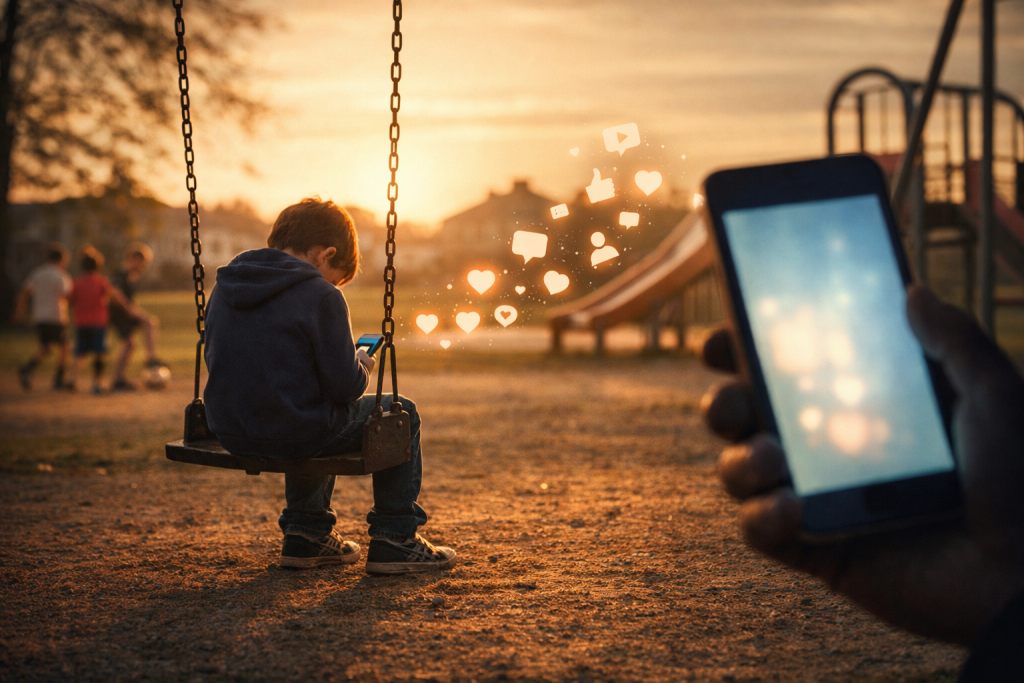
Why banning social media for under-16s may feel right — but fails to address the real issue
There is a growing political appetite to ban social media for under-16s. Governments in countries such as Australia and Indonesia have already moved in this direction, driven by rising concern about anxiety, depression, and the psychological effects of digital life.
The instinct is understandable. But it may also be wrong.
The comfort of the ban
A ban is politically attractive because it is clear, decisive and easy to communicate. It signals protection. It tells a worried public that something is being done.
But it also avoids a harder question.
Why has social media become so central to childhood in the first place?
Policy without evidence
The Cambridge psychologist Sander van der Linden has been unusually blunt. There is, he argues, “zero empirical evidence” that banning social media for teenagers improves outcomes.
His warning is not ideological but methodological:
“Blindly instituting wholesale bans for teens takes the ‘evidence’ out of evidence-based policy.”
This matters. Because once policy is driven primarily by anxiety, it becomes vulnerable to simplification.
And simplification is exactly what this issue does not need.
The variability problem
Social media does not affect all children in the same way.
For some, it amplifies vulnerability: comparison, exclusion, anxiety.
For others, it provides connection, identity and support. As well as of course access to information for school work.
The outcome depends on:
-
- personality
- patterns of use
- existing mental health
- social environment
A blanket ban assumes uniform harm where there is, in reality, radical variation.
The misdiagnosis
More fundamentally, a ban risks targeting the wrong thing.
The problem is not simply that children use social media. It is that social media have been designed to capture attention:
-
- infinite scroll
- algorithmic reinforcement
- intermittent rewards
These are not neutral features. They are behavioural systems.
Yet instead of regulating the environment, we regulate the child.
We restrict the user because we do not confront the system.
The illusion of control
Even on practical grounds, bans are fragile.
-
- Teenagers will bypass them
- Peer groups will remain online
- The demand for connection will persist
- Evidence shows that the dangers are greater once hidden underground
The behaviour does not disappear. It relocates. More importantly, a ban does not teach navigation. It postpones exposure.
From protection to preparation
Van der Linden’s alternative is not permissiveness, but preparation:
-
- early digital literacy
- gradual exposure
- critical thinking
- resilience
In short:
Not protection through restriction, but protection through competence.
The question beneath the question
But even this may not be the deepest layer because the focus on social media obscures a more uncomfortable possibility.
Over recent decades, childhood has changed:
-
- less independent movement
- less unsupervised play
- more adult control
- more structured time
Children are safer, and yet less free.
We did not simply give children smartphones.
We removed much of the world they would otherwise have enjoyed.
Social media did not replace childhood.
In some respects, it stepped into a space that had already been narrowed.
Conclusion
The case for concern about social media is strong.
The case for banning it is not.
As Sander van der Linden argues, policy should be guided by evidence, not urgency or political posturing. At present, the evidence for bans is thin, while the complexity of the problem is substantial.
If we want children to spend less time online, we will have to do something more difficult than passing laws.
We will have to ask what kind of childhood we are willing to allow.
“Of all tyrannies, a tyranny sincerely exercised for the good of its victims may be the most oppressive.” – C.S. Lewis
One thought on “Social Media Bans for Under 16s”