How a perfectly legal couple spends years fighting a system that claims to protect the family
I have always loved Europe.
I still do.
The peace, the democracy, the rule of law — these are extraordinary privileges, and I’m grateful every day to live in a part of the world that, compared to most of the planet, is safe, stable and humane.
But loving a thing does not mean lying about it.
And the deeper my own journey into the European immigration system has taken me, the more convinced I have become that something fundamental is broken — not just in Germany, not just in Britain, but across almost the entire continent.
This is not an anti-German story.
It is a story about what it feels like to do everything legally, responsibly, respectfully — and still find yourself treated as if love were a loophole, marriage an inconvenience, and foreign spouses a threat to be contained.
It is a story that could happen in almost any European capital.
It just happened to us in Berlin.
How Love Became a Test of Endurance
A few years ago, I fell in love with a remarkable man in Indonesia.
Our relationship grew quickly and deeply, and we knew we wanted to build a life together in Europe rather than in Indonesia. We planned to marry anyway, so we assumed — naively, as it turns out — that marriage and legitimacy would make the process of living together straightforward.
We were wrong.
Painfully, spectacularly wrong.
Wedding Bells, Bureaucratic Walls
Because our marriage would not be legally valid in Indonesia, we had to marry in Europe.
What we imagined would be a simple civil ceremony became a six-month odyssey through paperwork, translations, apostilles, appointments, contradictory guidance, and requirements that bordered on the absurd.
Still — we got married.
We thought the hardest part was behind us.
But marriage, we learned, is not a ticket to a shared life.
It is merely the beginning of a long, labyrinthine process designed, it seems, to test whether your relationship can outlast bureaucracy.
The Rule No One Tells You: “Apply in Jakarta, or Don’t Come at All”
Once married, we were informed of something almost nobody tells you in advance:
If you marry an Indonesian and want to live together in Europe, your Indonesian spouse must apply for a family-reunification visa from Jakarta — and only from Jakarta.
Not from Berlin.
Not from any European consulate closer to their home island.
Not from Europe on a tourist visa (which would be logical, humane, and in line with every legal principle about protecting marriage).
Jakarta.
Or nothing.
The waiting list?
One year.
We have the screenshot.
And that’s just the waiting list for you to submit your application — not the processing time afterwards.
Imagine telling any married couple in Europe:
“Congratulations on your marriage.
You will now be forcibly separated for at least 12 months.”
That is the system.
That is the norm.
One Document Wrong? Start All Over Again.
When our turn finally came, the embassy did not approve one of the documents uploaded during the online process. They asked us to delete it — and, indeed, there is a little trash-can icon on the website.
Except the icon doesn’t work.
It never has.
After weeks of emails, calls, and technical back-and-forth, the embassy’s final advice was:
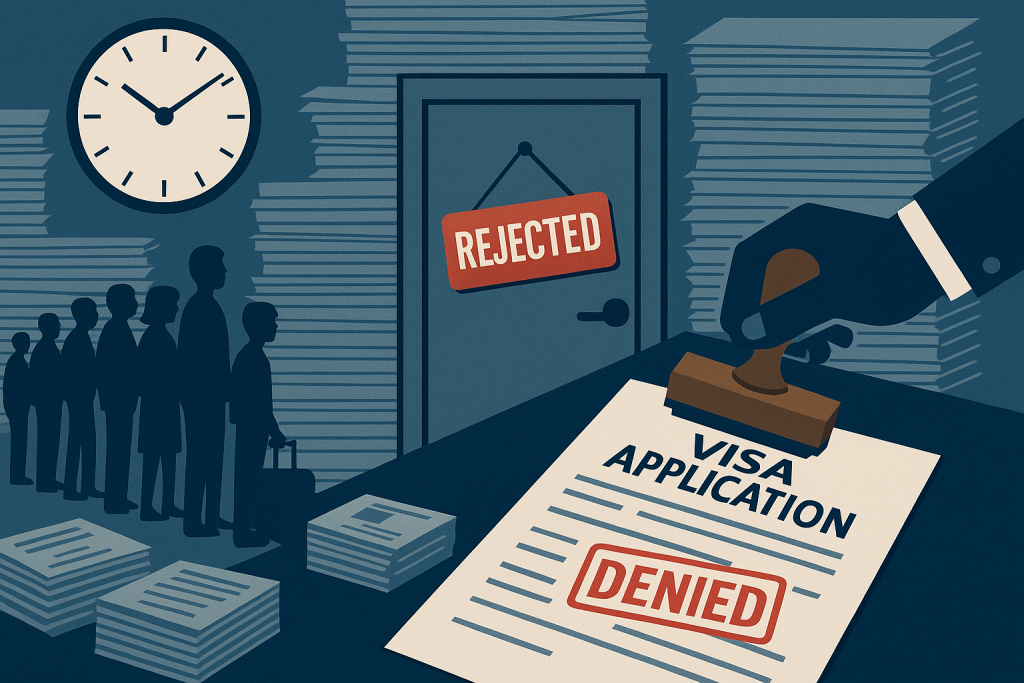
“Delete your entire application and start again.”
Which, in plain language, means:
“Restart the one-year waiting list.”
It is breathtaking to realise that the legal rights of marriage can be instantly overruled by a broken trash-can icon.
Geography as a Financial Weapon
If you are Indonesian and live on Sumatra, you must pay to fly twice to Jakarta — once for biometrics, and once to collect the visa. These costs are enormous relative to Indonesian salaries.
For many families, this is simply impossible.
This is what “legal migration” looks like in practice.
The 90/180 Trap: A Long-Distance Marriage by Law
Some couples try an alternative: the Schengen visitor visa.
But that route comes with its own cruelty:
-
Your spouse can visit for 90 days maximum
-
but must then leave for another 90 days minimum
Meaning:
You may live together for three months, then be forcibly separated for six.
Three on, six off. Three on, six off. Indefinitely.
Assuming, of course, you can afford the flights between Jakarta and Europe.
Most cannot.
The Berlin Immigration Office: A Fortress Without Doors
If the embassy maze is surreal, the immigration office in Berlin is its European twin.
You cannot phone them.
You cannot email them.
You cannot speak to a human being unless you already have an appointment — and you cannot get an appointment without submitting a webform that may sit unanswered for two months.
If you attempt to enter the building to ask for help, security guards turn you away.
“No appointment, no entry.”
It is Kafka with fluorescent lighting.
When Your Appointment Arrives… It’s Too Late
In our case, by the time Berlin offered my husband an appointment, his visitor visa had expired.
They could not — or would not — offer an earlier date.
He was legally in the country.
He had proof of marriage.
He had every document required.
But the system, moving at its own glacial pace, simply shrugged.
The Catch-22: Work to Stay, But You Can’t Work Until You Stay
Here is the cruelest irony:
To obtain residency, the European spouse must prove sufficient income to support both partners.
But the foreign spouse cannot work unless they already have residency.
So if the European partner earns too little, the spouse receives only a six-month Fiktionsbescheinigung — a kind of temporary suspension of deportation, halfway between permission and limbo.
With that document:
-
You cannot work
-
You cannot earn
-
You cannot contribute
-
Therefore you cannot raise household income
-
Therefore you do not qualify for residency
This is not immigration policy.
It is a bureaucratic cul-de-sac.
And Then You Realise: If It’s This Hard for Us… What About Them?
We are educated, organised, legally married, European-based, English-speaking, German-speaking, online-competent, and persistent.
And still we nearly drowned in the system.
What must this system feel like for asylum seekers?
For people fleeing war or persecution?
For couples separated across borders with children in tow?
For those without money, stability, documents, or perfect German?
Oh yes, and in case you’re wondering, I did contemplate moving back to the UK and applied for residency for my English-speaking husband there. Our application was declined.
The system does not merely fail people.
It dehumanises them.
A Quiet Exception: The Spain Nobody Talks About
There is one place in Europe where the logic is different: Spain.
Spain has a little-known rule — almost never advertised — called arraigo social.
If you remain in Spain for two years, stay out of trouble, and integrate into community life, you can obtain legal residency.
No endless separation.
No forced poverty.
No trapdoors disguised as requirements.
No broken webforms or locked doors.
If you are married and have property there, the chances are even better.
Whatever critics say, this is a system that treats people — even undocumented ones — as human beings capable of building a life.
It is the closest thing Europe has to a humane immigration philosophy.
What This Story Is Really About
This is not a rant.
Nor is it an attack on Germany, which continues to offer extraordinary opportunities to millions of people, myself included.
It is a plea.
A testimony.
A reminder that behind every “case number” is a love story, a family, a life.
Europe prides itself on protecting marriage – see ECHR, Article 8 §§1–2.
Courts across the continent insist that “bureaucratic inefficiency is not a legitimate reason to separate spouses.”
But in practice?
The systems built to uphold those principles routinely violate them.
If Europe wants to protect its values — its humanism, its dignity, its rule of law — the immigration system is where it must begin.
Not with walls.
Not with suspicion.
But with the simple recognition that married couples should not have to fight this hard to live under the same roof.
“Bureaucracy is the death of all human action.” — Max Weber