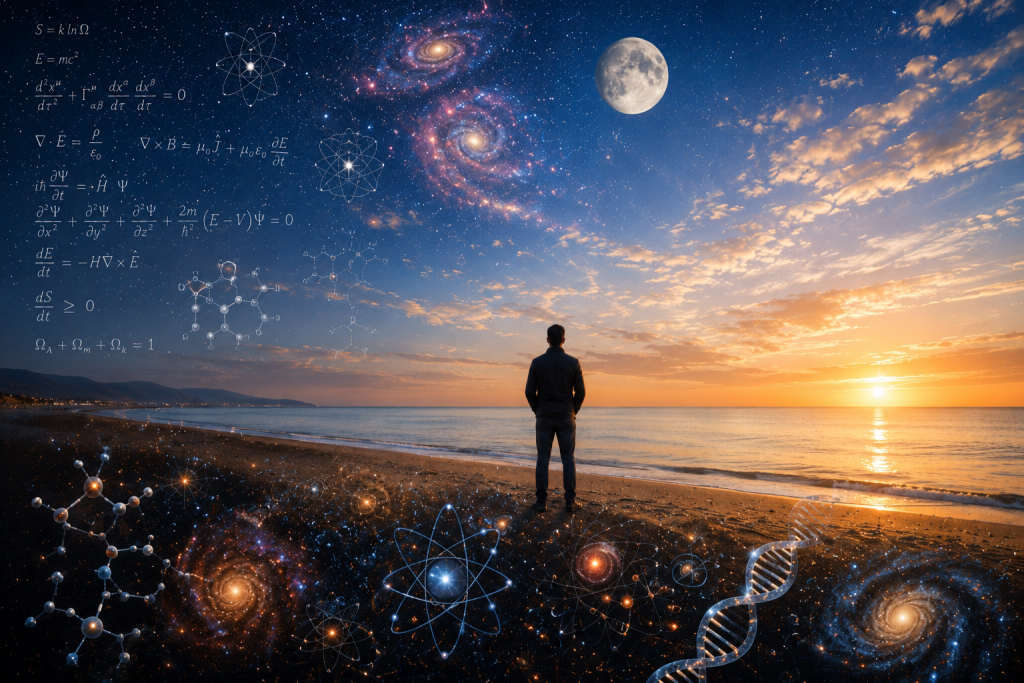
As I settle into my new life in Spain, I wake up before dawn in order to jog along the promenade before it gets too hot, watch the sunrise, contemplate cosmology and meditate.
Last week, to the west above the Carihuela, there was a huge, bright, full moon poised low in the sky before the sunrise.
It wasn’t merely bright. It seemed suspended. As if detached from its control of the tides below. Silver against an increasingly blue sky, refusing — for a few precious minutes — to surrender to the approaching sun.
The sea below was calm. The seagulls were swooping down majestically to collect their breakfast. Somewhere behind me, the town was waking. Yet for a brief moment everything felt strangely timeless.
I stood there on the harbour wall longer than I intended. Not because I understood what I was looking at. Indeed, as I meditated, I was startled by how little I did.
That quiet moment began another of my recent intellectual odysseys. I jogged home and began researching in detail the origins of the universe.
The answers I discovered have profoundly changed the way I see both the universe and humanity.
We began with almost nothing
According to our best scientific understanding, the Universe began around 13.8 billion years ago.
In the first few minutes after the Big Bang, almost all that existed were the simplest elements imaginable: hydrogen, helium and tiny traces of lithium.
There was no carbon.
No oxygen.
No calcium.
No iron.
No chlorine.
No lead.
Nothing from which planets, oceans or living organisms could eventually be built.
Everything else had yet to be created.
Stars are not simply lights
The next discovery astonished me even more.
I had always thought of stars as glowing balls of gas.
In reality, they are unimaginably powerful nuclear furnaces.
The identity of every chemical element is determined simply by the number of protons in the nucleus of each atom.
Hydrogen has one proton.
Helium has two.
Carbon has six.
Oxygen has eight.
Iron has twenty-six.
Lead has eighty-two.
Inside stars, gravity compresses matter with such extraordinary force that atomic nuclei are pushed together in a process known as nuclear fusion.
When four hydrogen nuclei fuse together, they produce helium and release enormous amounts of energy.
Later, when stars become even hotter, three helium nuclei combine to create carbon. Carbon can then fuse with helium to produce oxygen. Larger stars continue building heavier and heavier elements through countless further fusion reactions.
Quite literally, the periodic table is assembled one proton at a time.
Eventually, the largest stars manufacture elements all the way to iron. When those stars finally exhaust their fuel, they explode as supernovae, scattering their newly created elements across the galaxy.
During those unimaginably violent explosions, still heavier elements such as gold, lead and uranium are created before being hurled into interstellar space.
Without generations of stars living and dying long before our Solar System existed, neither the Earth nor we ourselves could ever have existed.
We really are made of stardust
Carl Sagan famously said:
“We are a way for the cosmos to know itself.”
He also said that we are made of star stuff.
For years I assumed that was simply a poetic metaphor.
It isn’t.
The hydrogen in the water within my body was formed shortly after the Big Bang itself.
But almost every other element within me has a different origin.
The carbon in my muscles.
The oxygen I breathe.
The calcium in my bones.
The iron carried around my body by my blood.
All of them were forged inside stars that died billions of years before the Earth even formed.
Some of those atoms may once have been part of ancient forests.
Some may have passed through dinosaurs.
Some may have circulated through countless generations of my own ancestors.
Matter itself is endlessly recycled.
The atoms change partners.
The universe never stops reusing its building blocks.
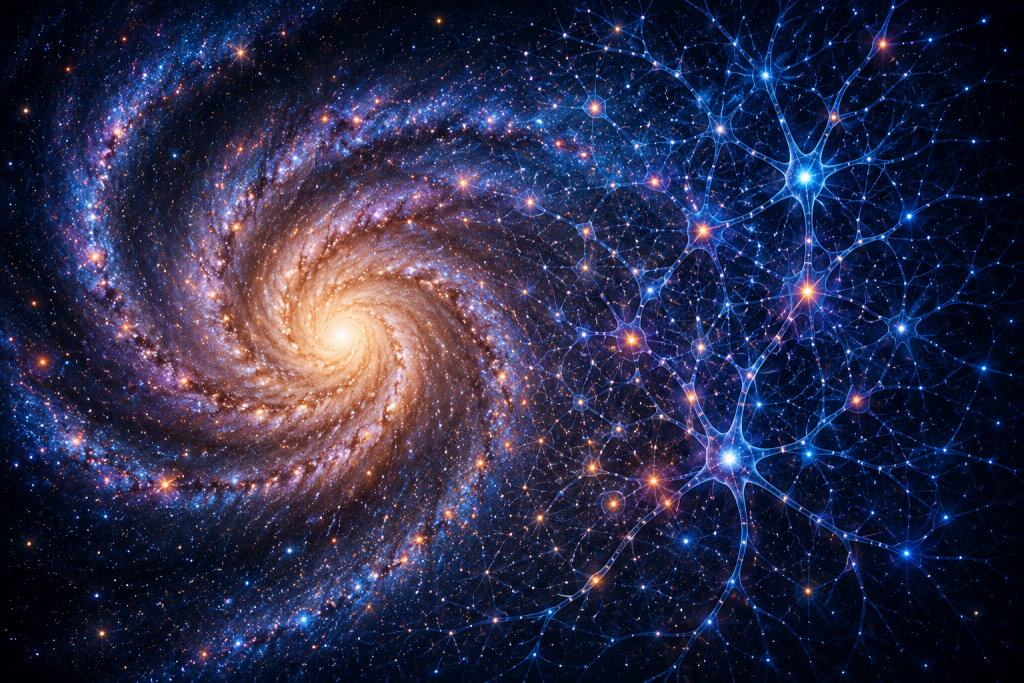
In this way, it is no coincidence that the branching networks of our neurons and the elegant spirals in hurricanes and elements of our DNA echo patterns that also appear throughout the cosmos. Different processes, different scales, yet strikingly familiar forms emerging from the same universe.
Then came another surprise
Just when I thought the story could not become any more remarkable, genetics added another layer.
Every person alive today shares common ancestry.
Research suggests that all living humans inherited their mitochondrial DNA from one woman who lived in Africa roughly 150,000 to 200,000 years ago.
Likewise, all living men inherited their Y chromosome from one man who lived much later.
They were not the only people alive at the time.
They are simply the individuals whose particular genetic lines survived uninterrupted to the present day.
Meanwhile, every generation doubles the number of our ancestors.
Travel back only a few thousand years and our family trees overlap so extensively that the distinctions between “my ancestors” and “your ancestors” begin to disappear.
In a very real biological sense, humanity is one enormous extended family.
A different foundation for responsibility
As the moon faded into the brightening Andalusian sky, I found myself asking a question that science itself cannot answer.
If Carl Sagan was right that “we are a way for the cosmos to know itself,” what follows logically from that?
As far as we currently know, nowhere else has the universe organised itself into beings capable of wondering where the universe came from.
Nowhere else has hydrogen learned to write symphonies.
Or paint masterpieces.
Or decode DNA.
Or ask why anything exists at all.
Perhaps intelligent life is common throughout the cosmos.
I hope it is.
But until we know otherwise, we must take seriously the possibility that conscious beings like ourselves are extraordinarily rare. Maybe even unique.
If that is true, then our responsibility extends far beyond ourselves.
Protecting our planet.
Seeking truth.
Advancing knowledge.
Caring for one another.
Safeguarding future generations.
These are not merely useful social conventions.
They become responsibilities entrusted to the very few beings — perhaps the only beings — capable of understanding what is at stake.
The moon itself had not changed that morning.
Nor had the sea.
Nor the rising sun.
What changed was my understanding.
For the first time, I began to see humanity not as something standing apart from the universe, but as one of the most extraordinary things the universe has so far produced.
Perhaps, after all, the starry heavens above us do not merely invite our curiosity. They really can provide us with the most rational basis for human ethics that we will ever discover.
“Two things fill the mind with ever new and increasing admiration and awe… the starry heavens above me and the moral law within me.”
— Immanuel Kant
 The British government has this week announced plans to ban social media access for under-16s. Ministers describe it as a historic intervention to protect children. Newspapers are full of discussion about algorithms, screen addiction and online harms. Yet as I watched the announcement unfold, I found myself asking a different question entirely. Why are we once again arguing about what children