Why Populists Thrive in a Connected World

Why Has Globalisation Increased Division Instead of Unity?

Globalisation should have been our great humanising force. For the first time in history, large numbers of people can travel freely, study abroad, work internationally, and encounter cultures that would once have remained distant and unknown. We have access to films, music, literature, foods, and languages from every continent. On paper, this should have produced an age of empathy. A century in which the old barriers of race, nationality, and religion dissolved into shared humanity.

Yet the opposite has happened. As the world has opened up, political identity has hardened. Populist nationalism has surged: Donald Trump in the United States, Viktor Orbán in Hungary, Vladimir Putin in Russia, and similar strongman figures elsewhere. Racism, religious extremism, conspiracy thinking, and tribal rhetoric are resurgent. The more connected the world becomes, the more threatened people seem to feel.

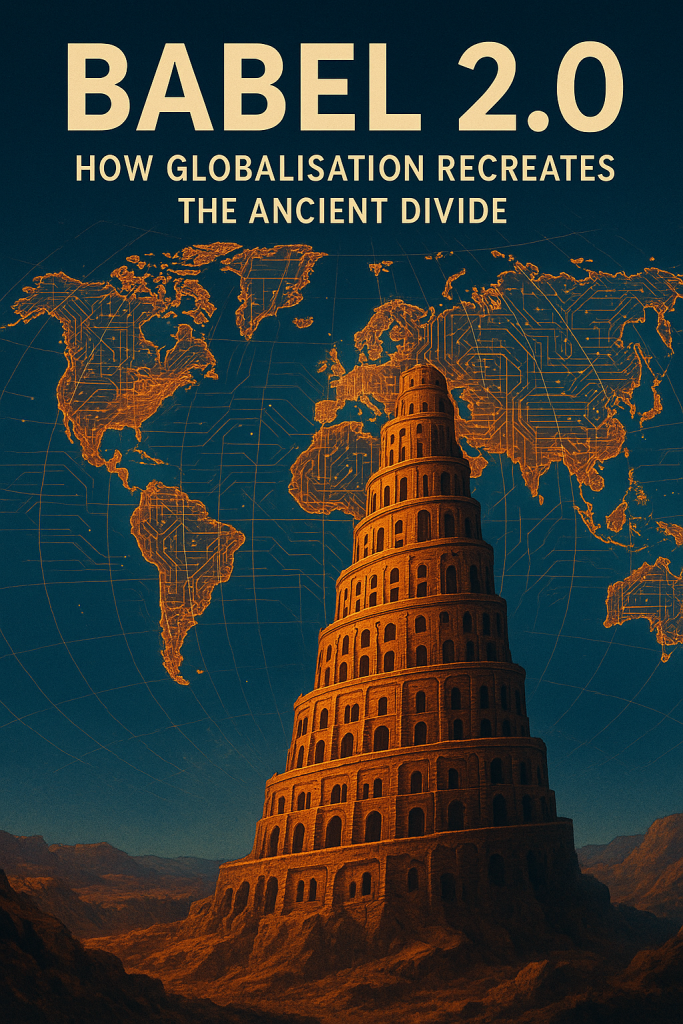
This contradiction is not new. It is the old story of the Tower of Babel. Human beings build upward toward unity, creativity, and common purpose—yet something in us fractures, resists, and disperses. Even if we don’t read that story religiously, it is psychologically precise. The closer we come to real integration, the more fear arises: fear of loss of identity, loss of control, loss of status.

Globalisation has consistently been experienced not as shared enrichment but as competition. The immigrant is framed not as a neighbour, but as a rival. Cultural diversity is discussed not as dialogue, but as dilution. Political rhetoric encourages the idea that “our” way of life is being erased. The result is defensive nationalism and, increasingly, violence.

This is not inevitable. The problem is not globalisation itself, but the absence of global solidarity to accompany global interdependence. We have integrated our economies, but not our ethics. We have connected our markets, but not our imaginations.

So the question is: How do we reverse the tide? How do we turn globalisation into a force for peace, dignity, and cooperation rather than division and resentment?

Here are three foundations:

1. Global Education that Teaches Perspective, Not Propaganda
International exchange programs cannot simply be tourism or language practice; they must cultivate the ability to see oneself from the outside. To understand how one’s culture appears to others, how history shapes identity, and how dignity must be mutual. Education that only reinforces national narratives will always produce suspicion, not solidarity.

2. Freedom of the Press, Protected by Law, Not Politics
Real democracy depends on the ability to critique power. When the press becomes the instrument of governments, oligarchs, or corporations, societies fracture along invented fears. The crisis at the BBC this week is not a local scandal—it is a warning. If journalism cannot report freely, citizens cannot think freely. And if citizens cannot think freely, they cannot live together freely.

3. Cross-Border Economic Cooperation That Shares, Not Extracts
The problem is not diversity—it is inequality. When globalisation enriches a few and impoverishes many, resentment is inevitable. But when globalisation supports fair wages, sustainable industry, ecological responsibility, and shared growth, it strengthens stability rather than fear.

In short: global interconnectedness must be matched with global empathy.

We already live in one shared world. The question is whether we will learn to behave as if that is true.

Unity is not naïve. It is the only realistic future we have.

“We may have different religions, different languages, different colored skin, but we all belong to one human race.”

–Kofi Annan

The Blueberry Paradox: Why We Keep Destroying the Systems That Could Save Us

On my last day in Spain, I sat at a small café, watching three men take down decorations from the town’s recent festival. The bunting had hung across the square for days, colouring the white-washed walls with celebration. Now the tourists had gone home, and these men — quiet, anonymous, methodical — were returning the square to its ordinary face.

Their work is unremarkable. No one applauds. Yet without people like them, the whole “beautiful tourist city” collapses.
Without them, the photos don’t look charming.
Without them, the streets feel neglected.
Without them, the illusion breaks.

I found myself thinking about fishermen at dawn, hotel cleaners before breakfast, bin collectors at 4am. The quiet labour that keeps the world turning — labour that rarely receives dignity, respect, or fair pay.

Then I looked at my arm.
At the blueberries.

Yes — I have blueberries tattooed on my forearm. And no, it’s not whimsical. Or perhaps it is, but in the way truth sometimes hides inside whimsy.

The blueberries remind me that I cannot enjoy anything alone.
Not even my breakfast.

To eat a blueberry, I depend on soil, weather, farmers, packers, transport workers, supermarket staff, the climate not collapsing this particular year. My pleasure is communal, whether I acknowledge it or not.

Upside down, from a distance, the blueberries form a heart-shape. I didn’t plan that. But perhaps the body speaks before the mind is ready to believe.

The tattoo is a reminder:
You are held. Your life is made by many lives. You are not independent.

And so here’s the question that came to me in that Spanish square:

If we know we are interdependent, why do we build societies that pretend we aren’t?

Why do we reward the illusion of the “self-made individual” while the world is built by the unseen hands of others?

Why does the fisherman earn less than the financier?
The cleaner less than the consultant?
The bin collector less than the politician?

It is not rational.
It is not moral.
It is not even economically coherent.

It is, however, familiar.

And this — whether people like to admit it or not — is where Marx enters the conversation.

Marx’s Point Was Never “Everyone Should Be the Same”

Marx’s central claim was beautifully simple:
Human labour creates value.
So the people who create value should benefit from it.

That’s it.
That’s the hinge.

Marx wasn’t calling for laziness, or enforced sameness, or the death of creativity. He was pointing out that societies become obscene when those who create the conditions for life (food, sanitation, infrastructure, care) are treated as disposable.

He believed in dignity through shared labour.
In contribution as meaning.
In justice as the redistribution of the wealth that labour creates.

Which is why, though he rejected religion, Marx comes surprisingly close to Jesus.

Jesus also preached the reversal of hierarchy:

“The last shall be first, and the first last.”

Not metaphorically — economically, socially, relationally.

Both men looked at society and said:

This is upside down.
We can live differently.

Both pointed to community over competition, relationship over possession, need over greed, dignity over dominance.

And yet —
we have not built the world either of them imagined.

Not once.
Not anywhere.
Not for long.

So the question is no longer Was Marx right?
Or Was Jesus right?

The question is:

What stops us from building the just society both of them saw so clearly?

The Answer Is Not Economic. It’s Psychological.

We call it capitalism vs. communism
but the real struggle is fear vs. trust.

We hoard because we are afraid there won’t be enough.
We compete because we are afraid of being overlooked, replaced, forgotten.
We dominate because we are afraid of being powerless.
We cling to hierarchy because we are afraid of being ordinary.

Fear is the water we swim in.
Fear is the undecorated square after the festival is taken down.
Fear is the silence in the early morning before the day begins.

Marx underestimated fear.
Jesus named it, but was killed for it.

And every system we have built has collapsed for the same reason:

We would prefer to be safe than to be equal.

The Failure Was Never Marx’s. It Was Ours.

We say “communism failed” as if ideology collapsed of its own weight.
But ideas don’t fail.
Systems don’t fail.

People fail.

We fail because we want justice until justice requires something of us.
We want equality until equality asks for our privilege.
We want community until community interrupts our autonomy.

We want the kingdom of God
without the cross.

We want Marx’s dignity of labour
without surrendering status.

So we keep building worlds in which:

  • the blueberry appears magically on the table

  • the labourer remains invisible

  • and we pretend we did this alone.

The Blueberries Again

I look at my arm.
The tattoo.
The accidental heart.

A reminder that interdependence isn’t an ideal —
it’s already true.

We just live as if it isn’t.

The question is not whether a just society is possible.
We already rely on one.
Every day.
Every meal.
Every building.
Every service.
Every breath of shared infrastructure.

The question is simply:

When will we live as though we know it?

And perhaps the first step toward a better society
is simply learning to say:

Thank you.
To the fisherman.
To the street worker.
To the invisible hands.
To the ones who keep the world turning
so that the rest of us can pretend we did it ourselves.

Re-Thinking Schooling for the Real World

When I walk into a classroom these days — as a teacher in the UK — I’m struck by how little our structure resembles the real world young people are entering. We still teach in 45- to 90-minute blocks, subject by subject: English, Maths, Science, History, Languages. We have bells. We have chairs. We have worksheets. We assess. We move on. Rinse. Repeat. Yet outside the school gate, the challenges our young people will face—from AI and globalisation to climate collapse and widening inequality—are not neatly partitioned into subjects. They are messy, interconnected, urgent.

Here are three international cases that suggest more radical alternatives—and then I’ll suggest how we might use them to reimagine schooling in the UK, starting now.


Case 1: Singapore – from mid-year exams to flexible pathways

In Singapore the national system has abolished mid-year exams in primary and secondary years, freeing time for deeper learning and teacher-led feedback instead of grinding revision loops.
At secondary level, the streaming model (Express, Normal, etc) is being replaced by Full Subject-Based Banding (“Full SBB”): instead of placing a young person in a fixed track, students choose subject levels (G1–G3) per subject, allowing them to mix strengths and interests rather than being boxed in.
What this means: fewer rigid exams, more flexible progression, and structural freedom to personalise learning.
For the UK: ask ourselves—why do we still do rigid tiers that assume a child is ‘strong’ or ‘weak’ across everything, instead of allowing them to pursue variable strengths (say strong in languages, average in science, needs support in maths)? And why do we still place so much weight on one set of exams at the end of a key stage, rather than more iterative assessment?


Case 2: India – NEP 2020, boards twice a year + life/vocational skills

India’s new National Education Policy (NEP 2020) mandates board exams twice a year for major classes, where students may keep their best score. This reduces the terrifying “all‐or‐nothing” moment and gives a chance for resubmission.
Additionally, it explicitly demands from Grade 6 onwards a ten-day “bagless” period of hands-on work (internships/local trades) and integrates vocational and life-skills education throughout.
Implication: schooling begins to resemble life and work, not just subject delivery and external testing.
For the UK: imagine a programme where Year 9 or Year 10 has a two-week “real-world problem” block: students pick a genuine local or global challenge (poverty, homelessness, climate change) and use maths, languages, geography, science, PSHE, enterprise skills to design a solution. That’s project-based, cross-curricular, tied to real life.


Case 3: Japan – active learning + financial literacy

In Japan the national curriculum has been revised to emphasise active learning: students present, debate, collaborate and solve problems rather than passively receive lectures. Also built into high school programmes are financial-literacy and consumer-skills modules (asset building, cashless payments, personal finance).
So: pedagogy changes (not just content), and the curriculum recognises the need for life literacy, not just exam preparation.
For the UK: we may ask — why is financial education so marginal in many schools? Why are pedagogical models still lecture-&-sit-in-rows when the world demands adaptability, collaboration & critical thinking?


The deeper problem: our modernist curriculum model

Putting all these cases side-by-side, what stands out is how far we in the UK remain locked into a modernist schema:

  • Distinct subjects taught in isolation, as though reality were tidily separable.

  • Fixed time-blocks (lessons) and chairs, with students sitting still for hours on end.

  • Exams that are terminal, summative, determined in a narrow timeframe and often divorced from the “real” problems pupils will face.

  • Little allowance for physical movement, cross-curricular exploration, problem-solving or student-agency.

  • A model that—I’m going to say it—feels weird, abnormal, cruel even, for keeping young children in chairs all day, little movement, scant exposure to purposeful activity or physical literacy. Meanwhile outside the gates they’ll live in a world wired for movement, disruption, interdisciplinarity.

In this model we risk producing young people who are: passive, desk-bound, conditioned to consume rather than create; taught to do school rather than do life. We train couch-potatoes for the hamster wheel of assessment rather than citizens capable of invention, exploration, critical thinking and embodied well-being.


What might a “real-world curriculum” look like?

Drawing on those international examples and your own teacher-intuitions, here are some provocations for UK schooling:

  1. Project-based, cross-curricular blocks
    Remove a full week (or more) per term from the timetable and turn it into a “challenge week”. Students choose or are assigned real problems: e.g., reduce poverty in a developing country, design a local food-supply solution, map the impact of climate change on migration. They use maths (statistics, modelling), geography (mapping), history (colonial legacies), languages (communication), science (systems thinking), psychology (behaviour change), ethics/citizenship (values). Teachers co-design and cross-facilitate rather than lead discrete 45-minute lessons.

  2. Flexible pathways, subject-by-subject
    Instead of rigid sets and tracks, allow students from Year 8/9 onwards to select subject-levels per subject based on interest, aptitude and growth—not past performance alone. Build in teacher-recommendation + student-choice models, as Singapore is doing.

  3. Life-skills & movement embedded, not optional

    • Integrate financial literacy, citizenship, personal data literacy (AI, privacy), entrepreneurial skills into the timetable.

    • Make movement (sports, outdoor education, active learning) a core part of the day: e.g., “walk-and-talk” lessons, outdoor problem-solving, labs under trees, standing/desks zones.

    • Schedule regular “bagless days” or “real-world internships” even for younger secondary pupils: local community projects, labs, fieldwork, digital-maker tasks.

  4. Iterative assessment, not one-shot exams
    Take a leaf from India: board-style exams + repeated attempts. In the UK context: split major assessments across the year, feed forward into the next block, allow ‘best score’ replacement, create more pupil-agency in when/how they demonstrate competence.

  5. Pedagogy aligned to complexity
    Shift from “teacher-tells” → “student-invents, collaborates, presents”. Use scaffolding but allow open-ended enquiry, design thinking, peer-review, public outcomes (presentations, exhibitions, digital portfolios). Curriculum design must explicitly graph skills like “team‐working”, “data-literacy”, “global-citizen hood”, “adaptability to AI”.


Vision required

Schools are not factories for producing uniform exam results. They are ecosystems for shaping young people who will live in an age of AI, climate instability, global mobility, social fragmentation and opportunity gaps. If we continue to treat them as though the 20th-century paradigm (boxed subjects, chairs in rows, summative exams) still fits, we are doing our children a disservice.

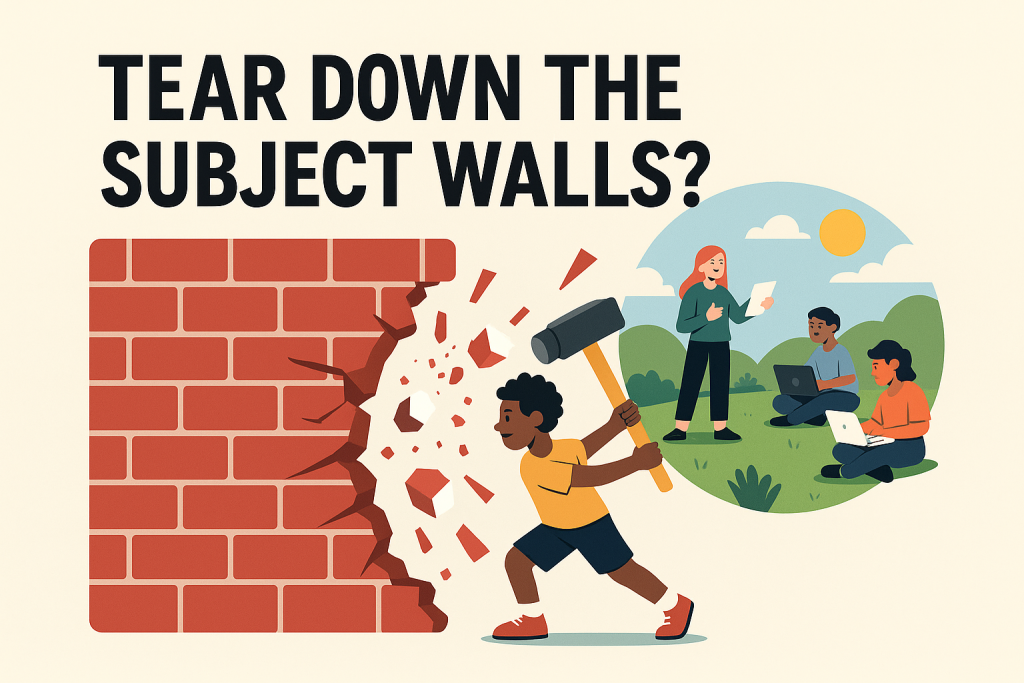
So I ask: Is it time we tore down the walls between our subjects, threw open the classroom door, took the chairs outside, gave pupils agency to solve real problems, taught them how to manage their money and data and bodies and minds — and changed the assessment regime from final-boss exam to ongoing, real-world performance?

The UK curriculum deserves this overhaul. Let the global examples inspire us—but the real work begins in our classrooms, as soon as we can find a minister for education with a vision.

Labour’s lost its Lesson Plan

So, the latest UK budget no longer talks about reviving grammar schools or rolling out new academies. Instead, the focus has shifted to funding school repairs and rebuilding. Labour has increased spending, but only by a very modest 1.6% real-terms rise per pupil—a tiny amount when compared with vast sums directed toward war and weapons. Large investments are being channelled into special educational needs (SEND), which is badly needed, but it means that mainstream schools are seeing relatively little benefit.

Personally—and speaking as a teacher—I remain in favour of a selective secondary education system, provided that it has safeguards. Late developers should be able to transfer schools, and children from disadvantaged areas must have genuine access to these opportunities. Without such mechanisms, selection only entrenches privilege.

There are, however, two issues that I find absurd about how Britain continues to “reform” its education system. First, there is still no sign of a politician with a passionate, forward-looking vision for schooling that genuinely prepares young people for the unstoppable forces of technology and globalisation. Such a vision might involve dismantling the outdated timetable of narrow subject blocks, and instead encouraging flexible, interdisciplinary learning. Secondly, the entire system has been treated for decades as a political football, demoralising teachers and disrupting the lives of millions of children.

As usual, the Conservative Party blames Labour for whatever blocks their proposals, while conveniently forgetting that it was the Conservatives themselves who abolished grammar schools and introduced comprehensive education in the first place.

Yet the politicisation of education is only the tip of the iceberg. The deeper problem is that nearly all politicians’ children attend private schools, misleadingly known as “public schools.” I hate to sound cynical, but perhaps this issue is ignored because:
a) the label “public school” disguises their exclusivity, and
b) so many of the country’s most successful journalists also attended them, and are thus either blind to the inequity or complicit in maintaining it.

Even now, the majority of Oxbridge students come from private schools, and they go on to fill senior positions in politics (David Cameron, Theresa May, Tony Blair), the civil service, journalism, law, medicine, diplomacy, and business. For as long as this pipeline exists, why would politicians truly care about the state system?

Nowhere else in Europe is the link between private schooling and elite opportunity so entrenched. Education in the UK remains less about nurturing knowledge, skills, or culture, and more about handing out socially constructed keys to financial security.

A quick comparison with other European countries—where politicians’ children generally attend state schools—confirms the point.

Marx was right: capitalism sustains itself by maintaining an alienated underclass. The British education system is one of the most efficient tools for ensuring exactly that.

Education for the future, or the preservation of privilege?

Intelligence vs. Success: Why Our Education System is Broken

What is Intelligence?

At its simplest, intelligence is not about certificates, grades, or titles. True intelligence is the ability to understand, process, and reapply information in new contexts. It is a flexible and adaptive capacity — the skill to see patterns, make connections, and act with insight in real life. Many of the most intelligent people I have ever met were not those who topped the class but those who could solve a problem in unexpected ways, or question assumptions everyone else accepted as “normal.”

Success in a Socially Constructed System

Our education system, however, rewards something quite different. It is socially constructed in such a way that success is often defined by compliance with rules and frameworks designed generations ago. More than that, it is geared towards the preservation of privilege. Children from wealthy families are more likely to thrive in a system that reflects their own cultural capital, gaining qualifications that open doors to secure and lucrative careers. By contrast, working-class children are too often measured against a yardstick that was never designed with them in mind. In effect, the system keeps the rich rich and the poor poor.

A Lesson from Sussex

When I was researching at the University of Sussex, I interviewed working-class students about their approaches to GCSE questions. In one memorable case, a group of students deliberately wrote down the “wrong” answer to a maths problem. Why? Because the “right” answer, when calculated, contradicted the real-life cost of a can of Coca-Cola in a vending machine. Their intelligence was not lacking — on the contrary, they were thinking critically, applying lived experience, and exposing the unreality of the exam question itself. Yet, in the rigid world of assessment, such insight was penalised as failure.

Knowledge as a Social Construct

We like to imagine that subjects such as biology, history, or geography represent objective slices of truth. But these disciplines are themselves social constructs — artificial divisions of what is, in reality, a seamless experience. Even mathematics, often called “pure,” is anything but: it is shaped by human assumptions, conventions, and applications. Our schools carve up knowledge into neat compartments, while real life is profoundly cross-curricular. Consider the simple act of buying groceries: it involves mathematics, nutrition, economics, language, and even ethics. Yet no exam paper will ever measure this.

Falling Behind in the Age of AI

The problem is not only philosophical but practical. Technology has already transformed our lives, and artificial intelligence is now reshaping them even more dramatically. Our education systems, however, remain outdated relics of the industrial age, leaving students poorly prepared for the world they are about to inherit. Those without academic certificates are too often made to feel unintelligent, when in fact they may possess precisely the skills and insight the future will demand.

Towards a Radical Rethink

Something must change — and fast. We urgently need to deconstruct the oligarchical system of education and redesign it from the ground up. A modern education must:

  • Equip students for the realities of a technologically advanced, interconnected world.

  • Foster creativity and critical thinking alongside adaptability and resilience.

  • Sustain a love of the arts while embracing science and innovation.

  • Provide equal opportunities for children from all racial, social, and economic backgrounds.

True education should not preserve privilege. It should unleash intelligence in all its diverse forms — and prepare every young person to flourish in a future that belongs to them.