This is a short story I wrote when I was 17 on holiday in Spain. I hope you enjoy it.
Room 911
A Tale of Two Holidays
‘Cabin crew, doors to manual.’
‘At last,’ sighed Paul as he unclipped his seatbelt.
The two-and-a-half-hour flight to Malaga had been an endurance test: three cramped seats in the back row next to the toilets; a turbulent climb out of Gatwick that rattled his nerves; two female pilots at the controls ; emphatically gay stewards; and, worst of all, two businessmen — Dutch, perhaps — who had spent most of the flight standing in the aisle, bellowing corporate plans in harsh, broken English.
Directly in front of him, an obese bald man had snored from take-off to landing with astonishing force.
How on earth did he not wake himself up? Paul coughed, jiggled his knees into the back of the seat, shifted noisily. Nothing worked.
Still, at least Jamie had been good.
His seven-year-old son had fallen asleep in the car on the way to Gatwick, then spent most of the flight happily playing Angry Birds on Paul’s iPad, munching Pringles, sipping J2O.
‘Got everything, Jamie?’ Maddie asked as she pulled down her coat and suitcase.
Jamie nodded, his large, chocolate-brown eyes catching triangles of white sunlight streaming through the aircraft windows.
Paul glanced at Maddie and thought back to their first encounter. Six months ago, on the Northern Line, they had been pressed together in the rush-hour crush. She had turned away shyly, her bobbed brown hair catching the carriage’s fluorescent light, her perfume — citrus with something woody beneath — cutting through the stale air.
He had noticed her avoidance, her embarrassment, and in that moment he had been struck by how long it had been since a woman had stirred anything in him. Not since the sudden death of his wife.
The awkward bump at Elephant and Castle had pushed Maddie’s slim frame briefly against his. She’d pulled away with a flustered smile, apologised, but Paul had taken it as a sign. Out of that accidental intimacy, a relationship had grown: dinners, films, music they both liked. Maddie had become a steady presence in his and Jamie’s life.
And now here they were — their first holiday as a makeshift family. A trial run at happiness.
As they shuffled down the aisle, a sudden sulphurous stench hit them. The obese man had broken wind.
‘Oh, Dad!’ Jamie whispered urgently. ‘Was that you?’
Paul grimaced and pointed towards the man, who was now speaking loudly in German to his tall, athletic son. As the man reached up for a suitcase, his bright green Adidas t-shirt rode up, exposing a vast balloon of pale stomach spilling over his belt. Jamie stared, fascinated and repelled.
They disembarked into the glass terminal, bathed in Andalusian sunlight. The sky was cloudless, the heat already rising, promising days of beach, pool, and warm evenings on the promenade.
Jamie lingered to look back at the Airbus 320. From one of its engines, he thought he saw thick black liquid dripping — oil, perhaps. Three men in overalls and the pilot stood below, pointing and gesturing in stress. To Jamie, it looked like his parents when they argued.
They collected their bags and stepped outside into the fierce sun.
‘El hotel Don Pablo, por favor,’ Paul told the taxi driver, proud of his phrasebook Spanish.
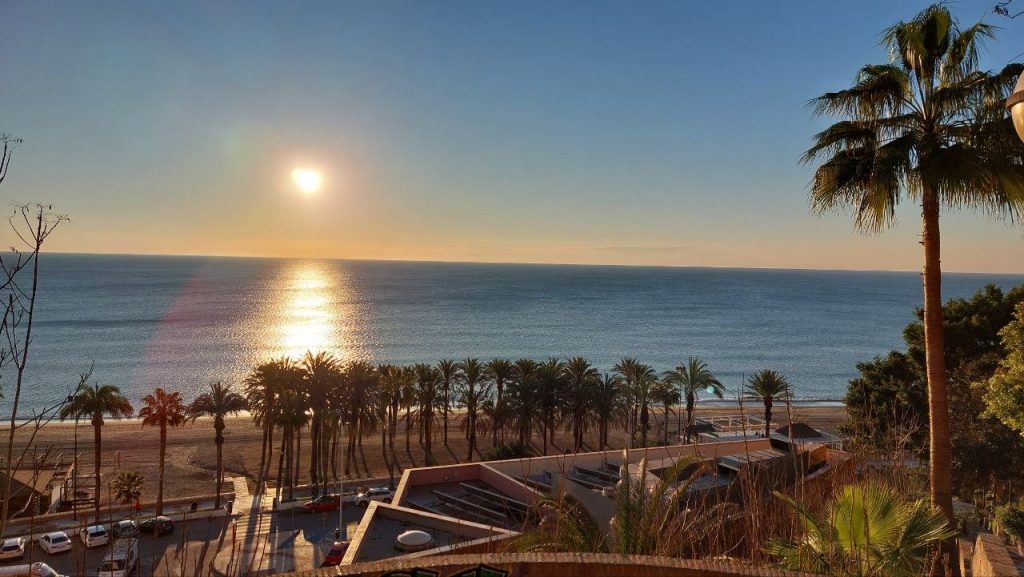
The taxi sped along shimmering tarmac, past a beer factory, down towards the tideless Mediterranean. The Don Pablo stood above the promenade, palm trees swaying between busy chiringuitos, rollerblading children weaving through strolling couples.
‘You’ll love it here, Jamie,’ Maddie said. ‘There are always lots of children. You’ll make friends.’
They checked in, took the lift to the ninth floor, and unlocked Room 911. Jamie swiped the keycard with the excitement of Christmas morning.
The smell hit Paul instantly: the nostalgic mix of stale suncream, faint bleach, warm varnished furniture — the essence of childhood holidays.
Above the bed hung a tapestry of the Last Supper.
‘Is that Jesus, Dad?’ Jamie asked.
‘Yes.’
‘And the one leaning on him — that’s Judas, right? The friend who betrayed him?’
‘Yes, son, that’s right.’
‘No,’ Maddie corrected softly. ‘That’s John, his closest friend. Judas is the one holding the bag of money.’
‘Really? Whatever,’ Paul muttered, impatient.
‘If Jesus was God, Dad, why did he have to die?’ Jamie pressed.
Paul hesitated. ‘I don’t really know.’
‘Maybe it was to show how much he loved us. Like Mum,’ Jamie said quietly.
Paul shot a glance at Maddie. Jamie, sensing he had touched a nerve, snatched up Terence, his Angry Birds toy, and bounded onto the balcony.
‘Look, Terence, the sea!’ he announced.
Below, families clustered around the pool, children splashing while parents dozed on sunbeds. Across the road stretched the beach, waves crashing harder than seemed reasonable on such a windless day.
‘Dad, why’s the sea so rough if there’s no wind?’
‘It’s the moon,’ Paul declared confidently. ‘It pulls on the sea like a magnet.’
Jamie nodded, satisfied.
Later, by the pool, they noticed the German man again — the snorer from the plane. With him sat his wiry son, a blonde woman with broad shoulders, and a pretty girl on the brink of adolescence. Jamie watched her flick her hair with unconscious poise, then turned his attention back to the pool.
The boy introduced himself. ‘I’m Lukas. We live in London. My dad is a doctor. He works in Africa sometimes.’ He grinned. ‘I’m nine. How old are you?’
‘I’m seven,’ Jamie replied eagerly, and they plunged together into the freezing water.
Over the next days, Lukas and Jamie were inseparable: pool, beach, games, laughter. Sometimes Lukas’s sister, Carla, joined them with her endless silly jokes that made Jamie laugh harder the less funny they were.
One afternoon the families shared lunch at a chiringuito. Maddie warmed to Petra, Lukas’s mother, and they talked about raising children abroad. Paul listened to Dominik — the German father — tell stories of medicine in Africa.
They were humbling tales, full of lives saved and lost. Paul felt suddenly small, his job in Shell’s London office seeming shallow by comparison. He also noticed how little Dominik ate, despite his size. Dominik explained, matter-of-factly, that a rare glandular disease made him obese regardless of diet or exercise.
Paul was chastened; his prejudices felt mean and petty in the face of the man’s quiet dignity.
As they lingered over coffee, Jamie piped up. ‘Dad, didn’t you say the moon makes the waves? But it isn’t windy…’
Dominik smiled, poured mineral water into a saucer, and tilted it until the liquid sloshed over the rim.
‘The Mediterranean is like this basin. The water slops because of the earth’s rotation. And some waves start far away, where the wind is stronger than here.’
‘Oh,’ Jamie said, disappointed but thoughtful.
The next day, Paul and Maddie decided to stay at the hotel. They were tired, and perhaps — Paul hoped — ready for some time alone.
‘Please, Dad, can I go to the beach with Lukas? It’s their last day!’ Jamie begged.
Paul hesitated, then caught Maddie’s eye. The look they shared made his decision.
‘All right,’ he said. ‘But be careful.’
Jamie hugged him tight. ‘Love you, Dad.’ Then he grabbed his towel and flip-flops and ran towards the beach, smiling all the way.
Back in Room 911, Paul and Maddie lay together, finally free of interruption. The midday sun pressed against the balcony doors, and outside the sea continued its ceaseless rhythm.
On the beach, Jamie waited by the water’s edge. Lukas wasn’t there yet. He stepped into the waves, remembering Dominik’s saucer, thinking how the sea slopped and pulled, alive with its own hidden force.
Above, Paul and Maddie surrendered to their closeness, lost in each other. Their pleasure also came in waves. Breath-taking undulations, larger and larger and louder and louder.
Seconds later came the largest and loudest wave of all, furious, foaming, final. And not unlike the one that, at that very moment, came crashing over Jamie, carrying his small body out into the indifferent sea.