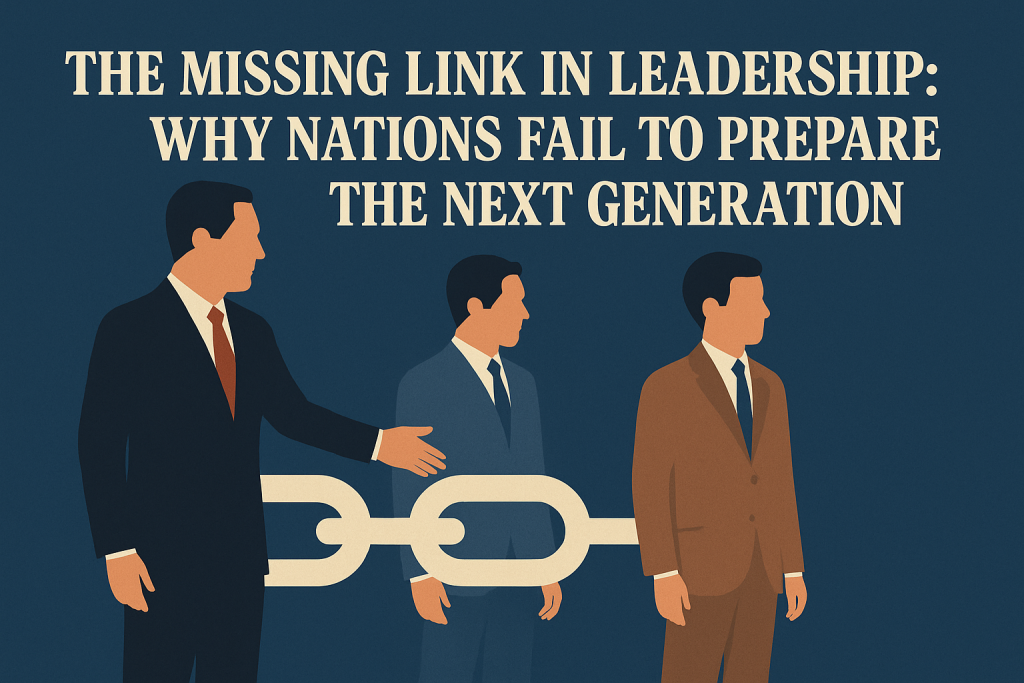
Over the last few days, I’ve been reflecting on something that almost nobody talks about, yet it quietly shapes the political and economic stability of entire nations: the absence of intentional discipleship—or whatever secular term we prefer—among significant leaders.
Call it mentoring, call it succession planning, call it “forming the next generation.” But the idea itself is ancient: I do it and you watch me; you do it and I watch you; now you do it on your own. Most successful cultures in history depended on it. Yet today, it is almost entirely absent in politics, business, and public life.
And we are paying the price.
1. Politics Without Apprenticeship: Why Every Transition Is a Crisis
Look at almost any Western democracy and you’ll notice the same pattern: when a leader falls, nobody has the faintest idea who will replace them.
-
- When Boris Johnson collapsed, nobody was preparing themselves—or being prepared—to step in.
- Liz Truss, Rishi Sunak, and even Theresa May were not household names with long apprenticeships behind them. They were simply the next names in a Rolodex that nobody had ever looked at.
- In the corporate world, nobody outside Cupertino had ever heard of Tim Cook until Steve Jobs died. Cook was extremely competent—but invisible.
Leadership emerges by accident, not formation.
Even in Germany—historically better at structured, team-based governance—the same problem now shows. Under Angela Merkel, we at least knew her ministers. If health, education, or foreign affairs made the news, it was the responsible minister speaking, not Merkel herself. There was a sense of team, of distributed competence, of the German belief that no one person can or should dominate every conversation.
But even then, there was no visible apprentice. No one standing next to her, learning, questioning, absorbing, preparing. When she stepped down, the vacuum opened.
Fast-forward to today, and the contrast is severe. Germany has ended up with Friedrich Merz—almost the polar opposite of Merkel in style, values, and public ethos. The shift is not just political; it’s generational and philosophical. It is what happens when leadership is not passed on but simply replaced.
2. The Danger of Blind Replacements
A country cannot thrive if every transition resembles a blind date.
Democracies need continuity, not clones—but at least a thread connecting one chapter to the next:
-
- Shared institutional memory
- A carried-forward vision
- Stability in economic and social policy
- Someone who has made mistakes privately before making them publicly
Instead, we jump from one unfamiliar figure to another. We “discover” a new potential leader the same way we discover a new toothpaste at the supermarket: whatever is placed at eye level becomes the default option.
And voters are expected to trust people they have never had the chance to watch, listen to, or grow accustomed to.
3. Corporate Life: Exactly the Same Problem
The same dysfunction exists in industry.
Most FTSE100 or Fortune500 companies have:
-
- “leadership pipelines”
- “talent funnels”
- “succession plans” in binders
But very few have real relational apprenticeship:
-
- Nobody spends two years shadowing a CEO.
- Nobody grows up inside a leader’s thinking.
- Nobody is intentionally shown how to hold the weight of power.
So transitions become fragile. Massive instability follows. Cultures collapse when their figureheads move on.
You saw it with Jobs → Cook.
You saw it with Gates → Ballmer.
You saw it with nearly every major bank pre-2008.
This is not an HR problem. It’s a civilisational one.
4. Why Discipleship (Not Just Mentoring) Actually Matters
Mentoring can be a coffee once a month. Coaching can be transactional. Consulting can be outsourced.
Discipleship is different: it means forming someone through proximity, vulnerability, imitation, failure, and shared responsibility.
It means:
-
- I do it; you watch.
The next generation witnesses how problems are carried, how crises are handled, how decisions are made. - You do it; I watch.
Mistakes happen in a safeguarded environment where correction is possible without public humiliation. - Now you do it on your own.
By the time leadership is handed over, the nation already knows who this person is—and why they should be trusted.
- I do it; you watch.
This is not religious; it is simply human. Every craft, every guild, every durable culture has always worked this way.
Except modern politics and modern corporations.
5. Preparing One Generation Down
If we want stability, we must think at least one generation down:
-
- Who is learning the skills?
- Who is absorbing the vision?
- Who is gaining credibility in public life before holding office?
- Who is confident enough to lead, not because they are ambitious, but because they are prepared?
Nations fall apart when nobody knows who is next.
Nations thrive when leadership is a relay race, not a wrestling match.
We cannot talk about the future without preparing the people who will carry it.
“There is no success without a successor.” – Peter Drucker