The Electric Car Story We Should All Be Talking About

Electric cars are sold to us as the clean, ethical future: the simple solution to petrol, emissions, and climate collapse. No exhaust pipe. No fumes. No guilt. Drive electric and you’re doing your part.

But the longer I listen to the certainty around EVs — the smug finality, the “case closed” tone — the more I suspect we haven’t solved the problem at all. We’ve simply moved it.

Because “zero emissions” is only true in one narrow sense: electric cars don’t emit at the tailpipe. That matters for city air quality, and it’s not trivial. But climate impact isn’t just about what comes out of the back of the vehicle. It’s about the whole chain: extraction, manufacturing, electricity generation, and end-of-life disposal.

And yes: in many cases, electric cars really are better on the climate. A major life-cycle analysis has estimated that battery electric cars sold in Europe today can produce dramatically lower overall greenhouse-gas emissions than comparable petrol cars. That’s a real advantage, and it’s worth acknowledging.

But “better than petrol” doesn’t automatically mean “clean.” It doesn’t mean “ethical.” And it certainly doesn’t mean “no victims.

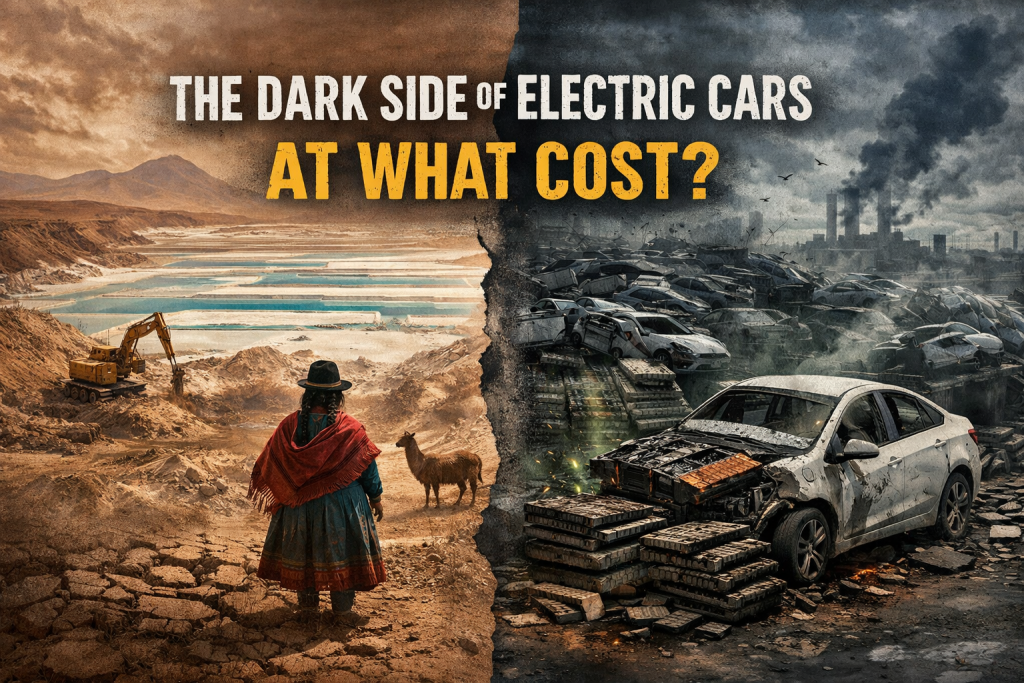
The modern electric car runs on more than electricity. It runs on minerals — and minerals have to be ripped out of the earth. The new fuel of the “green future” isn’t oil alone: it’s lithium, nickel, cobalt, graphite, and more. And the extraction doesn’t happen in glossy European showrooms. It happens in places where ecosystems are fragile, water is scarce, and the people who live nearby often have far less power to resist the pressure.

Chile is frequently held up as a symbol of this new reality. In the Atacama region, concerns have been raised for years about lithium extraction and water stress in an already arid landscape. And while “displacement” doesn’t always mean literal bulldozers and forced removals, communities can still be displaced in practice, when resources shrink, livelihoods collapse and the land becomes harder to inhabit. You don’t always need an eviction notice to be pushed off your own future.

Then comes the question nobody wants to picture too clearly: what happens when millions of EV batteries die?

Batteries degrade. Capacity drops. Replacement costs bite. Cars are written off. And suddenly we’re not looking at a futuristic revolution, we’re looking at a looming waste problem. We are manufacturing the next century’s landfill with a smile on our faces, because it feels cleaner today.

Yes, recycling exists. Yes, there are second-life uses for some batteries. Yes, policymakers talk about circular economies. But the scale is the issue. Recycling infrastructure doesn’t magically appear just because consumers feel virtuous. It requires systems, enforcement, investment, and time — and at the moment, the global EV rollout is moving faster than the uncomfortable questions that should be travelling alongside it.

So why does this side of the story still feel strangely muted?

Partly because it’s complex, and complex stories don’t trend. But partly because the car industry is not politically neutral. The automobile sector has been one of the most powerful lobbying forces shaping transport policy, regulation, and public messaging for decades. That doesn’t require a secret conspiracy. It only requires something much more ordinary — influence, money, access, timing, and the gentle steering of what gets taken seriously.

This is the deeper danger: the electric car has become a moral symbol. Question it and you’re treated as pro-oil. Doubt it and you’re dismissed as anti-progress. But this isn’t how ethical responsibility works. A solution isn’t automatically good because it comes wrapped in green language.

Electric cars may reduce emissions. But they don’t end extraction. They don’t end harm.

We’re not transitioning from dirty to clean. We’re transitioning from visible pollution to invisible supply chains, from smoke in our cities to disruption in deserts we’ll never visit.

So yes: electrification may be part of the future. But only if we stop treating it like a miracle and start treating it like what it really is: a trade-off. A compromise. A human project, built inside a world of scarcity, power and competing interests.

If we want an energy transition worthy of the name, we need more than new engines. We need transparency, better public transport, enforceable standards, serious recycling systems and the courage to count the human cost, not as an inconvenient footnote, but as part of the moral equation.

“A thing is right when it tends to preserve the integrity, stability and beauty of the biotic community. It is wrong when it tends otherwise.”
Aldo Leopold

Is It Time For A Peaceful Revolution?

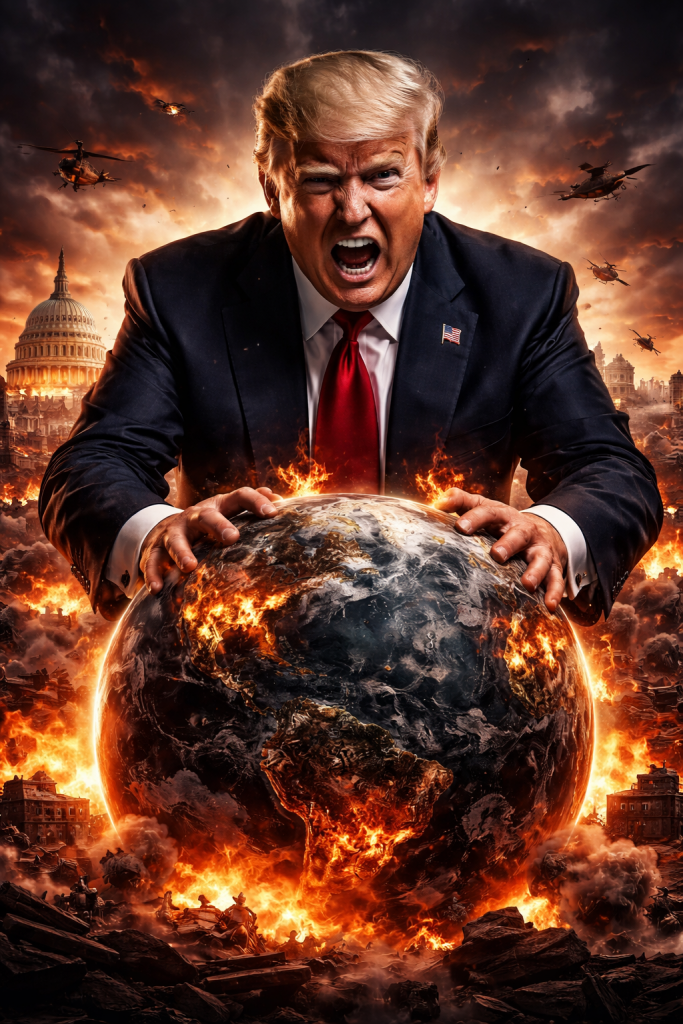
The return of Donald Trump is not merely a political event. It is a moral diagnostic.

It tells us something deeply unsettling about the state of our world: that values, principles, and ethics have slipped from the centre of public life. They have been displaced largely by financial gain, grievance politics, racialised fear, and the steady erosion of democratic norms.

This is not an American problem alone. It is a global one.

Trump is not the cause of this collapse; he is its most conspicuous symptom, like a mirror held up to societies that have quietly traded moral seriousness for spectacle, responsibility for outrage and truth for tribal loyalty.


The Disappearance of Principle

Where are the people of principle?

Where are the politicians who speak honestly about limits, responsibility, and restraint, rather than promising everything while meaning nothing? Where are the leaders willing to say “this is wrong” even when doing so costs them popularity, office, or power?

And where, more troubling still, are the faith communities — Christian, Jewish, Muslim, secular humanist — when democracy is undermined and human dignity reduced to a slogan?

Too often, there is silence.
Or worse: rationalisation.


Ethics in a ‘Post-God’ World

We increasingly describe ourselves as living in a “post-God” world. Whatever one’s beliefs, this framing carries an uncomfortable implication.

If there is no higher authority to appeal to, no divine judgement, no metaphysical reckoning, then responsibility does not disappear. It intensifies.

In such a world, ethics cannot be outsourced to tradition, scripture or institutions. They must be embodied in individuals.

We are fully and finally accountable for what we tolerate, excuse, and normalise.

The collapse of shared ethical frameworks does not free us. It leaves us more exposed.


When Systems Fail

When political systems fail, when institutions rot from within, when law bends to power and truth bends to profit, waiting politely is no longer a virtue.

Peaceful resistance is not extremism.
Civic courage is not disorder.
Refusing to normalise injustice is not naïveté.

History does not judge societies kindly for their patience in the face of moral collapse.


The GDR: Proof That Change Is Possible

I live in the former German Democratic Republic.

Within my own lifetime, I have seen proof that enormous social change is not only possible, but inevitable, when large numbers of ordinary people rise up peacefully and say: Enough.

No tanks.
No violence.
Just people.

The fall of the GDR was not engineered by heroes or generals. It was brought about by teachers, factory workers, church groups, writers, engineers: people who withdrew their consent from a system that no longer deserved it.

That lesson should haunt us and teach us.


Have We Gone Mad?

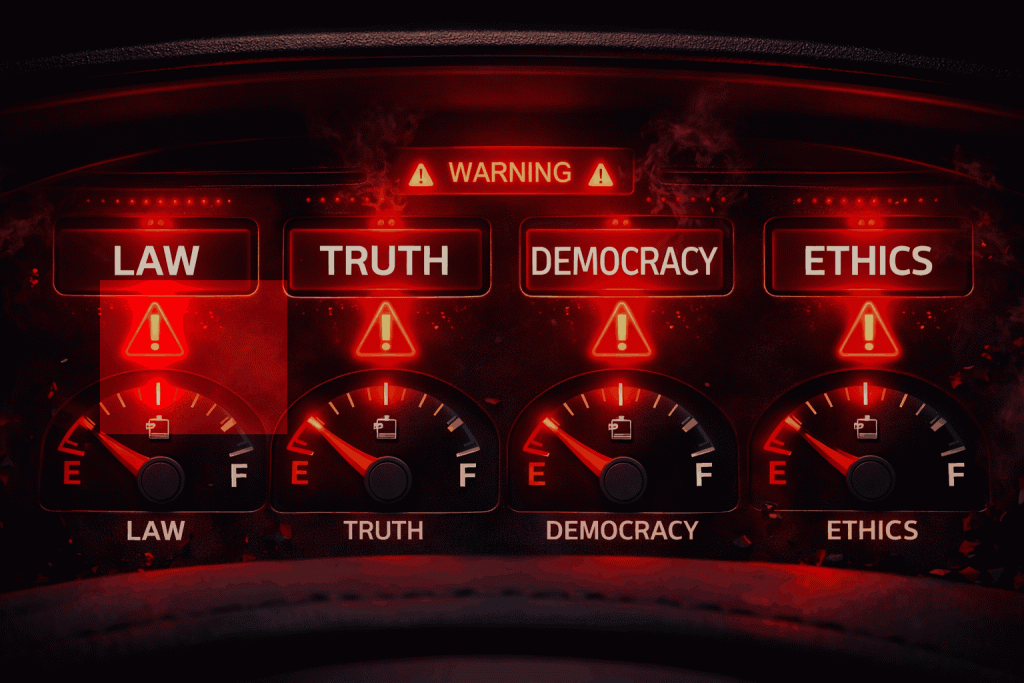
As a warning light on the dashboard of history, young Germans are once again being asked whether they are prepared to fight for their country.

After everything Europe has lived through: after the ruins, the camps, the mass graves, the promises of Nie wieder — have we learned nothing?

The question should not be how to prepare the next generation for war, but how we allowed ourselves to drift back towards the conditions that make war imaginable again.


Democracy Belongs to the Ordinary

Democracy does not belong to elites.
It does not belong to parties, platforms, or billionaires.

It belongs to writers.
Teachers.
Lawyers.
Nurses and doctors.
Construction workers.
Refuse collectors.

It belongs to all of us.

When democratic systems disintegrate, it is not because “the people” failed. It is because too many people were persuaded that their voice no longer mattered.


Silence Is Not Neutral

Some of us are old enough to know where silence, blame-shifting, and passivity lead.

Writing from exile as Europe collapsed around him, Stefan Zweig issued a warning that has lost none of its force:

“The greatest danger threatening humanity today is not fanaticism itself, but the silent toleration of fanaticism.”

Zweig understood that history is not undone by villains alone, but by the quiet compliance of the reasonable.


So Where Is the Line?

If Zweig was right, then the question is no longer whether we see what is happening.

The question is this:

Where do you draw the line?
What responsibility do professionals, educators, faith communities, and citizens have when institutions fail?
What does peaceful resistance look like now?

Enough silence.
Enough normalisation.
Enough waiting.

History does not move only through great men. It moves when ordinary people decide that they will no longer cooperate with the unacceptable.

The moment is not coming.

It is already here.

“Truth to tell, we are all criminals if we remain silent.”

—Stefan Zweig

The Trump Presidency: A Legacy of Lawlessness, Chaos and Global Instability

The return of Donald Trump to the White House was sold as a revival of American strength and clarity. Instead, it has produced a presidency defined by lawlessness abroad, institutional corrosion at home, economic volatility and moral collapse at the top.

From the unlawful military assault on a sovereign nation to the degradation of public discourse and democratic norms, Trump’s tenure increasingly resembles not leadership, but deranged instability — driven less by coherent strategy than by impulse, grievance and personal spectacle.


1. The Unlawful Attack on Venezuela: A Crime Against Sovereignty

In January 2026, Trump authorised a U.S. military operation in Venezuela resulting in the capture of President Nicolás Maduro and his wife, who were flown to New York to face charges. Trump openly stated that the United States would “run the country” during a transition and signalled willingness to deploy ground troops if necessary.

International law experts were unequivocal: the operation violated the UN Charter, which prohibits the use of force against a sovereign state absent self-defence or explicit UN Security Council authorisation. Venezuela was not at warwith the United States. No imminent threat was demonstrated. Congress was not meaningfully consulted.

This was not law enforcement. It was executive force projection without legal basis — the kind of unilateral action the post-1945 international order was designed to prevent. Trump is considering similar illegal aggression in Colombia and Greenland.


2. Failed Peace in Palestine, Ukraine, and Beyond

Trump’s claim to be a “peacemaker” collapses under scrutiny.

In Gaza, he floated proposals involving U.S. control of territory and the relocation of civilian populations — ideas widely condemned as unlawful, destabilising, and ethically indefensible.

In Ukraine, his approach has leaned toward freezing conflict on terms favourable to Russian territorial gains, weakening Ukrainian sovereignty while undermining the principle that borders cannot be changed by force.

In both cases, Trump has confused domination with diplomacy, mistaking coercion and spectacle for peacebuilding.


3. Character Matters: A President Unfit for the World Stage

Before economics, before diplomacy, before markets, one must confront a more basic question:

Is this man fit to exercise power at all?

Trump is:

    • Twice impeached by the U.S. House of Representatives
    • Convicted on 34 felony counts in a New York criminal court
    • Found civilly liable for sexual abuse by a jury
    • A man with a long public record of racist rhetoric, including attacks on judges, migrants, foreign leaders, and entire nations
    • Someone who displays proud incuriosity, routinely dismissing expert briefings, intelligence assessments, and scientific consensus

Beyond legality lies a deeper problem: Trump lacks the intellectual and rhetorical equipment required of a statesman on the world stage.

His speech is repetitive, grievance-driven, factually loose and emotionally reactive. He substitutes insult for argument, volume for substance, and loyalty tests for reasoning. Complex geopolitical realities are reduced to slogans. Allies are treated as stupid inferiors. Democratic institutions are treated as obstacles to his dictatorship.

This is not merely a stylistic issue. Language is how power is exercised, alliances are sustained, and crises are defused. A leader unable or unwilling  to speak with precision, restraint and moral seriousness inevitably degrades the office itself.

The chaos of the Trump presidency is not accidental. It is character made policy.


4. Isolation of the United States Abroad

Under Trump, the United States has shifted from coalition-builder to disruptor.

Long-standing allies describe Washington as unpredictable and transactional. NATO cohesion has been strained. European leaders increasingly speak of “strategic autonomy” — diplomatic language for no longer trusting the United States to act responsibly.

International institutions once anchored by U.S. leadership are now treated with open hostility or contempt. The result is not strength, but diminished influence and accelerated fragmentation of global norms.


5. Damage to International Markets and Global Stability

Trump’s foreign policy volatility has produced tangible economic consequences.

The Venezuela intervention rattled energy markets and increased geopolitical risk premiums. Unpredictable rhetoric on trade, sanctions, and conflict has made long-term investment planning harder — not just abroad, but at home.

Meanwhile, China flourishes with BYD overtaking Tesla as just one indicator.

Markets dislike uncertainty. Trump manufactures it.


6. The Myth of Economic Mastery

Trump continues to claim unparalleled economic success. The data tells a more restrained story:

    • GDP growth has been moderate, not exceptional
    • Unemployment has risen relative to prior post-pandemic lows
    • Stock market gains largely reflect global cycles rather than presidential policy
    • Wage growth continues to struggle against persistent inflation

Outside healthcare and a few protected sectors, job quality remains uneven, household debt is rising, and borrowing costs remain high.

This is not an economic renaissance. It is fragile performance sustained by volatility and lies on ‘Truth’ Social.


Conclusion: Not Statesmanship, But Spectacle

Trump is still treated by parts of the media and political class as a “serious statesman.” This is perhaps the most dangerous illusion of all.

A man repeatedly found to have violated the law, to have abused power and to have debased public discourse does not become presidential through repetition or normalization. Power does not cleanse character; it exposes it.

If any American voice should frame this moment, let it be that of Dwight D. Eisenhower, a Republican, a general, and a president who understood the cost of reckless leadership:

“When peace has been lost, when confidence in the persistence of orderly government has gone, cities are sacked, institutions fail, and men perish.”

Trump’s presidency will not be remembered as a defence of America — but as a warning of what happens when spectacle replaces judgment, and character is dismissed as irrelevant.

Love, Bureaucracy, and the Borders of Europe

How a perfectly legal couple spends years fighting a system that claims to protect the family

I have always loved Europe.
I still do.

The peace, the democracy, the rule of law — these are extraordinary privileges, and I’m grateful every day to live in a part of the world that, compared to most of the planet, is safe, stable and humane.

But loving a thing does not mean lying about it.
And the deeper my own journey into the European immigration system has taken me, the more convinced I have become that something fundamental is broken — not just in Germany, not just in Britain, but across almost the entire continent.

This is not an anti-German story.
It is a story about what it feels like to do everything legally, responsibly, respectfully — and still find yourself treated as if love were a loophole, marriage an inconvenience, and foreign spouses a threat to be contained.

It is a story that could happen in almost any European capital.

It just happened to us in Berlin.


How Love Became a Test of Endurance

A few years ago, I fell in love with a remarkable man in Indonesia.
Our relationship grew quickly and deeply, and we knew we wanted to build a life together in Europe rather than in Indonesia. We planned to marry anyway, so we assumed — naively, as it turns out — that marriage and legitimacy would make the process of living together straightforward.

We were wrong.
Painfully, spectacularly wrong.


Wedding Bells, Bureaucratic Walls

Because our marriage would not be legally valid in Indonesia, we had to marry in Europe.
What we imagined would be a simple civil ceremony became a six-month odyssey through paperwork, translations, apostilles, appointments, contradictory guidance, and requirements that bordered on the absurd.

Still — we got married.
We thought the hardest part was behind us.

But marriage, we learned, is not a ticket to a shared life.
It is merely the beginning of a long, labyrinthine process designed, it seems, to test whether your relationship can outlast bureaucracy.


The Rule No One Tells You: “Apply in Jakarta, or Don’t Come at All”

Once married, we were informed of something almost nobody tells you in advance:

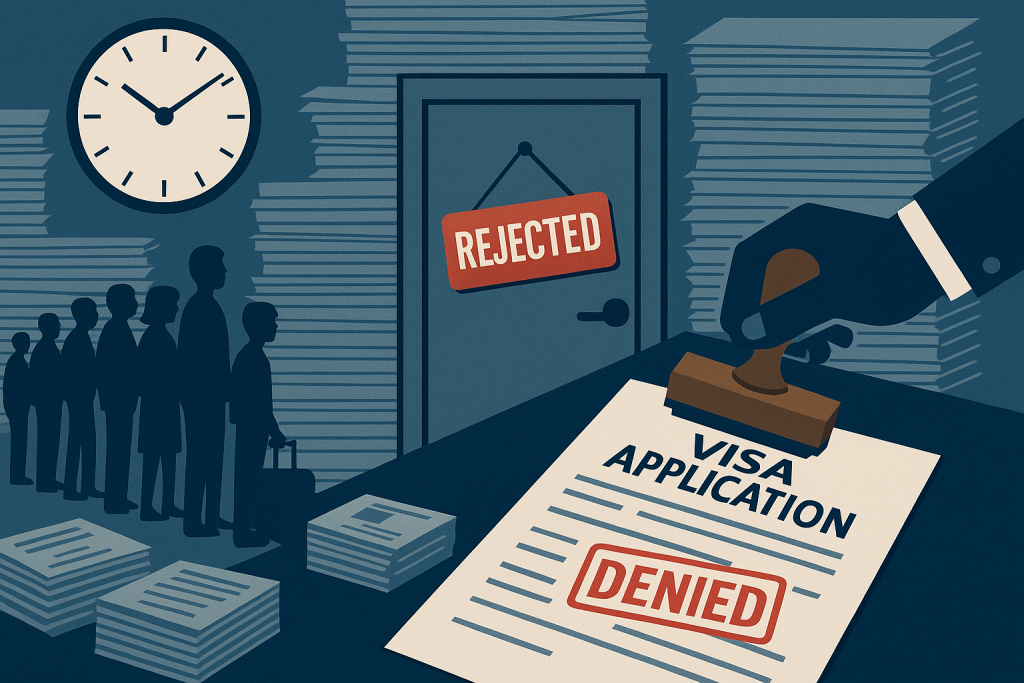
If you marry an Indonesian and want to live together in Europe, your Indonesian spouse must apply for a family-reunification visa from Jakarta — and only from Jakarta.

Not from Berlin.
Not from any European consulate closer to their home island.
Not from Europe on a tourist visa (which would be logical, humane, and in line with every legal principle about protecting marriage).

Jakarta.
Or nothing.

The waiting list?
One year.
We have the screenshot.

And that’s just the waiting list for you to submit your application — not the processing time afterwards.

Imagine telling any married couple in Europe:

“Congratulations on your marriage.
You will now be forcibly separated for at least 12 months.”

That is the system.
That is the norm.


One Document Wrong? Start All Over Again.

When our turn finally came, the embassy did not approve one of the documents uploaded during the online process. They asked us to delete it — and, indeed, there is a little trash-can icon on the website.

Except the icon doesn’t work.
It never has.

After weeks of emails, calls, and technical back-and-forth, the embassy’s final advice was:

“Delete your entire application and start again.”

Which, in plain language, means:

“Restart the one-year waiting list.”

It is breathtaking to realise that the legal rights of marriage can be instantly overruled by a broken trash-can icon.


Geography as a Financial Weapon

If you are Indonesian and live on Sumatra, you must pay to fly twice to Jakarta — once for biometrics, and once to collect the visa. These costs are enormous relative to Indonesian salaries.

For many families, this is simply impossible.

This is what “legal migration” looks like in practice.


The 90/180 Trap: A Long-Distance Marriage by Law

Some couples try an alternative: the Schengen visitor visa.
But that route comes with its own cruelty:

  • Your spouse can visit for 90 days maximum

  • but must then leave for another 90 days minimum

Meaning:

You may live together for three months, then be forcibly separated for six.
Three on, six off. Three on, six off. Indefinitely.

Assuming, of course, you can afford the flights between Jakarta and Europe.
Most cannot.


The Berlin Immigration Office: A Fortress Without Doors

If the embassy maze is surreal, the immigration office in Berlin is its European twin.

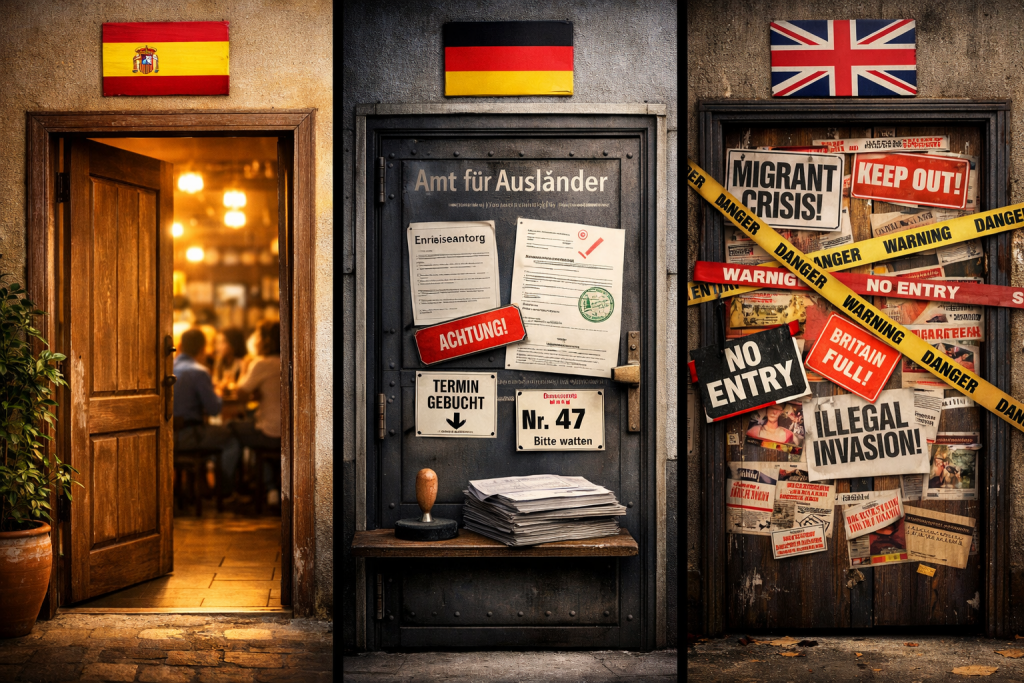
You cannot phone them.
You cannot email them.
You cannot speak to a human being unless you already have an appointment — and you cannot get an appointment without submitting a webform that may sit unanswered for two months.

If you attempt to enter the building to ask for help, security guards turn you away.
“No appointment, no entry.”

It is Kafka with fluorescent lighting.


When Your Appointment Arrives… It’s Too Late

In our case, by the time Berlin offered my husband an appointment, his visitor visa had expired.
They could not — or would not — offer an earlier date.

He was legally in the country.
He had proof of marriage.
He had every document required.

But the system, moving at its own glacial pace, simply shrugged.


The Catch-22: Work to Stay, But You Can’t Work Until You Stay

Here is the cruelest irony:

To obtain residency, the European spouse must prove sufficient income to support both partners.

But the foreign spouse cannot work unless they already have residency.

So if the European partner earns too little, the spouse receives only a six-month Fiktionsbescheinigung — a kind of temporary suspension of deportation, halfway between permission and limbo.

With that document:

  • You cannot work

  • You cannot earn

  • You cannot contribute

  • Therefore you cannot raise household income

  • Therefore you do not qualify for residency

This is not immigration policy.
It is a bureaucratic cul-de-sac.


And Then You Realise: If It’s This Hard for Us… What About Them?

We are educated, organised, legally married, European-based, English-speaking, German-speaking, online-competent, and persistent.

And still we nearly drowned in the system.

What must this system feel like for asylum seekers?
For people fleeing war or persecution?
For couples separated across borders with children in tow?
For those without money, stability, documents, or perfect German?

Oh yes, and in case you’re wondering, I did contemplate moving back to the UK and applied for residency for my English-speaking husband there. Our application was declined.

The system does not merely fail people.
It dehumanises them.


A Quiet Exception: The Spain Nobody Talks About

There is one place in Europe where the logic is different: Spain.

Spain has a little-known rule — almost never advertised — called arraigo social.

If you remain in Spain for two years, stay out of trouble, and integrate into community life, you can obtain legal residency.

No endless separation.
No forced poverty.
No trapdoors disguised as requirements.
No broken webforms or locked doors.

If you are married and have property there, the chances are even better.

Whatever critics say, this is a system that treats people — even undocumented ones — as human beings capable of building a life.

It is the closest thing Europe has to a humane immigration philosophy.


What This Story Is Really About

This is not a rant.
Nor is it an attack on Germany, which continues to offer extraordinary opportunities to millions of people, myself included.

It is a plea.
A testimony.
A reminder that behind every “case number” is a love story, a family, a life.

Europe prides itself on protecting marriage – see ECHR, Article 8 §§1–2.
Courts across the continent insist that “bureaucratic inefficiency is not a legitimate reason to separate spouses.”

But in practice?
The systems built to uphold those principles routinely violate them.

If Europe wants to protect its values — its humanism, its dignity, its rule of law — the immigration system is where it must begin.

Not with walls.
Not with suspicion.
But with the simple recognition that married couples should not have to fight this hard to live under the same roof.

“Bureaucracy is the death of all human action.” — Max Weber

Dialogue or Destruction: Why Peace Has Only One Road Left

A Century That Should Have Known Better

Some days it feels as if the twenty-first century has learned nothing from the horrors that preceded it. We live in an age where the map of human suffering is once again studded with names we should never have to say in the same sentence: Gaza and southern Israel, Ukraine, Yemen, Sudan, Myanmar, Ethiopia – and now even Thailand and Vietnam finding themselves drawn back, in different ways, into cycles of unrest they thought they had escaped.

The tragedies differ in their causes, but they share one characteristic: they are morally unacceptable in a world that has the knowledge, the wealth, and the historical memory to do better.
War may once have been considered an inevitability of human conflict. But wars of aggression – and the atrocities committed in their shadows – cannot be squared with a species that claims to be moral, rational, or enlightened.

The sorrow is not only in the scale of destruction, but in its banality. Innocent men, women and children, whose only mistake was being born in the wrong place, are suffering because powerful individuals with guns, money, or ideology choose violence over the one thing that has ever worked: talking.

The Human Duality: Building Mars Rockets While Bombing Cities

It is one of the oldest and saddest paradoxes of the human condition:
We are capable of extraordinary intelligence and astonishing stupidity at the very same time.

In the same decade that we are preparing missions to Mars, mapping the human genome, and coordinating global relief efforts after earthquakes and floods, we are also manufacturing weapons so sophisticated and so profitable that entire economies depend on them.

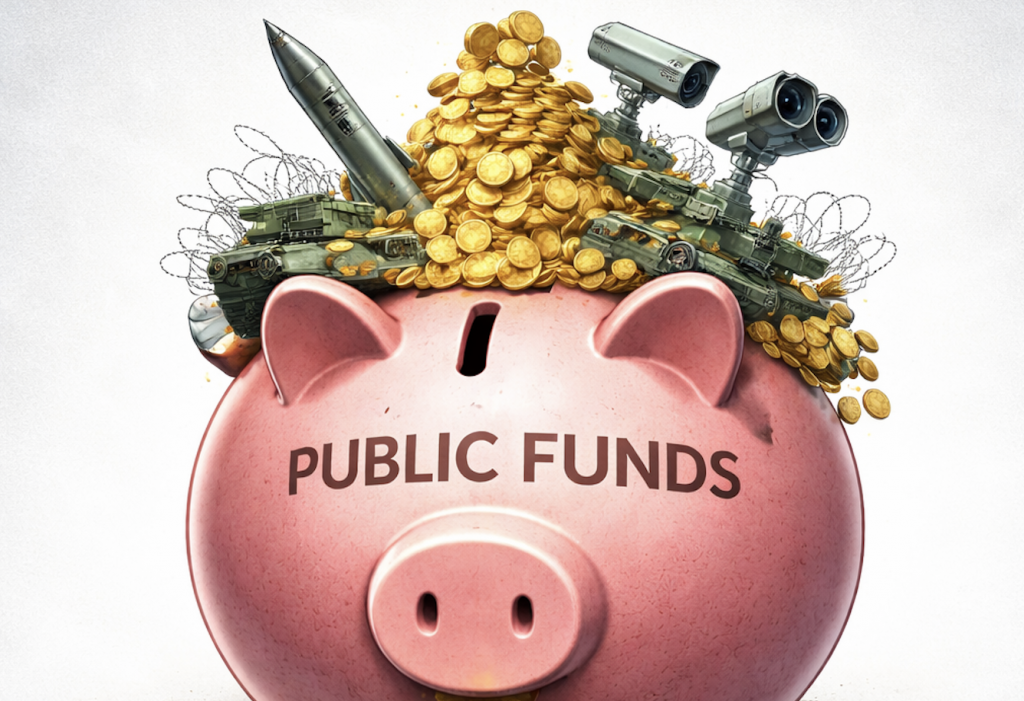
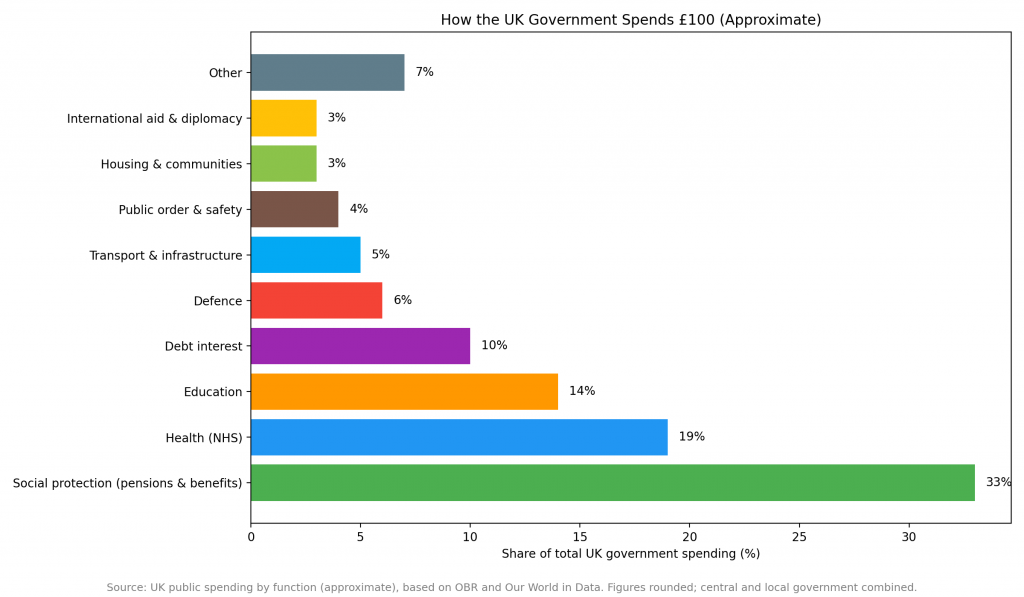
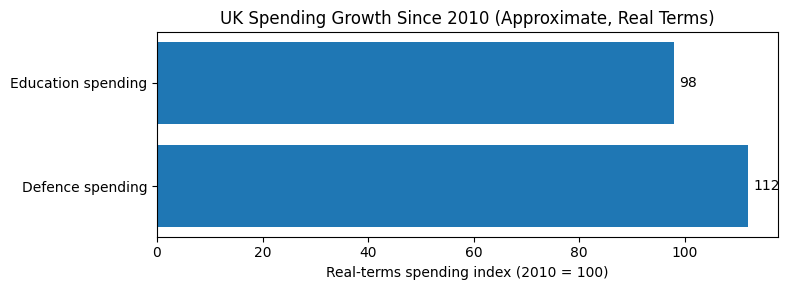
Take the UK: a country with billions for advanced weapons systems but somehow “no money” for freezing pensioners, collapsing hospitals, or universal, high-quality education. This is not a mystery of economics; it is a reflection of politics, psychology, and a global weapons industry whose profits dwarf the budgets of most ministries of health. And while this grotesque misallocation of resources goes largely unexamined, public attention is successfully diverted towards the performative jingoism of Nigel Farage and his circle, obsessing over small boats as if they posed a greater threat than the industrial machinery of war.

Sociologically, all this reveals something darker:
that collective fear is more powerful than collective compassion,
and that democracies and dictatorships alike are willing to pour unimaginable sums into tools of destruction, even as their own citizens queue at food banks.

When you look at the sheer size of the arms economy – involving states, private firms, lobbyists, intelligence networks, and geopolitical strategists – it is no surprise that conspiracy theories flourish. One begins to wonder, not whether secret cabals exist, but whether the structural incentives of money, power, and fear create something that behaves exactly like a conspiracy: an unaccountable machine that profits from perpetual insecurity.

Yet even here, there is a deeper sadness:
This is all human-made. It could all be human-unmade.

The Only Road Left: Global Responsibility and Relentless Dialogue

Ending war and the suffering it unleashes is not a task for Washington or Moscow or Beijing alone. It is not a “European problem” or a “Middle Eastern problem” or an “African problem.”

It is a human problem.

And humans, whether in India, New Zealand, Switzerland, Brazil, Nigeria, or Japan, share equal responsibility for the world we are shaping.

The world is too interconnected – economically, technologically, environmentally – for the myth of “regional conflicts” to survive. A war in Ukraine destabilises global grain markets. A war in Gaza destabilises entire alliances. A war in the Sahel or Sudan creates refugee flows that reshape the politics of Europe within months.

And yet, our political rhetoric remains stuck in the nineteenth century: great powers posturing like drunken emperors, minor powers waiting for permission to act, populations encouraged to choose a side rather than choose a future.

Into this steps Donald Trump, who postures as a dealmaker but speaks as a man who has never studied history, diplomacy, or the complexity of human suffering. His racist, West-centric, emotionally stunted theatrics are not only unhelpful — they actively block the one thing that has ever stopped wars:

serious, sustained, structured dialogue.

China said this nearly two years ago, and they were right:
There is no military solution to these conflicts.
There is no future in “victory” defined as someone else’s obliteration.

If the stakes were framed differently —
If it were your grandmother being raped,
your daughter being shot,
your son sent to die in a trench,

would anyone still think that pride, posturing, or “teaching the enemy a lesson” was worth it?

Dialogue is not weakness.
Dialogue is not appeasement.
Dialogue is not naïve.

Dialogue is the only alternative to extinction-level stupidity.

What we need is a global determination — from governments, from civil society, from the international institutions we mock until we suddenly need them — to bring leaders and peoples into conversation with each other before the next atrocity, the next drone strike, the next unmarked grave.

We do not need more weapons.
We need more courage — the courage to talk to our enemies.

Because the only road that has ever led out of hell is the one people walked together, however awkwardly, toward a table, a room, a conversation.

Dialogue is not one option among many.
Dialogue is the only road left.

“If you want peace, you don’t talk to your friends. You talk to your enemies.”  -Desmond Tutu


Unseen Innovation: Europe’s Arcadian Missions in Agriculture and Beyond

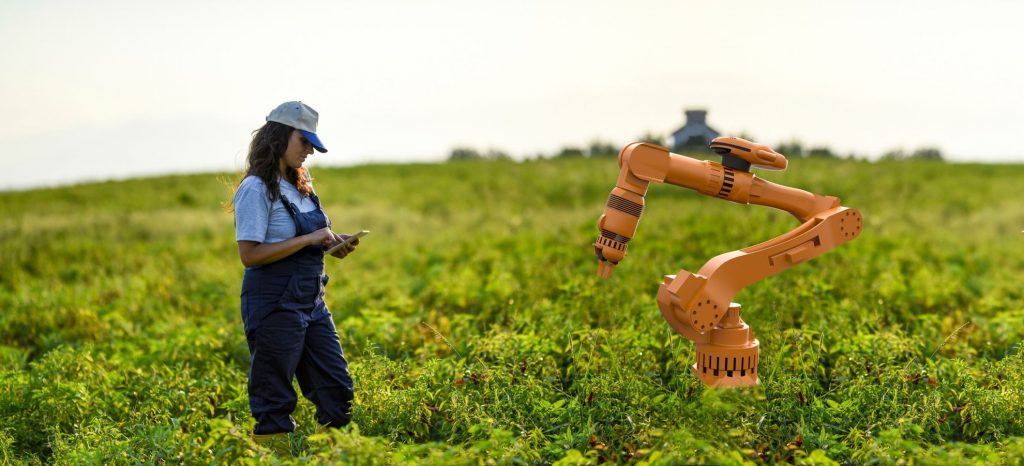
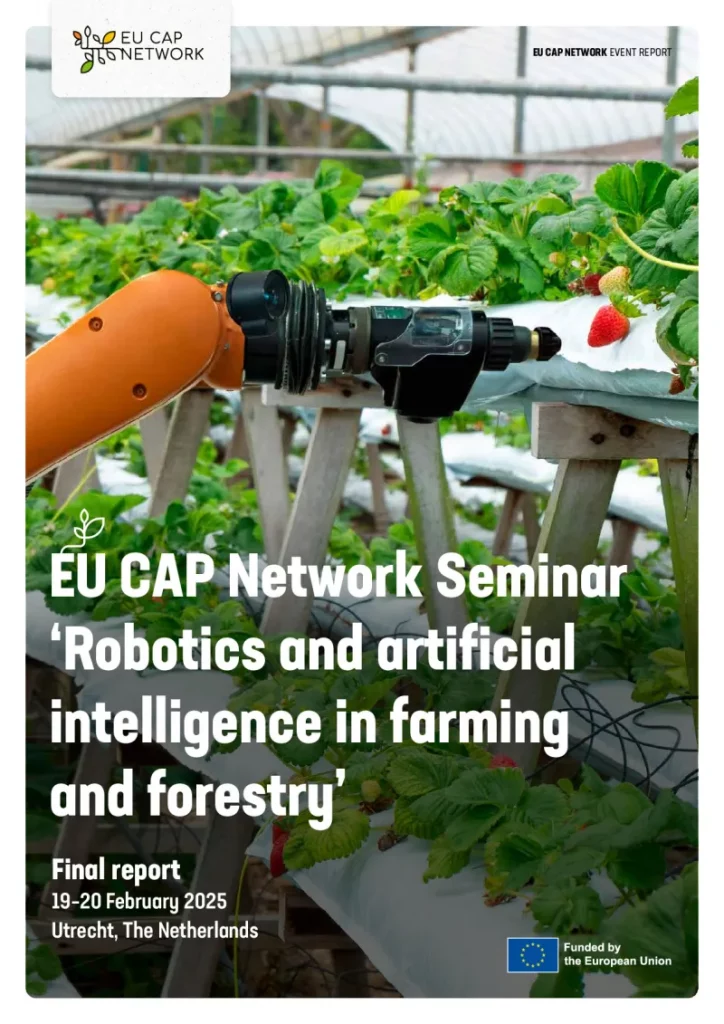
Innovation rarely arrives with fanfare. It doesn’t always make the headlines. Instead, it often unfolds silently in the fields, the orchards and the hinterlands — where precision matters, human know-how meets technology, and tomorrow’s systems are shaped today. One such endeavour is the AgRimate project: a multi-national European initiative that demonstrates how real-world research quietly drives systemic change.

A good example: AgRimate

Launched under the Horizon Europe programme (grant agreement 101182739), AgRimate brings together 11 partners from Spain, Finland, Italy, Greece, Germany and Ireland.  Its target: to transform pruning practices in olive groves and vineyards through AI-driven decision support, augmented reality (AR) assistants and robotic systems. By 2030, the project aims for a technology-readiness level of 7 or more, to validate in real-world field trials across Spain and Greece.

Among its goals:

    • Integrate sensor networks and drone data to feed AI models that learn from expert pruners — combining tradition and technology.
    • Deploy AR-based training and guidance tools to enhance worker competence and safety.
    • Design robotic platforms and exoskeletons to reduce physical strain and improve productivity in high-value cropping.
    • Ensure human-centred design: evaluating how AI and robotics impact worker well-being, autonomy and skill development.

This is farming at the intersection of cognition, competence, machine intelligence and everyday labour: exactly where digital transformation meets human factors.

“The soil is the great connector of lives, the source and destination of all.”
— Wendell Berry

Why such projects matter

While big science programmes grab attention, applied-field projects like AgRimate deliver the operational breakthroughs — the nuts-and-bolts tools that farmers will use. In the EU, research shows that every €1 invested in agricultural innovation can yield up to €10-11 in return over 25 years.

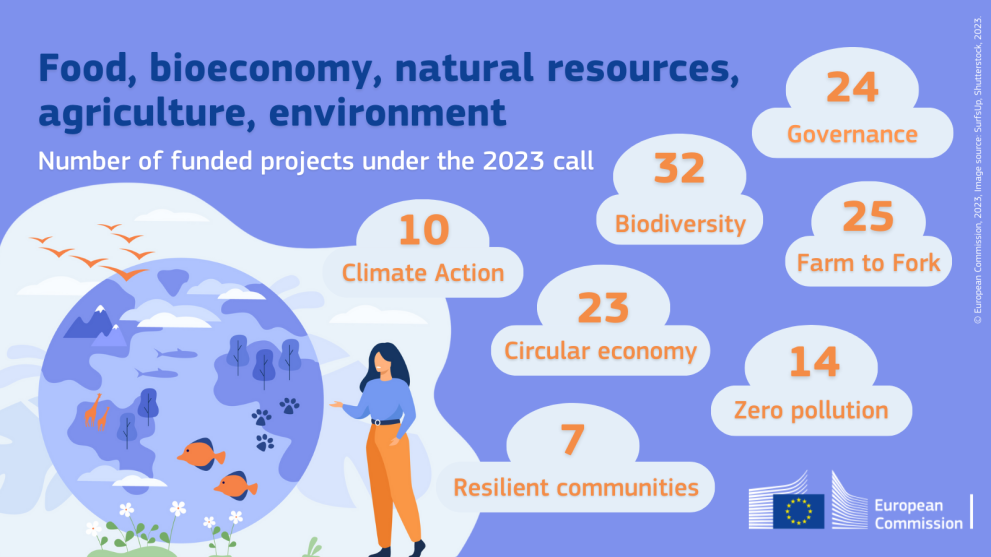
And financially: Horizon Europe carries a budget of about €93.5 billion (2021-2027). Within that, agriculture, bioeconomy and natural-resources projects account for roughly €9 billion of dedicated support. ([European Commission])

Such funding enables:

    • innovation in digital farming, robotics and AR
    • capacity-building and competence-development in rural areas
    • sustainability, productivity and social inclusion
    • spill-over benefits beyond Europe: from knowledge export to global partners

Beyond agriculture: the hidden ecosystem

Though agriculture provides a compelling lens, research-funding stretches across domains. For example:

    • The Erasmus+ programme fosters mobility and competence across borders, equipping educators and learners for global challenges.
    • Health-related initiatives like EU4Health support medical research and pandemic resilience.
    • Digital-technology programmes (digital Europe) underpin innovation in every sector.

Together, they create a background mosaic of everyday research infrastructure — quiet, distributed, and deeply impactful.

Global value, local roots

Projects like AgRimate don’t just upgrade a Spanish olive grove. Their tools, methods and models travel. Exoskeletons, AR training tools, AI-driven decision-engines: all are transferable to Latin America, Africa or Asia where smallholder farmers face similar labour constraints, skill gaps and sustainability demands. Research-driven competence models and embedded human-tech interaction frameworks are the heart of global agricultural progress.

Why we should pay attention

Often, we know about the big telescopes, the megaprojects, the splashy tech launches. But real change also happens quietly — in pruning trellises, orchards, farm-hands learning AR interfaces, complex sensor systems taking field-data at dawn. These are the systems that translate innovation into impact.

For professionals, researchers and rural practitioners alike, the message is clear: technology alone isn’t enough. It’s human competence, interaction design, usability, learning architecture and worker autonomy that bring tech alive. Projects like AgRimate embody that blend.

And for you — or for any practitioner, researcher or farmer — this is the invitation: monitor the unseen, celebrate the unsung, and recognise the spider-web of research beneath your everyday tools. Because behind those quiet fields, Europe is building the futures we’ll harvest tomorrow.

“Europe will not be made all at once, nor according to a single plan, but through concrete achievements which first create a de facto solidarity.”
— Robert Schuman, 1950