The Electric Car Story We Should All Be Talking About

Electric cars are sold to us as the clean, ethical future: the simple solution to petrol, emissions, and climate collapse. No exhaust pipe. No fumes. No guilt. Drive electric and you’re doing your part.

But the longer I listen to the certainty around EVs — the smug finality, the “case closed” tone — the more I suspect we haven’t solved the problem at all. We’ve simply moved it.

Because “zero emissions” is only true in one narrow sense: electric cars don’t emit at the tailpipe. That matters for city air quality, and it’s not trivial. But climate impact isn’t just about what comes out of the back of the vehicle. It’s about the whole chain: extraction, manufacturing, electricity generation, and end-of-life disposal.

And yes: in many cases, electric cars really are better on the climate. A major life-cycle analysis has estimated that battery electric cars sold in Europe today can produce dramatically lower overall greenhouse-gas emissions than comparable petrol cars. That’s a real advantage, and it’s worth acknowledging.

But “better than petrol” doesn’t automatically mean “clean.” It doesn’t mean “ethical.” And it certainly doesn’t mean “no victims.

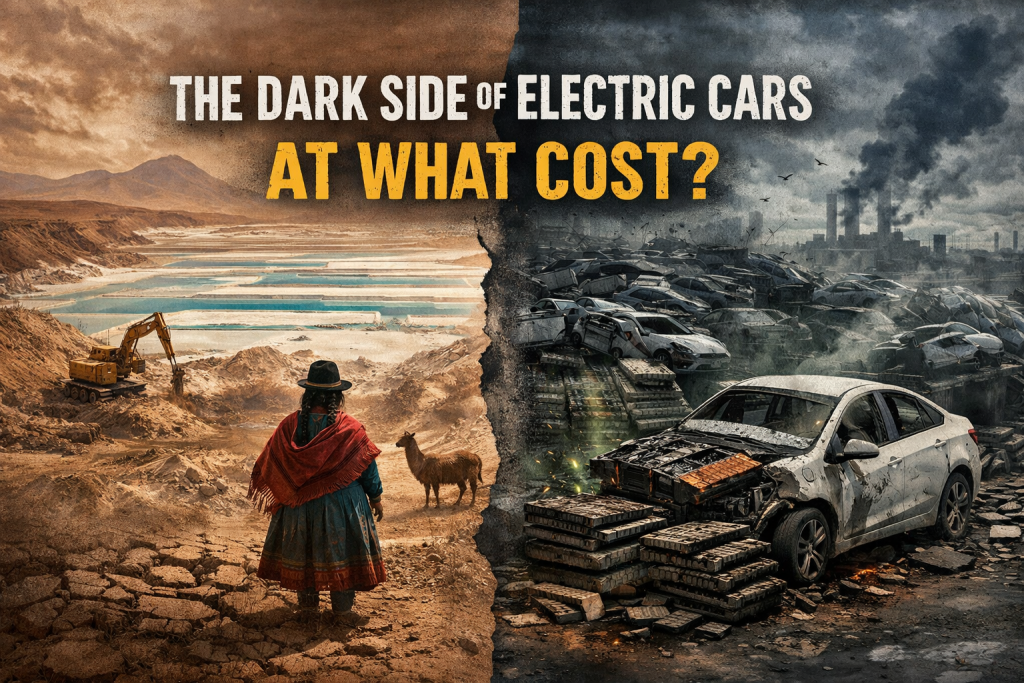
The modern electric car runs on more than electricity. It runs on minerals — and minerals have to be ripped out of the earth. The new fuel of the “green future” isn’t oil alone: it’s lithium, nickel, cobalt, graphite, and more. And the extraction doesn’t happen in glossy European showrooms. It happens in places where ecosystems are fragile, water is scarce, and the people who live nearby often have far less power to resist the pressure.

Chile is frequently held up as a symbol of this new reality. In the Atacama region, concerns have been raised for years about lithium extraction and water stress in an already arid landscape. And while “displacement” doesn’t always mean literal bulldozers and forced removals, communities can still be displaced in practice, when resources shrink, livelihoods collapse and the land becomes harder to inhabit. You don’t always need an eviction notice to be pushed off your own future.

Then comes the question nobody wants to picture too clearly: what happens when millions of EV batteries die?

Batteries degrade. Capacity drops. Replacement costs bite. Cars are written off. And suddenly we’re not looking at a futuristic revolution, we’re looking at a looming waste problem. We are manufacturing the next century’s landfill with a smile on our faces, because it feels cleaner today.

Yes, recycling exists. Yes, there are second-life uses for some batteries. Yes, policymakers talk about circular economies. But the scale is the issue. Recycling infrastructure doesn’t magically appear just because consumers feel virtuous. It requires systems, enforcement, investment, and time — and at the moment, the global EV rollout is moving faster than the uncomfortable questions that should be travelling alongside it.

So why does this side of the story still feel strangely muted?

Partly because it’s complex, and complex stories don’t trend. But partly because the car industry is not politically neutral. The automobile sector has been one of the most powerful lobbying forces shaping transport policy, regulation, and public messaging for decades. That doesn’t require a secret conspiracy. It only requires something much more ordinary — influence, money, access, timing, and the gentle steering of what gets taken seriously.

This is the deeper danger: the electric car has become a moral symbol. Question it and you’re treated as pro-oil. Doubt it and you’re dismissed as anti-progress. But this isn’t how ethical responsibility works. A solution isn’t automatically good because it comes wrapped in green language.

Electric cars may reduce emissions. But they don’t end extraction. They don’t end harm.

We’re not transitioning from dirty to clean. We’re transitioning from visible pollution to invisible supply chains, from smoke in our cities to disruption in deserts we’ll never visit.

So yes: electrification may be part of the future. But only if we stop treating it like a miracle and start treating it like what it really is: a trade-off. A compromise. A human project, built inside a world of scarcity, power and competing interests.

If we want an energy transition worthy of the name, we need more than new engines. We need transparency, better public transport, enforceable standards, serious recycling systems and the courage to count the human cost, not as an inconvenient footnote, but as part of the moral equation.

“A thing is right when it tends to preserve the integrity, stability and beauty of the biotic community. It is wrong when it tends otherwise.”
Aldo Leopold

When God Comes Back: A Note of Caution for Gen Z (from an Ex-Pastor)

On 11 January 2026, Sky News ran a piece with a headline that would have sounded unlikely a decade ago: “How did Gen Z become the most religious generation alive?”

The article reports an uptick in religious belief and church attendance among young adults, with social media playing a surprising role in how faith is “discovered” and spread: short-form religious content on TikTok and Instagram, influencers speaking openly about God, and churches receiving enquiries from young people who first encountered religion online.

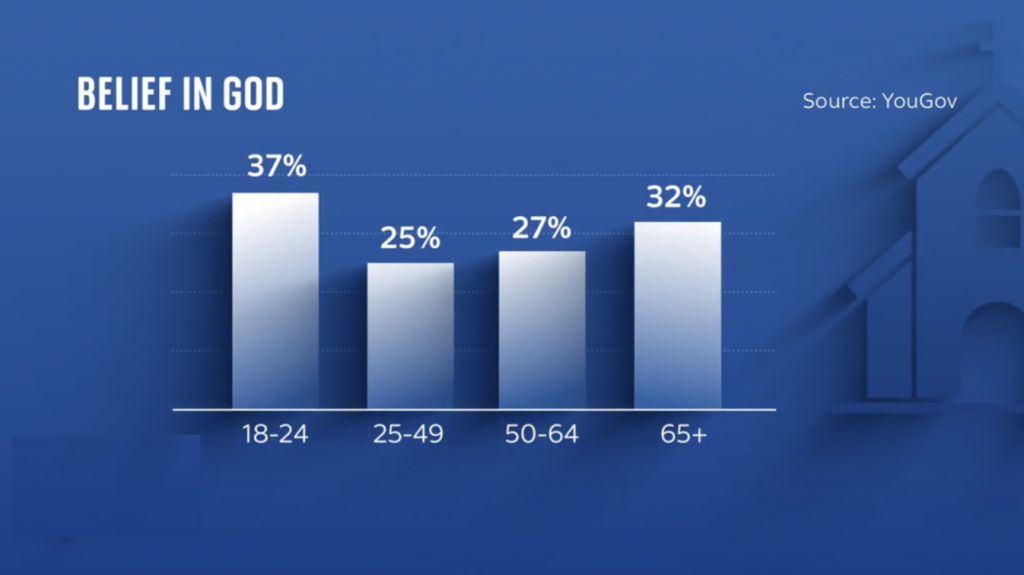
Sky’s piece includes voices from Christian influencers who say they’re seeing a noticeable rise in young people asking how to get involved, and it references YouGov data suggesting a marked shift: among 18–25s, monthly church attendance rising from 7% (2018) to 23% (2024), and belief in a higher power rising from 28% to 49% across the same period.

Even the sceptics appear in the report—young atheists who say this doesn’t match what they see online, or who wonder whether the change is temporary and pandemic-shaped.

So: something is happening. And if we care about society, about meaning, about the moral atmosphere we all breathe, we should pay attention.

Why this makes sense (even if you’re not religious)

I teach university students. I write about social meaning. And I have to admit: the trend itself is not mysterious to me.

When a society loses confidence in its shared story, people don’t become “purely rational.” They become hungry.

For a long time, the West lived off inherited moral capital: ideas of human dignity, restraint, compassion, truth-telling, fidelity, responsibility—values that were once anchored in a Christian metaphysics, then carried forward as if they could survive on sentiment alone.

But sentiment doesn’t sustain a civilisation.

What we increasingly offer young people instead is:

    • Ethical drift: everything negotiable, nothing binding
    • Performative role models: influence without character, aesthetics without responsibility
    • Thin narratives: “be yourself,” “live your truth,” “manifest your future” — slogans that collapse under suffering
    • A destabilised world: economic fragility, housing impossibility, ecological anxiety, war returning as background noise

Under those conditions, it is almost inevitable that many will reach for something older and firmer than the modern self. Something that says:

    • this is real
    • this is right
    • this is wrong
    • your life is not an accident
    • your suffering is not meaningless
    • there is a way through

And in the Western world, that “something” is most readily available in Christianity.

Which churches will benefit most

If Gen Z is turning toward Christianity for meaning and stability, we should be honest about where the gravitational pull will land.

It will not primarily be the churches that sound like ritual, bored faces and committees.

It will be the churches that sound like conviction.

The kinds of churches most likely to grow are the ones that offer:

    • non-negotiable truth (not “your personal journey,” but The Answer)
    • a strong identity (“this is who we are; this is how we live”)
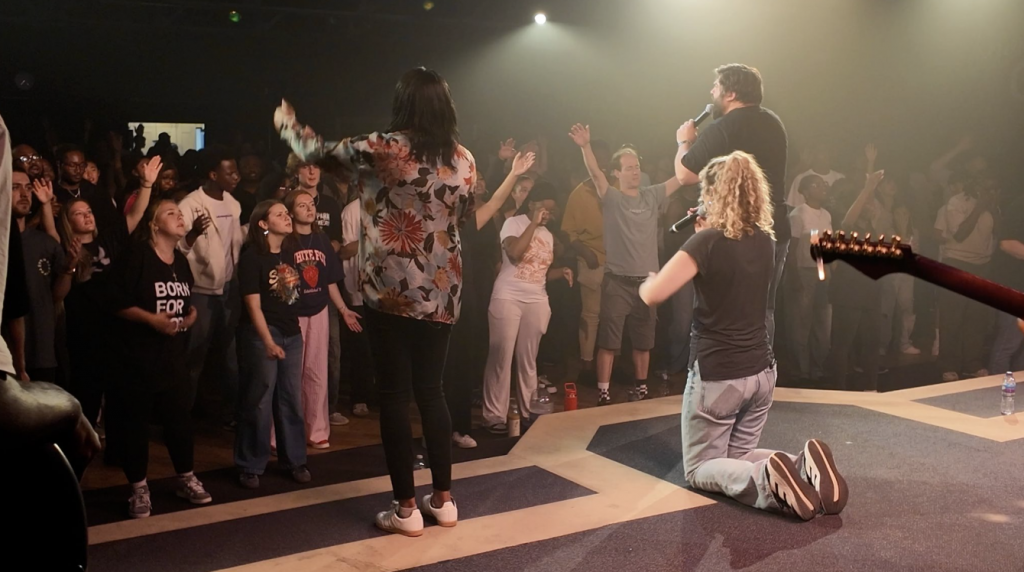
    • high emotional impact (music, lighting, atmosphere, collective intensity)
    • clarity about enemies (the world, the devil, “compromise,” secular decadence)
    • belonging that feels immediate and total

The Sky News article points to the rise of Christian content on TikTok and influencer culture around faith.

That ecosystem naturally rewards certainty, compression, drama, and transformation narratives—all things charismatic and fundamentalist Christianity has always been good at packaging.

If you want a religion that fits social media, you will end up with the kind of religion that performs well on social media.

And that is where my caution begins.

My stake in this: I used to be one of them

I am not writing this as an anti-Christian hit piece.

I am writing this as someone who once stood inside that world—as a pastor, not merely a visitor. I believed. I preached. I led people. I sold my house and car and moved abroad with my family. I was part of the machinery that makes a high-commitment church feel like home and destiny at the same time.

I no longer believe in God.

And because I know what these churches can do—both the beauty and the damage—I want to say something directly to any Gen Z reader who is moving toward Christianity because the world feels hollow and unstable.

You are not foolish for wanting meaning.

You are not stupid for wanting a moral anchor.

But you may be walking, without realising it, into a system designed to take more from you than it gives.

So let me offer a warning, not against faith as such, but against a particular style of faith that is increasingly likely to catch you.


Four warnings before you hand over your life

1) It offers “ultimate truth” — but it cannot prove it

Fundamentalist Christianity sells certainty.

It tells you the world has a secret structure and it possesses the key: virgin births, miracles, demons, healings, resurrections, prayers that alter reality. It gives you a total explanation and calls that “faith.”

But human beings will believe almost anything if it fits the narrative they are offered—especially when the narrative arrives wrapped in community, music, belonging, and moral purpose.

That is not an insult to believers. It is an observation about humans.

A strong story can feel true even when it isn’t.

And the stronger the story, the more it demands you interpret everything through it: your sexuality, your friendships, your doubts, your pain, your ambitions, your money, your family.

Once you interpret reality through a sacred script, the script becomes self-sealing. Evidence against it becomes “temptation” or “attack” or “pride.”

That isn’t truth. That is a closed system.

2) It trains you to call the selflessness “love” — but salvation is still about you

There is a reason Nietzsche was so ferocious about Christianity.

Christianity can produce remarkable acts of compassion—real kindness, real service. Many Christians are genuinely good people.

But at the structural level the religion often contains a hidden centre of gravity: your soul, your salvation, your standing before God, your purity, your afterlife.

Even love can become instrumental:

    • I love you because I must be Christlike
    • I witness to you because your conversion validates my worldview
    • I “forgive” you because it keeps me clean
    • I help you because it stores treasure somewhere else

When salvation is the central preoccupation, the self never truly exits the stage.

You may feel you are becoming “more loving,” but you may also be becoming more morally anxious, more self-monitoring, more dependent on approval, more afraid of your own doubt.

3) The sacrifices will not deliver what is promised

High-commitment Christianity often sells a paradox:

Give up the world and you will gain joy.

And sometimes, at first, it works. Early conversion can feel like oxygen: clarity, unconditional love, a new tribe, a new identity, a new sense of direction. In a lonely world, that is powerful.

But over time the bargain changes.

You will be asked to sacrifice things that are not merely “sinful,” but simply human:

    • parts of your identity that don’t fit the template
    • questions you’re not allowed to keep asking
    • desires you must rename as temptation
    • relationships that become “unequally yoked”
    • your own inner authority

And here’s the trap: the moral standard is often impossible.

You will be told to be holy, pure, humble, grateful, surrendered, joyful, obedient, servant-hearted, faithful, prayerful, disciplined, generous, forgiving, and to treat doubt as rebellion.

That produces one of two outcomes:

    1. you become a performer: outward righteousness, inward fracture
    2. you become perpetually guilty: never enough, never clean, never sure

Neither is freedom.

4) You may be entering a soft prison you won’t easily leave

This is the warning I most want to underline.

A church can become a total social world:

    • your friends
    • your dating pool
    • your weekends
    • your music
    • your language
    • your moral framework
    • your sense of being “safe”

And once that happens, leaving is not like changing a hobby. It is like exiting a country.

The gravitational pull is real:

    • leaders frame departure as betrayal
    • friends become wary, then distant
    • doubts must be hidden or confessed
    • your identity becomes fused with the group
    • your fear of “backsliding” keeps you inside

Even if nothing “cultic” is happening, the system can still function like a sect: high belonging, high cost, high control.

And if your life later falls apart, as lives sometimes do, the love you thought was unconditional can become conditional very quickly.

I have lived that.

When my own life imploded, many of the people who had once spoken the language of grace stepped back. Disappeared. Some rewrote history. Some behaved as if I had never existed. It was as though my entire Christian life was deleted overnight.

And the cruelty of that is specific: because Christianity is often sold as the cure for rejection. You think you are finally safe.

Then you discover you were safe only while you were useful, coherent, and compliant.


A closing word to Gen Z: don’t outsource your hunger

If you are drawn toward Christianity because the world feels unstable, I understand.

The moral void is real.

The longing for meaning is not childish. It is the most adult thing about you.

But please, before you hand over your identity, time, sexuality, money, and inner authority to a high-commitment religious system—pause.

Ask:

    • Does this community make me more honest, or merely more certain?
    • Does it strengthen my conscience, or replace it?
    • Does it widen my compassion, or narrow my world?
    • Can I doubt here without being punished?
    • If I leave, will love remain?
    • What is the cost of belonging—and who benefits?

If you still choose faith, choose it with open eyes.

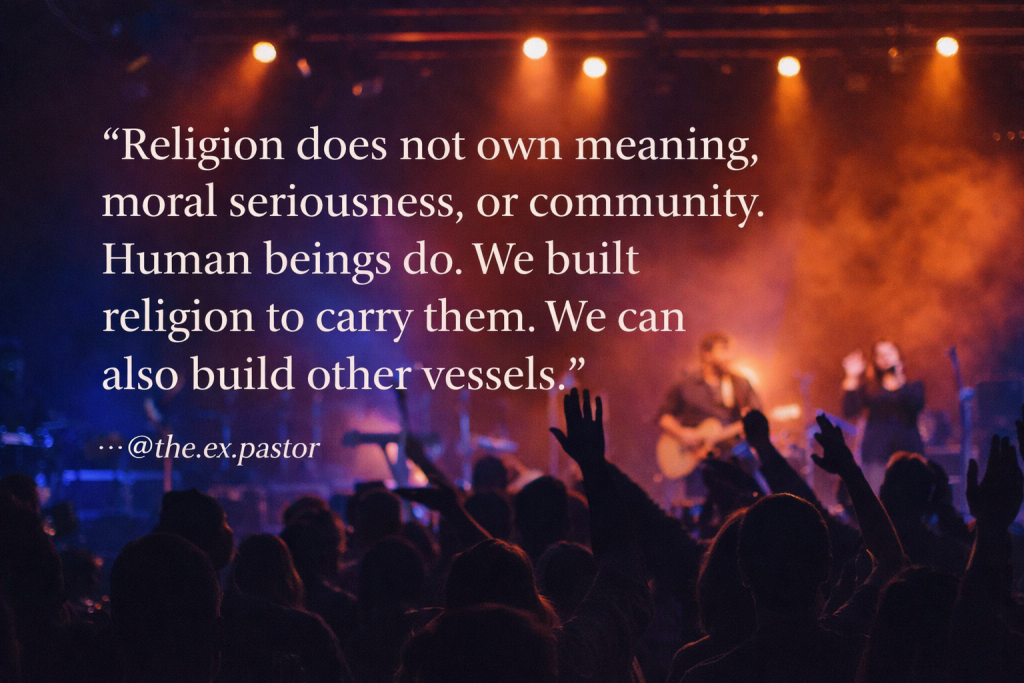
And if what you are really seeking is meaning, moral seriousness, and community, remember: religion does not own those things. Human beings do.

We built religion to carry them. We can also build other vessels.

The point is not to mock your hunger.

The point is to protect you from people who know exactly how to use it.

“I might believe in the Redeemer if his disciples looked more redeemed.”
— Friedrich Nietzsche

The Trump Presidency: A Legacy of Lawlessness, Chaos and Global Instability

The return of Donald Trump to the White House was sold as a revival of American strength and clarity. Instead, it has produced a presidency defined by lawlessness abroad, institutional corrosion at home, economic volatility and moral collapse at the top.

From the unlawful military assault on a sovereign nation to the degradation of public discourse and democratic norms, Trump’s tenure increasingly resembles not leadership, but deranged instability — driven less by coherent strategy than by impulse, grievance and personal spectacle.


1. The Unlawful Attack on Venezuela: A Crime Against Sovereignty

In January 2026, Trump authorised a U.S. military operation in Venezuela resulting in the capture of President Nicolás Maduro and his wife, who were flown to New York to face charges. Trump openly stated that the United States would “run the country” during a transition and signalled willingness to deploy ground troops if necessary.

International law experts were unequivocal: the operation violated the UN Charter, which prohibits the use of force against a sovereign state absent self-defence or explicit UN Security Council authorisation. Venezuela was not at warwith the United States. No imminent threat was demonstrated. Congress was not meaningfully consulted.

This was not law enforcement. It was executive force projection without legal basis — the kind of unilateral action the post-1945 international order was designed to prevent. Trump is considering similar illegal aggression in Colombia and Greenland.


2. Failed Peace in Palestine, Ukraine, and Beyond

Trump’s claim to be a “peacemaker” collapses under scrutiny.

In Gaza, he floated proposals involving U.S. control of territory and the relocation of civilian populations — ideas widely condemned as unlawful, destabilising, and ethically indefensible.

In Ukraine, his approach has leaned toward freezing conflict on terms favourable to Russian territorial gains, weakening Ukrainian sovereignty while undermining the principle that borders cannot be changed by force.

In both cases, Trump has confused domination with diplomacy, mistaking coercion and spectacle for peacebuilding.


3. Character Matters: A President Unfit for the World Stage

Before economics, before diplomacy, before markets, one must confront a more basic question:

Is this man fit to exercise power at all?

Trump is:

    • Twice impeached by the U.S. House of Representatives
    • Convicted on 34 felony counts in a New York criminal court
    • Found civilly liable for sexual abuse by a jury
    • A man with a long public record of racist rhetoric, including attacks on judges, migrants, foreign leaders, and entire nations
    • Someone who displays proud incuriosity, routinely dismissing expert briefings, intelligence assessments, and scientific consensus

Beyond legality lies a deeper problem: Trump lacks the intellectual and rhetorical equipment required of a statesman on the world stage.

His speech is repetitive, grievance-driven, factually loose and emotionally reactive. He substitutes insult for argument, volume for substance, and loyalty tests for reasoning. Complex geopolitical realities are reduced to slogans. Allies are treated as stupid inferiors. Democratic institutions are treated as obstacles to his dictatorship.

This is not merely a stylistic issue. Language is how power is exercised, alliances are sustained, and crises are defused. A leader unable or unwilling  to speak with precision, restraint and moral seriousness inevitably degrades the office itself.

The chaos of the Trump presidency is not accidental. It is character made policy.


4. Isolation of the United States Abroad

Under Trump, the United States has shifted from coalition-builder to disruptor.

Long-standing allies describe Washington as unpredictable and transactional. NATO cohesion has been strained. European leaders increasingly speak of “strategic autonomy” — diplomatic language for no longer trusting the United States to act responsibly.

International institutions once anchored by U.S. leadership are now treated with open hostility or contempt. The result is not strength, but diminished influence and accelerated fragmentation of global norms.


5. Damage to International Markets and Global Stability

Trump’s foreign policy volatility has produced tangible economic consequences.

The Venezuela intervention rattled energy markets and increased geopolitical risk premiums. Unpredictable rhetoric on trade, sanctions, and conflict has made long-term investment planning harder — not just abroad, but at home.

Meanwhile, China flourishes with BYD overtaking Tesla as just one indicator.

Markets dislike uncertainty. Trump manufactures it.


6. The Myth of Economic Mastery

Trump continues to claim unparalleled economic success. The data tells a more restrained story:

    • GDP growth has been moderate, not exceptional
    • Unemployment has risen relative to prior post-pandemic lows
    • Stock market gains largely reflect global cycles rather than presidential policy
    • Wage growth continues to struggle against persistent inflation

Outside healthcare and a few protected sectors, job quality remains uneven, household debt is rising, and borrowing costs remain high.

This is not an economic renaissance. It is fragile performance sustained by volatility and lies on ‘Truth’ Social.


Conclusion: Not Statesmanship, But Spectacle

Trump is still treated by parts of the media and political class as a “serious statesman.” This is perhaps the most dangerous illusion of all.

A man repeatedly found to have violated the law, to have abused power and to have debased public discourse does not become presidential through repetition or normalization. Power does not cleanse character; it exposes it.

If any American voice should frame this moment, let it be that of Dwight D. Eisenhower, a Republican, a general, and a president who understood the cost of reckless leadership:

“When peace has been lost, when confidence in the persistence of orderly government has gone, cities are sacked, institutions fail, and men perish.”

Trump’s presidency will not be remembered as a defence of America — but as a warning of what happens when spectacle replaces judgment, and character is dismissed as irrelevant.

Meaning Before Language

At the start of the New Year, I began growing mung bean sprouts on the kitchen counter. Nothing ambitious: a glass jar, a handful of dry beans, water, patience. It was partly practical — a small attempt to eat better — and partly seasonal, a gesture of beginning again.

But as so often happens, attention did the rest.

Each morning and evening I rinsed the beans, drained the water, and tilted the jar back into place. Within a day, change began. Roots appeared. Pale shoots followed. By the third day, the jar was quietly alive with direction and momentum. Nothing dramatic. Nothing expressive. Just steady response.

Watching this simple process unfold gave rise to a set of thoughts that have stayed with me.

There is something quietly reassuring in discovering that:

    • order doesn’t require intention
    • meaning can emerge from conditions
    • responsiveness is not the same as consciousness

A seed doesn’t care —
but it is exquisitely attuned.

That distinction matters far beyond botany.

A mung bean has no brain, no awareness, no sense of purpose. It does not want to grow. It does not know that it is growing. And yet, when the conditions are right — moisture, warmth, oxygen — it responds. Enzymes activate, stored energy is released, cells divide, and a process begins that looks uncannily like purpose.

But it isn’t.

What the seed demonstrates is something both humbling and quietly radical: meaning can arise from structure rather than intention. Order can appear without a planner. Direction can emerge without desire. Life can move forward without knowing why.

“Life is not obliged to make sense to us.”
Richard Dawkins

We tend to assume the opposite about ourselves.

Much of modern human anxiety is rooted in the belief that meaning must be consciously created: unless we are constantly choosing, narrating, justifying, our lives risk becoming meaningless. We speak as if significance must always be meant by someone, preferably articulated, preferably defensible.

And yet, much of what shapes us most deeply happens long before we have words for it.

Which brings us to language.

There is a quiet assumption, widely shared and rarely examined, that meaning only exists where language exists. I certainly absorbed this idea early on: that without words, symbols, and narratives there could be no meaning, only blind mechanism. Animals, plants, seeds may be somehow alive, but they are not conscious of their existence because they do not have language. But is this assumption true under closer attention? Language does not so much create meaning as name it. Long before we describe a situation as safe or threatening, nourishing or hostile, our bodies are already responding. Long before a child can articulate belonging or neglect, those conditions are shaping who they become. Meaning, in this sense, precedes language. Language arrives later, not as the origin of significance, but as its echo.

Taken seriously, this idea does not just reshape education or psychology; it also presses uncomfortably on our concepts of religion.

If meaning precedes language, then religion becomes structurally vulnerable in a way it rarely acknowledges. Religious systems depend on language to define, order, and sanctify a reality that was already unfolding long before it was named. Just as the seed germinates without reference to our metaphors, doctrines, or reverence, the world generates complexity, order, and awe without requiring theological narration. Religion, in this light, does not create meaning but gathers around it — stabilising, preserving, and sometimes claiming ownership of what would otherwise continue unbothered. The danger is not that religion is false, but that it mistakes itself for the source rather than the afterimage of meaning: a linguistic architecture built around processes that do not need to be spoken in order to be real.

“There are no facts, only interpretations.”
Friedrich Nietzsche

Seen this way, the seed is not a lower form of life waiting for consciousness to redeem it. It is a reminder that attunement comes before articulation.

This has implications for how we think about human agency. To say that meaning can emerge from conditions is not to deny responsibility or choice. It is to relocate them. Agency is not constant control; it is responsiveness within constraints. The skill is not to will meaning into existence, but to recognise what kinds of environments allow growth — in ourselves and in others.

And this is where education enters the picture.

Much of contemporary schooling still reflects a modernist inheritance: knowledge divided into discrete subjects, timetabled and assessed in isolation. Biology here. Chemistry there. Physics somewhere else. Meaning nowhere in particular.

We teach biology largely as a catalogue of facts — cell structures, taxonomies, cycles, pathways — accurate, necessary, and often lifeless. Rarely do we teach it as the study of responsive systems. We talk about genes, but not environments. About mechanisms, but not emergence. Students learn that a seed needs water, warmth, and oxygen, yet miss the astonishing implication: life does not need a mind in order to organise itself.

By separating biology from physics and chemistry, we also reinforce a subtle illusion — that life is something apart from the rest of reality, rather than a continuation of it. As if metabolism were not chemistry in motion. As if growth were not physics slowed down and shaped by constraint. As if living systems did not obey the same laws as rivers and stars, only at a different scale.

A more truthful curriculum would dissolve these boundaries.

“What we observe is not nature itself, but nature exposed to our method of questioning.”
Werner Heisenberg

Imagine teaching “life” as a conversation between disciplines:
chemistry becoming organised,
physics learning to linger,
energy flowing through matter long enough to notice itself.

In such a curriculum, a sprouting seed would not be a marginal example but a foundational one. Students would be invited to ask not only what happens, but what it reveals: that responsiveness predates consciousness, that attunement is older than intention, that meaning does not need to be imposed in order to arise.

The ethical consequences would follow naturally. Instead of moralising failure, students might ask better questions: What conditions were missing? What environments are we creating? What do we reward, nourish, neglect?

Education, at its best, does not manufacture outcomes.
It creates conditions.

A seed doesn’t care.
But it responds.

So do children.
So do communities.
And, more often than we like to admit, so do we.

Perhaps part of the task of education — and of adult life — is to relearn this modest, hopeful truth: that meaning does not always need to be pursued or declared. Sometimes it only needs the right conditions in which to emerge.

“The most incomprehensible thing about the universe is that it is comprehensible.”
Albert Einstein

Love, Bureaucracy, and the Borders of Europe

How a perfectly legal couple spends years fighting a system that claims to protect the family

I have always loved Europe.
I still do.

The peace, the democracy, the rule of law — these are extraordinary privileges, and I’m grateful every day to live in a part of the world that, compared to most of the planet, is safe, stable and humane.

But loving a thing does not mean lying about it.
And the deeper my own journey into the European immigration system has taken me, the more convinced I have become that something fundamental is broken — not just in Germany, not just in Britain, but across almost the entire continent.

This is not an anti-German story.
It is a story about what it feels like to do everything legally, responsibly, respectfully — and still find yourself treated as if love were a loophole, marriage an inconvenience, and foreign spouses a threat to be contained.

It is a story that could happen in almost any European capital.

It just happened to us in Berlin.


How Love Became a Test of Endurance

A few years ago, I fell in love with a remarkable man in Indonesia.
Our relationship grew quickly and deeply, and we knew we wanted to build a life together in Europe rather than in Indonesia. We planned to marry anyway, so we assumed — naively, as it turns out — that marriage and legitimacy would make the process of living together straightforward.

We were wrong.
Painfully, spectacularly wrong.


Wedding Bells, Bureaucratic Walls

Because our marriage would not be legally valid in Indonesia, we had to marry in Europe.
What we imagined would be a simple civil ceremony became a six-month odyssey through paperwork, translations, apostilles, appointments, contradictory guidance, and requirements that bordered on the absurd.

Still — we got married.
We thought the hardest part was behind us.

But marriage, we learned, is not a ticket to a shared life.
It is merely the beginning of a long, labyrinthine process designed, it seems, to test whether your relationship can outlast bureaucracy.


The Rule No One Tells You: “Apply in Jakarta, or Don’t Come at All”

Once married, we were informed of something almost nobody tells you in advance:

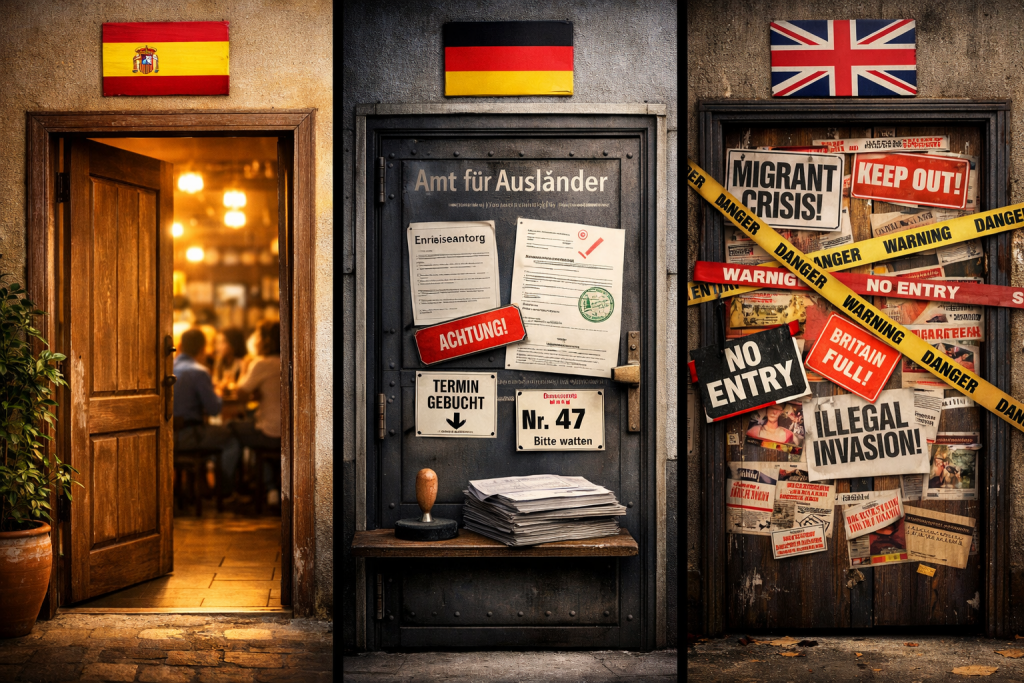
If you marry an Indonesian and want to live together in Europe, your Indonesian spouse must apply for a family-reunification visa from Jakarta — and only from Jakarta.

Not from Berlin.
Not from any European consulate closer to their home island.
Not from Europe on a tourist visa (which would be logical, humane, and in line with every legal principle about protecting marriage).

Jakarta.
Or nothing.

The waiting list?
One year.
We have the screenshot.

And that’s just the waiting list for you to submit your application — not the processing time afterwards.

Imagine telling any married couple in Europe:

“Congratulations on your marriage.
You will now be forcibly separated for at least 12 months.”

That is the system.
That is the norm.


One Document Wrong? Start All Over Again.

When our turn finally came, the embassy did not approve one of the documents uploaded during the online process. They asked us to delete it — and, indeed, there is a little trash-can icon on the website.

Except the icon doesn’t work.
It never has.

After weeks of emails, calls, and technical back-and-forth, the embassy’s final advice was:

“Delete your entire application and start again.”

Which, in plain language, means:

“Restart the one-year waiting list.”

It is breathtaking to realise that the legal rights of marriage can be instantly overruled by a broken trash-can icon.


Geography as a Financial Weapon

If you are Indonesian and live on Sumatra, you must pay to fly twice to Jakarta — once for biometrics, and once to collect the visa. These costs are enormous relative to Indonesian salaries.

For many families, this is simply impossible.

This is what “legal migration” looks like in practice.


The 90/180 Trap: A Long-Distance Marriage by Law

Some couples try an alternative: the Schengen visitor visa.
But that route comes with its own cruelty:

  • Your spouse can visit for 90 days maximum

  • but must then leave for another 90 days minimum

Meaning:

You may live together for three months, then be forcibly separated for six.
Three on, six off. Three on, six off. Indefinitely.

Assuming, of course, you can afford the flights between Jakarta and Europe.
Most cannot.


The Berlin Immigration Office: A Fortress Without Doors

If the embassy maze is surreal, the immigration office in Berlin is its European twin.

You cannot phone them.
You cannot email them.
You cannot speak to a human being unless you already have an appointment — and you cannot get an appointment without submitting a webform that may sit unanswered for two months.

If you attempt to enter the building to ask for help, security guards turn you away.
“No appointment, no entry.”

It is Kafka with fluorescent lighting.


When Your Appointment Arrives… It’s Too Late

In our case, by the time Berlin offered my husband an appointment, his visitor visa had expired.
They could not — or would not — offer an earlier date.

He was legally in the country.
He had proof of marriage.
He had every document required.

But the system, moving at its own glacial pace, simply shrugged.


The Catch-22: Work to Stay, But You Can’t Work Until You Stay

Here is the cruelest irony:

To obtain residency, the European spouse must prove sufficient income to support both partners.

But the foreign spouse cannot work unless they already have residency.

So if the European partner earns too little, the spouse receives only a six-month Fiktionsbescheinigung — a kind of temporary suspension of deportation, halfway between permission and limbo.

With that document:

  • You cannot work

  • You cannot earn

  • You cannot contribute

  • Therefore you cannot raise household income

  • Therefore you do not qualify for residency

This is not immigration policy.
It is a bureaucratic cul-de-sac.


And Then You Realise: If It’s This Hard for Us… What About Them?

We are educated, organised, legally married, European-based, English-speaking, German-speaking, online-competent, and persistent.

And still we nearly drowned in the system.

What must this system feel like for asylum seekers?
For people fleeing war or persecution?
For couples separated across borders with children in tow?
For those without money, stability, documents, or perfect German?

Oh yes, and in case you’re wondering, I did contemplate moving back to the UK and applied for residency for my English-speaking husband there. Our application was declined.

The system does not merely fail people.
It dehumanises them.


A Quiet Exception: The Spain Nobody Talks About

There is one place in Europe where the logic is different: Spain.

Spain has a little-known rule — almost never advertised — called arraigo social.

If you remain in Spain for two years, stay out of trouble, and integrate into community life, you can obtain legal residency.

No endless separation.
No forced poverty.
No trapdoors disguised as requirements.
No broken webforms or locked doors.

If you are married and have property there, the chances are even better.

Whatever critics say, this is a system that treats people — even undocumented ones — as human beings capable of building a life.

It is the closest thing Europe has to a humane immigration philosophy.


What This Story Is Really About

This is not a rant.
Nor is it an attack on Germany, which continues to offer extraordinary opportunities to millions of people, myself included.

It is a plea.
A testimony.
A reminder that behind every “case number” is a love story, a family, a life.

Europe prides itself on protecting marriage – see ECHR, Article 8 §§1–2.
Courts across the continent insist that “bureaucratic inefficiency is not a legitimate reason to separate spouses.”

But in practice?
The systems built to uphold those principles routinely violate them.

If Europe wants to protect its values — its humanism, its dignity, its rule of law — the immigration system is where it must begin.

Not with walls.
Not with suspicion.
But with the simple recognition that married couples should not have to fight this hard to live under the same roof.

“Bureaucracy is the death of all human action.” — Max Weber

A Perfectly Absurd Christmas Story

The other evening, in the spirit of seasonal escapism, we were watching Man vs Baby—a piece of festive fluff involving slapstick chaos, an unruly infant, and, inevitably, a primary-school nativity play.

At some point, my husband—who grew up in Indonesia and is unfamiliar with Christian traditions—turned to me and asked, quite innocently, what the story was actually about.

So I explained.

A teenage girl called Mary, who was also a virgin, gives birth to a baby. This baby is God. He is born in a stable because there is no room for him in the local accommodation. A star appears in the sky, guiding three wise men and a group of shepherds to come and worship this baby and bring him gifts. This child will later be executed, rise from the dead, ascend into heaven, and now sits—still in a human body—on the throne of the universe, exercising ultimate authority over all of existence for all eternity.

My husband listened politely. He nodded. He asked no follow-up questions.

But as I heard my own voice recounting this story, I had a sudden, almost comic moment of estrangement. Detached from carols, candlelight, stained glass, and nostalgia, the narrative sounded astonishingly absurd.

And yet.

It is also undeniably beautiful.

As a story, it has extraordinary power. Told aloud. Set to music. Painted. Sculpted. Recreated each December in glowing wooden cribs in living rooms, churches, town squares, and shopping malls. It is gentle. It centres on vulnerability rather than force. A baby rather than a king. Straw rather than marble. Hope for the world arriving quietly, unnoticed and poor.

I once believed it all.

Not only as a child, but later for about fifteen years of my adult life, when I was a Bible-believing fundamentalist Christian. I genuinely thought this story, set in the Middle East two millennia ago, explained everything: meaning, love, suffering, death, and the ultimate destiny of the world. I didn’t experience it as absurd at all. It felt profound, coherent, and necessary.

But with distance, the story didn’t simply become implausible; it became troubling. Not because it is poetic or mysterious, but because of what has been built upon it. The same “cute” story about a baby has been used to justify division, exclusion, cruelty, war, and extraordinary human suffering. Not by accident, but repeatedly, systematically, and often with great confidence and moral certainty.

That, for me, is the real tragedy—not that the story is implausible, but that it has been weaponised.

And yet, here we are again.

Lights are going up. Schools are rehearsing their nativity plays. People are travelling, eating too much, falling out, making up, missing those who are no longer here and trying, in their imperfect ways, to be a little kinder.

So this is not a call to cancel Christmas. Nor is it an attack on those who still believe the story literally. It’s simply an honest moment of reflection: a recognition that something can be both moving and absurd; beautiful and dangerous; comforting and deeply problematic.

In any case, beliefs aside, I want to take this opportunity to wish you—whoever you are, wherever you are—a genuinely restful and enjoyable Christmas and New Year break. May there be moments of warmth, laughter, good food, and quiet. And for 2026, I wish all of us what really matters: peace, goodwill, good health, and a little more humility about the stories we tell ourselves—and each other.

Happy Christmas.

“Christmas is not a time nor a season, but a state of mind.”
Calvin Coolidge

Cathedrals of Quiet Light: An Homage to Libraries

I did not expect a pilgrimage. All I wanted, on a cold Berlin morning, was a simple desk in my local library. A familiar refuge where I could coax myself into writing. Instead, I arrived to find the doors barred and the building shrouded in scaffolding. Closed for refurbishment. And yet even that felt oddly hopeful: a library being tended to, repaired, protected. A chrysalis in plywood. Still, it left me homeless for the day, so I pointed myself into the centre of Berlin and followed a vague instinct in search of a different reading room.

By early afternoon I was standing inside the Humboldt University Library, in the central Jacob-und-Wilhelm-Grimm-Zentrum — a building completed in 2009 at a cost of roughly €150 million, a temple to light and linearity, a modern cathedral carved out of honey-coloured wood. I had never been inside before. I found my way up several flights of stairs, past quiet students and moving columns of books, until I arrived in the library’s great central atrium.

There are moments when atmosphere becomes an event, as if the air thickens with meaning, as though the space itself has a pulse. That is what happened. The first glance into the atrium felt like encountering a new idea before you have the words for it.

The room opened before me in tiers, receding downwards in vast wooden frames, each level lined with narrow study desks illuminated by soft rectangular lamps. Above, the ceiling dissolved into a grid of skylights, a geometry of glass and daylight. Below, hundreds of young people bent over books and laptops, headphones cocooning them, highlighters poised like tiny torches hunting for truth in margins. It was an amphitheatre of thought, tier upon tier of silent striving, human concentration arranged like an inverted ziggurat.

The sight moved me more than I had anticipated. I had often studied in the ancient libraries of Oxford, with their stone floors worn by centuries of scholars and portraits of stern-faced alumni glaring down with a mixture of judgement and encouragement. But this — this modern Berlin chamber with its clean lines and its open light — held its own kind of splendour. If Oxford’s libraries feel like the weight of the past pressing lovingly upon you, the Grimm-Zentrum feels like the future stretching out somewhere beyond the roof.

And suddenly I felt small and young again, in the most wonderful way.


A Place Where the World Learns How to Think

What struck me first was the sound — or rather, the absence of it. The quiet in a library is not mere silence. It is a collective agreement, a social pact, a voluntary reverence. The students around me were not quiet because they were told to be. They were quiet because they were invested. Because something mattered.

Then came the smell — that unmistakable perfume of libraries everywhere:
waxed linoleum; varnished wood; warm dust that rises from the turning of pages; and above all that distinctive scent of old books, a mixture of paper, glue, ink, and time itself. It carries, always, a faint edge of mystery – a reminder that knowledge ages like a living thing.

As I sat down on the highest tier, overlooking this incredible geometry of minds at work, it occurred to me that libraries are among the few places left in modern life where human concentration is visible. We watch it manifest physically: in posture, in scribbles, in slow-page turns, in the absorbed stillness of someone who is trying to understand.

The atmosphere was electric but hushed, charged but respectful. There were students mapping out theses with coloured pens, others scrolling through academic articles, some chewing their pens absentmindedly while staring into middle distance — that universal gesture of a mind wrestling with a concept. There were those who looked exhausted but determined, and others who looked exhilarated by a sentence they had just discovered. Every face was a small story of effort.

This collective striving was profoundly moving. It made visible something we often forget: knowledge is crafted, not downloaded. Even with all the technology around them, these students were still doing the slow, patient work that makes civilisation possible. Research is not glamorous. It is hours of searching, scanning, discarding, re-reading. Yet they persisted.

Watching them, I felt privileged — almost intrusive — as though I were witnessing a kind of secular liturgy.


This Is Not an Anti-AI Eulogy. Quite the Opposite.

Let me say this clearly, and early, because sentiments like mine are often misinterpreted: this is not a rear-guard lament against AI.
No pious calls to return to pre-digital methods. No false nostalgia. No technophobia.

I embrace AI wholeheartedly. I use it every day, and I consider it one of the most extraordinary tools ever created. It accelerates learning, supports human creativity, and holds vast potential for everything from agriculture to medicine to interplanetary exploration. It will help build the colonies on Mars long before we finish debating whether rocket fuel is environmentally friendly.

So this reflection is not a plea for a world without technology. It is instead an attempt to articulate something different: that libraries and AI are not adversaries.
They are partners.
One is where the human mind trains its depth; the other is where it extends its reach.

Libraries teach us how to think.
AI helps us learn faster once we know how.

The library is the gymnasium of cognition.
AI is the exoskeleton.

We need both.


A Secular Temple — or Something More

As I sat in the top tier of that atrium, I realised that all my senses were activated at once: sight, sound, smell, touch, and the quiet murmur of pages turning like a heartbeat for the whole building. It was almost too much. It bordered on the religious.

If you believe in God, you could easily imagine gratitude rising like incense: look what humanity — the species fashioned out of dust and breath — has managed to build. Look how our curiosity has unfolded into architecture, scholarship, craft, and a hunger for understanding that seems inexhaustible.

If you do not believe in God, the miracle remains.
After all, what could be more astonishing than this? That the random electrical impulses arising from an indifferent universe have generated organisms who sit together in vast wooden halls reading about Mesopotamia, quantum mechanics, marine ecosystems, political philosophy, medieval manuscripts, and machine learning algorithms. That atoms born in supernovae now write essays on ethics and the shape of a meaningful life.

Even the most hardened atheist cannot deny the improbability, the majesty of that.

To sit in a library is to witness a miracle in motion — a civilisation rehearsing its own continuation.


The Invisible People Who Make It Possible

It is easy, in moments of beauty, to forget the infrastructure that supports them. But libraries are not spontaneous miracles. They are daily, deliberate acts of civic generosity.

Someone designed this building with its lightwells, its tiers, its acoustics, its quiet. Someone else built it, brick by brick, panel by panel. Others maintain it, polish the floors, fix the lamps, organise the recycling, restock the bathrooms, oil the doors so they close softly.

Then there are the librarians, the custodians of order in our age of chaos. The ones who curate, classify, preserve, and patiently help bewildered visitors locate that one book whose title they have partially forgotten. They are the guardians of continuity, the keepers of fragments, the quiet historians of our intellectual life.

Yesterday, I watched a librarian register new readers at the desk. One of them was me. The young man helping me was in his early twenties, wearing a university hoodie, and fascinated by my British passport. He asked why the text was printed both in English and French. He was curious about British attitudes to Europe, about why I had come to Berlin, about what I was planning to write.

There was no transactional coldness in him. Only a genuine hunger to learn, to connect, to understand. It was a small moment, and yet it added a human warmth to the architecture around us. It reminded me that libraries are not only spatial achievements; they are social ones. They bring together people who believe — perhaps stubbornly, courageously — that knowledge should remain accessible to all.

And yes, I felt grateful. Deeply grateful. In an age dominated by cynicism about governments, it is worth remembering that states still choose to spend millions on libraries, archaeology departments, social sciences faculties, digitisation projects, and the preservation of knowledge. This is not trivial. It is evidence of a civilisation still investing in its own mind.


A Place Where My Own Creativity Woke Up

I did not plan to begin outlining a new novel yesterday. But the effect of sitting in that atrium was galvanising. The sight of hundreds of young minds in motion, the geometry of the architecture, the warm glow of the wood, the filtered daylight, the portraitless vastness that made every student their own protagonist — it all stirred something in me.

Creativity, I am convinced, is contagious. We borrow the electricity of others. When you place yourself in an environment charged with intellectual purpose, something inside you aligns. Ideas begin to organise themselves. Sentences appear without being summoned. Pages begin to form.

That is exactly what happened.

Within an hour of sitting down, my mind was in overdrive, casting threads between ideas I had been carrying for months, imagining scenes, characters, dilemmas. The space did not merely host my creativity; it provoked it. I left with the outline of my next book beating quietly inside my bag.


Why This Matters for the World Our Children Inherit

As I gazed into the atrium, I kept thinking about the thousands of young people around the world who will never experience something like this — who study in overcrowded classrooms, or at kitchen tables, or not at all. And then I thought of the students who do have this privilege and perhaps take it for granted, because we all take blessings for granted when they become part of the wallpaper of our days.

A library like this is not a neutral space.
It is a statement.
A declaration of values.
A place where a society says to its young:

Take this. Explore. Learn. Write. Think. Question. Become. We believe you are worth the investment.

My hope is that such spaces will not become relics. That they will not be drowned by the easy seductions of instant information, nor by political short-sightedness, nor by economic austerity. May libraries continue to stand as cathedrals of collective education, where young people can enter free of charge and leave richer in spirit, sharper in thought, and braver in imagination.


A Final Word of Gratitude

So this is my homage — not to nostalgia, but to possibility. To the people who keep these spaces alive. To the students who fill them. To the architects who imagine them. To the librarians who protect them. And yes, to the governments and taxpayers whose resources make them real.

Most of all, it is an expression of gratitude for the simple miracle that humans still gather in large wooden rooms to read books, annotate pages, debate arguments, and shape knowledge. In a world that often feels fragmented, libraries remind us that our species is still capable of collective enlightenment.

As long as there are libraries, there is hope.
As long as there are young people hunched over books, there is a future worth fighting for.
And as long as we preserve places like this — vast, warm, light-filled, reverent — our civilisation will continue to write itself into being.

Yesterday I entered a library looking for a desk.
I left having recovered my faith in human curiosity.

And perhaps that is the true gift of a library:
it does not simply store knowledge —
it awakens the desire to create more of it.

“Education is the point at which we decide whether we love the world enough to assume responsibility for it.”  – Hannah Arendt

If you love the world enough, go back to a library. Sit down. Read something difficult. Support these spaces. They are still where civilisation renews itself.


The Blueberry Paradox: Why We Keep Destroying the Systems That Could Save Us

On my last day in Spain, I sat at a small café, watching three men take down decorations from the town’s recent festival. The bunting had hung across the square for days, colouring the white-washed walls with celebration. Now the tourists had gone home, and these men — quiet, anonymous, methodical — were returning the square to its ordinary face.

Their work is unremarkable. No one applauds. Yet without people like them, the whole “beautiful tourist city” collapses.
Without them, the photos don’t look charming.
Without them, the streets feel neglected.
Without them, the illusion breaks.

I found myself thinking about fishermen at dawn, hotel cleaners before breakfast, bin collectors at 4am. The quiet labour that keeps the world turning — labour that rarely receives dignity, respect, or fair pay.

Then I looked at my arm.
At the blueberries.

Yes — I have blueberries tattooed on my forearm. And no, it’s not whimsical. Or perhaps it is, but in the way truth sometimes hides inside whimsy.

The blueberries remind me that I cannot enjoy anything alone.
Not even my breakfast.

To eat a blueberry, I depend on soil, weather, farmers, packers, transport workers, supermarket staff, the climate not collapsing this particular year. My pleasure is communal, whether I acknowledge it or not.

Upside down, from a distance, the blueberries form a heart-shape. I didn’t plan that. But perhaps the body speaks before the mind is ready to believe.

The tattoo is a reminder:
You are held. Your life is made by many lives. You are not independent.

And so here’s the question that came to me in that Spanish square:

If we know we are interdependent, why do we build societies that pretend we aren’t?

Why do we reward the illusion of the “self-made individual” while the world is built by the unseen hands of others?

Why does the fisherman earn less than the financier?
The cleaner less than the consultant?
The bin collector less than the politician?

It is not rational.
It is not moral.
It is not even economically coherent.

It is, however, familiar.

And this — whether people like to admit it or not — is where Marx enters the conversation.

Marx’s Point Was Never “Everyone Should Be the Same”

Marx’s central claim was beautifully simple:
Human labour creates value.
So the people who create value should benefit from it.

That’s it.
That’s the hinge.

Marx wasn’t calling for laziness, or enforced sameness, or the death of creativity. He was pointing out that societies become obscene when those who create the conditions for life (food, sanitation, infrastructure, care) are treated as disposable.

He believed in dignity through shared labour.
In contribution as meaning.
In justice as the redistribution of the wealth that labour creates.

Which is why, though he rejected religion, Marx comes surprisingly close to Jesus.

Jesus also preached the reversal of hierarchy:

“The last shall be first, and the first last.”

Not metaphorically — economically, socially, relationally.

Both men looked at society and said:

This is upside down.
We can live differently.

Both pointed to community over competition, relationship over possession, need over greed, dignity over dominance.

And yet —
we have not built the world either of them imagined.

Not once.
Not anywhere.
Not for long.

So the question is no longer Was Marx right?
Or Was Jesus right?

The question is:

What stops us from building the just society both of them saw so clearly?

The Answer Is Not Economic. It’s Psychological.

We call it capitalism vs. communism
but the real struggle is fear vs. trust.

We hoard because we are afraid there won’t be enough.
We compete because we are afraid of being overlooked, replaced, forgotten.
We dominate because we are afraid of being powerless.
We cling to hierarchy because we are afraid of being ordinary.

Fear is the water we swim in.
Fear is the undecorated square after the festival is taken down.
Fear is the silence in the early morning before the day begins.

Marx underestimated fear.
Jesus named it, but was killed for it.

And every system we have built has collapsed for the same reason:

We would prefer to be safe than to be equal.

The Failure Was Never Marx’s. It Was Ours.

We say “communism failed” as if ideology collapsed of its own weight.
But ideas don’t fail.
Systems don’t fail.

People fail.

We fail because we want justice until justice requires something of us.
We want equality until equality asks for our privilege.
We want community until community interrupts our autonomy.

We want the kingdom of God
without the cross.

We want Marx’s dignity of labour
without surrendering status.

So we keep building worlds in which:

  • the blueberry appears magically on the table

  • the labourer remains invisible

  • and we pretend we did this alone.

The Blueberries Again

I look at my arm.
The tattoo.
The accidental heart.

A reminder that interdependence isn’t an ideal —
it’s already true.

We just live as if it isn’t.

The question is not whether a just society is possible.
We already rely on one.
Every day.
Every meal.
Every building.
Every service.
Every breath of shared infrastructure.

The question is simply:

When will we live as though we know it?

And perhaps the first step toward a better society
is simply learning to say:

Thank you.
To the fisherman.
To the street worker.
To the invisible hands.
To the ones who keep the world turning
so that the rest of us can pretend we did it ourselves.