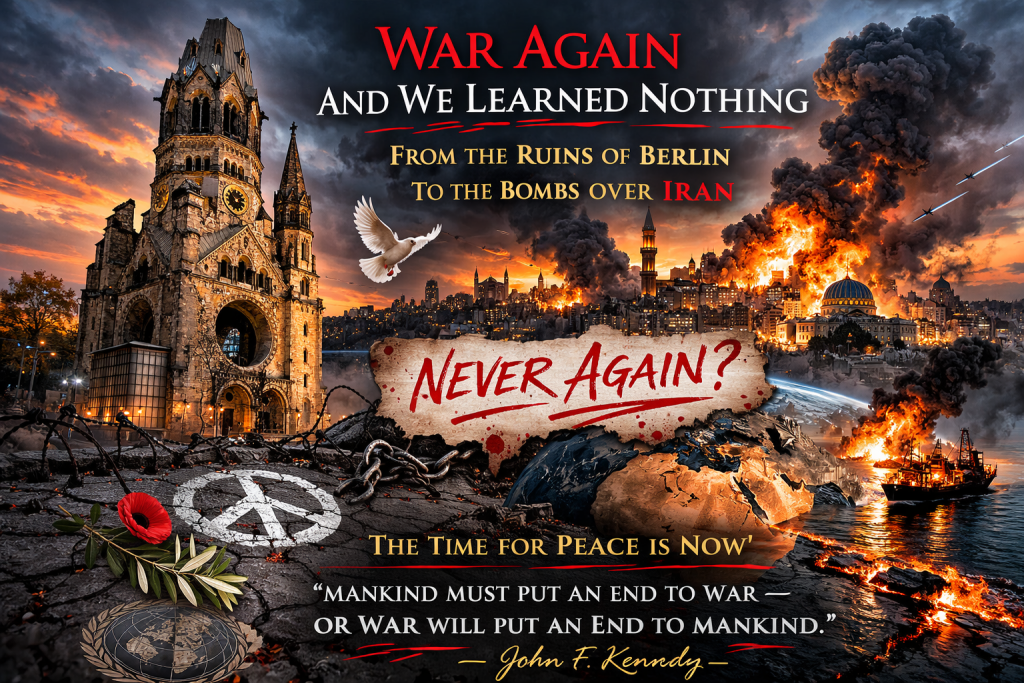
 A Ruin in Berlin
For three years I lived in West Berlin just a few streets from the Kaiser-Wilhelm-Gedächtniskirche.
The ruined spire of that church stands there deliberately. It was left broken after the bombing of Berlin in the Second World War as a powerfully emotive reminder, a warning in stone, of what war does to human civilisation.
Every day thousands of people walk past it.
Its message is simple:
Never again.
And yet, eighty years later, the world appears to have learned almost nothing.
Today we watch yet another war unfolding, this time in Iran, and once again political leaders behave as though history has taught us nothing at all.
International Law and the Collapse of Moral Consistency
The United States and Israel launched coordinated military strikes against Iran on 28 February 2026, triggering what is now a rapidly escalating regional conflict.
The legal justification for this war is deeply contested. In my opinion, it is illegal, as well as ethically abominable.
Under international law, the use of military force against another sovereign state is permitted only under very limited circumstances — primarily self-defence against an imminent armed attack or authorisation by the UN Security Council.
Neither condition is widely accepted as clearly satisfied in this case.
The uncomfortable truth is that international law increasingly appears to function selectively. Western governments rightly condemn Russia’s invasion of Ukraine as a violation of sovereignty and international law. Yet when powerful states carry out military action themselves, the language suddenly changes: “pre-emptive defence,” “security operations,” or “regime change.”
“The ideal subject of totalitarian rule is not the convinced Nazi or the convinced Communist, but people for whom the distinction between fact and fiction no longer exists.”
— Hannah Arendt
Such double standards undermine the very legal order the West claims to defend.
If international law is to mean anything at all, it must apply to everyone, including the most powerful nations on Earth.
A War Already Spreading Beyond Control
The consequences of the war are already rippling far beyond Iran’s borders.
Iran has retaliated with missile and drone strikes across the region, targeting U.S. bases and allied facilities in Gulf states.
Fighting has spread into neighbouring areas including Lebanon and Bahrain, and attacks on shipping in the Persian Gulf have threatened one of the world’s most important energy corridors.
The Strait of Hormuz, through which roughly 20 percent of global oil shipments pass, has become a focal point of the conflict. Next is (already, actually) the Bab-el-Mandeb Strait.
Oil prices have surged toward $100 per barrel, sending shock-waves through the global economy and pushing inflation higher worldwide.
And as always, when energy prices spike, it is the poorest people on Earth who suffer first and most.
Meanwhile geopolitical tensions are intensifying:
-
- Russia benefits financially from rising energy prices.
- The threat to Ukraine increases.
- Israel extends its devastating destruction.
- China watches carefully while global attention shifts elsewhere.
- Regional states are dragged into a widening conflict they did not start.
This is precisely how regional wars drift toward global crises.
The Question of Motives
Officially, the war is framed as an effort to neutralise Iran’s nuclear programme and weaken an authoritarian regime.
Yet history makes many observers sceptical of such explanations.
Geography and energy politics cannot be ignored.
Iran sits at one of the most strategically important crossroads on Earth — between Europe, the Middle East, Central Asia and South Asia. It possesses some of the world’s largest oil and gas reserves and lies adjacent to the shipping lanes that power the global economy.
Control of influence in this region has long been a central concern of global powers.
“Political language is designed to make lies sound truthful and murder respectable.”
— George Orwell
Other factors also shape the conflict:
• Iran’s nuclear ambitions
• Regional rivalry with Israel
• The network of Iranian-backed militias across the Middle East
• Energy security and shipping routes
• Domestic political calculations inside the United States and Israel
Wars are almost never driven by a single motive. They emerge from a tangled mix of fear, power politics, ideology and economic interests.
But honesty about those motives is essential if democratic societies are to judge the wars fought in their name.
The Human Cost
Behind every strategic analysis lies a far more brutal reality.
People are dying.
Human rights groups estimate that more than 3,000 people have already been killed in Iran, including over 1,300 civilians, since the war began.
Other casualties have occurred across the region, including deaths in Lebanon and Gulf states, as the conflict spreads beyond its original battlefield.
Millions of civilians have been displaced from their homes.
War statistics are discussed like numbers.
But every number is a human life.
Each number represents a human life:
a child, a parent, a teacher, a medic, a neighbour.
War statistics are often discussed like sports scores.
But they are not numbers.
They are people. One race: the same story written in different ink. Human beings who deserve dignity and respect. No different from you and me.
The Environmental Catastrophe Few Are Discussing
Modern warfare also carries an enormous environmental cost.
Bombed industrial sites release toxic chemicals. Burning fuel depots poison air and soil. Damaged oil infrastructure risks catastrophic spills into fragile marine ecosystems.
The Persian Gulf, already one of the most environmentally stressed seas on Earth, could suffer damage lasting decades.
War is not only a human disaster.
It is also an ecological one.
A Plea for Sanity
Standing in front of the ruined church in Berlin yesterday, it is impossible not to think about the generations who built the world we inherited.
They saw what total war could do.
They tried to create institutions — the United Nations, international law, human rights conventions — designed to prevent humanity from repeating the same catastrophe.
Those institutions are now under severe strain.
“Those who can make you believe absurdities can make you commit atrocities.”
— Voltaire
If they collapse entirely, the world risks sliding back into an age where tyrannical power alone determines what is right.
That path leads only to endless war.
An Urgent Plea for Peace
Standing before the ruined church in Berlin, it is impossible not to feel the weight of history.
Those shattered stones are not simply architecture. They are a warning left by an earlier generation that had seen cities burn and continents collapse into violence.
They believed that humanity might finally learn.
Yet today the same arrogance, the same illusions of power, the same willingness to sacrifice human lives for geopolitical ambition are once again steering the world toward catastrophe.
Ordinary people do not want war.
They want safety, dignity and the chance to live their lives in peace.
Diplomacy, accountability and international law remain the only realistic path forward. And perhaps even above that, an education for the world’s children that teaches them to embrace the riches of human diversity.
It is time for citizens, intellectuals, journalists and leaders everywhere to say what should never have needed saying again:
War is not a solution.
It is humanity’s greatest failure.
“I know not with what weapons World War III will be fought, but World War IV will be fought with sticks and stones.”
— Albert Einstein
One thought on “War Again — Have We Learned Nothing?”