Six Countries, One Question: Who Actually Knows How to Run a Modern State?

The puzzle we keep arguing about

Political debate in the West is strangely repetitive.

We argue about whether governments spend too much.
We argue about whether welfare states are affordable.
We argue about whether taxes are already too high.

What we almost never do is step back and ask a more structural question:

What does a successful modern state actually look like on both sides of the ledger?

Over the past weeks I have been comparing six very different countries:

    • United Kingdom
    • Germany
    • Spain
    • Finland
    • United States
    • India

Looking not at slogans, but at the underlying fiscal architecture:

    • Where governments actually spend their money
    • Where they actually get it from
    • And how coherently the two sides fit together

What emerges is not ideological. It is mathematical.
What the spending side reveals

Start with expenditure.

Across all advanced economies in this comparison, one fact stands out immediately:

Modern states already spend most of their money on the social foundations of economic life.

In different proportions, but with striking consistency, the largest items are:

    • Pensions and social protection
    • Health
    • Education

Even in the United States, public spending is heavily concentrated in these areas.

The real differences between countries are not about whether they fund a social state.

They are about how coherently and efficiently they do it.

Compare three cases.
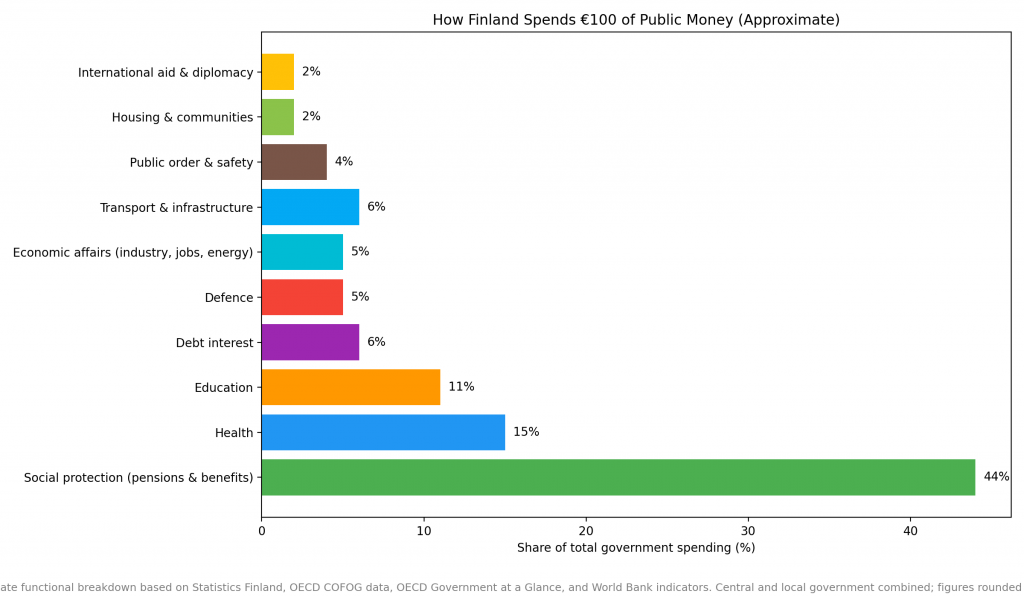
Finland represents the clean Nordic model:

    • Social protection is dominant
    • Health and education are heavily funded
    • Defence and debt interest remain contained

Nothing here is accidental. The spending profile is internally consistent and politically normalised.

Now contrast that with the United Kingdom.

The UK spends in recognisably European patterns — heavy on welfare and health — but with noticeably tighter margins and more visible fiscal strain.

And then there is the United States.
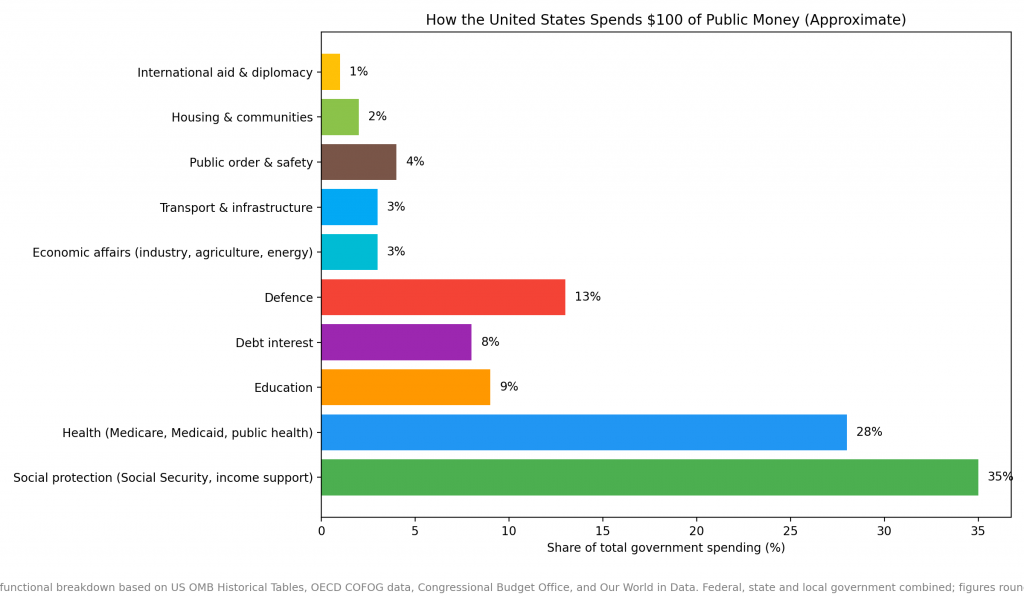
The US looks different in one crucial respect: defence and health together absorb an unusually large share of public money.

But the bigger insight is this:

On the spending side alone, most rich democracies look more similar than political rhetoric would suggest.

To understand why outcomes diverge, we have to look at the other half of the state.

The side we almost never discuss: how states raise the money

Public debate obsesses over spending.

But the real dividing line between successful and strained states lies on the revenue side.

When we map where governments actually get their money, the picture sharpens dramatically.
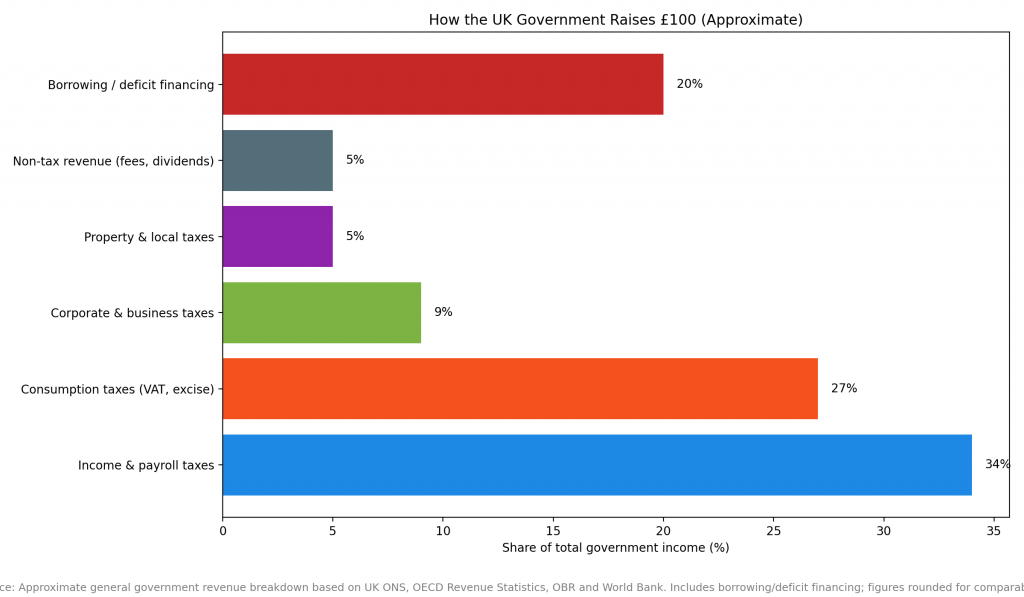
The United Kingdom raises most of its revenue from:

    • Income and payroll taxes
    • Consumption taxes (especially VAT)

But one feature stands out:

Borrowing plays a structurally large role.

In other words, part of the British state is routinely financed with future money.

Now compare Finland.
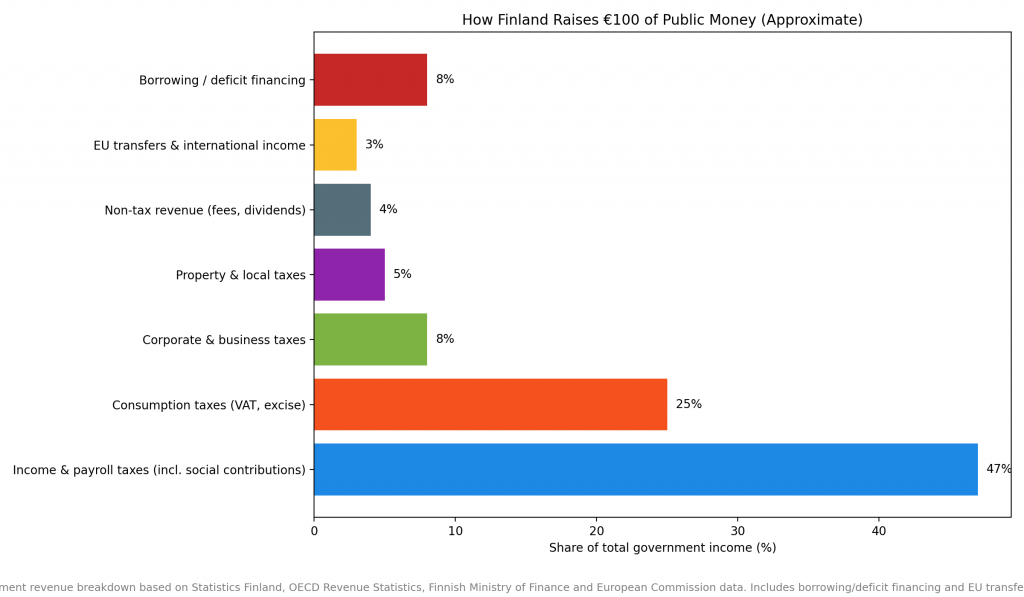
Here the architecture is strikingly different.

Finland funds its state primarily through:

    • Broad income and payroll taxation
    • Strong but not dominant consumption taxes
    • Limited reliance on borrowing

The key point is not that taxes are higher.

It is that the system is broad, balanced and paid for largely in real time.

Finally, the United States.
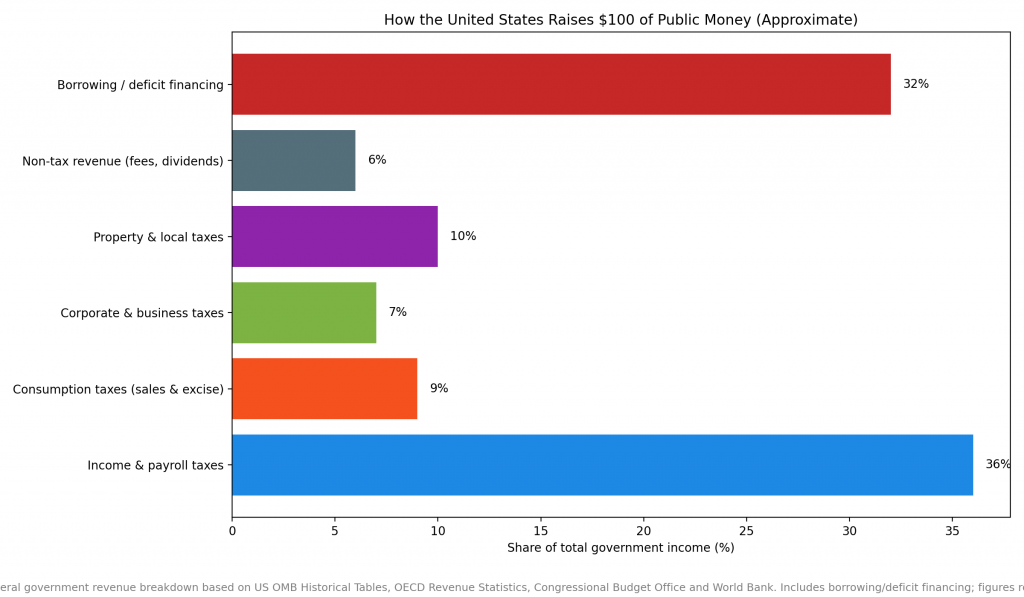
This is where the structural paradox becomes impossible to ignore.

The US has:

    • No national VAT
    • A relatively narrow tax base
    • Heavy dependence on borrowing

Roughly speaking, the American state is financed partly by something no other country in this comparison can rely on at scale: the global demand for US government debt.

The real dividing line

At this point the pattern becomes clear.

The question is not:

Who spends the most?

It is:

Who has built a revenue system capable of sustainably funding what they have promised?

In this six-country comparison, three broad models emerge.

The Nordic coherence model (Finland)

    • Broad tax base
    • High social trust
    • Strong upfront funding
    • Limited structural borrowing

Result: high social provision with relatively low fiscal drama.

The continental industrial model (Germany, partly Spain)

    • Strong payroll contributions
    • Embedded welfare financing
    • Export-supported tax base
    • Result: durable but dependent on continued industrial strength.

The Anglo-American fragility model (UK and US)

    • Narrower tax bases
    • Political resistance to broad taxation
    • Greater reliance on borrowing

Result: permanent fiscal anxiety despite comparable spending commitments.

India, meanwhile, represents something different again: not excess, but constraint — a state still expanding its tax capacity while carrying significant debt burdens.

So which model actually works best?

If we strip away culture, history, and political rhetoric — an artificial exercise, but a revealing one — the evidence points in a consistent direction.

The countries that most successfully combine:

    • economic competitiveness
    • high employment
    • strong social protection
    • and fiscal stability

tend to share three features:

First, they fund their social state broadly and visibly through taxation rather than chronically through borrowing.

Second, they treat health, education, and social protection not as residual costs but as core economic infrastructure.

Third, they minimise fragmentation and administrative leakage in how public money flows through the system.

In my six-country comparison, the model closest to this balance is the Nordic one, particularly Finland’s.

This does not mean it is easily transplantable.

But it does suggest something important.

The uncomfortable implication

If the arithmetic is this clear, why is the model so rare?

Because the barriers are not primarily technical.

They are political and psychological.

A fully coherent modern state requires:

    • broad-based taxation
    • high social trust
    • willingness to pay upfront
    • and political systems capable of explaining the trade-offs honestly

Many democracies struggle with precisely these conditions.

It is easier to argue about spending than to redesign revenue.
Easier to promise services than to build the tax base that sustains them.
Easier to borrow than to explain who must pay, and how.

But the underlying mathematics does not go away.

And the countries that align both sides of the ledger most cleanly are, increasingly, the ones that govern with the least fiscal drama.

Next question: not whether the Nordic model can be copied wholesale — it cannot — but which elements of fiscal design travel well across very different political systems.

“The difficulty lies not so much in developing new ideas as in escaping from old ones.”
— John Maynard Keynes


Britain’s Lost Boys — The Truth Behind Fatherless Teens

In response to Sky News, “The Lost Boys: How do you help fatherless teens who ask: ‘Am I the problem?’” (17 February 2026)

What if the crisis facing Britain’s boys is not primarily about absent fathers, but about a society that no longer knows how to raise them?

The recent Sky News report on fatherless teenage boys is careful, empathetic and clearly motivated by concern. It follows several boys growing up without consistent paternal presence, explores mentoring initiatives such as the GOAT Boys project and situates individual stories within a stark statistical landscape. Boys are lagging behind girls at school, men are dominating youth prison populations and young males increasingly disengaged from education and work.

The article deserves to be taken seriously. But it also reflects a broader tendency in public debate: to locate the problem too narrowly in fathers themselves — their absence, their failures, their irresponsibility — while overlooking the deeper institutional, cultural and economic structures that shape boys’ lives, whether their fathers are present or not.

If we want to help boys, we must go deeper.

I write as a teacher and teacher trainer with four decades of experience across Britain, Europe, and Mumbai, and also as a working-class boy from the north of England who, against the odds, obtained a scholarship to read modern languages at the University of Oxford. That trajectory gives me neither moral superiority nor nostalgic certainty. It does, however, give me a long view of how institutions speak and whom they fail to hear.


Boys’ underperformance: a statistic that explains too little

It is statistically true that boys underperform girls across most educational metrics, from early schooling through to A levels. But this fact, endlessly repeated, is not in itself explanatory.

The assumption often smuggled into public discussion is that boys would perform better if only their fathers stayed at home or returned. This is a comforting idea: simple, moral and politically safe. It is also inadequate.

The deeper issue is that our education system remains fundamentally antiquated: its syllabuses, pedagogies and assessment regimes are designed for compliance, abstraction, and credential-accumulation rather than meaning, relevance or lived intelligence. They were built for a pre-digital, class-stratified society and have never been fully rethought for a media-saturated, post-industrial world.

When I conducted research at the University of Sussex some years ago, I interviewed boys after a mock GCSE maths examination in which many had underperformed. Several explained something striking. They knew the mathematically correct answer — for example, the precise change returned by a Coca-Cola vending machine — but assumed it must be wrong. In real life, they said, Coca-Cola costs more than that so the amount of change given had to be less. So they altered their answers to make them “realistic”.

They were penalised for intelligence that refused to suspend reality.

This was not a failure of reasoning. It was a collision between lived rationality and institutional rationality. The institution won and the boys lost.

Educational language in Britain remains overwhelmingly middle-class in its assumptions, abstractions and modes of expression. Working-class boys often understand the task but not the game. They disengage not because they are incapable, but because the system repeatedly signals that what they really know does not count.

“If we teach today’s students as we taught yesterday’s, we rob them of tomorrow.”
John Dewey


Schooling, masculinity and the absence of ordinary men

Around 85–86% of primary school teachers in the UK are women. This is not a criticism of women teachers, many of whom do extraordinary work. It is an observation about institutional reality.

Primary schools are now among the few remaining public spaces in which many boys encounter almost no ordinary adult men at all. This matters for boys who already lack stable male presence at home or whose primary exposure to masculinity comes via social media.

Role models are not ideological constructs. They are relational. Boys need to see men reading, explaining, disciplining, failing, apologising, and persisting. Not as “mentors” or “interventions”, but as part of everyday life.

When this is absent, schools inherit a burden they were never designed to carry.


Father absence = delay discounting

Where father absence does matter educationally is not primarily in emotional damage, but in how boys learn to relate present action to future consequence.

Psychologists describe this as delay discounting: the tendency to devalue future rewards in favour of immediate ones. The consistent presence of a father often helps a boy internalise a basic cognitive link: what I do now shapes what becomes possible later.

When that link is weak or absent, education becomes almost unintelligible. Our system demands that students tolerate years of deferred gratification — irrelevant knowledge, abstract assessments, meaningless hurdles — in order to unlock a distant, hypothetical future. Boys who lack a lived sense of future consequence struggle to sacrifice present enjoyment for credentials that feel unreal.

As one headteacher in the Sky News article puts it:

“It’s really tricky sometimes to try to get into a young boy’s head the importance of passing their GCSEs, if someone outside school is offering them £500 to do a bit of work at the weekend for an illegal endeavour.”

Girls, for a range of social and psychological reasons, tend on average to navigate this demand more successfully. That does not mean the system is working. It means it is selectively survivable.


Prison, punishment and the confusion of severity with safety

Boys make up around 98% of the youth prison population. This is not a moral failure of boys. It is an institutional failure of the state.

Britain’s criminal justice system remains far quicker to incarcerate than to rehabilitate. Political and media incentives favour visible punishment over slow repair, toughness over effectiveness. Yet the evidence is overwhelming: harsher sentencing does not reduce crime in the long term.

Incarceration, especially of young men, often functions less as prevention than as delayed social accounting, the point at which the cost of earlier educational, familial and social failure finally appears on the balance sheet.

Justice matters. Victims matter. But revenge is not rehabilitation, and severity is not safety.


Why professionals cannot replace fathers

The mentoring initiatives described in the Sky News article are sincere and often impressive. They should not be dismissed. But we should also be honest about their limits.

Professionalised care cannot substitute for the long, morally binding authority of a biological or adoptive father who is present over time. Many mentors speak a language that remains distant from the lived reality of working-class boys. Acronyms, programmes, and “projects” may invite engagement, but they cannot create belonging.

This is not ingratitude. It is realism. Systems can support families; they cannot replace them.


What the boys themselves are actually saying

The most revealing moments in the Sky News article are not about fatherhood at all. They are about socially constructed meaning.

The boys speak of learning to tie a tie from YouTube. Of asking themselves, “Am I enough? Am I the problem?” They speak of emotional restraint, of being expected not to feel, not to speak, not to falter.

Gareth Southgate captures this precisely:

“Young men are suffering. They are grappling with their masculinity and their broader place in society.”

This is not a parenting issue alone. It is a crisis of social imagination.


The hidden cost: to the state, the economy and social trust

The cost of this failure is enormous and is rarely calculated honestly.

    • Incarceration: Keeping one person in a closed prison in England and Wales costs roughly £54,000 per year. Multiply that across a heavily male prison population, and the fiscal consequences are staggering.
    • Healthcare: Smoking alone costs English society tens of billions of pounds annually, including around £1.8–1.9 billion in direct NHS costs. Men remain disproportionately affected by smoking-related heart disease and cancers.
    • Addiction: Over 300,000 adults are currently in contact with drug and alcohol treatment services, the majority of them men. Prevention is cheaper than cure; relapse is more expensive than early intervention.
    • Housing and family breakdown: Around 100,000 divorces occur annually in England and Wales. Family separation often creates two households where one existed before, intensifying housing pressure — a factor almost never mentioned in political discussions of the housing crisis.
    • Intergenerational effects: Children of divorced parents are statistically more likely to experience relationship instability themselves, compounding social and economic costs over time.

We argue endlessly about government borrowing, borders and defence spending, but rarely about the quiet, cumulative cost of boys who never quite find a place in society.


Adolescence and the limits of parental culpability

The Netflix series Adolescence makes an important and often overlooked point. Its central character has a good father and a good mother — and things still go wrong.

Social media, peer dynamics, algorithmic masculinities and online grievance cultures now shape boys’ inner worlds in ways parents cannot fully control. Parents remain responsible. Absent fathers must own their absence. But culpability cannot be total.

Responsibility is lifelong. Control is not.


Conclusion: prevention, not panic

If prevention matters more than cure, then three things follow:

First, we must radically rethink education: its language, its assessments, and its relationship to real life.

Second, we must invest moral seriousness in something other than punishment, debt-reduction and symbolic toughness.

Third, we must collectively decide that boys are not problems to be managed, but human beings to be formed.

It takes more than a village to raise a healthy boy.
It takes a society willing to mean what it says about the future.

A society is not judged by how it punishes those who fail within it,
but by how seriously it takes the work of forming those who will one day inherit it.

The Elephant in the British Room: Why There Is Always Money for War, but Never for Care

Over the past decade, British governments have repeatedly demonstrated that fiscal limits are flexible. When spending is framed as urgent, unavoidable, or tied to national security, the state borrows freely and at scale. When spending concerns education, healthcare, or the living standards of poorer pensioners, we are told, with equal confidence, that there is no money.

The contradiction is not hidden. It is simply normalised.


The fiction of scarcity

The UK does not suffer from an absolute inability to spend. It suffers from a selective definition of what counts as affordable. Public borrowing is not rejected in principle; it is filtered by legitimacy.

Debt incurred for defence, border enforcement, or security infrastructure is framed as realism, regrettable but necessary in a dangerous world. Debt incurred to maintain schools, fund care, or prevent old-age poverty is framed as indulgence, risk, or irresponsibility.

This distinction is not economic. It is rhetorical and moral. Once embedded, it removes priorities from democratic debate and replaces them with a language of inevitability.


Where the money goes

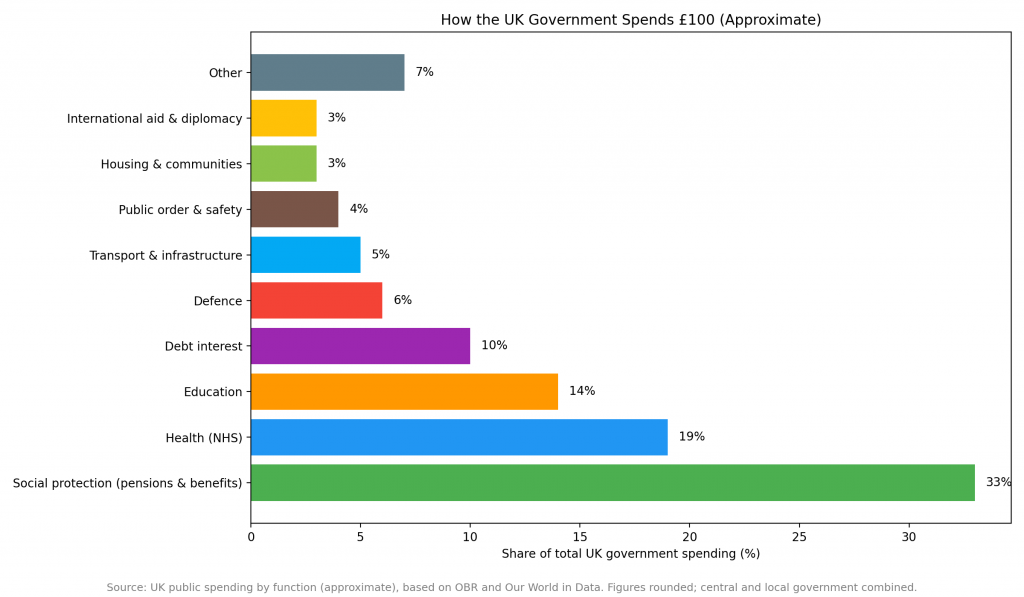
The overall structure of UK government spending already tells part of the story.

How the UK government spends £100 (approximate).
Based on OBR, HM Treasury, and Our World in Data. Figures rounded; central and local government combined.

At first glance, the picture appears balanced. Social protection, healthcare, and education account for a substantial share of spending. Defence, by contrast, is not the largest item.

But this is precisely where the debate often goes wrong. The issue is not whether defence dominates the budget. It is which areas of spending are treated as politically untouchable.

One category in the chart deserves particular attention: debt interest. A significant share of public money now goes simply to servicing past decisions, producing no public services at all. Yet even this is treated as unavoidable, while investments in human and social infrastructure are endlessly questioned.


What is protected over time

To understand political priorities, we need to look not just at levels of spending, but at what is protected from decline.

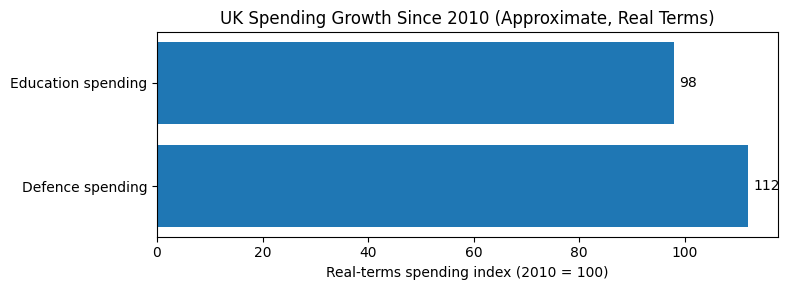
UK spending growth since 2010 (real terms, index: 2010 = 100).
Approximate indices based on Treasury, IFS, and OBR data; figures rounded for clarity.

Since 2010, UK defence spending has grown modestly in real terms. Education spending has failed even to keep pace with inflation.

This divergence matters. Growth here does not imply excess, nor does stagnation imply neglect by accident. It reflects which areas of public life are shielded from erosion, and which are allowed to decline quietly, year after year.

Defence is treated as structurally non-negotiable. Education is treated as adjustable.


Managed distraction and political theatre

This hierarchy of priorities is sustained by a wider political and media environment that rarely lingers on structural questions.

Public attention is instead drawn toward asylum boats, royal scandals, party infighting, leadership personalities, tactical U-turns, and culture-war skirmishes. Each may be newsworthy in isolation, but together they form a fog, absorbing outrage while larger financial commitments pass with limited scrutiny.

While headlines fixate on spectacle, long-term spending decisions are presented as technical necessities rather than political choices. Defence increases are framed as serious and sober. Social spending is framed as contentious, expensive, or unrealistic.


What “we can’t afford it” really means

The phrase “we can’t afford it” has become a shorthand for this does not rank high enough. It signals which forms of harm the state is willing to tolerate, and which it is determined to prevent.

In contemporary Britain, the harms associated with underfunded care, deteriorating schools, and pensioner poverty are treated as regrettable but acceptable. The risks associated with under-spending on defence or control are treated as intolerable.


The issue that remains

The real test of a society is not what it claims it cannot afford, but what it never seriously debates cutting.

Until this issue is faced honestly, debates about affordability will continue to obscure what is really at stake. The elephant will remain in the room: visible, substantial, and politely ignored.

“Budgets are moral documents.”
— Jim Wallis


Spain Governs Immigration. Britain and Germany Perform It.

Living Between Spain, Britain, and Germany

As a British citizen who has lived in Germany for fifteen years and who also has a home in Spain, I find myself moving between different moral climates when it comes to immigration. All three countries depend on migration. All three speak about it constantly. Yet they govern it with very different degrees of conviction.

Spain’s decision to regularise around half a million undocumented migrants has been widely described as bold. What strikes me more is that it feels principled. It reflects a style of leadership associated with Pedro Sánchez. Whether one agrees with him or not, he governs from a recognisable ethical framework. That framework informs domestic policy and foreign stances alike, including Spain’s willingness to articulate an independent position on Gaza. Immigration policy flows from that same seriousness. The law is being aligned with reality rather than used to perform toughness.

Germany approaches integration through procedure and moral discipline. This reflects a political culture now shaped by Friedrich Merz, a self-described capitalist whose flexibility seems to run in one direction only. Long-standing commitments are suddenly negotiable when it comes to rearmament, national debt, welfare retrenchment, or deportation rhetoric, provided wealth hierarchies remain untouched. The result is a system that demands compliance from the vulnerable while offering constant reassurance to capital. Integration becomes conditional, slow, emotionally distant, even hostile.

Britain’s problem is different but no less corrosive. Under Keir Starmer, the country is led by someone who claims a socialist inheritance but governs as a weathervane. Immigration policy shifts according to polling rather than principle. Positions harden according to headlines. The message to migrants is clear: you are needed, resented, and rhetorically punished all at the same time.

Spain, by contrast, currently shows a confidence that much of Europe lacks. It does not deny that immigration produces pressure. Housing shortages and exploitation are real. But regularisation is treated as governance, not surrender. Integration is understood as something that happens socially before it is certified administratively.

My own perspective here is sharpened by marriage. I am British, resident in Germany, and married to an Indonesian. After a year of marriage, my husband still has no residency or work permit in Germany. He is merely tolerated. In the UK, we cannot apply at all because I no longer live and work there. In Spain, later this year, he would have both residency and the right to work. Sitting together at Luca’s Café in Torremolinos, the contrast is impossible to ignore. Spain does not interrogate our presence. It respects us and welcomes us.

This difference is not accidental. It reflects political leadership. Confidence integrates better than fear. And at the moment, Spain is one of the few Western countries still willing to govern from that truth.

“Hospitality is not a gesture of kindness. It is a measure of political confidence.”
Jacques Derrida

Why Did Banks Need Three Days to Move Your Money? They Didn’t.

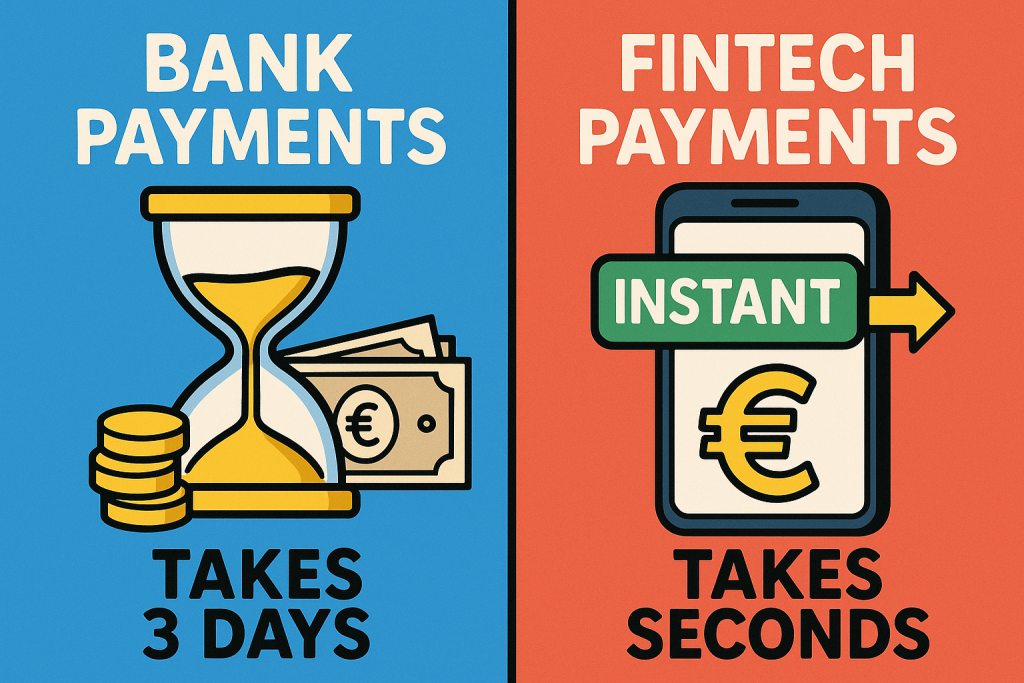
For decades, banks told us that transferring money takes three working days. It sounded reasonable — until fintech arrived and proved it was never about technology at all.


🏦 The Myth of “Processing Time”

For most of modern banking history, delays were justified by “overnight clearing” or “batch processing.” Customers were told that money needed time to “settle.”

But by the 1990s, computers were perfectly capable of real-time transactions. Internal transfers within the same bank were often instant — yet balances were still held back. The reason wasn’t technical; it was institutional.


💰 The Real Reason: The Float

The float — the period between debit from one account and credit to another — generated billions in hidden profits. While your funds were “in transit,” they sat in pooled accounts earning overnight interest for the bank.

For the customer, that money was already gone. For the bank, it was still working — quietly compounding returns day after day.


🧑‍⚖️ Political Inertia and Banking Lobbying

When consumer groups and policymakers began demanding faster payments, large financial institutions pushed back.

They claimed instant payments would increase fraud risk and require costly system upgrades. Governments, often reliant on bank stability and liquidity, accepted the argument.

The result: decades of delay disguised as “prudence,” while customers unknowingly financed the system’s inefficiency.


💡 Fintech Breaks the Illusion

Everything changed when fintech challengers like N26, Revolut, and Wise (formerly TransferWise) arrived. Their apps moved money instantly — sometimes across borders — and at transparent, near-zero cost.

Customers began asking the obvious question:

“If I can send money abroad in seconds, why does my domestic transfer still take days?”

That question broke the spell.


🇪🇺 Europe Finally Acts

The European Union responded with the Second Payment Services Directive (PSD2) and the SEPA Instant Credit Transfer (SCT Inst) system.

    • Launched: 2017
    • Mandated: 2024, with full compliance required by 2025–26

Under this law, all EU banks must offer instant euro transfers 24/7 at no extra charge.

Even conservative institutions like Santander, Barclays, and Deutsche Bank have now adopted instant payments, finally aligning with what fintechs proved was possible years ago.


🌍 A Global Shift Toward Real-Time Banking

    • United Kingdom: Introduced Faster Payments in 2008 — a major step forward. Initially, some banks charged modest fees; today, most domestic transfers are free for personal accounts.
    • India: The Unified Payments Interface (UPI), launched in 2016, made instant transfers completely free and is now used by over a billion people.
    • Brazil: PIX, launched in 2020, offers 24/7 real-time transfers — also free for individuals and a fraction of the cost for businesses.
    • United States: Only caught up in 2023 with the Federal Reserve’s FedNow service, which is still rolling out gradually.

⏳ The Lesson: Time as Currency

For decades, banks didn’t need three days to move your money — they needed three days to make money from your money.

Fintechs exposed the fiction. The new laws merely confirm what the technology had shown all along: that time, like capital, belongs to those who create it.

“It is difficult to get a man to understand something, when his salary depends upon his not understanding it.” — Upton Sinclair