Love, Bureaucracy, and the Borders of Europe

How a perfectly legal couple spends years fighting a system that claims to protect the family

I have always loved Europe.
I still do.

The peace, the democracy, the rule of law — these are extraordinary privileges, and I’m grateful every day to live in a part of the world that, compared to most of the planet, is safe, stable and humane.

But loving a thing does not mean lying about it.
And the deeper my own journey into the European immigration system has taken me, the more convinced I have become that something fundamental is broken — not just in Germany, not just in Britain, but across almost the entire continent.

This is not an anti-German story.
It is a story about what it feels like to do everything legally, responsibly, respectfully — and still find yourself treated as if love were a loophole, marriage an inconvenience, and foreign spouses a threat to be contained.

It is a story that could happen in almost any European capital.

It just happened to us in Berlin.


How Love Became a Test of Endurance

A few years ago, I fell in love with a remarkable man in Indonesia.
Our relationship grew quickly and deeply, and we knew we wanted to build a life together in Europe rather than in Indonesia. We planned to marry anyway, so we assumed — naively, as it turns out — that marriage and legitimacy would make the process of living together straightforward.

We were wrong.
Painfully, spectacularly wrong.


Wedding Bells, Bureaucratic Walls

Because our marriage would not be legally valid in Indonesia, we had to marry in Europe.
What we imagined would be a simple civil ceremony became a six-month odyssey through paperwork, translations, apostilles, appointments, contradictory guidance, and requirements that bordered on the absurd.

Still — we got married.
We thought the hardest part was behind us.

But marriage, we learned, is not a ticket to a shared life.
It is merely the beginning of a long, labyrinthine process designed, it seems, to test whether your relationship can outlast bureaucracy.


The Rule No One Tells You: “Apply in Jakarta, or Don’t Come at All”

Once married, we were informed of something almost nobody tells you in advance:

If you marry an Indonesian and want to live together in Europe, your Indonesian spouse must apply for a family-reunification visa from Jakarta — and only from Jakarta.

Not from Berlin.
Not from any European consulate closer to their home island.
Not from Europe on a tourist visa (which would be logical, humane, and in line with every legal principle about protecting marriage).

Jakarta.
Or nothing.

The waiting list?
One year.
We have the screenshot.

And that’s just the waiting list for you to submit your application — not the processing time afterwards.

Imagine telling any married couple in Europe:

“Congratulations on your marriage.
You will now be forcibly separated for at least 12 months.”

That is the system.
That is the norm.


One Document Wrong? Start All Over Again.

When our turn finally came, the embassy did not approve one of the documents uploaded during the online process. They asked us to delete it — and, indeed, there is a little trash-can icon on the website.

Except the icon doesn’t work.
It never has.

After weeks of emails, calls, and technical back-and-forth, the embassy’s final advice was:

“Delete your entire application and start again.”

Which, in plain language, means:

“Restart the one-year waiting list.”

It is breathtaking to realise that the legal rights of marriage can be instantly overruled by a broken trash-can icon.


Geography as a Financial Weapon

If you are Indonesian and live on Sumatra, you must pay to fly twice to Jakarta — once for biometrics, and once to collect the visa. These costs are enormous relative to Indonesian salaries.

For many families, this is simply impossible.

This is what “legal migration” looks like in practice.


The 90/180 Trap: A Long-Distance Marriage by Law

Some couples try an alternative: the Schengen visitor visa.
But that route comes with its own cruelty:

  • Your spouse can visit for 90 days maximum

  • but must then leave for another 90 days minimum

Meaning:

You may live together for three months, then be forcibly separated for six.
Three on, six off. Three on, six off. Indefinitely.

Assuming, of course, you can afford the flights between Jakarta and Europe.
Most cannot.


The Berlin Immigration Office: A Fortress Without Doors

If the embassy maze is surreal, the immigration office in Berlin is its European twin.

You cannot phone them.
You cannot email them.
You cannot speak to a human being unless you already have an appointment — and you cannot get an appointment without submitting a webform that may sit unanswered for two months.

If you attempt to enter the building to ask for help, security guards turn you away.
“No appointment, no entry.”

It is Kafka with fluorescent lighting.


When Your Appointment Arrives… It’s Too Late

In our case, by the time Berlin offered my husband an appointment, his visitor visa had expired.
They could not — or would not — offer an earlier date.

He was legally in the country.
He had proof of marriage.
He had every document required.

But the system, moving at its own glacial pace, simply shrugged.


The Catch-22: Work to Stay, But You Can’t Work Until You Stay

Here is the cruelest irony:

To obtain residency, the European spouse must prove sufficient income to support both partners.

But the foreign spouse cannot work unless they already have residency.

So if the European partner earns too little, the spouse receives only a six-month Fiktionsbescheinigung — a kind of temporary suspension of deportation, halfway between permission and limbo.

With that document:

  • You cannot work

  • You cannot earn

  • You cannot contribute

  • Therefore you cannot raise household income

  • Therefore you do not qualify for residency

This is not immigration policy.
It is a bureaucratic cul-de-sac.


And Then You Realise: If It’s This Hard for Us… What About Them?

We are educated, organised, legally married, European-based, English-speaking, German-speaking, online-competent, and persistent.

And still we nearly drowned in the system.

What must this system feel like for asylum seekers?
For people fleeing war or persecution?
For couples separated across borders with children in tow?
For those without money, stability, documents, or perfect German?

Oh yes, and in case you’re wondering, I did contemplate moving back to the UK and applied for residency for my English-speaking husband there. Our application was declined.

The system does not merely fail people.
It dehumanises them.


A Quiet Exception: The Spain Nobody Talks About

There is one place in Europe where the logic is different: Spain.

Spain has a little-known rule — almost never advertised — called arraigo social.

If you remain in Spain for two years, stay out of trouble, and integrate into community life, you can obtain legal residency.

No endless separation.
No forced poverty.
No trapdoors disguised as requirements.
No broken webforms or locked doors.

If you are married and have property there, the chances are even better.

Whatever critics say, this is a system that treats people — even undocumented ones — as human beings capable of building a life.

It is the closest thing Europe has to a humane immigration philosophy.


What This Story Is Really About

This is not a rant.
Nor is it an attack on Germany, which continues to offer extraordinary opportunities to millions of people, myself included.

It is a plea.
A testimony.
A reminder that behind every “case number” is a love story, a family, a life.

Europe prides itself on protecting marriage – see ECHR, Article 8 §§1–2.
Courts across the continent insist that “bureaucratic inefficiency is not a legitimate reason to separate spouses.”

But in practice?
The systems built to uphold those principles routinely violate them.

If Europe wants to protect its values — its humanism, its dignity, its rule of law — the immigration system is where it must begin.

Not with walls.
Not with suspicion.
But with the simple recognition that married couples should not have to fight this hard to live under the same roof.

“Bureaucracy is the death of all human action.” — Max Weber

A Perfectly Absurd Christmas Story

The other evening, in the spirit of seasonal escapism, we were watching Man vs Baby—a piece of festive fluff involving slapstick chaos, an unruly infant, and, inevitably, a primary-school nativity play.

At some point, my husband—who grew up in Indonesia and is unfamiliar with Christian traditions—turned to me and asked, quite innocently, what the story was actually about.

So I explained.

A teenage girl called Mary, who was also a virgin, gives birth to a baby. This baby is God. He is born in a stable because there is no room for him in the local accommodation. A star appears in the sky, guiding three wise men and a group of shepherds to come and worship this baby and bring him gifts. This child will later be executed, rise from the dead, ascend into heaven, and now sits—still in a human body—on the throne of the universe, exercising ultimate authority over all of existence for all eternity.

My husband listened politely. He nodded. He asked no follow-up questions.

But as I heard my own voice recounting this story, I had a sudden, almost comic moment of estrangement. Detached from carols, candlelight, stained glass, and nostalgia, the narrative sounded astonishingly absurd.

And yet.

It is also undeniably beautiful.

As a story, it has extraordinary power. Told aloud. Set to music. Painted. Sculpted. Recreated each December in glowing wooden cribs in living rooms, churches, town squares, and shopping malls. It is gentle. It centres on vulnerability rather than force. A baby rather than a king. Straw rather than marble. Hope for the world arriving quietly, unnoticed and poor.

I once believed it all.

Not only as a child, but later for about fifteen years of my adult life, when I was a Bible-believing fundamentalist Christian. I genuinely thought this story, set in the Middle East two millennia ago, explained everything: meaning, love, suffering, death, and the ultimate destiny of the world. I didn’t experience it as absurd at all. It felt profound, coherent, and necessary.

But with distance, the story didn’t simply become implausible; it became troubling. Not because it is poetic or mysterious, but because of what has been built upon it. The same “cute” story about a baby has been used to justify division, exclusion, cruelty, war, and extraordinary human suffering. Not by accident, but repeatedly, systematically, and often with great confidence and moral certainty.

That, for me, is the real tragedy—not that the story is implausible, but that it has been weaponised.

And yet, here we are again.

Lights are going up. Schools are rehearsing their nativity plays. People are travelling, eating too much, falling out, making up, missing those who are no longer here and trying, in their imperfect ways, to be a little kinder.

So this is not a call to cancel Christmas. Nor is it an attack on those who still believe the story literally. It’s simply an honest moment of reflection: a recognition that something can be both moving and absurd; beautiful and dangerous; comforting and deeply problematic.

In any case, beliefs aside, I want to take this opportunity to wish you—whoever you are, wherever you are—a genuinely restful and enjoyable Christmas and New Year break. May there be moments of warmth, laughter, good food, and quiet. And for 2026, I wish all of us what really matters: peace, goodwill, good health, and a little more humility about the stories we tell ourselves—and each other.

Happy Christmas.

“Christmas is not a time nor a season, but a state of mind.”
Calvin Coolidge

Dialogue or Destruction: Why Peace Has Only One Road Left

A Century That Should Have Known Better

Some days it feels as if the twenty-first century has learned nothing from the horrors that preceded it. We live in an age where the map of human suffering is once again studded with names we should never have to say in the same sentence: Gaza and southern Israel, Ukraine, Yemen, Sudan, Myanmar, Ethiopia – and now even Thailand and Vietnam finding themselves drawn back, in different ways, into cycles of unrest they thought they had escaped.

The tragedies differ in their causes, but they share one characteristic: they are morally unacceptable in a world that has the knowledge, the wealth, and the historical memory to do better.
War may once have been considered an inevitability of human conflict. But wars of aggression – and the atrocities committed in their shadows – cannot be squared with a species that claims to be moral, rational, or enlightened.

The sorrow is not only in the scale of destruction, but in its banality. Innocent men, women and children, whose only mistake was being born in the wrong place, are suffering because powerful individuals with guns, money, or ideology choose violence over the one thing that has ever worked: talking.

The Human Duality: Building Mars Rockets While Bombing Cities

It is one of the oldest and saddest paradoxes of the human condition:
We are capable of extraordinary intelligence and astonishing stupidity at the very same time.

In the same decade that we are preparing missions to Mars, mapping the human genome, and coordinating global relief efforts after earthquakes and floods, we are also manufacturing weapons so sophisticated and so profitable that entire economies depend on them.

Take the UK: a country with billions for advanced weapons systems but somehow “no money” for freezing pensioners, collapsing hospitals, or universal, high-quality education. This is not a mystery of economics; it is a reflection of politics, psychology, and a global weapons industry whose profits dwarf the budgets of most ministries of health. And while this grotesque misallocation of resources goes largely unexamined, public attention is successfully diverted towards the performative jingoism of Nigel Farage and his circle, obsessing over small boats as if they posed a greater threat than the industrial machinery of war.

Sociologically, all this reveals something darker:
that collective fear is more powerful than collective compassion,
and that democracies and dictatorships alike are willing to pour unimaginable sums into tools of destruction, even as their own citizens queue at food banks.

When you look at the sheer size of the arms economy – involving states, private firms, lobbyists, intelligence networks, and geopolitical strategists – it is no surprise that conspiracy theories flourish. One begins to wonder, not whether secret cabals exist, but whether the structural incentives of money, power, and fear create something that behaves exactly like a conspiracy: an unaccountable machine that profits from perpetual insecurity.

Yet even here, there is a deeper sadness:
This is all human-made. It could all be human-unmade.

The Only Road Left: Global Responsibility and Relentless Dialogue

Ending war and the suffering it unleashes is not a task for Washington or Moscow or Beijing alone. It is not a “European problem” or a “Middle Eastern problem” or an “African problem.”

It is a human problem.

And humans, whether in India, New Zealand, Switzerland, Brazil, Nigeria, or Japan, share equal responsibility for the world we are shaping.

The world is too interconnected – economically, technologically, environmentally – for the myth of “regional conflicts” to survive. A war in Ukraine destabilises global grain markets. A war in Gaza destabilises entire alliances. A war in the Sahel or Sudan creates refugee flows that reshape the politics of Europe within months.

And yet, our political rhetoric remains stuck in the nineteenth century: great powers posturing like drunken emperors, minor powers waiting for permission to act, populations encouraged to choose a side rather than choose a future.

Into this steps Donald Trump, who postures as a dealmaker but speaks as a man who has never studied history, diplomacy, or the complexity of human suffering. His racist, West-centric, emotionally stunted theatrics are not only unhelpful — they actively block the one thing that has ever stopped wars:

serious, sustained, structured dialogue.

China said this nearly two years ago, and they were right:
There is no military solution to these conflicts.
There is no future in “victory” defined as someone else’s obliteration.

If the stakes were framed differently —
If it were your grandmother being raped,
your daughter being shot,
your son sent to die in a trench,

would anyone still think that pride, posturing, or “teaching the enemy a lesson” was worth it?

Dialogue is not weakness.
Dialogue is not appeasement.
Dialogue is not naïve.

Dialogue is the only alternative to extinction-level stupidity.

What we need is a global determination — from governments, from civil society, from the international institutions we mock until we suddenly need them — to bring leaders and peoples into conversation with each other before the next atrocity, the next drone strike, the next unmarked grave.

We do not need more weapons.
We need more courage — the courage to talk to our enemies.

Because the only road that has ever led out of hell is the one people walked together, however awkwardly, toward a table, a room, a conversation.

Dialogue is not one option among many.
Dialogue is the only road left.

“If you want peace, you don’t talk to your friends. You talk to your enemies.”  -Desmond Tutu


From Village Carpenter to Global Force: The Strange Success of Christianity

It remains one of the strangest facts of history.

A thirty-something artisan from a provincial backwater, speaking Aramaic in a corner of the Roman Empire, is now at the centre of the world’s most geographically widespread religion. Two thousand years later, his story is still believed – not just by the desperate and uneducated, but by surgeons, software engineers, lawyers, professors and prime ministers.

We can debate for ever whether the miracles happened, whether the tomb was empty, whether God exists at all. But even if you bracket all that out, a hard question stays on the table:

How did this particular faith story become so portable, so durable, and so attractive to intelligent people for so long?

And – just as interesting – why does Christianity grow in some places today and haemorrhage members in others?

I want to suggest that the answer has less to do with miracles, and more to do with four things:

    • its portability
    • its God of love
    • its dual appeal to heart and reason
    • and the way it behaves sociologically – either as a movement or as an institution.

Christianity’s Secret Weapon: Portability

Most ancient religions came bundled with a package deal: one god, one people, one place, one language.

You worshipped the gods of your tribe, your city, your land. The temple was in that city, the sacrifices at that altar, the prayers in that tongue. This is how religion normally works.

Christianity broke that model.

From the very beginning it said, in effect:

“You don’t need to be Jewish. You don’t need to move to Jerusalem. You don’t need to learn a sacred language. This is for everyone.”

No temple to travel to.
No hierarchical clergy or priesthood – every believer is a priest
No sacred script only the initiated can read.

Just a set of compelling and memorable stories and teachings about Jesus and a small travelling community who claimed that his life, death and (as they saw it) resurrection had changed what it meant to be human.

That made Christianity absurdly portable:

    • It moved from Aramaic into Greek.
    • Then into Latin, Coptic, Syriac, Armenian, Gothic.
    • It made the jump into the philosophical worlds of Plato and Stoicism, and then into the legal and administrative world of Rome.
    • Today it sits comfortably in English, Swahili, Korean, Portuguese and Tagalog without asking anyone to “become Jewish” first.

If you strip Christianity back to its core, the essentials are strangely easy to translate:

    • love
    • forgiveness
    • dignity
    • care for the poor
    • hope beyond death
    • justice
    • meaning
    • transformation

No sacred mountain. No exclusive caste. No single holy language.

Just a story and a way of life that can, at least in theory, be picked up anywhere.

Whenever Christianity has leaned into this radical portability – no guarantees, no bureaucracy, just small communities trying to live this story in their own culture – it has tended to spread.

Whenever it has wrapped itself in state power, fixed liturgies, heavy buildings and highly controlled hierarchies, after some initial growth, it has tended to stall and then decline.

We can see that empirically now.


A Shockingly Different God

Portability explains how Christianity can move.
It doesn’t yet explain why anyone would actually want it.

Here I think we come to the most explosive claim at the heart of Christian faith:

God loves you. Personally.

We are used to that sentence now. In the ancient world, it was dynamite. All humans are looking for existential meaning and personal acceptance.

The gods of Rome were powerful, but capricious.
The gods of Greek myth were brilliant, but aloof.
The philosophers spoke of a Logos or a First Principle – interesting, but hardly something you would sing hymns to.

Then along come the Christians, saying:
the ultimate reality behind the universe is not raw power, not blind fate, not an impersonal force, but self-giving love – and that this love is somehow focused on you.

Not just: “There is a god.”
But: “You are known and wanted.”

Add to that some other, equally disruptive ideas:

    • that slaves have dignity,
    • that women and children matter,
    • that the poor, the stranger, the sick, the disabled are not disposable but precious,
    • that every human being, without exception, bears the image of God.

In an empire that threw away unwanted babies, left the sick to die in the street, and treated most people as economically useful units at best, this was not just comforting. It was revolutionary.

You didn’t have to believe in miracles to find this vision of the world compelling. Many still don’t.


Heart and Mind in the Same Story

There is another piece to the puzzle. Christianity did something that very few religions manage to sustain over centuries:

It offered a credible home for both the heart and the mind.

On the heart side, it speaks to:

    • forgiveness for real guilt
    • a path to change when you hate the person you’ve become
    • a community that will (at least in theory) walk with you
    • the intuition that love and justice somehow matter more than success
    • the fear of death and the longing that death is not the end

On the mind side, it offers:

    • a universe that is ordered and intelligible rather than random
    • a moral framework that is more than “my preference vs. yours”
    • a coherent story of how humans can be capable of both beauty and horror
    • a God-concept that can be, and has been, taken seriously by some of the most demanding intellects in history

Augustine, Aquinas, Pascal, Kierkegaard, Bonhoeffer – whatever you make of their conclusions, these are not gullible people. They were not seduced by a cosy fairy tale. They found in Christianity a way of thinking that was at least big enough to wrestle with reality.

That combination – emotional depth and intellectual seriousness – is rare. It goes some way to explaining why, in every generation, some doctors, lawyers, scientists and philosophers still end up in church despite knowing all the reasons not to.


When Christianity Behaves Like a Religion, It Shrinks

The really uncomfortable part, especially if you belong to an established church, is what happens next.

Over time, the portable, story-driven movement becomes something else:

    • It builds buildings.
    • It develops liturgy and rules.
    • It trains a professional clergy.
    • It negotiates with states and empires.
    • It learns to sit quite comfortably next to imperial power, feudal systems, colonial projects and nationalist dreams – sometimes as their chaplain.

Some of this is inevitable. Human beings organise. Communities need structure. Not every bishop is a villain.

But the sociological pattern is striking:

    • In much of Europe, the old state-linked churches – Catholic, Anglican, Lutheran, Reformed – are in steep numerical decline.
    • They are rich in buildings, history and liturgy; poor in young adults, fresh converts and living energy.
    • Many of their most enthusiastic members quietly slip away to small, lay-led, often charismatic communities – or out of the Christian story altogether.

You don’t need supernatural explanations for this.
It is what tends to happen when a movement becomes an institution and then an arm of the state.

The religion that once prided itself on having “no temple, no priesthood, no sacred language” has sometimes become exactly the kind of religion Jesus himself spent so much time arguing with.

And people vote with their feet.


When Christianity Behaves Like a Movement, It Spreads

The picture is very different whenever Christianity sheds the imperial clothing and goes back to something closer to its original form.

We see this in:

    • house-church networks under communism
    • base communities in Latin America
    • Pentecostal and independent churches in parts of Africa, Asia and Latin America
    • small experimental communities in post-Christian cities in Europe.

What these movements tend to have in common is not a particular theology but a form:

    • they are locally led,
    • often meeting in homes, schools or rented halls rather than cathedrals,
    • heavily relational,
    • high on participation and experience,
    • able to translate the message into local culture without waiting for permission from a distant headquarters.

They may or may not be “charismatic” in the technical sense. Many are. Some aren’t. But they are recognisable cousins of that first generation of Jesus-followers who met in houses, shared meals, argued, prayed, fell out, reconciled and tried to work out what this story meant in Corinth, or Antioch, or Rome.

Where Christianity looks like that, it is often growing – sometimes quietly, sometimes explosively.

Where Christianity looks like a bureaucratic service provider for people who need weddings, funerals and a vague sense of national identity, it is often dying.

Again, you don’t need to believe in God to see the pattern. It’s written in the attendance figures.


So Why This One Story?

None of this “proves” that Christianity is true. That’s a different discussion.

But it does, I think, make sense of why this particular faith story has had such reach:

    • It told an outrageous story of love in a world ruled by fear.
    • It insisted that the most important truths about human life could be carried in a portable story, not locked in a temple or a tribe.
    • It managed, at its best moments, to give both the heart and the mind something serious to work with.
    • And it has a built-in tendency to break out of its own institutions and reinvent itself as a movement again whenever those institutions become too heavy.

An Aramaic-speaking artisan from a nowhere village should have vanished into the long list of forgotten preachers.

Instead, people all over the world are still arguing about him, still praying to him, still walking away from him in anger, still quietly coming back.

You can explain that purely in sociological and psychological terms, if you like. Or you can, if you are so inclined, wonder whether the “God of love” at the centre of the story has something to do with its refusal to die.

Either way, it is hard to deny that the story is still on the move – and that it travels lightest when it remembers where it began.

“The Christian ideal has not been tried and found wanting; it has been found difficult and left untried.”  – G. K. Chesterton

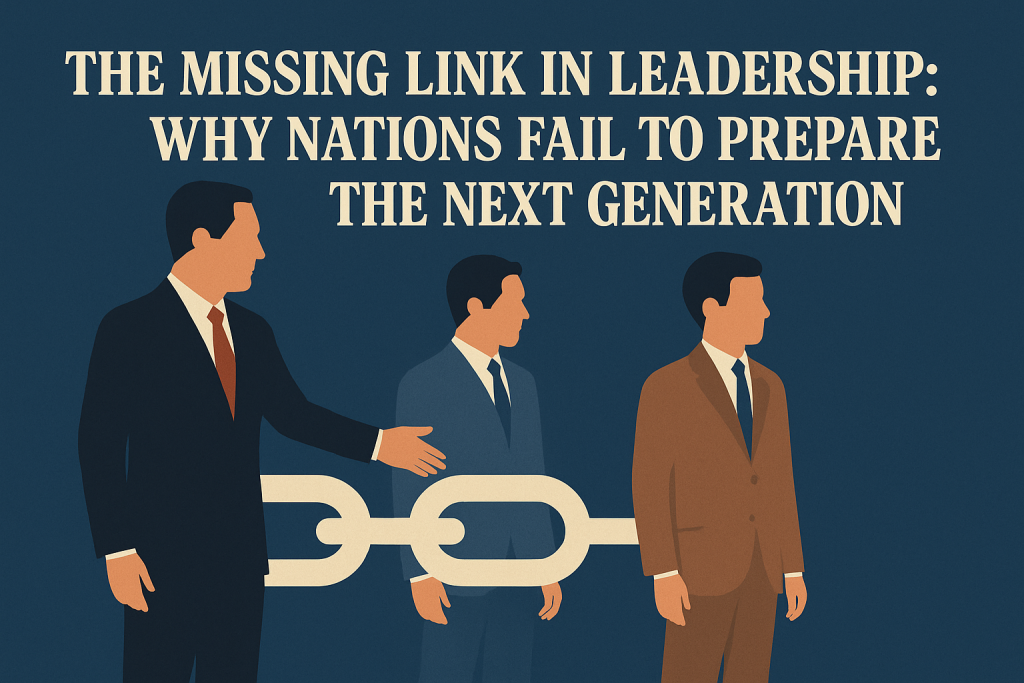
The Missing Link in Leadership: Who are you preparing to replace you?

Over the last few days, I’ve been reflecting on something that almost nobody talks about, yet it quietly shapes the political and economic stability of entire nations: the absence of intentional discipleship—or whatever secular term we prefer—among significant leaders.

Call it mentoring, call it succession planning, call it “forming the next generation.” But the idea itself is ancient: I do it and you watch me; you do it and I watch you; now you do it on your own. Most successful cultures in history depended on it. Yet today, it is almost entirely absent in politics, business, and public life.

And we are paying the price.


1. Politics Without Apprenticeship: Why Every Transition Is a Crisis

Look at almost any Western democracy and you’ll notice the same pattern: when a leader falls, nobody has the faintest idea who will replace them.

    • When Boris Johnson collapsed, nobody was preparing themselves—or being prepared—to step in.
    • Liz Truss, Rishi Sunak, and even Theresa May were not household names with long apprenticeships behind them. They were simply the next names in a Rolodex that nobody had ever looked at.
    • In the corporate world, nobody outside Cupertino had ever heard of Tim Cook until Steve Jobs died. Cook was extremely competent—but invisible.

Leadership emerges by accident, not formation.

Even in Germany—historically better at structured, team-based governance—the same problem now shows. Under Angela Merkel, we at least knew her ministers. If health, education, or foreign affairs made the news, it was the responsible minister speaking, not Merkel herself. There was a sense of team, of distributed competence, of the German belief that no one person can or should dominate every conversation.

But even then, there was no visible apprentice. No one standing next to her, learning, questioning, absorbing, preparing. When she stepped down, the vacuum opened.

Fast-forward to today, and the contrast is severe. Germany has ended up with Friedrich Merz—almost the polar opposite of Merkel in style, values, and public ethos. The shift is not just political; it’s generational and philosophical. It is what happens when leadership is not passed on but simply replaced.


2. The Danger of Blind Replacements

A country cannot thrive if every transition resembles a blind date.

Democracies need continuity, not clones—but at least a thread connecting one chapter to the next:

    • Shared institutional memory
    • A carried-forward vision
    • Stability in economic and social policy
    • Someone who has made mistakes privately before making them publicly

Instead, we jump from one unfamiliar figure to another. We “discover” a new potential leader the same way we discover a new toothpaste at the supermarket: whatever is placed at eye level becomes the default option.

And voters are expected to trust people they have never had the chance to watch, listen to, or grow accustomed to.


3. Corporate Life: Exactly the Same Problem

The same dysfunction exists in industry.

Most FTSE100 or Fortune500 companies have:

    • “leadership pipelines”
    • “talent funnels”
    • “succession plans” in binders

But very few have real relational apprenticeship:

    • Nobody spends two years shadowing a CEO.
    • Nobody grows up inside a leader’s thinking.
    • Nobody is intentionally shown how to hold the weight of power.

So transitions become fragile. Massive instability follows. Cultures collapse when their figureheads move on.

You saw it with Jobs → Cook.
You saw it with Gates → Ballmer.
You saw it with nearly every major bank pre-2008.

This is not an HR problem. It’s a civilisational one.


4. Why Discipleship (Not Just Mentoring) Actually Matters

Mentoring can be a coffee once a month. Coaching can be transactional. Consulting can be outsourced.

Discipleship is different: it means forming someone through proximity, vulnerability, imitation, failure, and shared responsibility.

It means:

    1. I do it; you watch.
      The next generation witnesses how problems are carried, how crises are handled, how decisions are made.
    2. You do it; I watch.
      Mistakes happen in a safeguarded environment where correction is possible without public humiliation.
    3. Now you do it on your own.
      By the time leadership is handed over, the nation already knows who this person is—and why they should be trusted.

This is not religious; it is simply human. Every craft, every guild, every durable culture has always worked this way.

Except modern politics and modern corporations.


5. Preparing One Generation Down

If we want stability, we must think at least one generation down:

    • Who is learning the skills?
    • Who is absorbing the vision?
    • Who is gaining credibility in public life before holding office?
    • Who is confident enough to lead, not because they are ambitious, but because they are prepared?

Nations fall apart when nobody knows who is next.
Nations thrive when leadership is a relay race, not a wrestling match.

We cannot talk about the future without preparing the people who will carry it.

“There is no success without a successor.”  –  Peter Drucker