On my last day in Spain, I sat at a small café, watching three men take down decorations from the town’s recent festival. The bunting had hung across the square for days, colouring the white-washed walls with celebration. Now the tourists had gone home, and these men — quiet, anonymous, methodical — were returning the square to its ordinary face.
Their work is unremarkable. No one applauds. Yet without people like them, the whole “beautiful tourist city” collapses.
Without them, the photos don’t look charming.
Without them, the streets feel neglected.
Without them, the illusion breaks.
I found myself thinking about fishermen at dawn, hotel cleaners before breakfast, bin collectors at 4am. The quiet labour that keeps the world turning — labour that rarely receives dignity, respect, or fair pay.
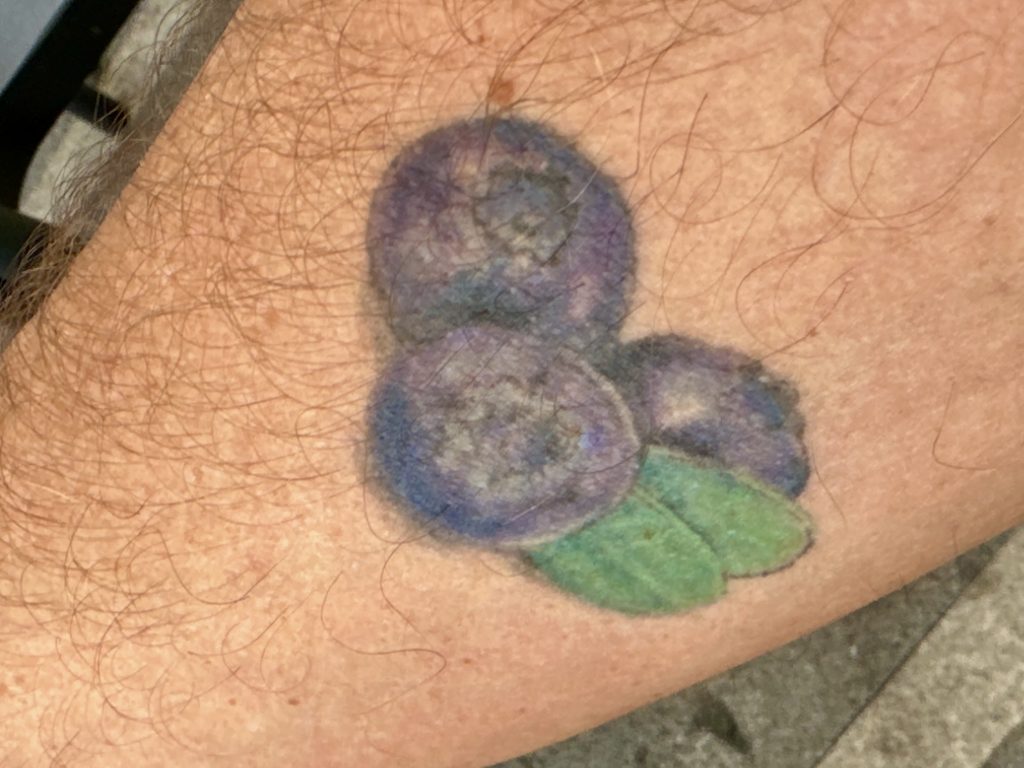
Then I looked at my arm.
At the blueberries.
Yes — I have blueberries tattooed on my forearm. And no, it’s not whimsical. Or perhaps it is, but in the way truth sometimes hides inside whimsy.
The blueberries remind me that I cannot enjoy anything alone.
Not even my breakfast.
To eat a blueberry, I depend on soil, weather, farmers, packers, transport workers, supermarket staff, the climate not collapsing this particular year. My pleasure is communal, whether I acknowledge it or not.
Upside down, from a distance, the blueberries form a heart-shape. I didn’t plan that. But perhaps the body speaks before the mind is ready to believe.
The tattoo is a reminder:
You are held. Your life is made by many lives. You are not independent.
And so here’s the question that came to me in that Spanish square:
If we know we are interdependent, why do we build societies that pretend we aren’t?
Why do we reward the illusion of the “self-made individual” while the world is built by the unseen hands of others?
Why does the fisherman earn less than the financier?
The cleaner less than the consultant?
The bin collector less than the politician?
It is not rational.
It is not moral.
It is not even economically coherent.
It is, however, familiar.
And this — whether people like to admit it or not — is where Marx enters the conversation.
Marx’s Point Was Never “Everyone Should Be the Same”
Marx’s central claim was beautifully simple:
Human labour creates value.
So the people who create value should benefit from it.
That’s it.
That’s the hinge.
Marx wasn’t calling for laziness, or enforced sameness, or the death of creativity. He was pointing out that societies become obscene when those who create the conditions for life (food, sanitation, infrastructure, care) are treated as disposable.
He believed in dignity through shared labour.
In contribution as meaning.
In justice as the redistribution of the wealth that labour creates.
Which is why, though he rejected religion, Marx comes surprisingly close to Jesus.
Jesus also preached the reversal of hierarchy:
“The last shall be first, and the first last.”
Not metaphorically — economically, socially, relationally.
Both men looked at society and said:
This is upside down.
We can live differently.
Both pointed to community over competition, relationship over possession, need over greed, dignity over dominance.
And yet —
we have not built the world either of them imagined.
Not once.
Not anywhere.
Not for long.
So the question is no longer Was Marx right?
Or Was Jesus right?
The question is:
What stops us from building the just society both of them saw so clearly?
The Answer Is Not Economic. It’s Psychological.
We call it capitalism vs. communism
but the real struggle is fear vs. trust.
We hoard because we are afraid there won’t be enough.
We compete because we are afraid of being overlooked, replaced, forgotten.
We dominate because we are afraid of being powerless.
We cling to hierarchy because we are afraid of being ordinary.
Fear is the water we swim in.
Fear is the undecorated square after the festival is taken down.
Fear is the silence in the early morning before the day begins.
Marx underestimated fear.
Jesus named it, but was killed for it.
And every system we have built has collapsed for the same reason:
We would prefer to be safe than to be equal.
The Failure Was Never Marx’s. It Was Ours.
We say “communism failed” as if ideology collapsed of its own weight.
But ideas don’t fail.
Systems don’t fail.
People fail.
We fail because we want justice until justice requires something of us.
We want equality until equality asks for our privilege.
We want community until community interrupts our autonomy.
We want the kingdom of God
without the cross.
We want Marx’s dignity of labour
without surrendering status.
So we keep building worlds in which:
-
the blueberry appears magically on the table
-
the labourer remains invisible
-
and we pretend we did this alone.
The Blueberries Again
I look at my arm.
The tattoo.
The accidental heart.
A reminder that interdependence isn’t an ideal —
it’s already true.
We just live as if it isn’t.
The question is not whether a just society is possible.
We already rely on one.
Every day.
Every meal.
Every building.
Every service.
Every breath of shared infrastructure.
The question is simply:
When will we live as though we know it?
And perhaps the first step toward a better society
is simply learning to say:
Thank you.
To the fisherman.
To the street worker.
To the invisible hands.
To the ones who keep the world turning
so that the rest of us can pretend we did it ourselves.