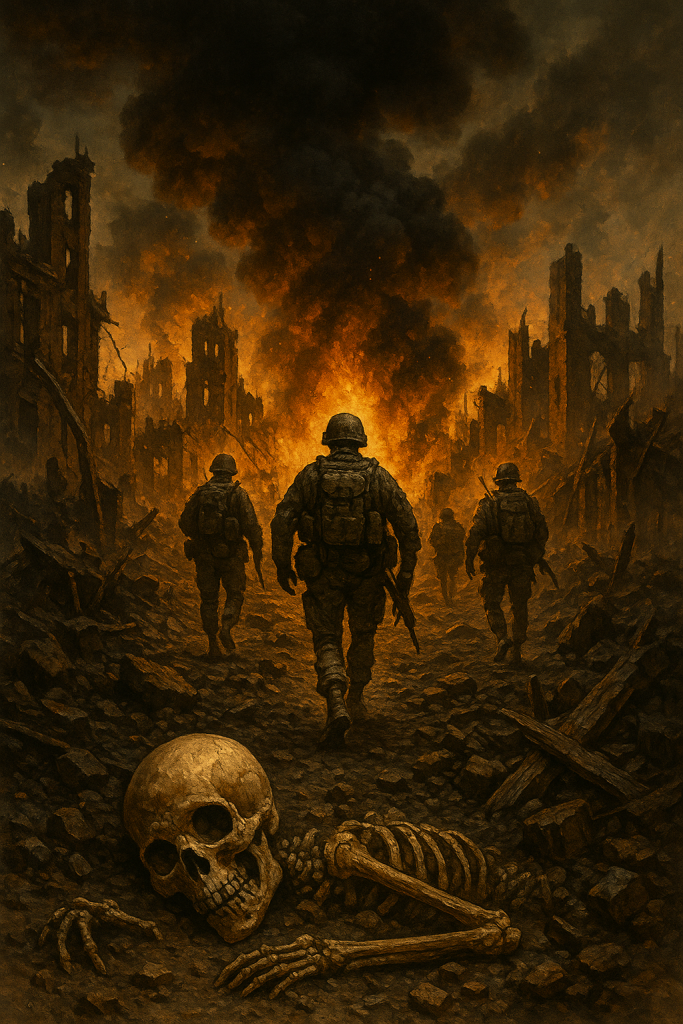
A Century That Should Have Known Better
Some days it feels as if the twenty-first century has learned nothing from the horrors that preceded it. We live in an age where the map of human suffering is once again studded with names we should never have to say in the same sentence: Gaza and southern Israel, Ukraine, Yemen, Sudan, Myanmar, Ethiopia – and now even Thailand and Vietnam finding themselves drawn back, in different ways, into cycles of unrest they thought they had escaped.
The tragedies differ in their causes, but they share one characteristic: they are morally unacceptable in a world that has the knowledge, the wealth, and the historical memory to do better.
War may once have been considered an inevitability of human conflict. But wars of aggression – and the atrocities committed in their shadows – cannot be squared with a species that claims to be moral, rational, or enlightened.
The sorrow is not only in the scale of destruction, but in its banality. Innocent men, women and children, whose only mistake was being born in the wrong place, are suffering because powerful individuals with guns, money, or ideology choose violence over the one thing that has ever worked: talking.
The Human Duality: Building Mars Rockets While Bombing Cities
It is one of the oldest and saddest paradoxes of the human condition:
We are capable of extraordinary intelligence and astonishing stupidity at the very same time.
In the same decade that we are preparing missions to Mars, mapping the human genome, and coordinating global relief efforts after earthquakes and floods, we are also manufacturing weapons so sophisticated and so profitable that entire economies depend on them.
Take the UK: a country with billions for advanced weapons systems but somehow “no money” for freezing pensioners, collapsing hospitals, or universal, high-quality education. This is not a mystery of economics; it is a reflection of politics, psychology, and a global weapons industry whose profits dwarf the budgets of most ministries of health. And while this grotesque misallocation of resources goes largely unexamined, public attention is successfully diverted towards the performative jingoism of Nigel Farage and his circle, obsessing over small boats as if they posed a greater threat than the industrial machinery of war.
Sociologically, all this reveals something darker:
that collective fear is more powerful than collective compassion,
and that democracies and dictatorships alike are willing to pour unimaginable sums into tools of destruction, even as their own citizens queue at food banks.
When you look at the sheer size of the arms economy – involving states, private firms, lobbyists, intelligence networks, and geopolitical strategists – it is no surprise that conspiracy theories flourish. One begins to wonder, not whether secret cabals exist, but whether the structural incentives of money, power, and fear create something that behaves exactly like a conspiracy: an unaccountable machine that profits from perpetual insecurity.
Yet even here, there is a deeper sadness:
This is all human-made. It could all be human-unmade.
The Only Road Left: Global Responsibility and Relentless Dialogue
Ending war and the suffering it unleashes is not a task for Washington or Moscow or Beijing alone. It is not a “European problem” or a “Middle Eastern problem” or an “African problem.”
It is a human problem.
And humans, whether in India, New Zealand, Switzerland, Brazil, Nigeria, or Japan, share equal responsibility for the world we are shaping.
The world is too interconnected – economically, technologically, environmentally – for the myth of “regional conflicts” to survive. A war in Ukraine destabilises global grain markets. A war in Gaza destabilises entire alliances. A war in the Sahel or Sudan creates refugee flows that reshape the politics of Europe within months.
And yet, our political rhetoric remains stuck in the nineteenth century: great powers posturing like drunken emperors, minor powers waiting for permission to act, populations encouraged to choose a side rather than choose a future.
Into this steps Donald Trump, who postures as a dealmaker but speaks as a man who has never studied history, diplomacy, or the complexity of human suffering. His racist, West-centric, emotionally stunted theatrics are not only unhelpful — they actively block the one thing that has ever stopped wars:
serious, sustained, structured dialogue.
China said this nearly two years ago, and they were right:
There is no military solution to these conflicts.
There is no future in “victory” defined as someone else’s obliteration.
If the stakes were framed differently —
If it were your grandmother being raped,
your daughter being shot,
your son sent to die in a trench,
would anyone still think that pride, posturing, or “teaching the enemy a lesson” was worth it?
Dialogue is not weakness.
Dialogue is not appeasement.
Dialogue is not naïve.
Dialogue is the only alternative to extinction-level stupidity.
What we need is a global determination — from governments, from civil society, from the international institutions we mock until we suddenly need them — to bring leaders and peoples into conversation with each other before the next atrocity, the next drone strike, the next unmarked grave.
We do not need more weapons.
We need more courage — the courage to talk to our enemies.
Because the only road that has ever led out of hell is the one people walked together, however awkwardly, toward a table, a room, a conversation.
Dialogue is not one option among many.
Dialogue is the only road left.
“If you want peace, you don’t talk to your friends. You talk to your enemies.” -Desmond Tutu