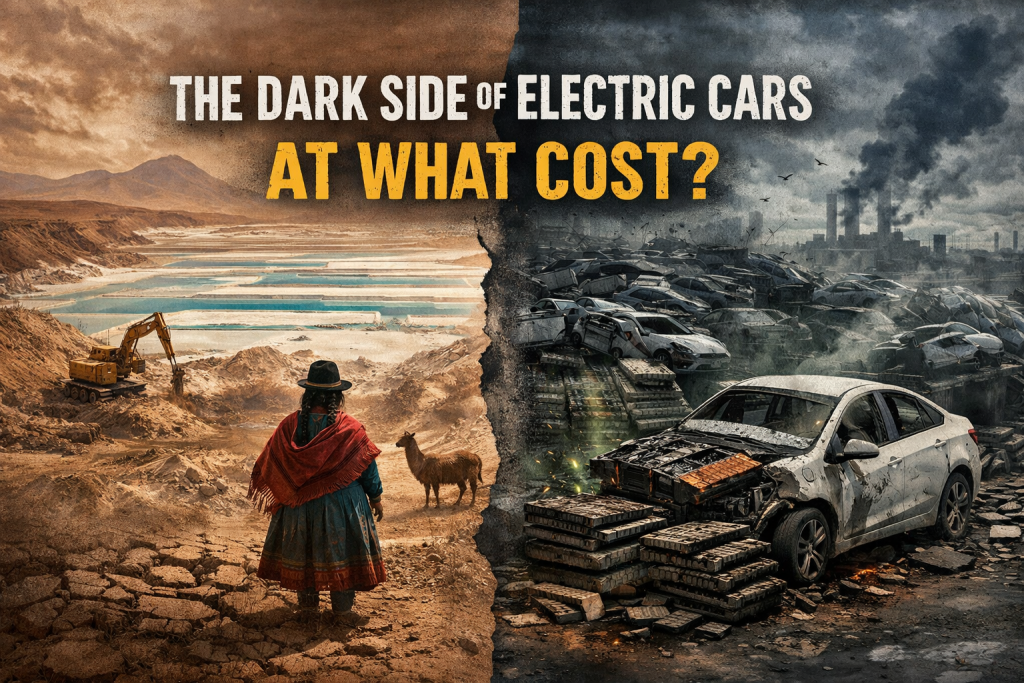
The Electric Car Story We Should All Be Talking About

Electric cars are sold to us as the clean, ethical future: the simple solution to petrol, emissions, and climate collapse. No exhaust pipe. No fumes. No guilt. Drive electric and you’re doing your part.

But the longer I listen to the certainty around EVs — the smug finality, the “case closed” tone — the more I suspect we haven’t solved the problem at all. We’ve simply moved it.

Because “zero emissions” is only true in one narrow sense: electric cars don’t emit at the tailpipe. That matters for city air quality, and it’s not trivial. But climate impact isn’t just about what comes out of the back of the vehicle. It’s about the whole chain: extraction, manufacturing, electricity generation, and end-of-life disposal.

And yes: in many cases, electric cars really are better on the climate. A major life-cycle analysis has estimated that battery electric cars sold in Europe today can produce dramatically lower overall greenhouse-gas emissions than comparable petrol cars. That’s a real advantage, and it’s worth acknowledging.

But “better than petrol” doesn’t automatically mean “clean.” It doesn’t mean “ethical.” And it certainly doesn’t mean “no victims.

The modern electric car runs on more than electricity. It runs on minerals — and minerals have to be ripped out of the earth. The new fuel of the “green future” isn’t oil alone: it’s lithium, nickel, cobalt, graphite, and more. And the extraction doesn’t happen in glossy European showrooms. It happens in places where ecosystems are fragile, water is scarce, and the people who live nearby often have far less power to resist the pressure.

Chile is frequently held up as a symbol of this new reality. In the Atacama region, concerns have been raised for years about lithium extraction and water stress in an already arid landscape. And while “displacement” doesn’t always mean literal bulldozers and forced removals, communities can still be displaced in practice, when resources shrink, livelihoods collapse and the land becomes harder to inhabit. You don’t always need an eviction notice to be pushed off your own future.

Then comes the question nobody wants to picture too clearly: what happens when millions of EV batteries die?

Batteries degrade. Capacity drops. Replacement costs bite. Cars are written off. And suddenly we’re not looking at a futuristic revolution, we’re looking at a looming waste problem. We are manufacturing the next century’s landfill with a smile on our faces, because it feels cleaner today.

Yes, recycling exists. Yes, there are second-life uses for some batteries. Yes, policymakers talk about circular economies. But the scale is the issue. Recycling infrastructure doesn’t magically appear just because consumers feel virtuous. It requires systems, enforcement, investment, and time — and at the moment, the global EV rollout is moving faster than the uncomfortable questions that should be travelling alongside it.

So why does this side of the story still feel strangely muted?

Partly because it’s complex, and complex stories don’t trend. But partly because the car industry is not politically neutral. The automobile sector has been one of the most powerful lobbying forces shaping transport policy, regulation, and public messaging for decades. That doesn’t require a secret conspiracy. It only requires something much more ordinary — influence, money, access, timing, and the gentle steering of what gets taken seriously.

This is the deeper danger: the electric car has become a moral symbol. Question it and you’re treated as pro-oil. Doubt it and you’re dismissed as anti-progress. But this isn’t how ethical responsibility works. A solution isn’t automatically good because it comes wrapped in green language.

Electric cars may reduce emissions. But they don’t end extraction. They don’t end harm.

We’re not transitioning from dirty to clean. We’re transitioning from visible pollution to invisible supply chains, from smoke in our cities to disruption in deserts we’ll never visit.

So yes: electrification may be part of the future. But only if we stop treating it like a miracle and start treating it like what it really is: a trade-off. A compromise. A human project, built inside a world of scarcity, power and competing interests.

If we want an energy transition worthy of the name, we need more than new engines. We need transparency, better public transport, enforceable standards, serious recycling systems and the courage to count the human cost, not as an inconvenient footnote, but as part of the moral equation.

“A thing is right when it tends to preserve the integrity, stability and beauty of the biotic community. It is wrong when it tends otherwise.”
Aldo Leopold

Meaning Before Language

At the start of the New Year, I began growing mung bean sprouts on the kitchen counter. Nothing ambitious: a glass jar, a handful of dry beans, water, patience. It was partly practical — a small attempt to eat better — and partly seasonal, a gesture of beginning again.

But as so often happens, attention did the rest.

Each morning and evening I rinsed the beans, drained the water, and tilted the jar back into place. Within a day, change began. Roots appeared. Pale shoots followed. By the third day, the jar was quietly alive with direction and momentum. Nothing dramatic. Nothing expressive. Just steady response.

Watching this simple process unfold gave rise to a set of thoughts that have stayed with me.

There is something quietly reassuring in discovering that:

    • order doesn’t require intention
    • meaning can emerge from conditions
    • responsiveness is not the same as consciousness

A seed doesn’t care —
but it is exquisitely attuned.

That distinction matters far beyond botany.

A mung bean has no brain, no awareness, no sense of purpose. It does not want to grow. It does not know that it is growing. And yet, when the conditions are right — moisture, warmth, oxygen — it responds. Enzymes activate, stored energy is released, cells divide, and a process begins that looks uncannily like purpose.

But it isn’t.

What the seed demonstrates is something both humbling and quietly radical: meaning can arise from structure rather than intention. Order can appear without a planner. Direction can emerge without desire. Life can move forward without knowing why.

“Life is not obliged to make sense to us.”
Richard Dawkins

We tend to assume the opposite about ourselves.

Much of modern human anxiety is rooted in the belief that meaning must be consciously created: unless we are constantly choosing, narrating, justifying, our lives risk becoming meaningless. We speak as if significance must always be meant by someone, preferably articulated, preferably defensible.

And yet, much of what shapes us most deeply happens long before we have words for it.

Which brings us to language.

There is a quiet assumption, widely shared and rarely examined, that meaning only exists where language exists. I certainly absorbed this idea early on: that without words, symbols, and narratives there could be no meaning, only blind mechanism. Animals, plants, seeds may be somehow alive, but they are not conscious of their existence because they do not have language. But is this assumption true under closer attention? Language does not so much create meaning as name it. Long before we describe a situation as safe or threatening, nourishing or hostile, our bodies are already responding. Long before a child can articulate belonging or neglect, those conditions are shaping who they become. Meaning, in this sense, precedes language. Language arrives later, not as the origin of significance, but as its echo.

Taken seriously, this idea does not just reshape education or psychology; it also presses uncomfortably on our concepts of religion.

If meaning precedes language, then religion becomes structurally vulnerable in a way it rarely acknowledges. Religious systems depend on language to define, order, and sanctify a reality that was already unfolding long before it was named. Just as the seed germinates without reference to our metaphors, doctrines, or reverence, the world generates complexity, order, and awe without requiring theological narration. Religion, in this light, does not create meaning but gathers around it — stabilising, preserving, and sometimes claiming ownership of what would otherwise continue unbothered. The danger is not that religion is false, but that it mistakes itself for the source rather than the afterimage of meaning: a linguistic architecture built around processes that do not need to be spoken in order to be real.

“There are no facts, only interpretations.”
Friedrich Nietzsche

Seen this way, the seed is not a lower form of life waiting for consciousness to redeem it. It is a reminder that attunement comes before articulation.

This has implications for how we think about human agency. To say that meaning can emerge from conditions is not to deny responsibility or choice. It is to relocate them. Agency is not constant control; it is responsiveness within constraints. The skill is not to will meaning into existence, but to recognise what kinds of environments allow growth — in ourselves and in others.

And this is where education enters the picture.

Much of contemporary schooling still reflects a modernist inheritance: knowledge divided into discrete subjects, timetabled and assessed in isolation. Biology here. Chemistry there. Physics somewhere else. Meaning nowhere in particular.

We teach biology largely as a catalogue of facts — cell structures, taxonomies, cycles, pathways — accurate, necessary, and often lifeless. Rarely do we teach it as the study of responsive systems. We talk about genes, but not environments. About mechanisms, but not emergence. Students learn that a seed needs water, warmth, and oxygen, yet miss the astonishing implication: life does not need a mind in order to organise itself.

By separating biology from physics and chemistry, we also reinforce a subtle illusion — that life is something apart from the rest of reality, rather than a continuation of it. As if metabolism were not chemistry in motion. As if growth were not physics slowed down and shaped by constraint. As if living systems did not obey the same laws as rivers and stars, only at a different scale.

A more truthful curriculum would dissolve these boundaries.

“What we observe is not nature itself, but nature exposed to our method of questioning.”
Werner Heisenberg

Imagine teaching “life” as a conversation between disciplines:
chemistry becoming organised,
physics learning to linger,
energy flowing through matter long enough to notice itself.

In such a curriculum, a sprouting seed would not be a marginal example but a foundational one. Students would be invited to ask not only what happens, but what it reveals: that responsiveness predates consciousness, that attunement is older than intention, that meaning does not need to be imposed in order to arise.

The ethical consequences would follow naturally. Instead of moralising failure, students might ask better questions: What conditions were missing? What environments are we creating? What do we reward, nourish, neglect?

Education, at its best, does not manufacture outcomes.
It creates conditions.

A seed doesn’t care.
But it responds.

So do children.
So do communities.
And, more often than we like to admit, so do we.

Perhaps part of the task of education — and of adult life — is to relearn this modest, hopeful truth: that meaning does not always need to be pursued or declared. Sometimes it only needs the right conditions in which to emerge.

“The most incomprehensible thing about the universe is that it is comprehensible.”
Albert Einstein