A Perfectly Absurd Christmas Story

The other evening, in the spirit of seasonal escapism, we were watching Man vs Baby—a piece of festive fluff involving slapstick chaos, an unruly infant, and, inevitably, a primary-school nativity play.

At some point, my husband—who grew up in Indonesia and is unfamiliar with Christian traditions—turned to me and asked, quite innocently, what the story was actually about.

So I explained.

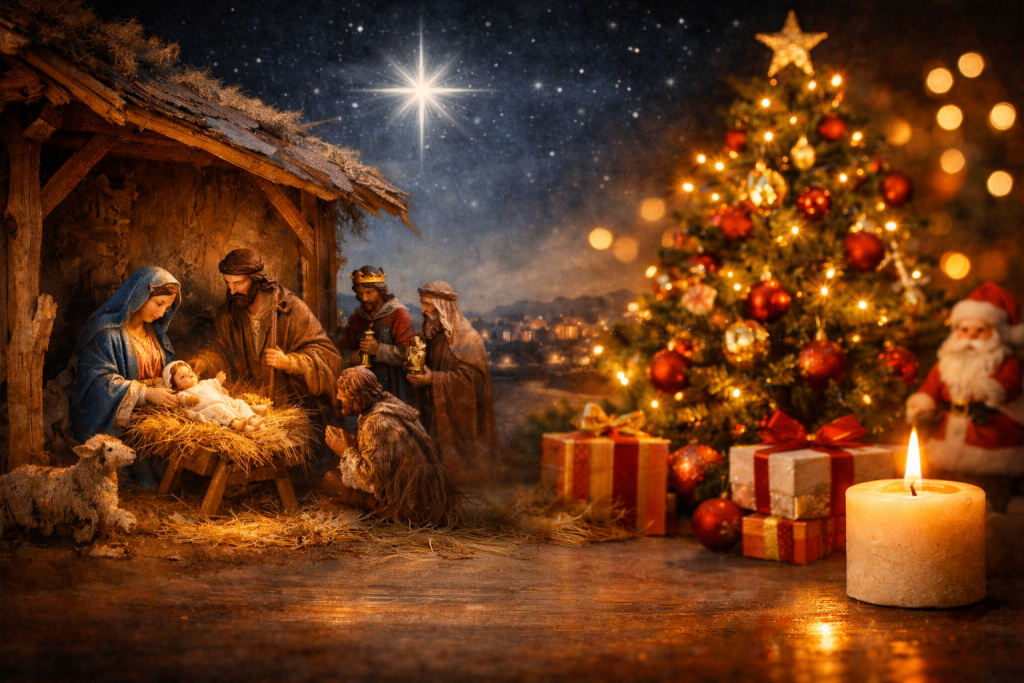
A teenage girl called Mary, who was also a virgin, gives birth to a baby. This baby is God. He is born in a stable because there is no room for him in the local accommodation. A star appears in the sky, guiding three wise men and a group of shepherds to come and worship this baby and bring him gifts. This child will later be executed, rise from the dead, ascend into heaven, and now sits—still in a human body—on the throne of the universe, exercising ultimate authority over all of existence for all eternity.

My husband listened politely. He nodded. He asked no follow-up questions.

But as I heard my own voice recounting this story, I had a sudden, almost comic moment of estrangement. Detached from carols, candlelight, stained glass, and nostalgia, the narrative sounded astonishingly absurd.

And yet.

It is also undeniably beautiful.

As a story, it has extraordinary power. Told aloud. Set to music. Painted. Sculpted. Recreated each December in glowing wooden cribs in living rooms, churches, town squares, and shopping malls. It is gentle. It centres on vulnerability rather than force. A baby rather than a king. Straw rather than marble. Hope for the world arriving quietly, unnoticed and poor.

I once believed it all.

Not only as a child, but later for about fifteen years of my adult life, when I was a Bible-believing fundamentalist Christian. I genuinely thought this story, set in the Middle East two millennia ago, explained everything: meaning, love, suffering, death, and the ultimate destiny of the world. I didn’t experience it as absurd at all. It felt profound, coherent, and necessary.

But with distance, the story didn’t simply become implausible; it became troubling. Not because it is poetic or mysterious, but because of what has been built upon it. The same “cute” story about a baby has been used to justify division, exclusion, cruelty, war, and extraordinary human suffering. Not by accident, but repeatedly, systematically, and often with great confidence and moral certainty.

That, for me, is the real tragedy—not that the story is implausible, but that it has been weaponised.

And yet, here we are again.

Lights are going up. Schools are rehearsing their nativity plays. People are travelling, eating too much, falling out, making up, missing those who are no longer here and trying, in their imperfect ways, to be a little kinder.

So this is not a call to cancel Christmas. Nor is it an attack on those who still believe the story literally. It’s simply an honest moment of reflection: a recognition that something can be both moving and absurd; beautiful and dangerous; comforting and deeply problematic.

In any case, beliefs aside, I want to take this opportunity to wish you—whoever you are, wherever you are—a genuinely restful and enjoyable Christmas and New Year break. May there be moments of warmth, laughter, good food, and quiet. And for 2026, I wish all of us what really matters: peace, goodwill, good health, and a little more humility about the stories we tell ourselves—and each other.

Happy Christmas.

“Christmas is not a time nor a season, but a state of mind.”
Calvin Coolidge

The mirror we all hold

“For now we see only a reflection as in a mirror; then we shall see face to face. Now I know in part; then I shall know fully, even as I am fully known.”
— 1 Corinthians 13:12

 In the Bible’s finest chapter on love, we find the core of what all human beings seek: to know the truth and to be loved unconditionally. Some are forced to abandon the search by war, famine, or disaster. Others numb it with money, power, routine, or religion. But painters, composers, writers, and prisoners ache until the search is done. Life may be a poor player strutting its hour upon the stage, yet it remains a miraculous gift. In my own search, this is what I have learned:

Our reality is socially constructed. It is not simply out there, an objective truth. It is shaped through interaction, language, and shared meaning. What we take as natural or real is the result of human processes. We create culture, institutions, and practices until they appear objective, unquestionable. Society is a human product, and humans are also a product of society.

So, God is not dead; she was never alive. Human beings are distinguished by language, and only with language could we invent the search for truth and love and confront our fear of death. We created narratives to explain, console, and control — each shaped by its ethnicity. When those narratives masquerade as religion, they breed arrogance and division, and evil flourishes in the shadows they cast.

In postmodern times, these grand stories have been dismantled, leaving behind fragments of wisdom, still priceless, still relevant. With their collapse comes the dissolution of absolute truth, the perfect mirror. We are left with fractured mirrors that blur and distort. We will never see face to face. We will never fully know.

Yet one certainty remains: we are constellations of atoms, stardust reassembled by chance and time, hurtling around our sun on a rock at 67,000 mph. DNA coils like ancient runes in every cell, issuing silent instructions: become, live, persist. From this choreography comes breath, thought, memory: a mother’s laughter, longing for distant places, a lover’s hand in the dark. We invent gods and heroes, build cathedrals and poems, grieve, and love. All this from fragile molecules wrapped in skin. Just chemistry. An echo of evolution. And yet: is it not a miracle that matter dreams at all?

As animals without God, we are capable of both the sublime and the grotesque, like a spider whose web can dazzle, yet devour. Both poles dwell in every heart. When misaligned in childhood, they consume more than they weave. Our destruction harms others as much as ourselves. Only when such misalignment is brought into the light, described and objectified, can disaster be averted. There is no cure, but it can be managed.

And yes, we need others. The fool thinks he can do it alone, with drugs or double lives. But we are social creatures, destined to create and to destroy together. We are the same story, written in different ink, linked like islands beneath the ocean. We need one another to hold up the mirrors in which we might glimpse truth — and love.

Love is the fiction we live and die for. Our need for sex and closeness becomes sonnet and story, until the invention feels more real than the words that birthed it. Yet in that fiction, light is found. And only in that light do the mirrors reflect enough to end our search.

The arts are our vehicle for this search. Education is archaic. It is preserved that way by an oligarchy masquerading as democracy to secure the success of its offspring. Were curricula ever to be revised, the arts must not be replaced by AI or science, but contextualised by them. Only then might humanity move toward security and enlightenment, instead of decline and crime.

I’d be very interested in your comments.