When God Comes Back: A Note of Caution for Gen Z (from an Ex-Pastor)

On 11 January 2026, Sky News ran a piece with a headline that would have sounded unlikely a decade ago: “How did Gen Z become the most religious generation alive?”

The article reports an uptick in religious belief and church attendance among young adults, with social media playing a surprising role in how faith is “discovered” and spread: short-form religious content on TikTok and Instagram, influencers speaking openly about God, and churches receiving enquiries from young people who first encountered religion online.

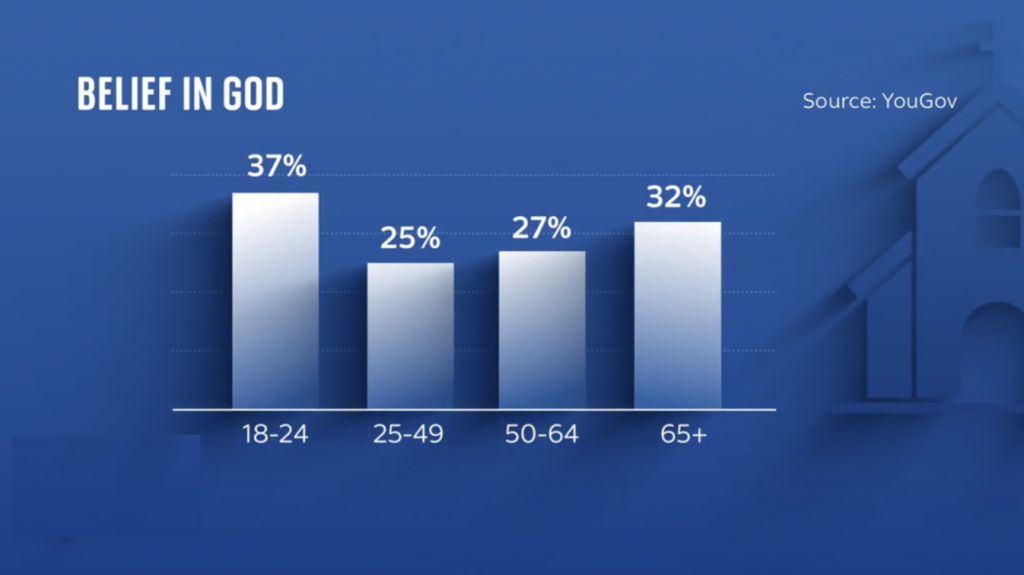
Sky’s piece includes voices from Christian influencers who say they’re seeing a noticeable rise in young people asking how to get involved, and it references YouGov data suggesting a marked shift: among 18–25s, monthly church attendance rising from 7% (2018) to 23% (2024), and belief in a higher power rising from 28% to 49% across the same period.
Even the sceptics appear in the report—young atheists who say this doesn’t match what they see online, or who wonder whether the change is temporary and pandemic-shaped.

So: something is happening. And if we care about society, about meaning, about the moral atmosphere we all breathe, we should pay attention.

Why this makes sense (even if you’re not religious)

I teach university students. I write about social meaning. And I have to admit: the trend itself is not mysterious to me.

When a society loses confidence in its shared story, people don’t become “purely rational.” They become hungry.

For a long time, the West lived off inherited moral capital: ideas of human dignity, restraint, compassion, truth-telling, fidelity, responsibility—values that were once anchored in a Christian metaphysics, then carried forward as if they could survive on sentiment alone.

But sentiment doesn’t sustain a civilisation.

What we increasingly offer young people instead is:

    • Ethical drift: everything negotiable, nothing binding
    • Performative role models: influence without character, aesthetics without responsibility
    • Thin narratives: “be yourself,” “live your truth,” “manifest your future” — slogans that collapse under suffering
    • A destabilised world: economic fragility, housing impossibility, ecological anxiety, war returning as background noise

Under those conditions, it is almost inevitable that many will reach for something older and firmer than the modern self. Something that says:

    • this is real
    • this is right
    • this is wrong
    • your life is not an accident
    • your suffering is not meaningless
    • there is a way through

And in the Western world, that “something” is most readily available in Christianity.

Which churches will benefit most

If Gen Z is turning toward Christianity for meaning and stability, we should be honest about where the gravitational pull will land.

It will not primarily be the churches that sound like ritual, bored faces and committees.

It will be the churches that sound like conviction.

The kinds of churches most likely to grow are the ones that offer:

    • non-negotiable truth (not “your personal journey,” but The Answer)
    • a strong identity (“this is who we are; this is how we live”)
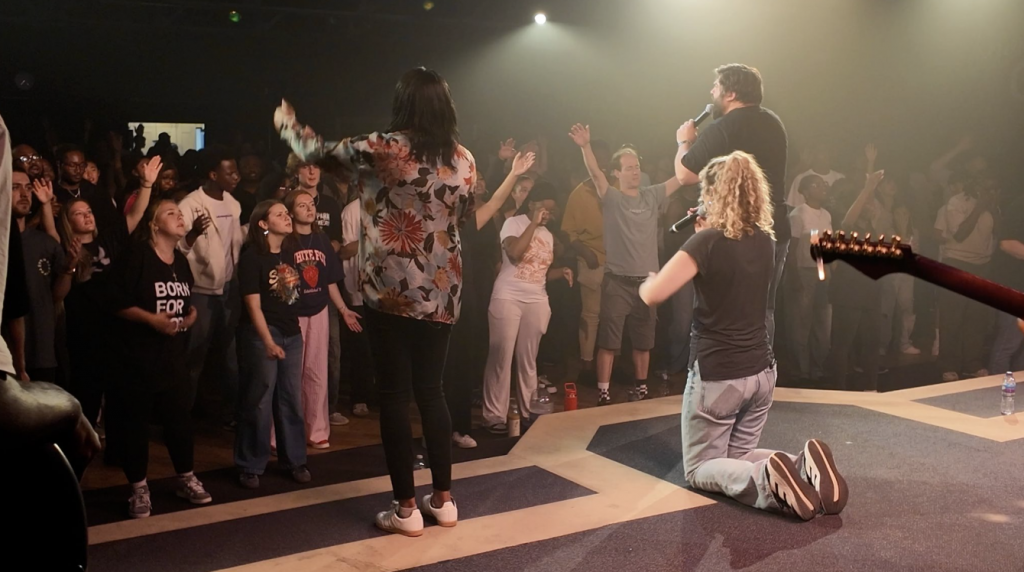
    • high emotional impact (music, lighting, atmosphere, collective intensity)
    • clarity about enemies (the world, the devil, “compromise,” secular decadence)
    • belonging that feels immediate and total

The Sky News article points to the rise of Christian content on TikTok and influencer culture around faith.

That ecosystem naturally rewards certainty, compression, drama, and transformation narratives—all things charismatic and fundamentalist Christianity has always been good at packaging.

If you want a religion that fits social media, you will end up with the kind of religion that performs well on social media.

And that is where my caution begins.

My stake in this: I used to be one of them

I am not writing this as an anti-Christian hit piece.

I am writing this as someone who once stood inside that world—as a pastor, not merely a visitor. I believed. I preached. I led people. I sold my house and car and moved abroad with my family. I was part of the machinery that makes a high-commitment church feel like home and destiny at the same time.

I no longer believe in God.

And because I know what these churches can do—both the beauty and the damage—I want to say something directly to any Gen Z reader who is moving toward Christianity because the world feels hollow and unstable.

You are not foolish for wanting meaning.

You are not stupid for wanting a moral anchor.

But you may be walking, without realising it, into a system designed to take more from you than it gives.

So let me offer a warning, not against faith as such, but against a particular style of faith that is increasingly likely to catch you.


Four warnings before you hand over your life

1) It offers “ultimate truth” — but it cannot prove it

Fundamentalist Christianity sells certainty.

It tells you the world has a secret structure and it possesses the key: virgin births, miracles, demons, healings, resurrections, prayers that alter reality. It gives you a total explanation and calls that “faith.”

But human beings will believe almost anything if it fits the narrative they are offered—especially when the narrative arrives wrapped in community, music, belonging, and moral purpose.
That is not an insult to believers. It is an observation about humans.

A strong story can feel true even when it isn’t.

And the stronger the story, the more it demands you interpret everything through it: your sexuality, your friendships, your doubts, your pain, your ambitions, your money, your family.

Once you interpret reality through a sacred script, the script becomes self-sealing. Evidence against it becomes “temptation” or “attack” or “pride.”

That isn’t truth. That is a closed system.

2) It trains you to call the selflessness “love” — but salvation is still about you

There is a reason Nietzsche was so ferocious about Christianity.

Christianity can produce remarkable acts of compassion—real kindness, real service. Many Christians are genuinely good people.

But at the structural level the religion often contains a hidden centre of gravity: your soul, your salvation, your standing before God, your purity, your afterlife.

Even love can become instrumental:

    • I love you because I must be Christlike
    • I witness to you because your conversion validates my worldview
    • I “forgive” you because it keeps me clean
    • I help you because it stores treasure somewhere else

When salvation is the central preoccupation, the self never truly exits the stage.

You may feel you are becoming “more loving,” but you may also be becoming more morally anxious, more self-monitoring, more dependent on approval, more afraid of your own doubt.

3) The sacrifices will not deliver what is promised

High-commitment Christianity often sells a paradox:

Give up the world and you will gain joy.

And sometimes, at first, it works. Early conversion can feel like oxygen: clarity, unconditional love, a new tribe, a new identity, a new sense of direction. In a lonely world, that is powerful.

But over time the bargain changes.

You will be asked to sacrifice things that are not merely “sinful,” but simply human:

    • parts of your identity that don’t fit the template
    • questions you’re not allowed to keep asking
    • desires you must rename as temptation
    • relationships that become “unequally yoked”
    • your own inner authority

And here’s the trap: the moral standard is often impossible.

You will be told to be holy, pure, humble, grateful, surrendered, joyful, obedient, servant-hearted, faithful, prayerful, disciplined, generous, forgiving, and to treat doubt as rebellion.

That produces one of two outcomes:

    1. you become a performer: outward righteousness, inward fracture
    2. you become perpetually guilty: never enough, never clean, never sure

Neither is freedom.

4) You may be entering a soft prison you won’t easily leave

This is the warning I most want to underline.

A church can become a total social world:

    • your friends
    • your dating pool
    • your weekends
    • your music
    • your language
    • your moral framework
    • your sense of being “safe”

And once that happens, leaving is not like changing a hobby. It is like exiting a country.

The gravitational pull is real:

    • leaders frame departure as betrayal
    • friends become wary, then distant
    • doubts must be hidden or confessed
    • your identity becomes fused with the group
    • your fear of “backsliding” keeps you inside

Even if nothing “cultic” is happening, the system can still function like a sect: high belonging, high cost, high control.

And if your life later falls apart, as lives sometimes do, the love you thought was unconditional can become conditional very quickly.

I have lived that.

When my own life imploded, many of the people who had once spoken the language of grace stepped back. Disappeared. Some rewrote history. Some behaved as if I had never existed. It was as though my entire Christian life was deleted overnight.

And the cruelty of that is specific: because Christianity is often sold as the cure for rejection. You think you are finally safe.

Then you discover you were safe only while you were useful, coherent, and compliant.


A closing word to Gen Z: don’t outsource your hunger

If you are drawn toward Christianity because the world feels unstable, I understand.

The moral void is real.

The longing for meaning is not childish. It is the most adult thing about you.

But please, before you hand over your identity, time, sexuality, money, and inner authority to a high-commitment religious system—pause.

Ask:

    • Does this community make me more honest, or merely more certain?
    • Does it strengthen my conscience, or replace it?
    • Does it widen my compassion, or narrow my world?
    • Can I doubt here without being punished?
    • If I leave, will love remain?
    • What is the cost of belonging—and who benefits?

If you still choose faith, choose it with open eyes.

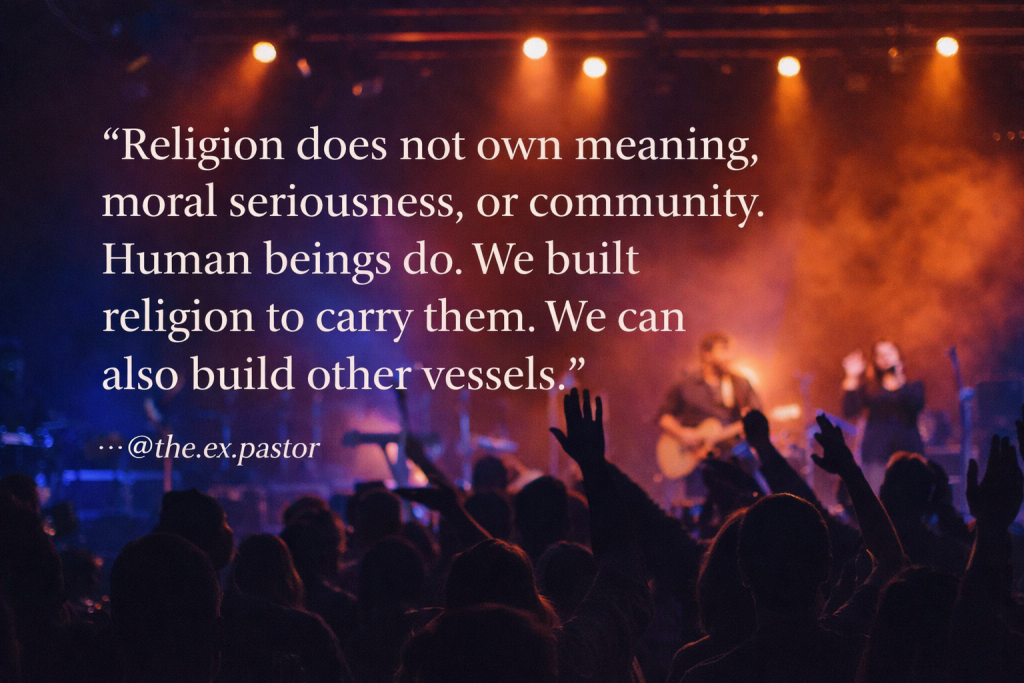
And if what you are really seeking is meaning, moral seriousness, and community, remember: religion does not own those things. Human beings do.

We built religion to carry them. We can also build other vessels.

The point is not to mock your hunger.

The point is to protect you from people who know exactly how to use it.

“I might believe in the Redeemer if his disciples looked more redeemed.”
— Friedrich Nietzsche
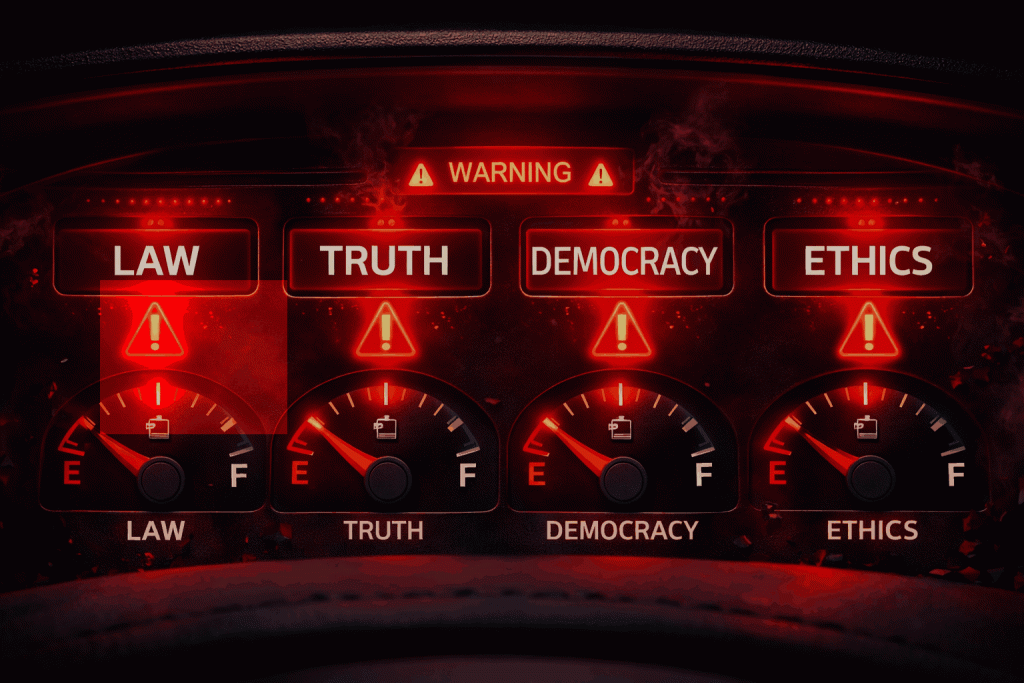
Is It Time For A Peaceful Revolution?

The return of Donald Trump is not merely a political event. It is a moral diagnostic.

It tells us something deeply unsettling about the state of our world: that values, principles, and ethics have slipped from the centre of public life. They have been displaced largely by financial gain, grievance politics, racialised fear, and the steady erosion of democratic norms.

This is not an American problem alone. It is a global one.

Trump is not the cause of this collapse; he is its most conspicuous symptom, like a mirror held up to societies that have quietly traded moral seriousness for spectacle, responsibility for outrage and truth for tribal loyalty.


The Disappearance of Principle

Where are the people of principle?

Where are the politicians who speak honestly about limits, responsibility, and restraint, rather than promising everything while meaning nothing? Where are the leaders willing to say “this is wrong” even when doing so costs them popularity, office, or power?

And where, more troubling still, are the faith communities — Christian, Jewish, Muslim, secular humanist — when democracy is undermined and human dignity reduced to a slogan?

Too often, there is silence.
Or worse: rationalisation.


Ethics in a ‘Post-God’ World

We increasingly describe ourselves as living in a “post-God” world. Whatever one’s beliefs, this framing carries an uncomfortable implication.

If there is no higher authority to appeal to, no divine judgement, no metaphysical reckoning, then responsibility does not disappear. It intensifies.

In such a world, ethics cannot be outsourced to tradition, scripture or institutions. They must be embodied in individuals.

We are fully and finally accountable for what we tolerate, excuse, and normalise.

The collapse of shared ethical frameworks does not free us. It leaves us more exposed.


When Systems Fail

When political systems fail, when institutions rot from within, when law bends to power and truth bends to profit, waiting politely is no longer a virtue.

Peaceful resistance is not extremism.
Civic courage is not disorder.
Refusing to normalise injustice is not naïveté.

History does not judge societies kindly for their patience in the face of moral collapse.


The GDR: Proof That Change Is Possible

I live in the former German Democratic Republic.

Within my own lifetime, I have seen proof that enormous social change is not only possible, but inevitable, when large numbers of ordinary people rise up peacefully and say: Enough.

No tanks.
No violence.
Just people.

The fall of the GDR was not engineered by heroes or generals. It was brought about by teachers, factory workers, church groups, writers, engineers: people who withdrew their consent from a system that no longer deserved it.

That lesson should haunt us and teach us.


Have We Gone Mad?

As a warning light on the dashboard of history, young Germans are once again being asked whether they are prepared to fight for their country.

After everything Europe has lived through: after the ruins, the camps, the mass graves, the promises of Nie wieder — have we learned nothing?

The question should not be how to prepare the next generation for war, but how we allowed ourselves to drift back towards the conditions that make war imaginable again.


Democracy Belongs to the Ordinary

Democracy does not belong to elites.
It does not belong to parties, platforms, or billionaires.

It belongs to writers.
Teachers.
Lawyers.
Nurses and doctors.
Construction workers.
Refuse collectors.

It belongs to all of us.

When democratic systems disintegrate, it is not because “the people” failed. It is because too many people were persuaded that their voice no longer mattered.


Silence Is Not Neutral

Some of us are old enough to know where silence, blame-shifting, and passivity lead.

Writing from exile as Europe collapsed around him, Stefan Zweig issued a warning that has lost none of its force:

“The greatest danger threatening humanity today is not fanaticism itself, but the silent toleration of fanaticism.”

Zweig understood that history is not undone by villains alone, but by the quiet compliance of the reasonable.


So Where Is the Line?

If Zweig was right, then the question is no longer whether we see what is happening.

The question is this:

Where do you draw the line?
What responsibility do professionals, educators, faith communities, and citizens have when institutions fail?
What does peaceful resistance look like now?

Enough silence.
Enough normalisation.
Enough waiting.

History does not move only through great men. It moves when ordinary people decide that they will no longer cooperate with the unacceptable.

The moment is not coming.

It is already here.

“Truth to tell, we are all criminals if we remain silent.”

—Stefan Zweig

Dialogue or Destruction: Why Peace Has Only One Road Left

A Century That Should Have Known Better

Some days it feels as if the twenty-first century has learned nothing from the horrors that preceded it. We live in an age where the map of human suffering is once again studded with names we should never have to say in the same sentence: Gaza and southern Israel, Ukraine, Yemen, Sudan, Myanmar, Ethiopia – and now even Thailand and Vietnam finding themselves drawn back, in different ways, into cycles of unrest they thought they had escaped.

The tragedies differ in their causes, but they share one characteristic: they are morally unacceptable in a world that has the knowledge, the wealth, and the historical memory to do better.
War may once have been considered an inevitability of human conflict. But wars of aggression – and the atrocities committed in their shadows – cannot be squared with a species that claims to be moral, rational, or enlightened.

The sorrow is not only in the scale of destruction, but in its banality. Innocent men, women and children, whose only mistake was being born in the wrong place, are suffering because powerful individuals with guns, money, or ideology choose violence over the one thing that has ever worked: talking.

The Human Duality: Building Mars Rockets While Bombing Cities

It is one of the oldest and saddest paradoxes of the human condition:
We are capable of extraordinary intelligence and astonishing stupidity at the very same time.

In the same decade that we are preparing missions to Mars, mapping the human genome, and coordinating global relief efforts after earthquakes and floods, we are also manufacturing weapons so sophisticated and so profitable that entire economies depend on them.

Take the UK: a country with billions for advanced weapons systems but somehow “no money” for freezing pensioners, collapsing hospitals, or universal, high-quality education. This is not a mystery of economics; it is a reflection of politics, psychology, and a global weapons industry whose profits dwarf the budgets of most ministries of health. And while this grotesque misallocation of resources goes largely unexamined, public attention is successfully diverted towards the performative jingoism of Nigel Farage and his circle, obsessing over small boats as if they posed a greater threat than the industrial machinery of war.

Sociologically, all this reveals something darker:
that collective fear is more powerful than collective compassion,
and that democracies and dictatorships alike are willing to pour unimaginable sums into tools of destruction, even as their own citizens queue at food banks.

When you look at the sheer size of the arms economy – involving states, private firms, lobbyists, intelligence networks, and geopolitical strategists – it is no surprise that conspiracy theories flourish. One begins to wonder, not whether secret cabals exist, but whether the structural incentives of money, power, and fear create something that behaves exactly like a conspiracy: an unaccountable machine that profits from perpetual insecurity.

Yet even here, there is a deeper sadness:
This is all human-made. It could all be human-unmade.

The Only Road Left: Global Responsibility and Relentless Dialogue

Ending war and the suffering it unleashes is not a task for Washington or Moscow or Beijing alone. It is not a “European problem” or a “Middle Eastern problem” or an “African problem.”

It is a human problem.

And humans, whether in India, New Zealand, Switzerland, Brazil, Nigeria, or Japan, share equal responsibility for the world we are shaping.

The world is too interconnected – economically, technologically, environmentally – for the myth of “regional conflicts” to survive. A war in Ukraine destabilises global grain markets. A war in Gaza destabilises entire alliances. A war in the Sahel or Sudan creates refugee flows that reshape the politics of Europe within months.

And yet, our political rhetoric remains stuck in the nineteenth century: great powers posturing like drunken emperors, minor powers waiting for permission to act, populations encouraged to choose a side rather than choose a future.

Into this steps Donald Trump, who postures as a dealmaker but speaks as a man who has never studied history, diplomacy, or the complexity of human suffering. His racist, West-centric, emotionally stunted theatrics are not only unhelpful — they actively block the one thing that has ever stopped wars:

serious, sustained, structured dialogue.

China said this nearly two years ago, and they were right:
There is no military solution to these conflicts.
There is no future in “victory” defined as someone else’s obliteration.

If the stakes were framed differently —
If it were your grandmother being raped,
your daughter being shot,
your son sent to die in a trench,

would anyone still think that pride, posturing, or “teaching the enemy a lesson” was worth it?

Dialogue is not weakness.
Dialogue is not appeasement.
Dialogue is not naïve.

Dialogue is the only alternative to extinction-level stupidity.

What we need is a global determination — from governments, from civil society, from the international institutions we mock until we suddenly need them — to bring leaders and peoples into conversation with each other before the next atrocity, the next drone strike, the next unmarked grave.

We do not need more weapons.
We need more courage — the courage to talk to our enemies.

Because the only road that has ever led out of hell is the one people walked together, however awkwardly, toward a table, a room, a conversation.

Dialogue is not one option among many.
Dialogue is the only road left.

“If you want peace, you don’t talk to your friends. You talk to your enemies.”  -Desmond Tutu