Welfare Money Does Not Disappear
Across Europe the debate about welfare spending tends to follow a predictable script. Governments warn about ballooning costs. Conservative politicians complain about incentives. Newspapers highlight the most extreme cases of abuse. The impression created is simple: the state hands money out, and the money is gone. This is even implied in the English word “dole.”
But economically, this picture is deeply misleading.
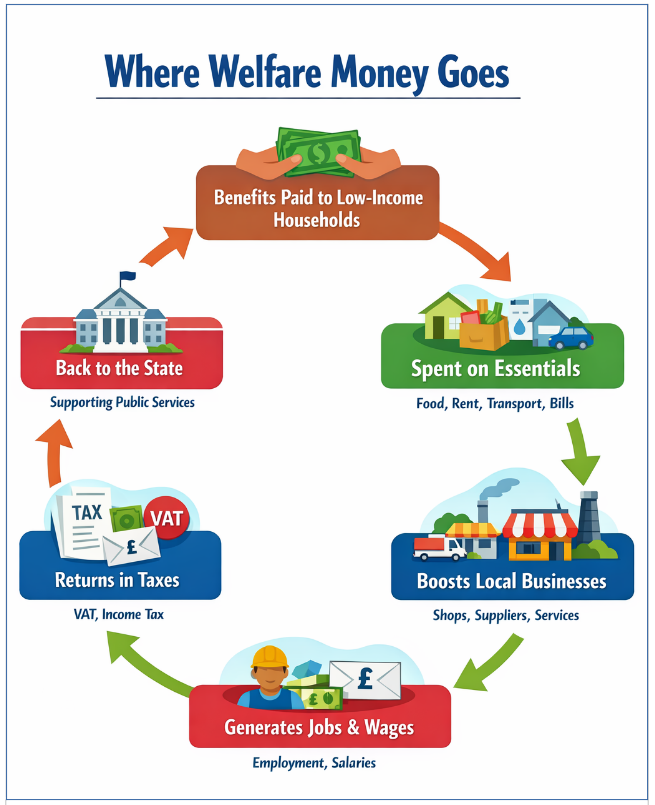 Money paid to low-income households does not disappear. It circulates through the economy, supports businesses, generates tax revenue and stabilises demand. A portion returns immediately to the state through consumption taxes. A larger portion sustains economic activity that would otherwise collapse.
Once this is understood, the political argument about welfare begins to look rather different.
The immediate return: consumption taxes
Across Europe, the final consumer pays VAT (or its equivalent). In Germany it is 19 percent; in the UK it is 20 percent; reduced rates apply to essentials such as food or children’s clothing.
When a low-income household spends welfare payments on groceries, toiletries, clothing, transport or household goods, a share of that spending flows straight back to the public purse.
This means welfare transfers are never purely one-way payments. Even before wider economic effects are considered, part of the money immediately returns to government.
The multiplier effect
The more important effect comes from how poorer households use money.
Economists describe this through the marginal propensity to consume — the proportion of additional income that is spent rather than saved.
Low-income households typically spend most or all of any extra income simply because they have to. Bills must be paid, food bought, and rent covered. Wealthier households, by contrast, are more likely to save additional income or invest it, taking advantage of tax incentives that reduce government income.
This matters because spending generates economic activity.
When a welfare recipient buys groceries:
-
- the supermarket pays staff
- suppliers receive orders
- workers earn wages
- those workers spend their own income
Taxes are paid at multiple stages — VAT, payroll taxes, corporate taxes.
Studies by organisations such as the International Monetary Fund and the OECD repeatedly find that transfers to poorer households produce relatively high fiscal multipliers. In simple terms, each euro or pound transferred can generate more than one euro or pound of economic activity.
The invisible stabiliser
This mechanism is why many European welfare systems act as automatic stabilisers during economic downturns.
When unemployment rises:
-
- government spending increases
- households retain some purchasing power
- businesses retain customers
This prevents economic contractions from becoming deeper recessions.
Germany’s Kurzarbeit scheme during the COVID-19 crisis is an example of the same principle applied to wages. By subsidising reduced working hours instead of allowing mass layoffs, the government kept millions of workers connected to their employers and maintained consumer demand.
Income support, in other words, is often cheaper than economic collapse.
The Marxian shadow
None of this would have surprised Karl Marx. Marx argued that capitalist economies maintain what he called a “reserve army of labour” — a population that is unemployed or precariously employed, exerting downward pressure on wages and disciplining those who remain in work.
Whether one accepts Marx’s wider conclusions or not, the idea captures a persistent truth: labour markets always contain a margin of insecurity.
Welfare systems therefore operate at a delicate intersection. They prevent destitution while preserving enough economic pressure to keep labour markets functioning.
“The greater the social wealth, the functioning capital, the extent and energy of its growth… the greater is the industrial reserve army.” — Karl Marx
The political misdirection
The numbers themselves reveal how distorted the debate often is.
In Germany, for example, spending on pensions alone exceeds €500 billion per year, while the Bürgergeld programme for the long-term unemployed accounts for only a small fraction of total social spending.
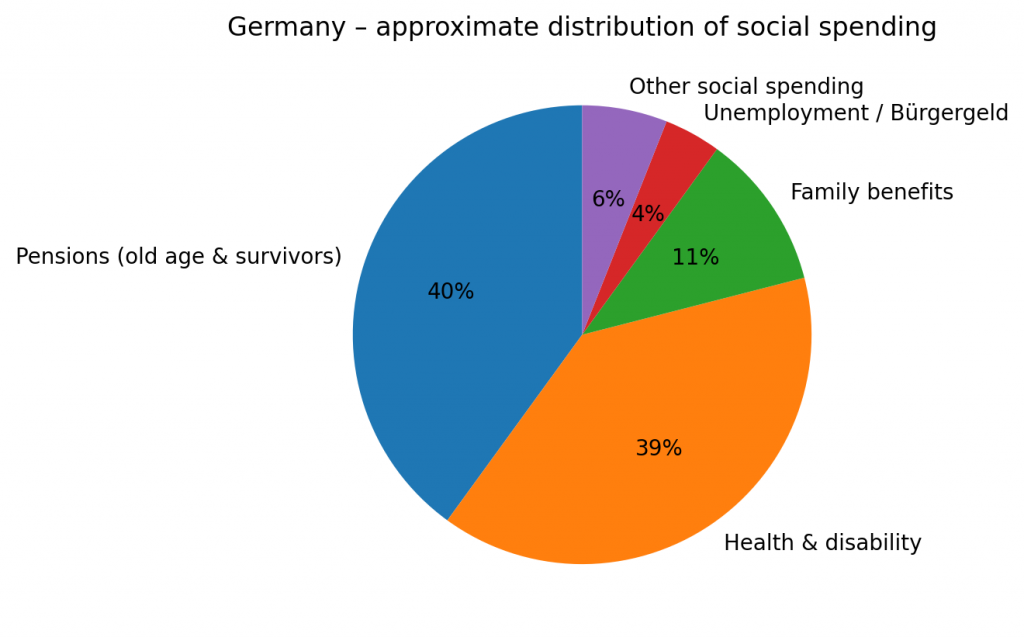
Yet political debates frequently focus obsessively on the latter.
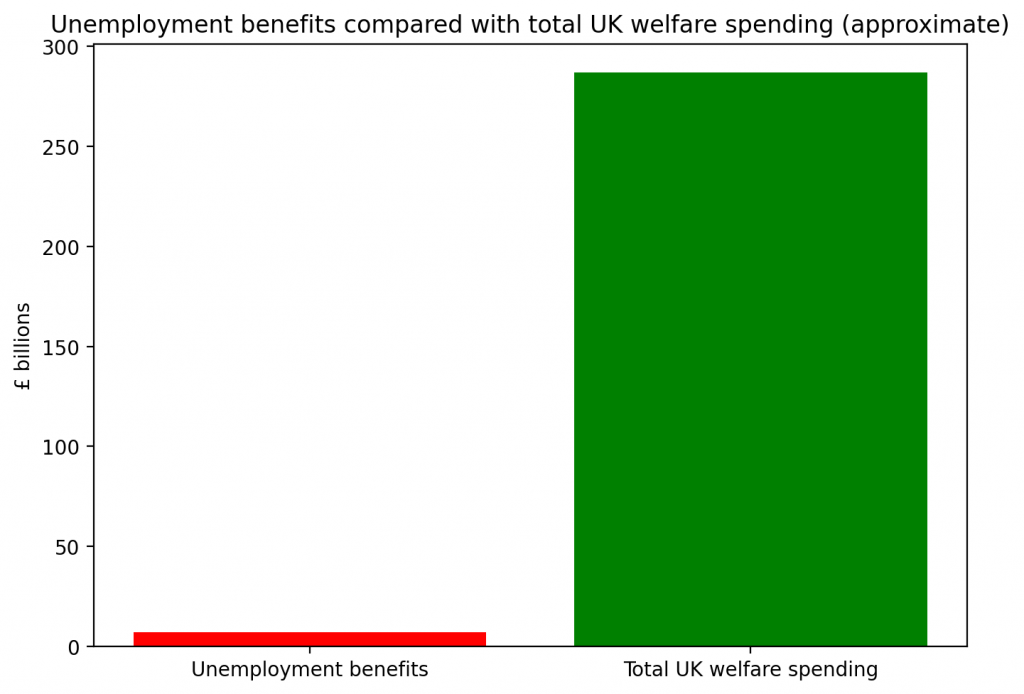
Across Europe the pattern is similar: politically visible welfare programmes for the unemployed attract far more attention than the vastly larger costs associated with pensions, healthcare, demographic ageing and long-term care.
The result is a curious form of fiscal theatre. Here is the statistical reality in the UK:
The real question
If governments genuinely want fewer people dependent on welfare, the answer is not moral outrage. It is:
-
- economic growth
- functioning labour markets
- effective training systems
- efficient public administration
- investment in education and skills
Until those foundations improve, the debate about welfare spending risks becoming little more than a ritualised complaint about the weakest participants in the economy, akin to refugees arriving in boats.
A more honest conversation
The welfare debate would look very different if it began with a simple act of honesty. Welfare money does not disappear. It circulates through shops, businesses, wages and tax systems before returning, partly and often quickly, to the state itself.
The real fiscal pressures facing European governments lie elsewhere: ageing populations, pensions, healthcare and the long-term costs of economic stagnation. Yet political attention continues to circle obsessively around the smallest slice of the welfare state. Perhaps that is because it is easier to argue about the poor than to confront the deeper structural challenges of a modern economy.
The ideas of economists and political philosophers, both when they are right and when they are wrong, are more powerful than is commonly understood. — John Maynard Keynes