When God Comes Back: A Note of Caution for Gen Z (from an Ex-Pastor)

On 11 January 2026, Sky News ran a piece with a headline that would have sounded unlikely a decade ago: “How did Gen Z become the most religious generation alive?”

The article reports an uptick in religious belief and church attendance among young adults, with social media playing a surprising role in how faith is “discovered” and spread: short-form religious content on TikTok and Instagram, influencers speaking openly about God, and churches receiving enquiries from young people who first encountered religion online.

Sky’s piece includes voices from Christian influencers who say they’re seeing a noticeable rise in young people asking how to get involved, and it references YouGov data suggesting a marked shift: among 18–25s, monthly church attendance rising from 7% (2018) to 23% (2024), and belief in a higher power rising from 28% to 49% across the same period.

Even the sceptics appear in the report—young atheists who say this doesn’t match what they see online, or who wonder whether the change is temporary and pandemic-shaped.

So: something is happening. And if we care about society, about meaning, about the moral atmosphere we all breathe, we should pay attention.

Why this makes sense (even if you’re not religious)

I teach university students. I write about social meaning. And I have to admit: the trend itself is not mysterious to me.

When a society loses confidence in its shared story, people don’t become “purely rational.” They become hungry.

For a long time, the West lived off inherited moral capital: ideas of human dignity, restraint, compassion, truth-telling, fidelity, responsibility—values that were once anchored in a Christian metaphysics, then carried forward as if they could survive on sentiment alone.

But sentiment doesn’t sustain a civilisation.

What we increasingly offer young people instead is:

    • Ethical drift: everything negotiable, nothing binding
    • Performative role models: influence without character, aesthetics without responsibility
    • Thin narratives: “be yourself,” “live your truth,” “manifest your future” — slogans that collapse under suffering
    • A destabilised world: economic fragility, housing impossibility, ecological anxiety, war returning as background noise

Under those conditions, it is almost inevitable that many will reach for something older and firmer than the modern self. Something that says:

    • this is real
    • this is right
    • this is wrong
    • your life is not an accident
    • your suffering is not meaningless
    • there is a way through

And in the Western world, that “something” is most readily available in Christianity.

Which churches will benefit most

If Gen Z is turning toward Christianity for meaning and stability, we should be honest about where the gravitational pull will land.

It will not primarily be the churches that sound like ritual, bored faces and committees.

It will be the churches that sound like conviction.

The kinds of churches most likely to grow are the ones that offer:

    • non-negotiable truth (not “your personal journey,” but The Answer)
    • a strong identity (“this is who we are; this is how we live”)
    • high emotional impact (music, lighting, atmosphere, collective intensity)
    • clarity about enemies (the world, the devil, “compromise,” secular decadence)
    • belonging that feels immediate and total

The Sky News article points to the rise of Christian content on TikTok and influencer culture around faith.

That ecosystem naturally rewards certainty, compression, drama, and transformation narratives—all things charismatic and fundamentalist Christianity has always been good at packaging.

If you want a religion that fits social media, you will end up with the kind of religion that performs well on social media.

And that is where my caution begins.

My stake in this: I used to be one of them

I am not writing this as an anti-Christian hit piece.

I am writing this as someone who once stood inside that world—as a pastor, not merely a visitor. I believed. I preached. I led people. I sold my house and car and moved abroad with my family. I was part of the machinery that makes a high-commitment church feel like home and destiny at the same time.

I no longer believe in God.

And because I know what these churches can do—both the beauty and the damage—I want to say something directly to any Gen Z reader who is moving toward Christianity because the world feels hollow and unstable.

You are not foolish for wanting meaning.

You are not stupid for wanting a moral anchor.

But you may be walking, without realising it, into a system designed to take more from you than it gives.

So let me offer a warning, not against faith as such, but against a particular style of faith that is increasingly likely to catch you.


Four warnings before you hand over your life

1) It offers “ultimate truth” — but it cannot prove it

Fundamentalist Christianity sells certainty.

It tells you the world has a secret structure and it possesses the key: virgin births, miracles, demons, healings, resurrections, prayers that alter reality. It gives you a total explanation and calls that “faith.”

But human beings will believe almost anything if it fits the narrative they are offered—especially when the narrative arrives wrapped in community, music, belonging, and moral purpose.

That is not an insult to believers. It is an observation about humans.

A strong story can feel true even when it isn’t.

And the stronger the story, the more it demands you interpret everything through it: your sexuality, your friendships, your doubts, your pain, your ambitions, your money, your family.

Once you interpret reality through a sacred script, the script becomes self-sealing. Evidence against it becomes “temptation” or “attack” or “pride.”

That isn’t truth. That is a closed system.

2) It trains you to call the selflessness “love” — but salvation is still about you

There is a reason Nietzsche was so ferocious about Christianity.

Christianity can produce remarkable acts of compassion—real kindness, real service. Many Christians are genuinely good people.

But at the structural level the religion often contains a hidden centre of gravity: your soul, your salvation, your standing before God, your purity, your afterlife.

Even love can become instrumental:

    • I love you because I must be Christlike
    • I witness to you because your conversion validates my worldview
    • I “forgive” you because it keeps me clean
    • I help you because it stores treasure somewhere else

When salvation is the central preoccupation, the self never truly exits the stage.

You may feel you are becoming “more loving,” but you may also be becoming more morally anxious, more self-monitoring, more dependent on approval, more afraid of your own doubt.

3) The sacrifices will not deliver what is promised

High-commitment Christianity often sells a paradox:

Give up the world and you will gain joy.

And sometimes, at first, it works. Early conversion can feel like oxygen: clarity, unconditional love, a new tribe, a new identity, a new sense of direction. In a lonely world, that is powerful.

But over time the bargain changes.

You will be asked to sacrifice things that are not merely “sinful,” but simply human:

    • parts of your identity that don’t fit the template
    • questions you’re not allowed to keep asking
    • desires you must rename as temptation
    • relationships that become “unequally yoked”
    • your own inner authority

And here’s the trap: the moral standard is often impossible.

You will be told to be holy, pure, humble, grateful, surrendered, joyful, obedient, servant-hearted, faithful, prayerful, disciplined, generous, forgiving, and to treat doubt as rebellion.

That produces one of two outcomes:

    1. you become a performer: outward righteousness, inward fracture
    2. you become perpetually guilty: never enough, never clean, never sure

Neither is freedom.

4) You may be entering a soft prison you won’t easily leave

This is the warning I most want to underline.

A church can become a total social world:

    • your friends
    • your dating pool
    • your weekends
    • your music
    • your language
    • your moral framework
    • your sense of being “safe”

And once that happens, leaving is not like changing a hobby. It is like exiting a country.

The gravitational pull is real:

    • leaders frame departure as betrayal
    • friends become wary, then distant
    • doubts must be hidden or confessed
    • your identity becomes fused with the group
    • your fear of “backsliding” keeps you inside

Even if nothing “cultic” is happening, the system can still function like a sect: high belonging, high cost, high control.

And if your life later falls apart, as lives sometimes do, the love you thought was unconditional can become conditional very quickly.

I have lived that.

When my own life imploded, many of the people who had once spoken the language of grace stepped back. Disappeared. Some rewrote history. Some behaved as if I had never existed. It was as though my entire Christian life was deleted overnight.

And the cruelty of that is specific: because Christianity is often sold as the cure for rejection. You think you are finally safe.

Then you discover you were safe only while you were useful, coherent, and compliant.


A closing word to Gen Z: don’t outsource your hunger

If you are drawn toward Christianity because the world feels unstable, I understand.

The moral void is real.

The longing for meaning is not childish. It is the most adult thing about you.

But please, before you hand over your identity, time, sexuality, money, and inner authority to a high-commitment religious system—pause.

Ask:

    • Does this community make me more honest, or merely more certain?
    • Does it strengthen my conscience, or replace it?
    • Does it widen my compassion, or narrow my world?
    • Can I doubt here without being punished?
    • If I leave, will love remain?
    • What is the cost of belonging—and who benefits?

If you still choose faith, choose it with open eyes.

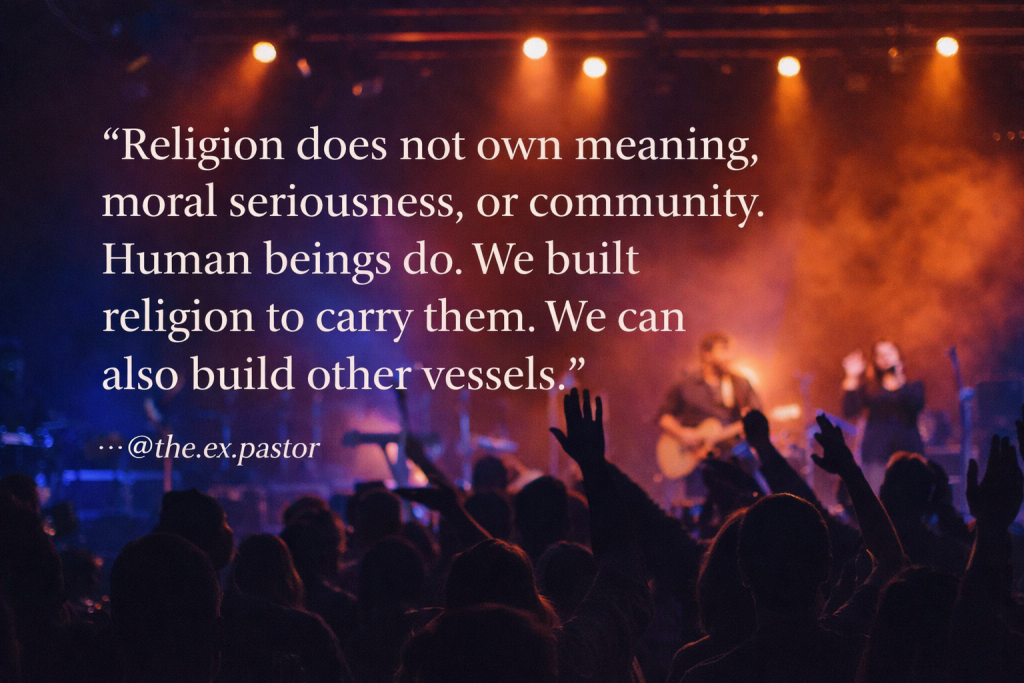
And if what you are really seeking is meaning, moral seriousness, and community, remember: religion does not own those things. Human beings do.

We built religion to carry them. We can also build other vessels.

The point is not to mock your hunger.

The point is to protect you from people who know exactly how to use it.

“I might believe in the Redeemer if his disciples looked more redeemed.”
— Friedrich Nietzsche

From Village Carpenter to Global Force: The Strange Success of Christianity

It remains one of the strangest facts of history.

A thirty-something artisan from a provincial backwater, speaking Aramaic in a corner of the Roman Empire, is now at the centre of the world’s most geographically widespread religion. Two thousand years later, his story is still believed – not just by the desperate and uneducated, but by surgeons, software engineers, lawyers, professors and prime ministers.

We can debate for ever whether the miracles happened, whether the tomb was empty, whether God exists at all. But even if you bracket all that out, a hard question stays on the table:

How did this particular faith story become so portable, so durable, and so attractive to intelligent people for so long?

And – just as interesting – why does Christianity grow in some places today and haemorrhage members in others?

I want to suggest that the answer has less to do with miracles, and more to do with four things:

    • its portability
    • its God of love
    • its dual appeal to heart and reason
    • and the way it behaves sociologically – either as a movement or as an institution.

Christianity’s Secret Weapon: Portability

Most ancient religions came bundled with a package deal: one god, one people, one place, one language.

You worshipped the gods of your tribe, your city, your land. The temple was in that city, the sacrifices at that altar, the prayers in that tongue. This is how religion normally works.

Christianity broke that model.

From the very beginning it said, in effect:

“You don’t need to be Jewish. You don’t need to move to Jerusalem. You don’t need to learn a sacred language. This is for everyone.”

No temple to travel to.
No hierarchical clergy or priesthood – every believer is a priest
No sacred script only the initiated can read.

Just a set of compelling and memorable stories and teachings about Jesus and a small travelling community who claimed that his life, death and (as they saw it) resurrection had changed what it meant to be human.

That made Christianity absurdly portable:

    • It moved from Aramaic into Greek.
    • Then into Latin, Coptic, Syriac, Armenian, Gothic.
    • It made the jump into the philosophical worlds of Plato and Stoicism, and then into the legal and administrative world of Rome.
    • Today it sits comfortably in English, Swahili, Korean, Portuguese and Tagalog without asking anyone to “become Jewish” first.

If you strip Christianity back to its core, the essentials are strangely easy to translate:

    • love
    • forgiveness
    • dignity
    • care for the poor
    • hope beyond death
    • justice
    • meaning
    • transformation

No sacred mountain. No exclusive caste. No single holy language.

Just a story and a way of life that can, at least in theory, be picked up anywhere.

Whenever Christianity has leaned into this radical portability – no guarantees, no bureaucracy, just small communities trying to live this story in their own culture – it has tended to spread.

Whenever it has wrapped itself in state power, fixed liturgies, heavy buildings and highly controlled hierarchies, after some initial growth, it has tended to stall and then decline.

We can see that empirically now.


A Shockingly Different God

Portability explains how Christianity can move.
It doesn’t yet explain why anyone would actually want it.

Here I think we come to the most explosive claim at the heart of Christian faith:

God loves you. Personally.

We are used to that sentence now. In the ancient world, it was dynamite. All humans are looking for existential meaning and personal acceptance.

The gods of Rome were powerful, but capricious.
The gods of Greek myth were brilliant, but aloof.
The philosophers spoke of a Logos or a First Principle – interesting, but hardly something you would sing hymns to.

Then along come the Christians, saying:
the ultimate reality behind the universe is not raw power, not blind fate, not an impersonal force, but self-giving love – and that this love is somehow focused on you.

Not just: “There is a god.”
But: “You are known and wanted.”

Add to that some other, equally disruptive ideas:

    • that slaves have dignity,
    • that women and children matter,
    • that the poor, the stranger, the sick, the disabled are not disposable but precious,
    • that every human being, without exception, bears the image of God.

In an empire that threw away unwanted babies, left the sick to die in the street, and treated most people as economically useful units at best, this was not just comforting. It was revolutionary.

You didn’t have to believe in miracles to find this vision of the world compelling. Many still don’t.


Heart and Mind in the Same Story

There is another piece to the puzzle. Christianity did something that very few religions manage to sustain over centuries:

It offered a credible home for both the heart and the mind.

On the heart side, it speaks to:

    • forgiveness for real guilt
    • a path to change when you hate the person you’ve become
    • a community that will (at least in theory) walk with you
    • the intuition that love and justice somehow matter more than success
    • the fear of death and the longing that death is not the end

On the mind side, it offers:

    • a universe that is ordered and intelligible rather than random
    • a moral framework that is more than “my preference vs. yours”
    • a coherent story of how humans can be capable of both beauty and horror
    • a God-concept that can be, and has been, taken seriously by some of the most demanding intellects in history

Augustine, Aquinas, Pascal, Kierkegaard, Bonhoeffer – whatever you make of their conclusions, these are not gullible people. They were not seduced by a cosy fairy tale. They found in Christianity a way of thinking that was at least big enough to wrestle with reality.

That combination – emotional depth and intellectual seriousness – is rare. It goes some way to explaining why, in every generation, some doctors, lawyers, scientists and philosophers still end up in church despite knowing all the reasons not to.


When Christianity Behaves Like a Religion, It Shrinks

The really uncomfortable part, especially if you belong to an established church, is what happens next.

Over time, the portable, story-driven movement becomes something else:

    • It builds buildings.
    • It develops liturgy and rules.
    • It trains a professional clergy.
    • It negotiates with states and empires.
    • It learns to sit quite comfortably next to imperial power, feudal systems, colonial projects and nationalist dreams – sometimes as their chaplain.

Some of this is inevitable. Human beings organise. Communities need structure. Not every bishop is a villain.

But the sociological pattern is striking:

    • In much of Europe, the old state-linked churches – Catholic, Anglican, Lutheran, Reformed – are in steep numerical decline.
    • They are rich in buildings, history and liturgy; poor in young adults, fresh converts and living energy.
    • Many of their most enthusiastic members quietly slip away to small, lay-led, often charismatic communities – or out of the Christian story altogether.

You don’t need supernatural explanations for this.
It is what tends to happen when a movement becomes an institution and then an arm of the state.

The religion that once prided itself on having “no temple, no priesthood, no sacred language” has sometimes become exactly the kind of religion Jesus himself spent so much time arguing with.

And people vote with their feet.


When Christianity Behaves Like a Movement, It Spreads

The picture is very different whenever Christianity sheds the imperial clothing and goes back to something closer to its original form.

We see this in:

    • house-church networks under communism
    • base communities in Latin America
    • Pentecostal and independent churches in parts of Africa, Asia and Latin America
    • small experimental communities in post-Christian cities in Europe.

What these movements tend to have in common is not a particular theology but a form:

    • they are locally led,
    • often meeting in homes, schools or rented halls rather than cathedrals,
    • heavily relational,
    • high on participation and experience,
    • able to translate the message into local culture without waiting for permission from a distant headquarters.

They may or may not be “charismatic” in the technical sense. Many are. Some aren’t. But they are recognisable cousins of that first generation of Jesus-followers who met in houses, shared meals, argued, prayed, fell out, reconciled and tried to work out what this story meant in Corinth, or Antioch, or Rome.

Where Christianity looks like that, it is often growing – sometimes quietly, sometimes explosively.

Where Christianity looks like a bureaucratic service provider for people who need weddings, funerals and a vague sense of national identity, it is often dying.

Again, you don’t need to believe in God to see the pattern. It’s written in the attendance figures.


So Why This One Story?

None of this “proves” that Christianity is true. That’s a different discussion.

But it does, I think, make sense of why this particular faith story has had such reach:

    • It told an outrageous story of love in a world ruled by fear.
    • It insisted that the most important truths about human life could be carried in a portable story, not locked in a temple or a tribe.
    • It managed, at its best moments, to give both the heart and the mind something serious to work with.
    • And it has a built-in tendency to break out of its own institutions and reinvent itself as a movement again whenever those institutions become too heavy.

An Aramaic-speaking artisan from a nowhere village should have vanished into the long list of forgotten preachers.

Instead, people all over the world are still arguing about him, still praying to him, still walking away from him in anger, still quietly coming back.

You can explain that purely in sociological and psychological terms, if you like. Or you can, if you are so inclined, wonder whether the “God of love” at the centre of the story has something to do with its refusal to die.

Either way, it is hard to deny that the story is still on the move – and that it travels lightest when it remembers where it began.

“The Christian ideal has not been tried and found wanting; it has been found difficult and left untried.”  – G. K. Chesterton

Faith and doubt

The Bible defines faith in strikingly absolute terms:

“Now faith is confidence in what we hope for and assurance about what we do not see.”
— Hebrews 11:1

For years, I lived inside that definition. To believe in God, in the death and resurrection of Jesus, in heaven and hell, was not to speculate but to be certain. I remember how real that certainty felt — as if the ground beneath me could not possibly give way.

Looking back, I can still see why conviction is so attractive. It simplifies life. It gives you direction. There’s something reassuring about being guided by a strong sense of rightness, rather than drifting on vague, half-formed notions. For a time, I admired that in myself and in others — the courage to stand firm, to be sure.

But certainty has a darker side. It divides the world into believers and non-believers, insiders and outsiders. I’ve seen how quickly that division hardens into judgment, superiority, even hostility. History is full of examples where religious certainty did not just separate communities but helped justify oppression and war. That recognition has been painful for me, because I once participated in the same mindset.

Doubt, by contrast, has never started wars. It doesn’t silence art or suppress science. If anything, doubt has opened doors — for creativity, for discovery, for dialogue. In my own life, doubt has forced me to pause, to ask questions I once thought dangerous. Strangely enough, it has made me more compassionate. To give someone the benefit of the doubt, even in ordinary relationships, is to allow space for understanding rather than condemnation. On a larger scale, when whole cultures are willing to live with doubt, it creates the possibility of cooperation instead of conflict.

For me, the shift from certainty to doubt has not been easy. It feels like stepping off firm ground into open air. But it also feels more honest. Faith, I now see, is not always confidence; it can just as easily be the refusal to face uncomfortable truths. Doubt, far from being weakness, has become — for me — a condition of dignity, the beginning of humility, the chance to meet others without the armour of superiority.

Voltaire once wrote:

“Si Dieu n’existait pas, il faudrait l’inventer.”
If God did not exist, it would be necessary to invent him.

Perhaps he was right. But if we are honest with ourselves, we may also need to invent doubt — not as a threat to our humanity, but as its safeguard.