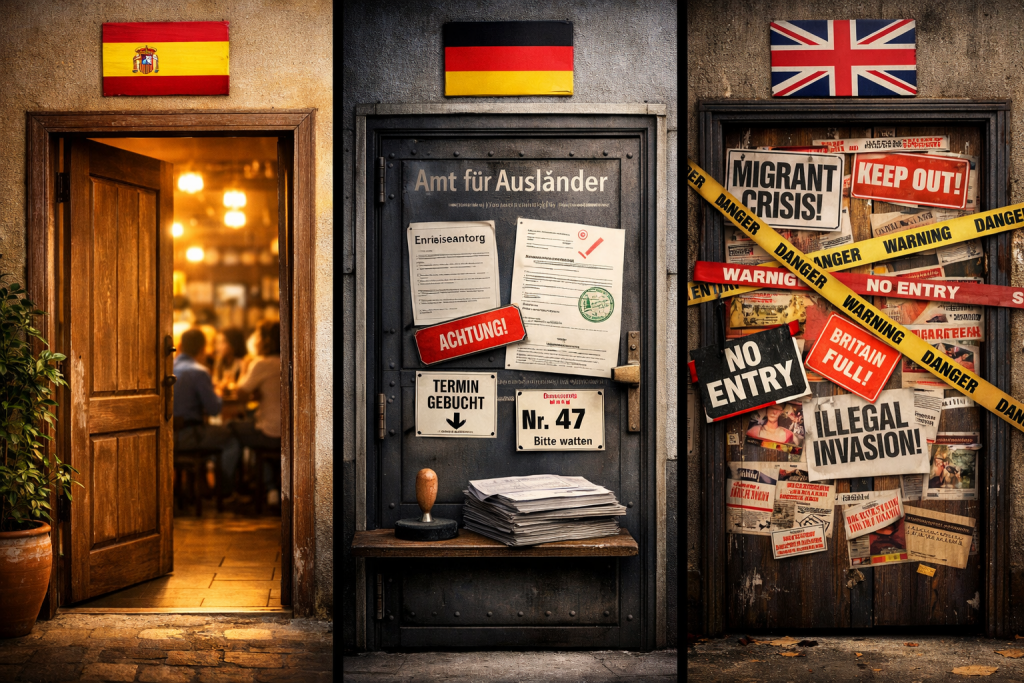
Living Between Spain, Britain, and Germany
As a British citizen who has lived in Germany for fifteen years and who also has a home in Spain, I find myself moving between different moral climates when it comes to immigration. All three countries depend on migration. All three speak about it constantly. Yet they govern it with very different degrees of conviction.
Spain’s decision to regularise around half a million undocumented migrants has been widely described as bold. What strikes me more is that it feels principled. It reflects a style of leadership associated with Pedro Sánchez. Whether one agrees with him or not, he governs from a recognisable ethical framework. That framework informs domestic policy and foreign stances alike, including Spain’s willingness to articulate an independent position on Gaza. Immigration policy flows from that same seriousness. The law is being aligned with reality rather than used to perform toughness.
Germany approaches integration through procedure and moral discipline. This reflects a political culture now shaped by Friedrich Merz, a self-described capitalist whose flexibility seems to run in one direction only. Long-standing commitments are suddenly negotiable when it comes to rearmament, national debt, welfare retrenchment, or deportation rhetoric, provided wealth hierarchies remain untouched. The result is a system that demands compliance from the vulnerable while offering constant reassurance to capital. Integration becomes conditional, slow, emotionally distant, even hostile.
Britain’s problem is different but no less corrosive. Under Keir Starmer, the country is led by someone who claims a socialist inheritance but governs as a weathervane. Immigration policy shifts according to polling rather than principle. Positions harden according to headlines. The message to migrants is clear: you are needed, resented, and rhetorically punished all at the same time.
Spain, by contrast, currently shows a confidence that much of Europe lacks. It does not deny that immigration produces pressure. Housing shortages and exploitation are real. But regularisation is treated as governance, not surrender. Integration is understood as something that happens socially before it is certified administratively.
My own perspective here is sharpened by marriage. I am British, resident in Germany, and married to an Indonesian. After a year of marriage, my husband still has no residency or work permit in Germany. He is merely tolerated. In the UK, we cannot apply at all because I no longer live and work there. In Spain, later this year, he would have both residency and the right to work. Sitting together at Luca’s Café in Torremolinos, the contrast is impossible to ignore. Spain does not interrogate our presence. It respects us and welcomes us.
This difference is not accidental. It reflects political leadership. Confidence integrates better than fear. And at the moment, Spain is one of the few Western countries still willing to govern from that truth.
“Hospitality is not a gesture of kindness. It is a measure of political confidence.”
— Jacques Derrida
2 thoughts on “Spain Governs Immigration. Britain and Germany Perform It.”