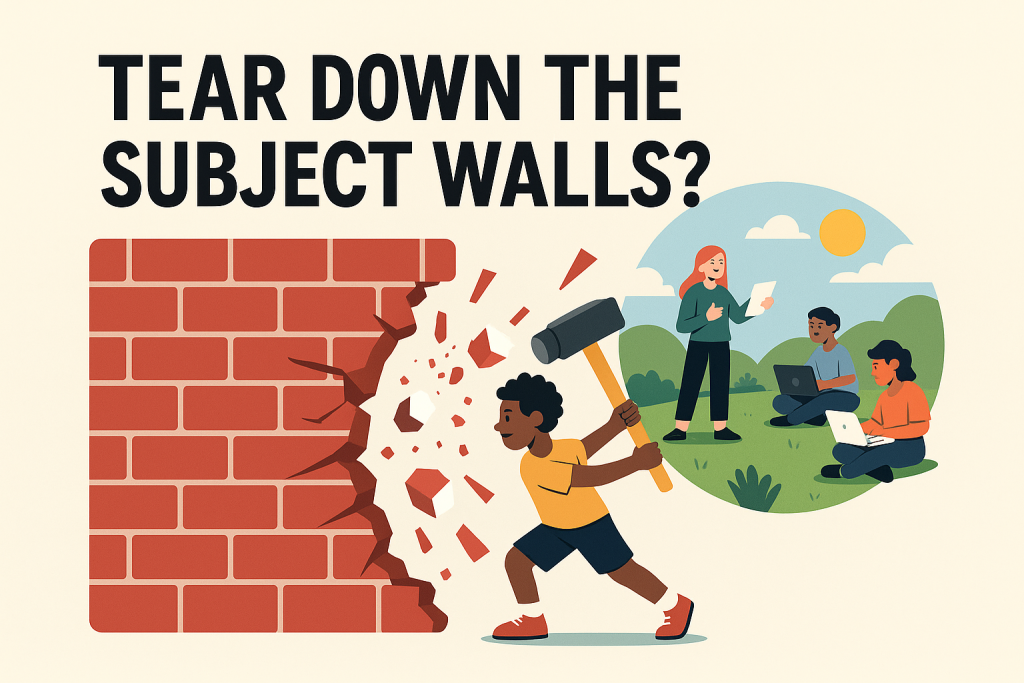
When I walk into a classroom these days — as a teacher in the UK — I’m struck by how little our structure resembles the real world young people are entering. We still teach in 45- to 90-minute blocks, subject by subject: English, Maths, Science, History, Languages. We have bells. We have chairs. We have worksheets. We assess. We move on. Rinse. Repeat. Yet outside the school gate, the challenges our young people will face—from AI and globalisation to climate collapse and widening inequality—are not neatly partitioned into subjects. They are messy, interconnected, urgent.
Here are three international cases that suggest more radical alternatives—and then I’ll suggest how we might use them to reimagine schooling in the UK, starting now.
Case 1: Singapore – from mid-year exams to flexible pathways
In Singapore the national system has abolished mid-year exams in primary and secondary years, freeing time for deeper learning and teacher-led feedback instead of grinding revision loops.
At secondary level, the streaming model (Express, Normal, etc) is being replaced by Full Subject-Based Banding (“Full SBB”): instead of placing a young person in a fixed track, students choose subject levels (G1–G3) per subject, allowing them to mix strengths and interests rather than being boxed in.
What this means: fewer rigid exams, more flexible progression, and structural freedom to personalise learning.
For the UK: ask ourselves—why do we still do rigid tiers that assume a child is ‘strong’ or ‘weak’ across everything, instead of allowing them to pursue variable strengths (say strong in languages, average in science, needs support in maths)? And why do we still place so much weight on one set of exams at the end of a key stage, rather than more iterative assessment?
Case 2: India – NEP 2020, boards twice a year + life/vocational skills
India’s new National Education Policy (NEP 2020) mandates board exams twice a year for major classes, where students may keep their best score. This reduces the terrifying “all‐or‐nothing” moment and gives a chance for resubmission.
Additionally, it explicitly demands from Grade 6 onwards a ten-day “bagless” period of hands-on work (internships/local trades) and integrates vocational and life-skills education throughout.
Implication: schooling begins to resemble life and work, not just subject delivery and external testing.
For the UK: imagine a programme where Year 9 or Year 10 has a two-week “real-world problem” block: students pick a genuine local or global challenge (poverty, homelessness, climate change) and use maths, languages, geography, science, PSHE, enterprise skills to design a solution. That’s project-based, cross-curricular, tied to real life.
Case 3: Japan – active learning + financial literacy
In Japan the national curriculum has been revised to emphasise active learning: students present, debate, collaborate and solve problems rather than passively receive lectures. Also built into high school programmes are financial-literacy and consumer-skills modules (asset building, cashless payments, personal finance).
So: pedagogy changes (not just content), and the curriculum recognises the need for life literacy, not just exam preparation.
For the UK: we may ask — why is financial education so marginal in many schools? Why are pedagogical models still lecture-&-sit-in-rows when the world demands adaptability, collaboration & critical thinking?
The deeper problem: our modernist curriculum model
Putting all these cases side-by-side, what stands out is how far we in the UK remain locked into a modernist schema:
-
Distinct subjects taught in isolation, as though reality were tidily separable.
-
Fixed time-blocks (lessons) and chairs, with students sitting still for hours on end.
-
Exams that are terminal, summative, determined in a narrow timeframe and often divorced from the “real” problems pupils will face.
-
Little allowance for physical movement, cross-curricular exploration, problem-solving or student-agency.
-
A model that—I’m going to say it—feels weird, abnormal, cruel even, for keeping young children in chairs all day, little movement, scant exposure to purposeful activity or physical literacy. Meanwhile outside the gates they’ll live in a world wired for movement, disruption, interdisciplinarity.
In this model we risk producing young people who are: passive, desk-bound, conditioned to consume rather than create; taught to do school rather than do life. We train couch-potatoes for the hamster wheel of assessment rather than citizens capable of invention, exploration, critical thinking and embodied well-being.
What might a “real-world curriculum” look like?
Drawing on those international examples and your own teacher-intuitions, here are some provocations for UK schooling:
-
Project-based, cross-curricular blocks
Remove a full week (or more) per term from the timetable and turn it into a “challenge week”. Students choose or are assigned real problems: e.g., reduce poverty in a developing country, design a local food-supply solution, map the impact of climate change on migration. They use maths (statistics, modelling), geography (mapping), history (colonial legacies), languages (communication), science (systems thinking), psychology (behaviour change), ethics/citizenship (values). Teachers co-design and cross-facilitate rather than lead discrete 45-minute lessons. -
Flexible pathways, subject-by-subject
Instead of rigid sets and tracks, allow students from Year 8/9 onwards to select subject-levels per subject based on interest, aptitude and growth—not past performance alone. Build in teacher-recommendation + student-choice models, as Singapore is doing. -
Life-skills & movement embedded, not optional
-
Integrate financial literacy, citizenship, personal data literacy (AI, privacy), entrepreneurial skills into the timetable.
-
Make movement (sports, outdoor education, active learning) a core part of the day: e.g., “walk-and-talk” lessons, outdoor problem-solving, labs under trees, standing/desks zones.
-
Schedule regular “bagless days” or “real-world internships” even for younger secondary pupils: local community projects, labs, fieldwork, digital-maker tasks.
-
-
Iterative assessment, not one-shot exams
Take a leaf from India: board-style exams + repeated attempts. In the UK context: split major assessments across the year, feed forward into the next block, allow ‘best score’ replacement, create more pupil-agency in when/how they demonstrate competence. -
Pedagogy aligned to complexity
Shift from “teacher-tells” → “student-invents, collaborates, presents”. Use scaffolding but allow open-ended enquiry, design thinking, peer-review, public outcomes (presentations, exhibitions, digital portfolios). Curriculum design must explicitly graph skills like “team‐working”, “data-literacy”, “global-citizen hood”, “adaptability to AI”.
Vision required
Schools are not factories for producing uniform exam results. They are ecosystems for shaping young people who will live in an age of AI, climate instability, global mobility, social fragmentation and opportunity gaps. If we continue to treat them as though the 20th-century paradigm (boxed subjects, chairs in rows, summative exams) still fits, we are doing our children a disservice.
So I ask: Is it time we tore down the walls between our subjects, threw open the classroom door, took the chairs outside, gave pupils agency to solve real problems, taught them how to manage their money and data and bodies and minds — and changed the assessment regime from final-boss exam to ongoing, real-world performance?
The UK curriculum deserves this overhaul. Let the global examples inspire us—but the real work begins in our classrooms, as soon as we can find a minister for education with a vision.
One thought on “Re-Thinking Schooling for the Real World”