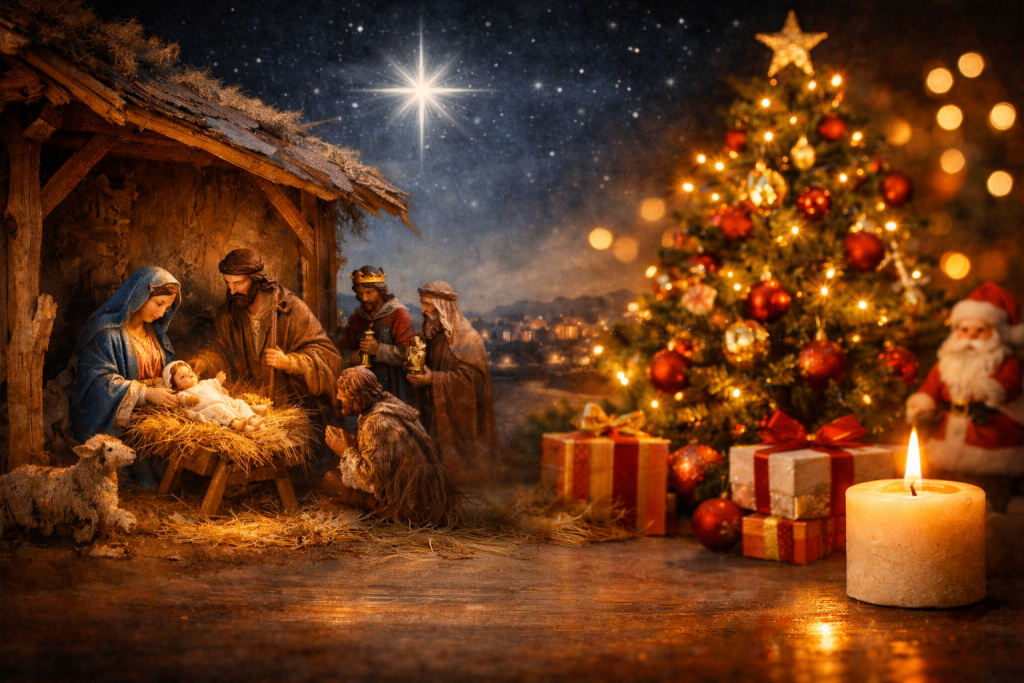
The other evening, in the spirit of seasonal escapism, we were watching Man vs Baby—a piece of festive fluff involving slapstick chaos, an unruly infant, and, inevitably, a primary-school nativity play.
At some point, my husband—who grew up in Indonesia and is unfamiliar with Christian traditions—turned to me and asked, quite innocently, what the story was actually about.
So I explained.
A teenage girl called Mary, who was also a virgin, gives birth to a baby. This baby is God. He is born in a stable because there is no room for him in the local accommodation. A star appears in the sky, guiding three wise men and a group of shepherds to come and worship this baby and bring him gifts. This child will later be executed, rise from the dead, ascend into heaven, and now sits—still in a human body—on the throne of the universe, exercising ultimate authority over all of existence for all eternity.
My husband listened politely. He nodded. He asked no follow-up questions.
But as I heard my own voice recounting this story, I had a sudden, almost comic moment of estrangement. Detached from carols, candlelight, stained glass, and nostalgia, the narrative sounded astonishingly absurd.
And yet.
It is also undeniably beautiful.
As a story, it has extraordinary power. Told aloud. Set to music. Painted. Sculpted. Recreated each December in glowing wooden cribs in living rooms, churches, town squares, and shopping malls. It is gentle. It centres on vulnerability rather than force. A baby rather than a king. Straw rather than marble. Hope for the world arriving quietly, unnoticed and poor.
I once believed it all.
Not only as a child, but later for about fifteen years of my adult life, when I was a Bible-believing fundamentalist Christian. I genuinely thought this story, set in the Middle East two millennia ago, explained everything: meaning, love, suffering, death, and the ultimate destiny of the world. I didn’t experience it as absurd at all. It felt profound, coherent, and necessary.
But with distance, the story didn’t simply become implausible; it became troubling. Not because it is poetic or mysterious, but because of what has been built upon it. The same “cute” story about a baby has been used to justify division, exclusion, cruelty, war, and extraordinary human suffering. Not by accident, but repeatedly, systematically, and often with great confidence and moral certainty.
That, for me, is the real tragedy—not that the story is implausible, but that it has been weaponised.
And yet, here we are again.
Lights are going up. Schools are rehearsing their nativity plays. People are travelling, eating too much, falling out, making up, missing those who are no longer here and trying, in their imperfect ways, to be a little kinder.
So this is not a call to cancel Christmas. Nor is it an attack on those who still believe the story literally. It’s simply an honest moment of reflection: a recognition that something can be both moving and absurd; beautiful and dangerous; comforting and deeply problematic.
In any case, beliefs aside, I want to take this opportunity to wish you—whoever you are, wherever you are—a genuinely restful and enjoyable Christmas and New Year break. May there be moments of warmth, laughter, good food, and quiet. And for 2026, I wish all of us what really matters: peace, goodwill, good health, and a little more humility about the stories we tell ourselves—and each other.
Happy Christmas.
“Christmas is not a time nor a season, but a state of mind.”
— Calvin Coolidge