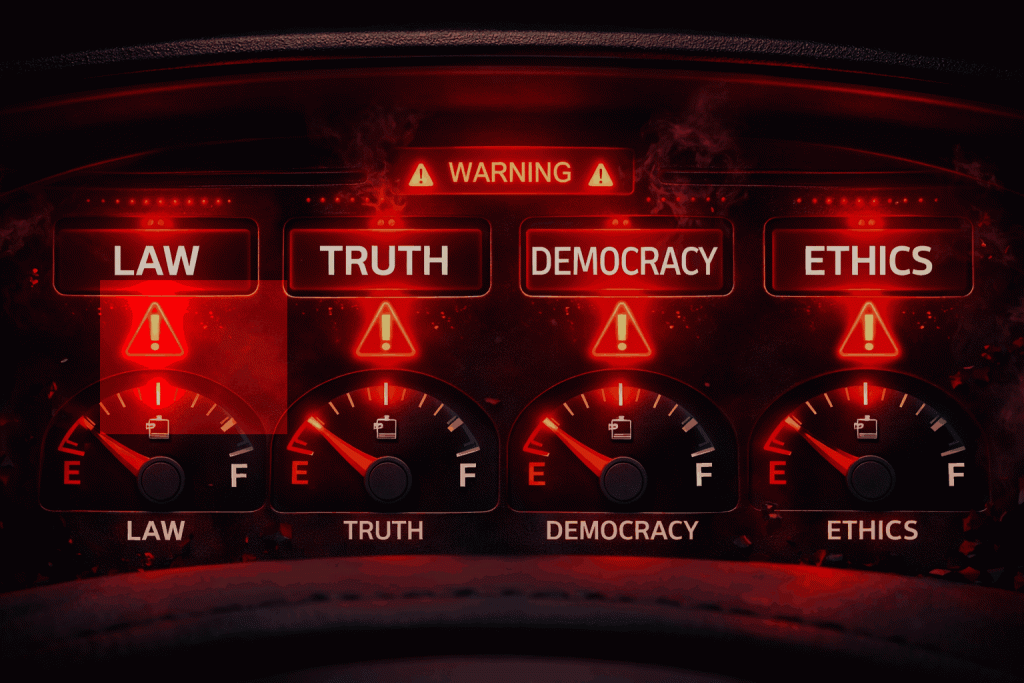
The return of Donald Trump is not merely a political event. It is a moral diagnostic.
It tells us something deeply unsettling about the state of our world: that values, principles, and ethics have slipped from the centre of public life. They have been displaced largely by financial gain, grievance politics, racialised fear, and the steady erosion of democratic norms.
This is not an American problem alone. It is a global one.
Trump is not the cause of this collapse; he is its most conspicuous symptom, like a mirror held up to societies that have quietly traded moral seriousness for spectacle, responsibility for outrage and truth for tribal loyalty.
The Disappearance of Principle
Where are the people of principle?
Where are the politicians who speak honestly about limits, responsibility, and restraint, rather than promising everything while meaning nothing? Where are the leaders willing to say “this is wrong” even when doing so costs them popularity, office, or power?
And where, more troubling still, are the faith communities — Christian, Jewish, Muslim, secular humanist — when democracy is undermined and human dignity reduced to a slogan?
Too often, there is silence.
Or worse: rationalisation.
Ethics in a ‘Post-God’ World
We increasingly describe ourselves as living in a “post-God” world. Whatever one’s beliefs, this framing carries an uncomfortable implication.
If there is no higher authority to appeal to, no divine judgement, no metaphysical reckoning, then responsibility does not disappear. It intensifies.
In such a world, ethics cannot be outsourced to tradition, scripture or institutions. They must be embodied in individuals.
We are fully and finally accountable for what we tolerate, excuse, and normalise.
The collapse of shared ethical frameworks does not free us. It leaves us more exposed.
When Systems Fail
When political systems fail, when institutions rot from within, when law bends to power and truth bends to profit, waiting politely is no longer a virtue.
Peaceful resistance is not extremism.
Civic courage is not disorder.
Refusing to normalise injustice is not naïveté.
History does not judge societies kindly for their patience in the face of moral collapse.
The GDR: Proof That Change Is Possible
I live in the former German Democratic Republic.
Within my own lifetime, I have seen proof that enormous social change is not only possible, but inevitable, when large numbers of ordinary people rise up peacefully and say: Enough.
No tanks.
No violence.
Just people.
The fall of the GDR was not engineered by heroes or generals. It was brought about by teachers, factory workers, church groups, writers, engineers: people who withdrew their consent from a system that no longer deserved it.
That lesson should haunt us and teach us.
Have We Gone Mad?
As a warning light on the dashboard of history, young Germans are once again being asked whether they are prepared to fight for their country.
After everything Europe has lived through: after the ruins, the camps, the mass graves, the promises of Nie wieder — have we learned nothing?
The question should not be how to prepare the next generation for war, but how we allowed ourselves to drift back towards the conditions that make war imaginable again.
Democracy Belongs to the Ordinary
Democracy does not belong to elites.
It does not belong to parties, platforms, or billionaires.
It belongs to writers.
Teachers.
Lawyers.
Nurses and doctors.
Construction workers.
Refuse collectors.
It belongs to all of us.
When democratic systems disintegrate, it is not because “the people” failed. It is because too many people were persuaded that their voice no longer mattered.
Silence Is Not Neutral
Some of us are old enough to know where silence, blame-shifting, and passivity lead.
Writing from exile as Europe collapsed around him, Stefan Zweig issued a warning that has lost none of its force:
“The greatest danger threatening humanity today is not fanaticism itself, but the silent toleration of fanaticism.”
Zweig understood that history is not undone by villains alone, but by the quiet compliance of the reasonable.
So Where Is the Line?
If Zweig was right, then the question is no longer whether we see what is happening.
The question is this:
Where do you draw the line?
What responsibility do professionals, educators, faith communities, and citizens have when institutions fail?
What does peaceful resistance look like now?
Enough silence.
Enough normalisation.
Enough waiting.
History does not move only through great men. It moves when ordinary people decide that they will no longer cooperate with the unacceptable.
The moment is not coming.
It is already here.
“Truth to tell, we are all criminals if we remain silent.”
—Stefan Zweig