
The puzzle we keep arguing about
Political debate in the West is strangely repetitive.
We argue about whether governments spend too much.
We argue about whether welfare states are affordable.
We argue about whether taxes are already too high.
What we almost never do is step back and ask a more structural question:
What does a successful modern state actually look like on both sides of the ledger?
Over the past weeks I have been comparing six very different countries:
-
- United Kingdom
- Germany
- Spain
- Finland
- United States
- India
Looking not at slogans, but at the underlying fiscal architecture:
-
- Where governments actually spend their money
- Where they actually get it from
- And how coherently the two sides fit together
What emerges is not ideological. It is mathematical.
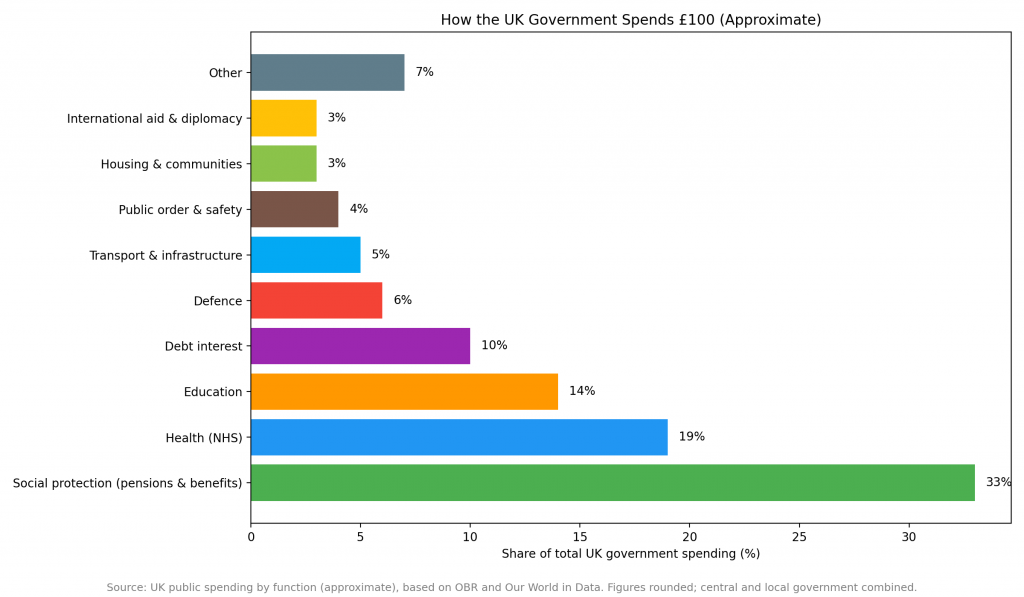
What the spending side reveals
Start with expenditure.
Across all advanced economies in this comparison, one fact stands out immediately:
Modern states already spend most of their money on the social foundations of economic life.
In different proportions, but with striking consistency, the largest items are:
-
- Pensions and social protection
- Health
- Education
Even in the United States, public spending is heavily concentrated in these areas.
The real differences between countries are not about whether they fund a social state.
They are about how coherently and efficiently they do it.
Compare three cases.
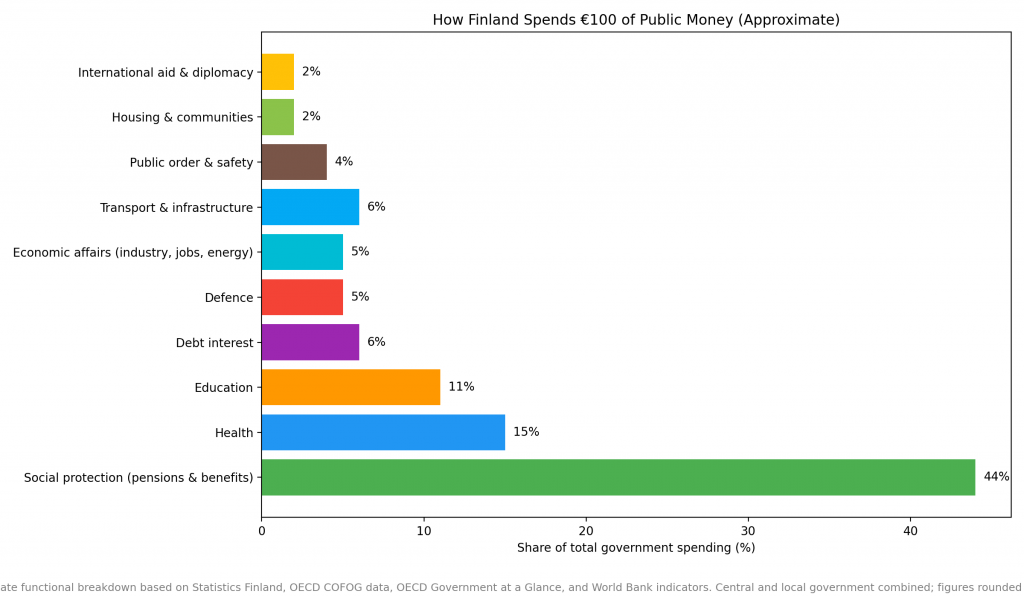
Finland represents the clean Nordic model:
-
- Social protection is dominant
- Health and education are heavily funded
- Defence and debt interest remain contained
Nothing here is accidental. The spending profile is internally consistent and politically normalised.
Now contrast that with the United Kingdom.
The UK spends in recognisably European patterns — heavy on welfare and health — but with noticeably tighter margins and more visible fiscal strain.
And then there is the United States.
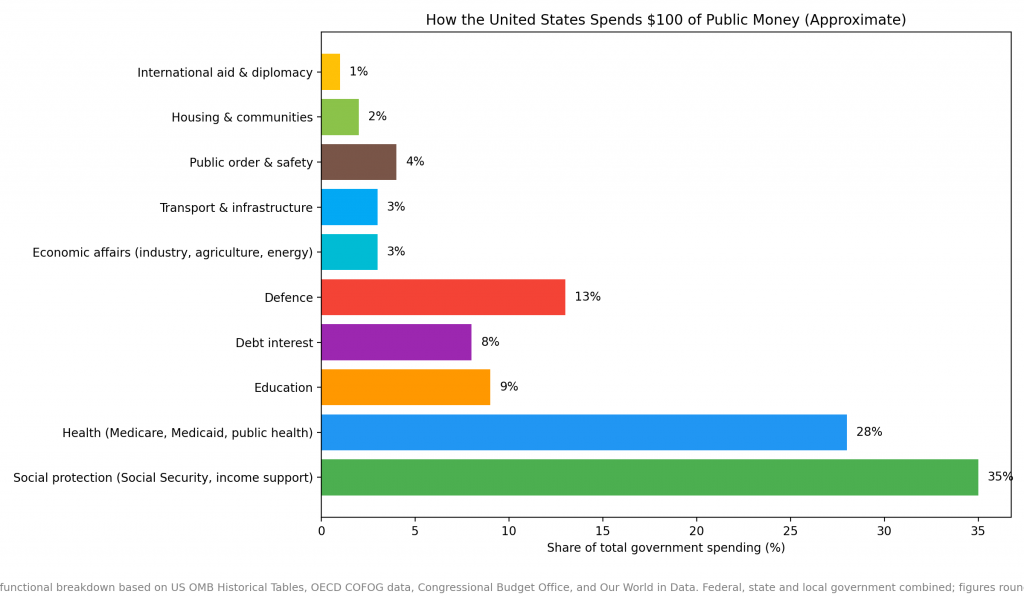
The US looks different in one crucial respect: defence and health together absorb an unusually large share of public money.
But the bigger insight is this:
On the spending side alone, most rich democracies look more similar than political rhetoric would suggest.
To understand why outcomes diverge, we have to look at the other half of the state.
The side we almost never discuss: how states raise the money
Public debate obsesses over spending.
But the real dividing line between successful and strained states lies on the revenue side.
When we map where governments actually get their money, the picture sharpens dramatically.
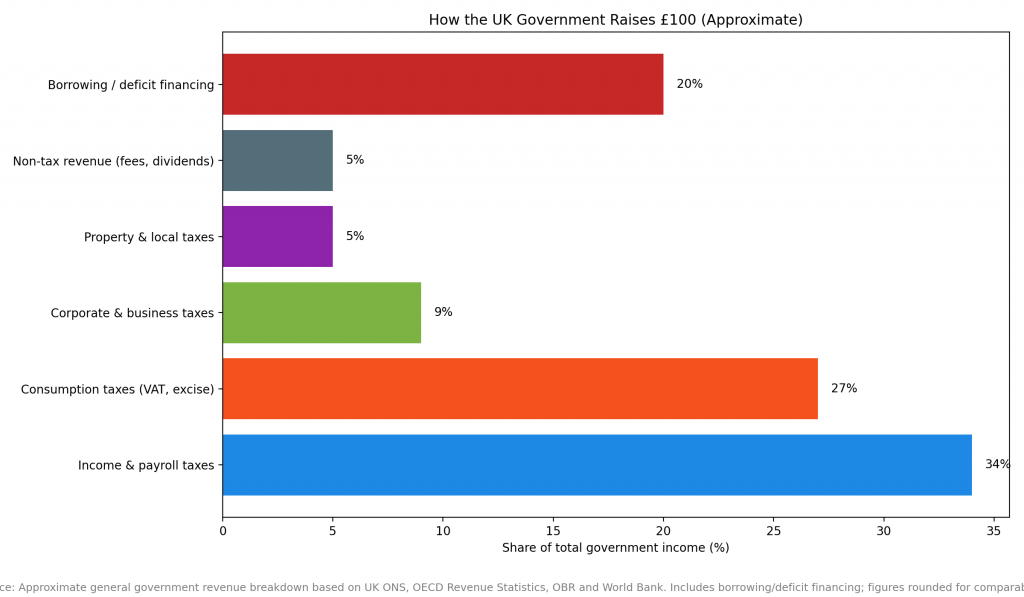
The United Kingdom raises most of its revenue from:
-
- Income and payroll taxes
- Consumption taxes (especially VAT)
But one feature stands out:
Borrowing plays a structurally large role.
In other words, part of the British state is routinely financed with future money.
Now compare Finland.
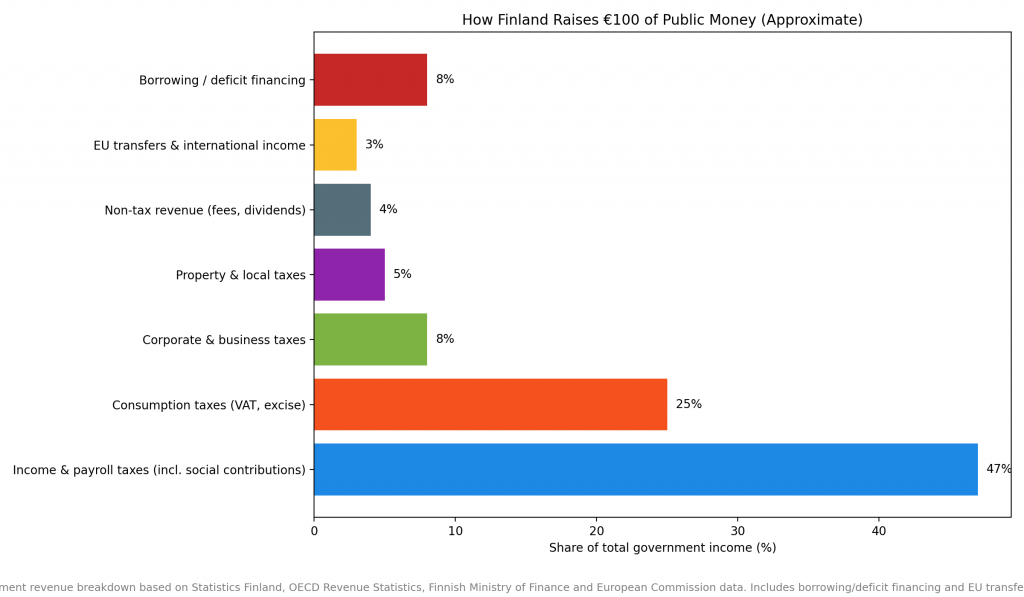
Here the architecture is strikingly different.
Finland funds its state primarily through:
-
- Broad income and payroll taxation
- Strong but not dominant consumption taxes
- Limited reliance on borrowing
The key point is not that taxes are higher.
It is that the system is broad, balanced and paid for largely in real time.
Finally, the United States.
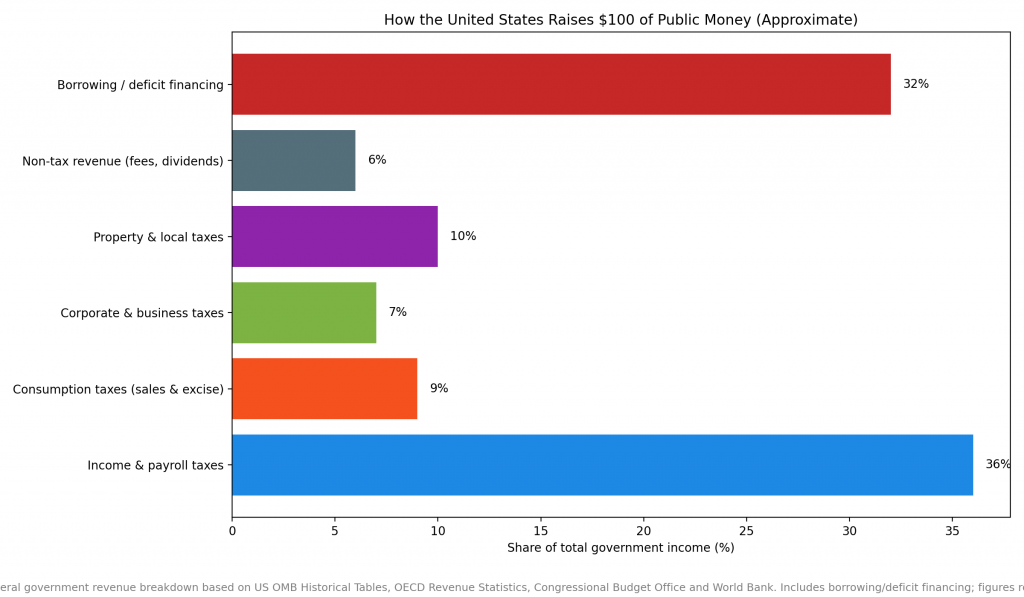
This is where the structural paradox becomes impossible to ignore.
The US has:
-
- No national VAT
- A relatively narrow tax base
- Heavy dependence on borrowing
Roughly speaking, the American state is financed partly by something no other country in this comparison can rely on at scale: the global demand for US government debt.
The real dividing line
At this point the pattern becomes clear.
The question is not:
Who spends the most?
It is:
Who has built a revenue system capable of sustainably funding what they have promised?
In this six-country comparison, three broad models emerge.
The Nordic coherence model (Finland)
-
- Broad tax base
- High social trust
- Strong upfront funding
- Limited structural borrowing
Result: high social provision with relatively low fiscal drama.
The continental industrial model (Germany, partly Spain)
-
- Strong payroll contributions
- Embedded welfare financing
- Export-supported tax base
- Result: durable but dependent on continued industrial strength.
The Anglo-American fragility model (UK and US)
-
- Narrower tax bases
- Political resistance to broad taxation
- Greater reliance on borrowing
Result: permanent fiscal anxiety despite comparable spending commitments.
India, meanwhile, represents something different again: not excess, but constraint — a state still expanding its tax capacity while carrying significant debt burdens.
So which model actually works best?
If we strip away culture, history, and political rhetoric — an artificial exercise, but a revealing one — the evidence points in a consistent direction.
The countries that most successfully combine:
-
- economic competitiveness
- high employment
- strong social protection
- and fiscal stability
tend to share three features:
First, they fund their social state broadly and visibly through taxation rather than chronically through borrowing.
Second, they treat health, education, and social protection not as residual costs but as core economic infrastructure.
Third, they minimise fragmentation and administrative leakage in how public money flows through the system.
In my six-country comparison, the model closest to this balance is the Nordic one, particularly Finland’s.
This does not mean it is easily transplantable.
But it does suggest something important.
The uncomfortable implication
If the arithmetic is this clear, why is the model so rare?
Because the barriers are not primarily technical.
They are political and psychological.
A fully coherent modern state requires:
-
- broad-based taxation
- high social trust
- willingness to pay upfront
- and political systems capable of explaining the trade-offs honestly
Many democracies struggle with precisely these conditions.
It is easier to argue about spending than to redesign revenue.
Easier to promise services than to build the tax base that sustains them.
Easier to borrow than to explain who must pay, and how.
But the underlying mathematics does not go away.
And the countries that align both sides of the ledger most cleanly are, increasingly, the ones that govern with the least fiscal drama.
Next question: not whether the Nordic model can be copied wholesale — it cannot — but which elements of fiscal design travel well across very different political systems.
“The difficulty lies not so much in developing new ideas as in escaping from old ones.”
— John Maynard Keynes